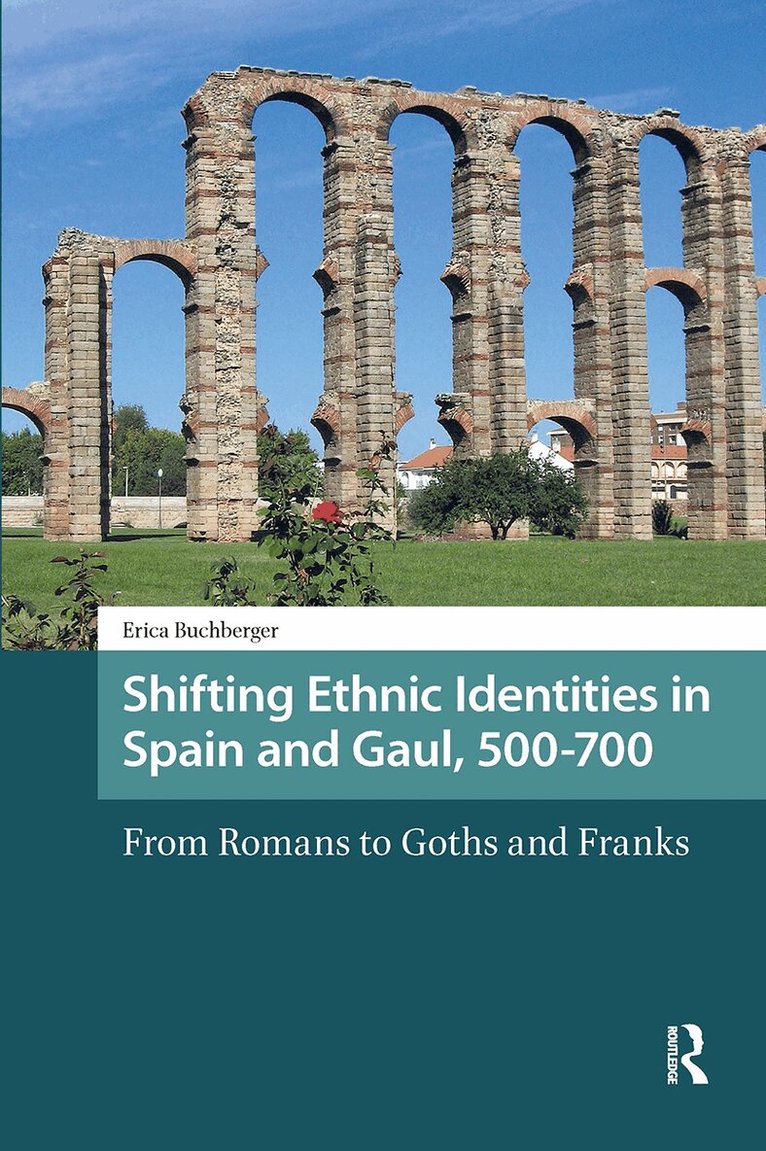
As this book demonstrates, early medieval 'Romanness' encompassed a sense of belonging to an ethnic group, which allowed Romans in Iberia and Gaul to adopt Gothic or Frankish identities in a more nuanced manner than has been previously acknowledged in the literature.
Erica Buchberger is an Assistant Professor at the University of Texas.
Recensioner i media
"In this delightfully readable monograph, Buchberger address a perennial question of the early Middle Ages namely how did entire populations of individuals once identified as Romans come to be labeled under the Germanic ethnicities of their respective barbarian kings? (...) Across an impressive range of texts (histories, hagiographies, legal codes), she enumerates the complex, multivalent, and even paradoxical ways that authors in the Visigothic and Frankish kingdoms deployed and renegotiated prima facie "ethnic labels."- Norman Underwood, New York University, Bulletin for Spanish and Portuguese Historical Studies, Vol. 43, 2018 "Buchberger has made a valuable contribution to the historical scholarship on early medieval ethnicity. She writes in a lucid and accessible style that is student friendly, and despite the relatively brief length of the monograph, it gives us much to reflect upon."- K. Patrick Fazioli, Mercy College, H-Medieval, H-Net Reviews, August, 2018
Innehållsförteckning
Acknowledgements, Introduction Part One: From a Roman to a Gothic World in Visigothic Spain Chapter One: Arians to Catholics Chapter Two: Church and State: Isidore and his Influence Chapter Three: The Later Seventh Century Part Two: From a Roman to a Frankish World in Merovingian Gaul Chapter Four: Gregory of Tours Chapter Five: Venantius Fortunatus Chapter Six: Fredegar Chapter Seven: Frankish Hagiograph, Conclusion, Bibliography, Index.