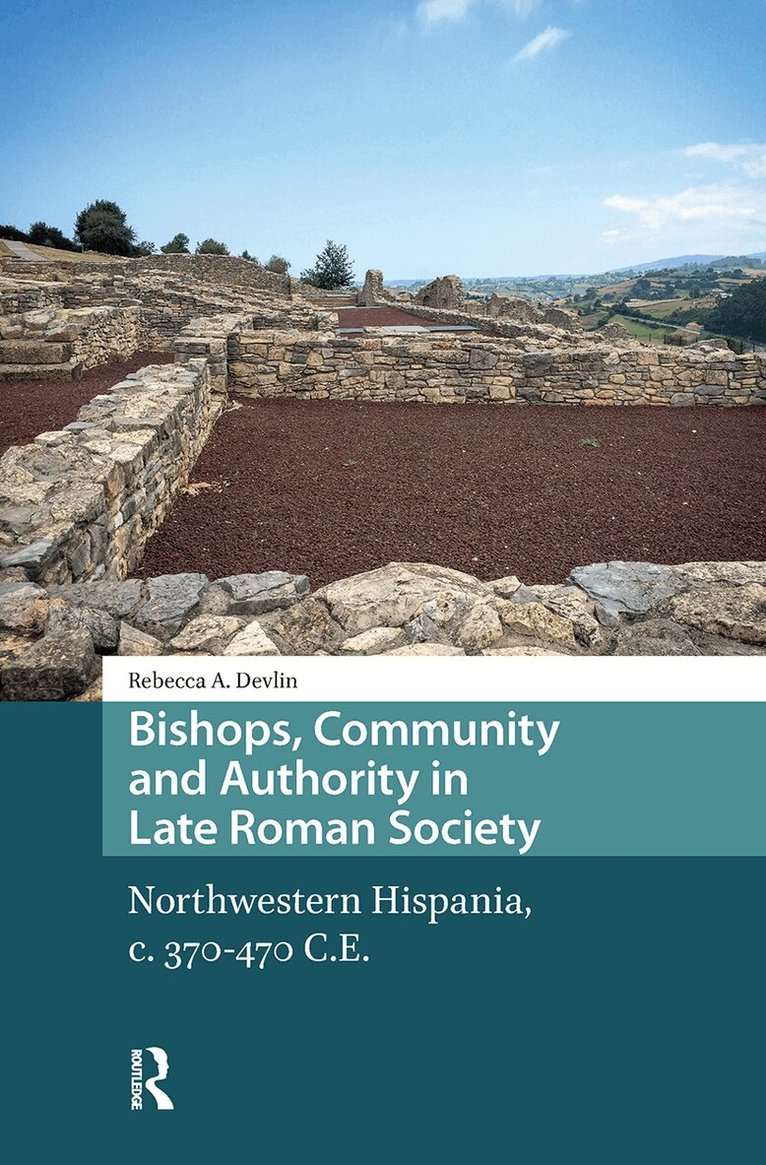
Häftad, Engelska, 2025
Bishops, Community and Authority in Late Roman Society
Northwestern Hispania, c. 370-470 C.E.
Del i serien Late Antique and Early Medieval Iberia
703 kr
Beställningsvara. Skickas inom 10-15 vardagar. Fri frakt över 249 kr.
Beskrivning
Produktinformation
- Utgivningsdatum: 2025-12-01
- Mått: 156 x 234 x 23 mm
- Vikt: 660 g
- Format: Häftad
- Språk: Engelska
- Serie: Late Antique and Early Medieval Iberia
- Antal sidor: 410
- Upplaga: 25001
- Förlag: Taylor & Francis Ltd
- ISBN: 9781041176190
Utforska kategorier
Mer om författaren
Dr. Devlin is an Assistant Professor (Term) of History at the University of Louisville. She has published on regional and long-distance networks and the familial, social and economic contexts of clerical communities during the Suevic and Visigothic Kingdoms. Her current project explores servi and liberti ecclesiae in the context of late antique global commerce.
Recensioner i media
"Overall, Devlin’s reconstruction of late antique episcopal leadership is convincing, and without dismissing the Priscillianist controversy and the Suevi, she avoids allowing these longstanding analytical lenses of Gallaecian religious history to obscure other factors. The greatest strength of the book is Devlin’s close attention to the changing material and economic landscapes of bishops and congregations and the potential impact they had on episcopal decisions. […] Her thoughtful exploration of these potential correlations produces a better understanding overall of how episcopal action responded to local economic and social as well as spiritual needs. While this book will surely be an essential read for historians of late antique Iberia, all scholars of late antique Christianity can learn much from Devlin’s methods.” -- Molly Lester, United States Naval Academy, Journal of Early Christian Studies, Vol 34, No 2, Summer 2026 (288-290)“Rebecca Devlin’s first monograph is an ambitious attempt to situate the “clerical communities” of Gallaecia (northwestern Spain and Portugal) within the tangled complex of social and economic changes that marked the twilight of Roman state power in the region. […] Devlin’s central contention is that ecclesiastical power did not simply fill a vacuum left by the withdrawal of the Roman state but rather grew through the varied local ways in which ecclesiastics negotiated their authority in relation to different status and interest groups. […] Devlin is at her best when addressing the archaeological evidence. She has a rich and deep knowledge of the rapidly growing literature in Galician, Castilian Spanish, and Portuguese and has much to tell even seasoned Iberianists. […] Devlin’s command of the archaeological material is impressive, and her book serves as an excellent survey of the social and economic history of the region. It will be essential reading not only for late Roman ists but also those researching the Suevic and Visigothic kingdoms, and, indeed, the longer history of medieval Galicia. Scholars of Orosius and Hydatius will also find much of interest.” -- David Addison, University of Liverpool, UK, Studies in Late Antiquity, Summer 2026"Rebecca Devlin authoritatively handles extensive physical and textual evidence to lay out the episcopal infrastructure of late Roman Gallaecia and explore the mechanisms of the growth of episcopal control in the region. […] This book will be invaluable for those studying late Roman Gallaecia. In addition to the valuable information it contains about Gallaecia itself, however, Devlin’s research provides a valuable methodological framework, as well as fruitful ground for analyses of contemporary bishops in other regions of Iberia and further afield. As such, it will be very useful and instructive for anyone working on or interested in the development of episcopal power or the social and economic impacts of Christianity in the late Roman world more broadly.” – Carolyn T. La Rocco, St John’s College, Oxford, UK, The Journal of Ecclesiastical History, Volume 77 Issue 2, April 2026.
Betyg & recensioner
0 recensioner
Inga recensioner tillgängliga.