Inbunden, Engelska, 2026
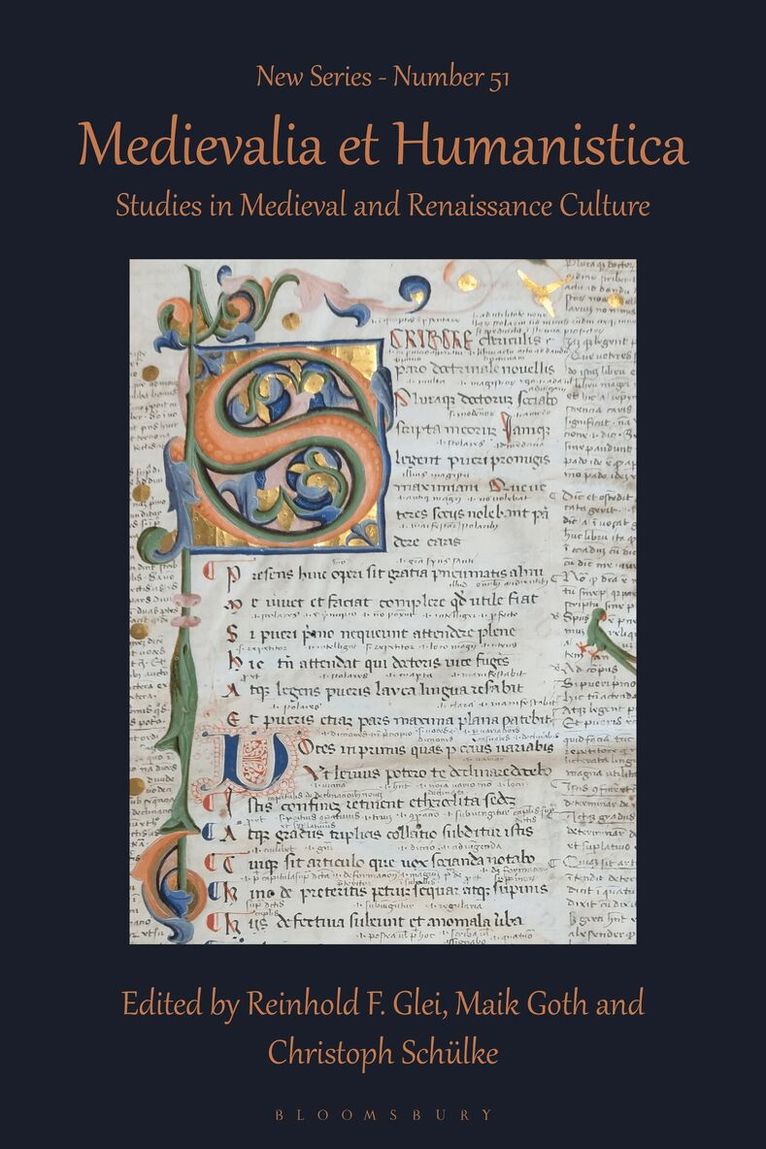
Medievalia et Humanistica, No. 51
Av Reinhold F. Glei, Maik Goth Goth, Christoph Schülke
1620 kr
Kommande
Beskrivning
For more than fifty years, Medievalia et Humanistica has fostered conversation across disciplines, languages, and methods. This special issue continues that spirit by opening up the vibrant “textual universe” surrounding Marco Polo’s Devisement dou monde. Instead of treating the book as a fixed classic, contributors show how it lived many different lives—as a Franco-Italian narrative, a Venetian redaction, a Dominican Latin translation, a Middle French courtly text, and eventually a staple of early print culture.Readers are invited into newly reassessed stories—such as the dramatic but historically elusive Ethiopian bishop episode—and into Marco Polo’s encounter with Mongol urban design through a semiotic reading of Shangdu. Other essays trace how the VA version reshaped the work for religious communities and how the rediscovered Foligno manuscript (VA6) enriches our understanding of its transmission. Detailed studies of Francesco Pipino’s Latin translation, including the Gouda incunable once annotated by Christopher Columbus, help reveal how Polo’s book entered classrooms, libraries, and printshops from the late Middle Ages into the modern era.Volume 51 is dedicated to "Marco Polo's Textual Universe". Introduced by Marc Kruse and Mario Klarer, it offers six original articles on various aspects of the Devisement dou monde: the relation between fact and fiction (Hubert Alisade), Marco Polo's perception of urban spaces (Eugenio Burgio), the rediscovered Foligno witness (Samuela Simion), Francesco Pipino's Latin translation (Carlo Giovanni Calloni), fifteenth-century French translation (Laura Tomasi), and the Devisement's editorial history in the early modern period (Alvise Andreose). The volume is rounded off with six review articles, ranging from the Jewish diaspora in the Western World, from Dante's negotiating between Latin schoolbooks and vernacular poetry, to the servus callidus on the early modern stage, from Shakespeare's contesting authority through liminal spaces, to 17th-Century Jesuit Plays in Latin staged in Japan.
Produktinformation
- Utgivningsdatum: 2026-12-10
- Mått: 152 x 229 x 25 mm
- Vikt: 454 g
- Format: Inbunden
- Språk: Engelska
- Serie: Medievalia et Humanistica Series
- Antal sidor: 272
- Förlag: Bloomsbury Publishing Plc
- ISBN: 9798216486893
Utforska kategorier
Betyg & recensioner
0 recensioner
Inga recensioner tillgängliga.