Carly A. Kocurek - Böcker
Visar alla böcker från författaren Carly A. Kocurek. Handla med fri frakt och snabb leverans.
18 produkter
18 produkter
862 kr
Skickas inom 7-10 vardagar
Video gaming: it’s a boy’s world, right? That’s what the industry wants us to think. Why and how we came to comply are what Carly A. Kocurek investigates in this provocative consideration of how an industry’s craving for respectability hooked up with cultural narratives about technology, masculinity, and youth at the video arcade.From the dawn of the golden age of video games with the launch of Atari’s Pong in 1972, through the industry-wide crash of 1983, to the recent nostalgia-bathed revival of the arcade, Coin-Operated Americans explores the development and implications of the “video gamer” as a cultural identity. This cultural-historical journey takes us to the Twin Galaxies arcade in Ottumwa, Iowa, for a close look at the origins of competitive gaming. It immerses us in video gaming’s first moral panic, generated by Exidy’s Death Race (1976), an unlicensed adaptation of the film Death Race 2000. And it ventures into the realm of video game films such as Tron and WarGames, in which gamers become brilliant, boyish heroes.Whether conducting a phenomenological tour of a classic arcade or evaluating attempts, then and now, to regulate or eradicate arcades and coin-op video games, Kocurek does more than document the rise and fall of a now-booming industry. Drawing on newspapers, interviews, oral history, films, and television, she examines the factors and incidents that contributed to the widespread view of video gaming as an enclave for young men and boys.A case study of this once emergent and now revived medium became the presumed enclave of boys and young men, Coin-Operated Americans is history that holds valuable lessons for contemporary culture as we struggle to address pervasive sexism in the domain of video games-and in the digital working world beyond.
230 kr
Skickas inom 7-10 vardagar
Video gaming: it’s a boy’s world, right? That’s what the industry wants us to think. Why and how we came to comply are what Carly A. Kocurek investigates in this provocative consideration of how an industry’s craving for respectability hooked up with cultural narratives about technology, masculinity, and youth at the video arcade.From the dawn of the golden age of video games with the launch of Atari’s Pong in 1972, through the industry-wide crash of 1983, to the recent nostalgia-bathed revival of the arcade, Coin-Operated Americans explores the development and implications of the “video gamer” as a cultural identity. This cultural-historical journey takes us to the Twin Galaxies arcade in Ottumwa, Iowa, for a close look at the origins of competitive gaming. It immerses us in video gaming’s first moral panic, generated by Exidy’s Death Race (1976), an unlicensed adaptation of the film Death Race 2000. And it ventures into the realm of video game films such as Tron and WarGames, in which gamers become brilliant, boyish heroes.Whether conducting a phenomenological tour of a classic arcade or evaluating attempts, then and now, to regulate or eradicate arcades and coin-op video games, Kocurek does more than document the rise and fall of a now-booming industry. Drawing on newspapers, interviews, oral history, films, and television, she examines the factors and incidents that contributed to the widespread view of video gaming as an enclave for young men and boys.A case study of this once emergent and now revived medium became the presumed enclave of boys and young men, Coin-Operated Americans is history that holds valuable lessons for contemporary culture as we struggle to address pervasive sexism in the domain of video games-and in the digital working world beyond.
354 kr
Skickas inom 10-15 vardagar
Brenda Laurel is best known for her work with Purple Moon, the pioneering game company she cofounded in the 1990s. Purple Moon’s games were based on years of research Laurel completed in an effort to understand why computer games seemed to be of so little interest to girls. Using diverse archival sources such as trade journals, newspapers, and recorded interviews, alongside Laurel’s completed games and own writings and an original interview with Laurel herself, this volume offers insight into both the early development of the games for girls movement of the 1990s and the lasting impact of Laurel’s game design breakthroughs. In her work with Purple Moon, Laurel drew on her background in theatre as well as her expertise in human computer interaction and qualitative research. By relying on this interdisciplinary background, Laurel made significant contributions to our understanding of the design and development of games as a medium for emotional rehearsal and storytelling. Additionally, her dedication to research-informed design has had a longstanding impact as companies and designers increasingly rely on audience research and metrics to shape their practices. The newest in Bloomsbury’s Influential Video Game Designers series, Carly Kocurek highlights the contributions of a designer whose work has had a profound impact on the development of both games for girls and empathy games.
1 343 kr
Skickas inom 10-15 vardagar
Brenda Laurel is best known for her work with Purple Moon, the pioneering game company she cofounded in the 1990s. Purple Moon’s games were based on years of research Laurel completed in an effort to understand why computer games seemed to be of so little interest to girls. Using diverse archival sources such as trade journals, newspapers, and recorded interviews, alongside Laurel’s completed games and own writings and an original interview with Laurel herself, this volume offers insight into both the early development of the games for girls movement of the 1990s and the lasting impact of Laurel’s game design breakthroughs. In her work with Purple Moon, Laurel drew on her background in theatre as well as her expertise in human computer interaction and qualitative research. By relying on this interdisciplinary background, Laurel made significant contributions to our understanding of the design and development of games as a medium for emotional rehearsal and storytelling. Additionally, her dedication to research-informed design has had a longstanding impact as companies and designers increasingly rely on audience research and metrics to shape their practices. The newest in Bloomsbury’s Influential Video Game Designers series, Carly Kocurek highlights the contributions of a designer whose work has had a profound impact on the development of both games for girls and empathy games.
1 383 kr
Skickas inom 10-15 vardagar
In the 1990s, the Personal Computer (or PC) was on the rise in homes, and with it came new genres of play. Yet most of the games in these new genres featured fantasylands or humorous science fiction landscapes with low stakes and little to suggest the potential of the PC as a serious space for art and play. Jane Jensen’s work and landmark Gabriel Knight series brought a new darkness and personality to PC gaming, offering a first powerful glimpse of what games could be as they came of age. As an author and designer, Jensen brought her approach as a designer-writer hybrid to the forefront of game design, with an approach to developing environments through detailed research to make game settings come to life, an attention to mature dilemmas and complex character development, and an audience-driven vision for genres reaching beyond the typical market approaches of the gaming industry. With a brand new interview with Jensen herself, Anastasia Salter provides the first ever look Jensen’s impact and role in advancing interactive narrative and writing in the game design process.
365 kr
Skickas inom 10-15 vardagar
In the 1990s, the Personal Computer (or PC) was on the rise in homes, and with it came new genres of play. Yet most of the games in these new genres featured fantasylands or humorous science fiction landscapes with low stakes and little to suggest the potential of the PC as a serious space for art and play. Jane Jensen’s work and landmark Gabriel Knight series brought a new darkness and personality to PC gaming, offering a first powerful glimpse of what games could be as they came of age. As an author and designer, Jensen brought her approach as a designer-writer hybrid to the forefront of game design, with an approach to developing environments through detailed research to make game settings come to life, an attention to mature dilemmas and complex character development, and an audience-driven vision for genres reaching beyond the typical market approaches of the gaming industry. With a brand new interview with Jensen herself, Anastasia Salter provides the first ever look Jensen’s impact and role in advancing interactive narrative and writing in the game design process.
661 kr
Skickas
The newest addition to our Influential Video Game Designers series explores the work of Todd Howard, executive producer at Bethesda Studios, known for how he consistently pushes the boundaries of open-world gaming and player agency. Howard’s games create worlds in which players can design their own characters and tell their own stories. While many games tell the story of the game’s main character, Todd Howard’s worldbuilding approach to game design focuses more on telling the story of the game’s world, whether it be the high fantasy environments of the Elder Scrolls series or the post-apocalyptic wasteland of the Fallout series. This focus on sculpting the world allows for remarkable amounts of player freedom and choice in an expansive game environment by creating a landscape rich with open opportunity. Drawing on both academic discussions of narrative, world design, and game design, as well as on officially released interviews, speeches, and presentations given by Howard and other designers at Bethesda Games, Wendi Sierra highlights three core areas set Howard’s design perspective apart from other designers: micronarratives, iterative design, and the sharing of design tools. Taken as a whole, these three elements demonstrate how Howard has used a worldbuilding perspective to shape his games. In doing so, he has impacted not only Bethesda Studios, but also the landscape of game design itself.
341 kr
Skickas inom 10-15 vardagar
The newest addition to our Influential Video Game Designers series explores the work of Todd Howard, executive producer at Bethesda Studios, known for how he consistently pushes the boundaries of open-world gaming and player agency. Howard’s games create worlds in which players can design their own characters and tell their own stories. While many games tell the story of the game’s main character, Todd Howard’s worldbuilding approach to game design focuses more on telling the story of the game’s world, whether it be the high fantasy environments of the Elder Scrolls series or the post-apocalyptic wasteland of the Fallout series. This focus on sculpting the world allows for remarkable amounts of player freedom and choice in an expansive game environment by creating a landscape rich with open opportunity. Drawing on both academic discussions of narrative, world design, and game design, as well as on officially released interviews, speeches, and presentations given by Howard and other designers at Bethesda Games, Wendi Sierra highlights three core areas set Howard’s design perspective apart from other designers: micronarratives, iterative design, and the sharing of design tools. Taken as a whole, these three elements demonstrate how Howard has used a worldbuilding perspective to shape his games. In doing so, he has impacted not only Bethesda Studios, but also the landscape of game design itself.
347 kr
Skickas
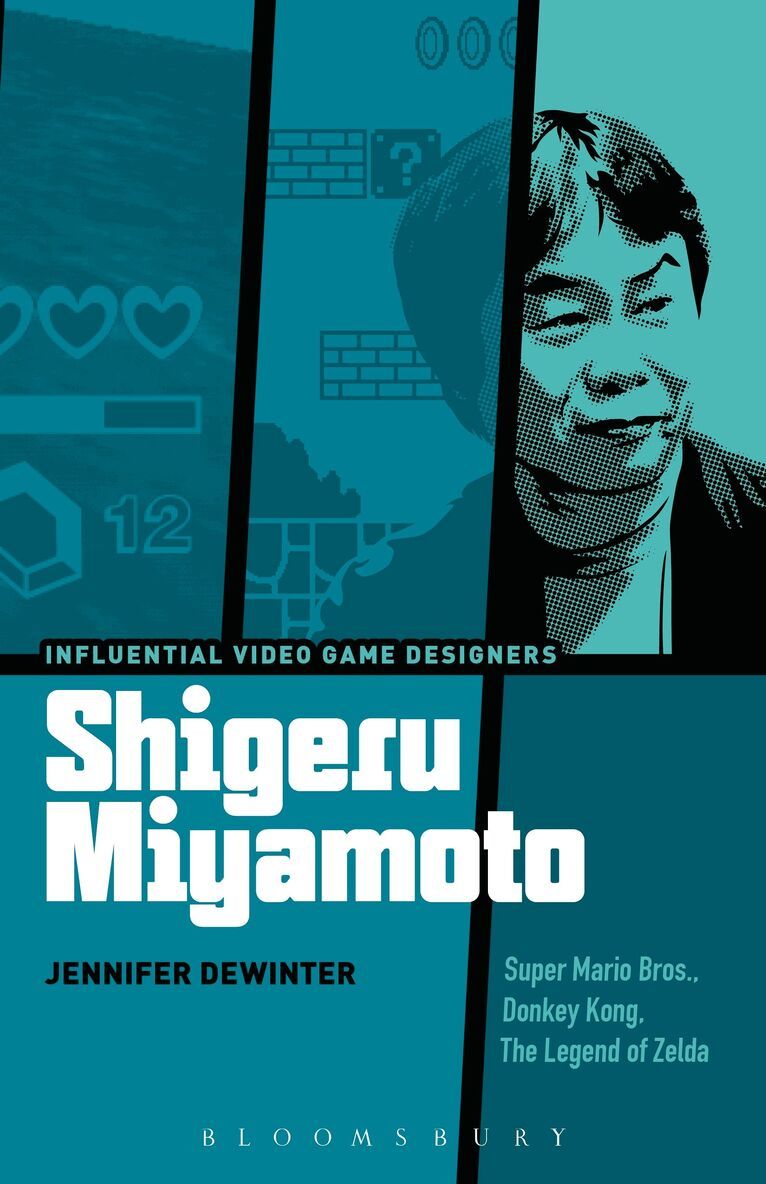
Video games are considered by many to be just entertainment—essentially void of skillful, artistic intervention. But as any gamer knows, there’s incredible technical and graphic talent behind even a flickering Gameboy screen.You may have never heard Shigeru Miyamoto’s name, but you’ve probably spent many a lazy afternoon absorbed in his work. Joining Nintendo as a video game designer in the late 1970s, Miyamoto created the powerhouse franchises Super Mario Bros., The Legend of Zelda, and Donkey Kong—games so ubiquitous that Miyamoto was named one of TIME’s 100 Most Influential People in 2007. Combining critical essays with interviews, bibliographies, and striking visuals, Shigeru Miyamoto unveils the artist behind thousands of glowing gaming screens, tracing out his design decisions, aesthetic preferences, and the material conditions that shaped his work. With this incredible (and incredibly unknown) figure, series editors Jennifer DeWinter and Carly Kocurek launch the Influential Video Game Designers series, at last giving these artists the recognition they deserve.
770 kr
Skickas
Video games are considered by many to be just entertainment—essentially void of skillful, artistic intervention. But as any gamer knows, there’s incredible technical and graphic talent behind even a flickering Gameboy screen.You may have never heard Shigeru Miyamoto’s name, but you’ve probably spent many a lazy afternoon absorbed in his work. Joining Nintendo as a video game designer in the late 1970s, Miyamoto created the powerhouse franchises Super Mario Bros., The Legend of Zelda, and Donkey Kong—games so ubiquitous that Miyamoto was named one of TIME’s 100 Most Influential People in 2007. Combining critical essays with interviews, bibliographies, and striking visuals, Shigeru Miyamoto unveils the artist behind thousands of glowing gaming screens, tracing out his design decisions, aesthetic preferences, and the material conditions that shaped his work. With this incredible (and incredibly unknown) figure, series editors Jennifer DeWinter and Carly Kocurek launch the Influential Video Game Designers series, at last giving these artists the recognition they deserve.
375 kr
Skickas inom 5-8 vardagar
168 kr
Skickas inom 7-10 vardagar
Ultima and World-Building in the Computer Role-Playing Game is the first scholarly book to focus exclusively on the long-running Ultima series of computer role-playing games (RPG) and to assess its lasting impact on the RPG genre and video game industry. Through archival and popular media sources, examinations of fan communities, and the game itself, this book historicizes the games and their authors. By attending to the salient moments and sites of game creation throughout the series’ storied past, authors Carly A. Kocurek and Matthew Thomas Payne detail the creative choices and structural forces that brought Ultima’s celebrated brand of role-playing to fruition.This book first considers the contributions of series founder and lead designer, Richard Garriott, examining how his fame and notoriety as a pioneering computer game auteur shaped Ultima’s reception and paved the way for the evolution of the series. Next, the authors retrace the steps that Garriott took in fusing analog, tabletop role-playing with his self-taught lessons in computer programming. Close textual analyses of Ultima I outline how its gameplay elements offered a foundational framework for subsequent innovations in design and storytelling. Moving beyond the game itself, the authors assess how marketing materials and physical collectibles amplified its immersive hold and how the series’ legions of fans have preserved the series. Game designers, long-time gamers, and fans will enjoy digging into the games’ production history and mechanics while media studies and game scholars will find Ultima and World-Building in the Computer Role-Playing Game a useful extension of inquiry into authorship, media history, and the role of fantasy in computer game design.
942 kr
Skickas inom 10-15 vardagar
An exploration of the influential work of Hideo Kojima, creator of cinematic titles such as the blockbuster Metal Gear Solid franchise, which has moved over 50 million units globally, as well as Snatcher, Policenauts, and Death Stranding.As the architect of the Metal Gear Solid franchise, Kojima is synonymous with the “stealth game” genre, where tension and excitement is created from players avoiding enemies rather than confronting them. Through the franchise, Kojima also helped to bridge the gap between games and other forms of media, arguing that games could be deep experiences that unearthed complex emotions from players on the same level as films or novels.Drawing on archives of interviews in English and Japanese with Kojima and his team, as well as academic discourses of social/political games and cinematic narrative/world-building, this book examines Kojima's progressive game design as it applies to four key areas: socially-relevant narratives, cinematic aesthetics, thematically-connected systems, and reflexive spaces.
301 kr
Skickas inom 10-15 vardagar
An exploration of the influential work of Hideo Kojima, creator of cinematic titles such as the blockbuster Metal Gear Solid franchise, which has moved over 50 million units globally, as well as Snatcher, Policenauts, and Death Stranding.As the architect of the Metal Gear Solid franchise, Kojima is synonymous with the “stealth game” genre, where tension and excitement is created from players avoiding enemies rather than confronting them. Through the franchise, Kojima also helped to bridge the gap between games and other forms of media, arguing that games could be deep experiences that unearthed complex emotions from players on the same level as films or novels.Drawing on archives of interviews in English and Japanese with Kojima and his team, as well as academic discourses of social/political games and cinematic narrative/world-building, this book examines Kojima's progressive game design as it applies to four key areas: socially-relevant narratives, cinematic aesthetics, thematically-connected systems, and reflexive spaces.
1 209 kr
Skickas inom 10-15 vardagar
This book explores the influential work of Eugene Jarvis, designer of the wildly-successful arcade games Defender, Robotron: 2084, NARC, Smash TV, and Cruis’n USA, among others.Embracing a variety of genres across decades, the video games of Eugene Jarvis offer a series of design lessons in how to craft coin-operated game machines that can survive and thrive even as the arcade was disappearing from the American landscape. In particular, his titles demonstrate the enduring appeal of gameplay challenges, taboo content, and possessing a larger-than-life form factor and accessible gameplay. Drawing upon multiple interviews with Jarvis and his collaborators, as well as scholarly reflections on game design, historic industry data, and archival documents, this book makes the case that Jarvis is the unparalleled “King of the Arcade” for his ability to craft gameplay experiences that cannot be replicated on home consoles or personal computers.
296 kr
Skickas inom 7-10 vardagar
This book explores the influential work of Eugene Jarvis, designer of the wildly-successful arcade games Defender, Robotron: 2084, NARC, Smash TV, and Cruis’n USA, among others.Embracing a variety of genres across decades, the video games of Eugene Jarvis offer a series of design lessons in how to craft coin-operated game machines that can survive and thrive even as the arcade was disappearing from the American landscape. In particular, his titles demonstrate the enduring appeal of gameplay challenges, taboo content, and possessing a larger-than-life form factor and accessible gameplay. Drawing upon multiple interviews with Jarvis and his collaborators, as well as scholarly reflections on game design, historic industry data, and archival documents, this book makes the case that Jarvis is the unparalleled “King of the Arcade” for his ability to craft gameplay experiences that cannot be replicated on home consoles or personal computers.
251 kr
Skickas inom 7-10 vardagar
This book explores Keiji Inafune’s unique and controversial approach to video game design by breaking down his prolific output into seven key concepts.Keiji Inafune is a polarizing figure in the video game community. While some view his work on Capcom’s Mega Man series as a pivotal contribution to the gaming industry, others question his very claim to the title of game designer. No matter one’s stance, however, Inafune’s work inspires passionate discussions about video game design and its history.In this book, Andrew Schartmann explores seven core principles that permeate Inafune’s output and constitute his creative “voice.” He also draws on Inafune’s controversial persona to probe the very definition of “video game designer”—a term problematized by the collaborative aspect of game design and the industry’s Wonka-esque obsession with secrecy. With high-profile games like Mega Man, Street Fighter and Resident Evil, Inafune's repertoire provides an ideal lens through which to explore the nuts and bolts of game design and the many forces that shape it.
833 kr
Skickas inom 10-15 vardagar
This book explores Keiji Inafune’s unique and controversial approach to video game design by breaking down his prolific output into seven key concepts.Keiji Inafune is a polarizing figure in the video game community. While some view his work on Capcom’s Mega Man series as a pivotal contribution to the gaming industry, others question his very claim to the title of game designer. No matter one’s stance, however, Inafune’s work inspires passionate discussions about video game design and its history.In this book, Andrew Schartmann explores seven core principles that permeate Inafune’s output and constitute his creative “voice.” He also draws on Inafune’s controversial persona to probe the very definition of “video game designer”—a term problematized by the collaborative aspect of game design and the industry’s Wonka-esque obsession with secrecy. With high-profile games like Mega Man, Street Fighter and Resident Evil, Inafune's repertoire provides an ideal lens through which to explore the nuts and bolts of game design and the many forces that shape it.