Jean-Laurent Rosenthal - Böcker
Visar alla böcker från författaren Jean-Laurent Rosenthal. Handla med fri frakt och snabb leverans.
9 produkter
9 produkter
The Fruits of Revolution
Property Rights, Litigation and French Agriculture, 1700-1860
Häftad, Engelska, 2009
441 kr
Skickas inom 7-10 vardagar
In The Fruits of Revolution Jean-Laurent Rosenthal investigates two central questions in French economic history: To what extent did institutions hold back agricultural development under the Old Regime, and did reforms carried out during the French Revolution significantly improve the structure of property rights in agriculture? Both questions have been the subject of much debate. Historians have touched on them in a number of local studies, yet usually they have been more concerned with community conflict than with economic development. Economists generally have researched the performance of the French economy without paying much attention to the impact of institutions on specific areas of the economy. This book attempts to utilize the best of both approaches: It focuses on broad questions of economic change, yet it is based on detailed archival investigations of the impact of property rights on water control.
523 kr
Skickas inom 7-10 vardagar
This volume includes ten essays dealing with financial and other forms of economic intermediation in Europe, Canada, and the United States since the seventeenth century. Each relates the development of institutions to economic change and describes their evolution over time, as well as discussing several different forms of intermediation, and deals with significant economic and historical issues.
The Fruits of Revolution
Property Rights, Litigation and French Agriculture, 1700-1860
Inbunden, Engelska, 1992
1 228 kr
Skickas inom 7-10 vardagar
In The Fruits of Revolution Jean-Laurent Rosenthal investigates two central questions in French economic history: To what extent did institutions hold back agricultural development under the Old Regime, and did reforms carried out during the French Revolution significantly improve the structure of property rights in agriculture? Both questions have been the subject of much debate. Historians have touched on them in a number of local studies, yet usually they have been more concerned with community conflict than with economic development. Economists generally have researched the performance of the French economy without paying much attention to the impact of institutions on specific areas of the economy. This book attempts to utilize the best of both approaches: It focuses on broad questions of economic change, yet it is based on detailed archival investigations of the impact of property rights on water control.
1 038 kr
Skickas inom 7-10 vardagar
This volume includes ten essays dealing with financial and other forms of economic intermediation in Europe, Canada, and the United States since the seventeenth century. Each relates the development of institutions to economic change and describes their evolution over time, as well as discussing several different forms of intermediation, and deals with significant economic and historical issues.
Surviving Large Losses
Financial Crises, the Middle Class, and the Development of Capital Markets
Häftad, Engelska, 2009
306 kr
Skickas inom 10-15 vardagar
Listen to a short interview with Philip T. HoffmanHost: Chris Gondek | Producer: Heron & CraneFinancial disasters often have long-range institutional consequences. When financial institutions--banks, insurance companies, brokerage firms, stock exchanges--collapse, new ones take their place, and these changes shape markets for decades or even generations. Surviving Large Losses explains why such financial crises occur, why their effects last so long, and what political and economic conditions can help countries both rich and poor survive--and even prosper--in the aftermath.Looking at past and more recent financial disasters through the lens of political economy, the authors identify three factors critical to the development of financial institutions: the level of government debt, the size of the middle class, and the quality of information that is available to participants in financial transactions. They seek to find out when these factors promote financial development and mitigate the effects of financial crises and when they exacerbate them.Although there is no panacea for crises--no one set of institutions that will resolve them--it is possible, the authors argue, to strengthen existing financial institutions, to encourage economic growth, and to limit the harm that future catastrophes can do.
Before and Beyond Divergence
The Politics of Economic Change in China and Europe
Inbunden, Engelska, 2011
572 kr
Skickas inom 10-15 vardagar
China has reemerged as a powerhouse in the global economy, reviving a classic question in economic history: why did sustained economic growth arise in Europe rather than in China?Many favor cultural and environmental explanations of the nineteenth-century economic divergence between Europe and the rest of the world. This book, the product of over twenty years of research, takes a sharply different tack. It argues that political differences which crystallized well before 1800 were responsible both for China’s early and more recent prosperity and for Europe’s difficulties after the fall of the Roman Empire and during early industrialization.Rosenthal and Wong show that relative prices matter to how economies evolve; institutions can have a large effect on relative prices; and the spatial scale of polities can affect the choices of institutions in the long run. Their historical perspective on institutional change has surprising implications for understanding modern transformations in China and Europe and for future expectations. It also yields insights in comparative economic history, essential to any larger social science account of modern world history.
581 kr
Skickas inom 7-10 vardagar
Students of comparative politics have long faced a vexing dilemma: how can social scientists draw broad, applicable principles of political order from specific historical examples? In Analytic Narratives, five senior scholars offer a new and ambitious methodological response to this important question. By employing rational-choice and game theory, the authors propose a way of extracting empirically testable, general hypotheses from particular cases. The result is both a methodological manifesto and an applied handbook that political scientists, economic historians, sociologists, and students of political economy will find essential. In their jointly written introduction, the authors frame their approach to the origins and evolution of political institutions. The individual essays that follow demonstrate the concept of the analytic narrative--a rational-choice approach to explain political outcomes--in case studies. Avner Greif traces the institutional foundations of commercial expansion in twelfth-century Genoa.Jean-Laurent Rosenthal analyzes how divergent fiscal policies affected absolutist European governments, while Margaret Levi examines the transformation of nineteenth-century conscription laws in France, the United States, and Prussia. Robert Bates explores the emergence of a regulatory organization in the international coffee market. Finally, Barry Weingast studies the institutional foundations of democracy in the antebellum United States and its breakdown in the Civil War. In the process, these studies highlight the economic role of political organizations, the rise and deterioration of political communities, and the role of coercion, especially warfare, in political life. The results are both empirically relevant and theoretically sophisticated. Analytic Narratives is an innovative and provocative work that bridges the gap between the game-theoretic and empirically driven approaches in political economy. Political historians will find the use of rational-choice models novel; theorists will discover arguments more robust and nuanced than those derived from abstract models.The book improves on earlier studies by advocating--and applying--a cross-disciplinary approach to explain strategic decision making in history.
Dark Matter Credit
The Development of Peer-to-Peer Lending and Banking in France
Inbunden, Engelska, 2019
388 kr
Skickas inom 7-10 vardagar
How a vast network of shadow credit financed European growth long before the advent of bankingPrevailing wisdom dictates that, without banks, countries would be mired in poverty. Yet somehow much of Europe managed to grow rich long before the diffusion of banks. Dark Matter Credit draws on centuries of cleverly collected loan data from France to reveal how credit abounded well before banks opened their doors. This incisive book shows how a vast system of shadow credit enabled nearly a third of French families to borrow in 1740, and by 1840 funded as much mortgage debt as the American banking system of the 1950s.Dark Matter Credit traces how this extensive private network outcompeted banks and thrived prior to World War I—not just in France but in Britain, Germany, and the United States—until killed off by government intervention after 1918. Overturning common assumptions about banks and economic growth, the book paints a revealing picture of an until-now hidden market of thousands of peer-to-peer loans made possible by a network of brokers who matched lenders with borrowers and certified the borrowers’ creditworthiness.A major work of scholarship, Dark Matter Credit challenges widespread misperceptions about French economic history, such as the notion that banks proliferated slowly, and the idea that financial innovation was hobbled by French law. By documenting how intermediaries in the shadow credit market devised effective financial instruments, this compelling book provides new insights into how countries can develop and thrive today.
412 kr
Skickas inom 7-10 vardagar
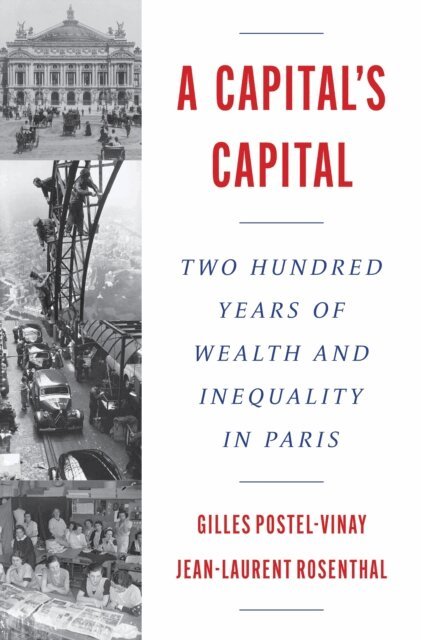
A study of the changes in wealth and its distribution in nineteenth- and twentieth-century Paris that maps the interplay among wealth, inequality, and welfareSuccessful economies sustain capital accumulation across generations, and capital accumulation leads to large increases in private wealth. In this book, Gilles Postel-Vinay and Jean-Laurent Rosenthal map the fluctuations in wealth and its distribution in Paris between 1807 and 1977. Drawing on a unique dataset of the bequests of almost 800,000 Parisians, they show that real wealth per decedent varied immensely during this period while inequality began high and declined only slowly. Parisians’ portfolios document startling changes in the geography and types of wealth over time.Postel-Vinay and Rosenthal’s account reveals the impact of economic factors (large shocks, technological changes, differential returns to wealth), political factors (changes in taxation), and demographic and social factors (age and gender) on wealth and inequality. Before World War I, private wealth was highly predictive of other indicators of welfare, including different forms of human capital, age at death, and access to local public goods. After World War I, public intervention reduced—but did not eliminate—the strong connection between wealth inequality and other forms of inequality. Over the two centuries covered, Paris and its wealth were on the vanguard of economic and social change that affected the rest of the country a generation later.