Arkeologi: metod och teknik
159 kr
Utnämnd till "Årets bok om svensk historia 2016" av Nättidningen Svensk Historia
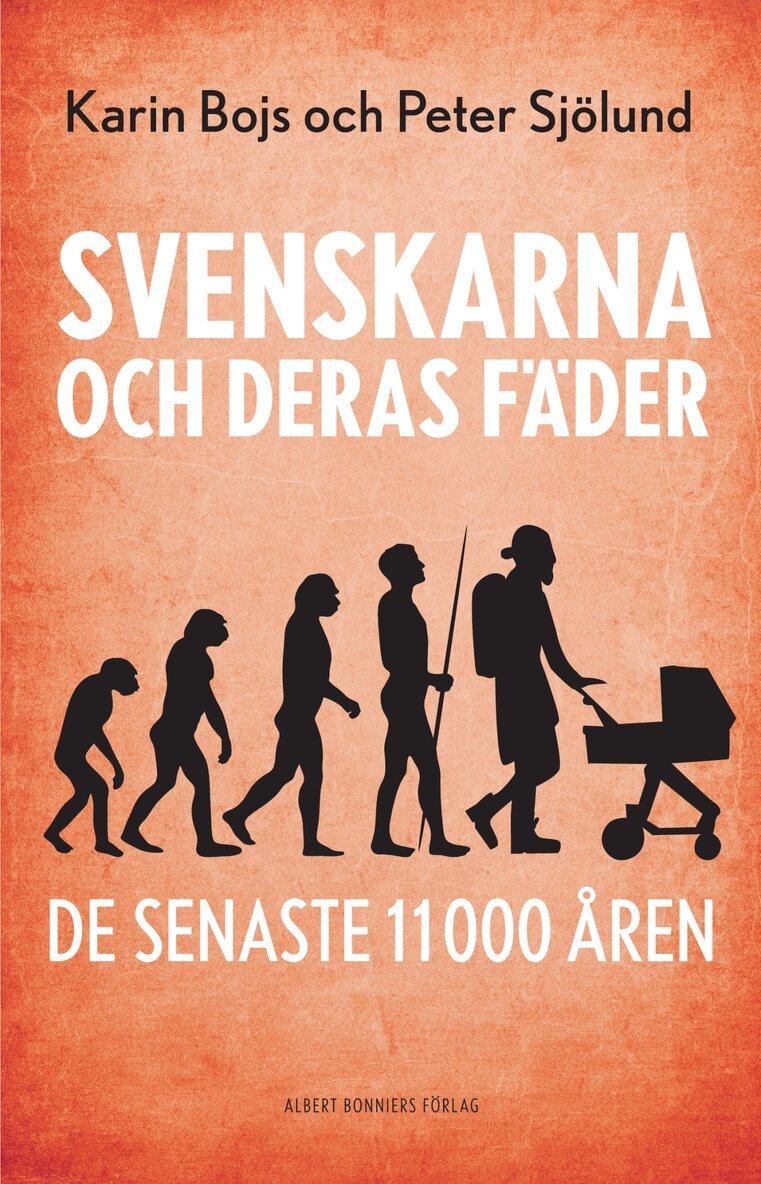
Först befolkades nuvarande Sverige av stenåldersjägare. Efter några tusen år anslöt bönderna. Det har DNA-tekniken nyligen lärt oss. Men bara några få procent av nu levande svenska män kan spåra sina fädernelinjer till de första jägarna och de första bönderna. De allra flesta – runt 80 procent – härstammar från ett fåtal mäktiga män som kom hit i samband med bronsåldern.När vi lägger ihop DNA-resultat från professionella forskare och släktforskande privatpersoner, framträder en ny bild av Sveriges historia. En mycket finkalibrerad bild, där de flesta svenska män kan hitta sina egna linjer i det stora gemensamma släktträdet. Svenskarna och deras fäder – de senaste 10 000 åren borrar vidare efter Karin Bojs Augustprisbelönade Min europeiska familj - de senaste 54 000 åren och Peter Sjölunds populära Släktforska med DNA.

79 kr
Läs direkt efter köp
Utnämnd till "Årets bok om svensk historia 2016" av Nättidningen Svensk Historia
Först befolkades nuvarande Sverige av stenåldersjägare. Efter några tusen år anslöt bönderna. Det har DNA-tekniken nyligen lärt oss. Men bara några få procent av nu levande svenska män kan spåra sina fädernelinjer till de första jägarna och de första bönderna. De allra flesta – runt 80 procent – härstammar från ett fåtal mäktiga män som kom hit i samband med bronsåldern.När vi lägger ihop DNA-resultat från professionella forskare och släktforskande privatpersoner, framträder en ny bild av Sveriges historia. En mycket finkalibrerad bild, där de flesta svenska män kan hitta sina egna linjer i det stora gemensamma släktträdet. Svenskarna och deras fäder – de senaste 10 000 åren borrar vidare efter Karin Bojs Augustprisbelönade Min europeiska familj - de senaste 54 000 åren och Peter Sjölunds populära Släktforska med DNA.
779 kr
Skickas inom 5-8 vardagar
1 088 kr
Skickas inom 10-15 vardagar
A classic in its field, Human Osteology has been used by students and professionals through nearly two decades. Now revised and updated for a third edition, the book continues to build on its foundation of detailed photographs and practical real-world application of science. New information, expanded coverage of existing chapters, and additional supportive photographs keep this book current and valuable for both classroom and field work.
Osteologists, archaeologists, anatomists, forensic scientists and paleontologists will all find practical information on accurately identifying, recovering, and analyzing and reporting on human skeletal remains and on making correct deductions from those remains.
From the world renowned and bestselling team of osteologist Tim D. White, Michael T. Black and photographer Pieter A. Folkens Includes hundreds of exceptional photographs in exquisite detail showing the maximum amount of anatomical information Features updated and expanded coverage including forensic damage to bone and updated case study examples Presents life sized images of skeletal parts for ease of study and reference236 kr
Skickas
657 kr
Skickas inom 5-8 vardagar
418 kr
Tillfälligt slut
104 kr
Läs direkt efter köp
Early Humans
299 kr
Läs direkt efter köp
Early Humans
426 kr
Skickas
214 kr
Lyssna direkt efter köp
1 401 kr
Skickas inom 10-15 vardagar
Palaeopathology of Children: Identification of Pathological Conditions in the Human Skeletal Remains of Non-Adults provides archaeological examples of pathological child remains with varying degrees of disease manifestation, and where possible, presents illustrations of individually affected bones to help with identification. The structure and inclusion of photographs and summary diagnostic tables make this suitable for use as a textbook. Each chapter includes a table of international archaeological cases collated by the author from published and unpublished literature.
Child skeletal remains come in a variety of different sizes, with bones appearing and fusing at different times during growth. Identifying pathology in such unfamiliar bones can be a challenge, and we often rely on photographs of clinical radiographs or intact anatomical specimens to try and interpret the lesions we see in archaeological material. These are usually the most extreme examples of the disease, and do not account for the wide degree of variation we may see in skeletal remains.
Provides a comprehensive review of the types of pathological conditions identified in non-adult skeletal remains Contains chapters that tackle a particular disease classification Features for each condition are described and illustrated to aid in the identification974 kr
Skickas inom 10-15 vardagar
Osteoarchaeology: A Guide to the Macroscopic Study of Human Skeletal Remains covers the identification of bones and teeth, taphonomy, sex, ancestry assessment, age estimation, the analysis of biodistances, growth patterns and activity markers, and paleopathology.
The book aims to familiarize the reader with the main applications of osteoarchaeology and provide the necessary knowledge required for the implementation of a broad range of osteological methods. It is ideal as a complement to existing textbooks used in upper level undergraduate and graduate courses on osteoarchaeology, human osteology, and, to some extent, forensic anthropology.
Pedagogical features include ample illustrations, case study material, revision exercises, and a glossary. Additional features comprise macros that facilitate data processing and analysis, as well as an extensive chapter on applied statistics.
2018 PROSE Awards - Honorable Mention, Textbook/Social Services: Association of American Publishers Contains coverage of nearly every aspect of human osteological macroscopic analysis Presents detailed descriptions of the application of different methods Includes a variety of online resources, including macros designed by the author for the calculation of the number of individuals in commingled assemblages, processing cranial landmarks and nonmetric traits, and more482 kr
Skickas inom 10-15 vardagar
Archaeological Geophysics for Ephemeral Human Occupations: Focusing on the Small-Scale combines technological advances in near-surface geophysics with recent archaeological scholarship and underlying archaeological premises to provide a practical manual for guiding archaeo-geophysical research design. By proposing the amelioration of communication gaps between traditional and geophysical archaeologists, this book will foment dialogue and participate in bringing about new ways of thinking anthropologically about archaeological geophysics, especially in relation to prehistoric open-air ephemeral sites. Offering a way to begin a dialogue between archaeology and geophysics, Archaeological Geophysics for Ephemeral Human Occupations is an important reference for practicing professionals, instructors, and students in geophysics and anthropology/archaeology, as well as geology.
Serves as a practical manual for guiding archaeo-geophysical research design Bridges the communication gap between traditional and geophysical archaeologists to contribute to new ways of thinking anthropologically about archaeological geophysics Provides a focus on prehistoric open-air ephemeral sites, which are often underrepresented Offers an important reference for practicing professionals, instructors, and students in geophysics and anthropology/archaeology, as well as geology1 239 kr
Skickas inom 10-15 vardagar
Dental Wear in Evolutionary and Biocultural Contexts provides a single source for disseminating the current state-of-the-art research regarding dental wear across a variety of hominoid species under a number of temporal and spatial contexts. The volume begins with a brief introductory chapter addressing the general history, understandings and approaches to the study of dental wear. Remaining chapters cover dental macrowear and dental microwear. Students and professionals in anthropology, specifically paleoanthropologists, bioarcheologists, archaeologists, and primatologists will find this book to be a valuable resource. In addition, it is a helpful guide for dentists and other dental professionals interested in dental function.
Covers a wide range of topics, including method and theory, macrowear and microwear in primates, and fossil hominins Highlights several recent technological innovations, including occlusal fingerprinting, considerations of enamel mechanical properties, and microwear texture Includes case studies from archaeological populations1 021 kr
Estimation of the Time Since Death is a current comprehensive work on the methods and research advances into the time since death and human decomposition. This work provides practitioners a starting point for research and practice to assist with the identification and analysis of human remains. It contains a collection of the latest scientific research, various estimation methods, and includes case studies, to highlight methodological application to real cases.
This reference first provides an introduction, including the early postmortem period, biochemical methods, and the value of entomology in estimating the time since death, along with other factors affecting the decomposition process. Further coverage explores importance of microbial communities in estimating time since death. Separate chapters on aquatic environments, carbon 14 dating and amino acid racemization, and total body scoring will round out the reference. The final chapter ties together the various themes in the context of the longest running human decomposition facility in the world and outlines future research directions.
Provides the first comprehensive reference to bring together all aspects of knowledge relating to the estimation of the post-mortem interval in decomposed human bodies Contains real case studies that underscore key estimation concepts Demonstrates the changing role of technology and advances in the estimation of time since death1 316 kr
Skickas inom 10-15 vardagar
Osteobiographies: The Discovery, Interpretation and Repatriation of Human Remains contextualizes repatriation, or the transfer of authority for human skeletal remains from the perspective of bioarchaelogists and evolutionary biologists. It approaches repatriation from a global perspective, touching upon the most well-known Native American Graves Protection and Repatriation Act (NAGPRA) legislation of the United States, while also covering Canada and African countries. The book focuses on the stories behind human skeletons, analyzing their biological factors to determine evolution patterns. Sections present an overview of anatomy, genomics, and stable isotopes from dietary and environmental factors, and how to identify these in skeletal remains.
The book then goes on to discuss European-origin, North American, and African paleopathology, ancient DNA links, and cultural issues and implications around repatriation. It concludes with case studies to show how information from archaeologically derived skeletons�is vital to understanding human evolution and provide respectful histories behind the remains.
Offers novel research and perspectives on the importance of skeletal remains on a global scale Identifies and distinguishes how genomics, biological factors and burial methods can be used to track human evolution through bones Addresses cultural differences over the human remains movement and repatriation, specifically between Europe and Africa4 569 kr
Skickas inom 5-8 vardagar
2 217 kr
Skickas inom 5-8 vardagar
1 888 kr
Läs direkt efter köp
1 888 kr
Läs direkt efter köp
2 451 kr
Skickas inom 5-8 vardagar
1 962 kr
Läs direkt efter köp
1 962 kr
Läs direkt efter köp
1 279 kr
Skickas inom 5-8 vardagar
712 kr
Skickas inom 5-8 vardagar
2 306 kr
Skickas inom 5-8 vardagar
1 665 kr
Skickas inom 5-8 vardagar
546 kr
Skickas inom 5-8 vardagar
532 kr
Läs direkt efter köp