Övrigt, Engelska, 2001
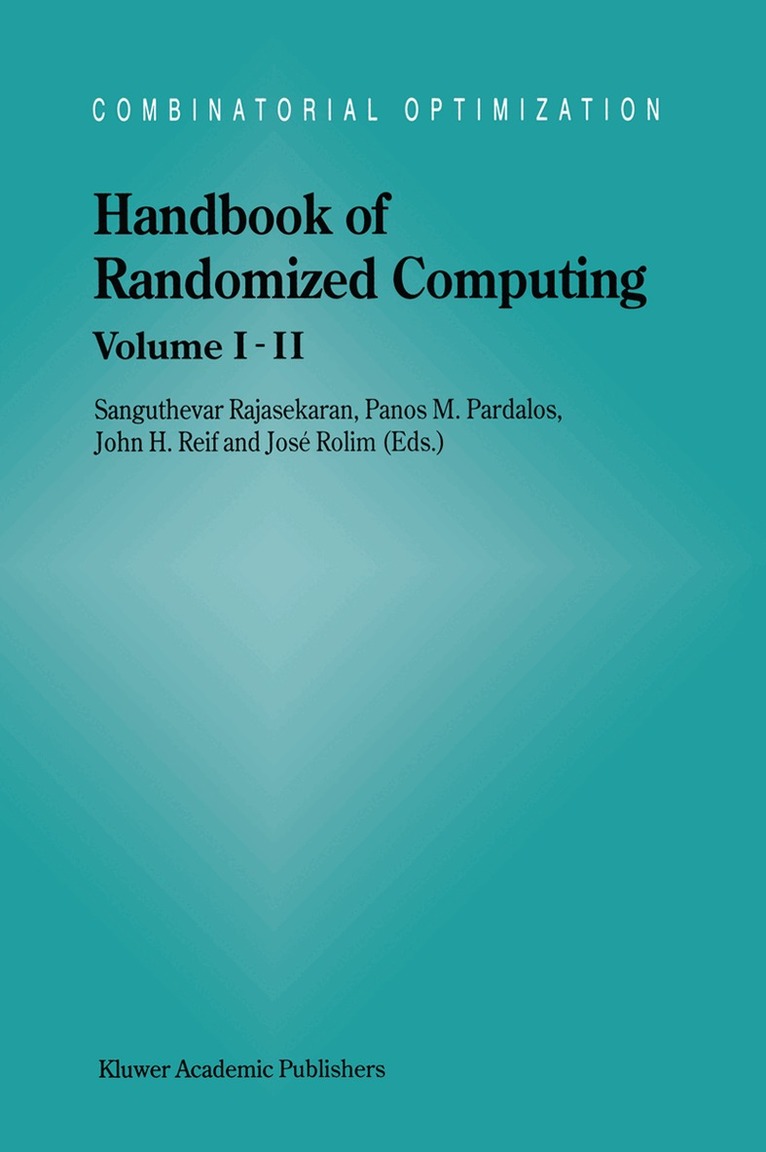
Handbook of Randomized Computing
Av Sanguthevar Rajasekaran, Panos M. Pardalos, J.H. Reif, José Rolim
651 kr
Beställningsvara. Skickas inom 10-15 vardagar. Fri frakt över 249 kr.
Beskrivning
The technique of randomization has been employed to solve numerous prob lems of computing both sequentially and in parallel. Examples of randomized algorithms that are asymptotically better than their deterministic counterparts in solving various fundamental problems abound. Randomized algorithms have the advantages of simplicity and better performance both in theory and often is a collection of articles written by renowned experts in practice. This book in the area of randomized parallel computing. A brief introduction to randomized algorithms In the analysis of algorithms, at least three different measures of performance can be used: the best case, the worst case, and the average case. Often, the average case run time of an algorithm is much smaller than the worst case. 2 For instance, the worst case run time of Hoare's quicksort is O(n ), whereas its average case run time is only O(nlogn). The average case analysis is conducted with an assumption on the input space. The assumption made to arrive at the O(n logn) average run time for quicksort is that each input permutation is equally likely. Clearly, any average case analysis is only as good as how valid the assumption made on the input space is. Randomized algorithms achieve superior performances without making any assumptions on the inputs by making coin flips within the algorithm. Any analysis done of randomized algorithms will be valid for all possible inputs.
Produktinformation
- Märke: Kluwer Academic Publishers
- Utgivningsdatum: 2001-07-31
- Höjd: 155 x 235 x 68 mm
- Vikt: 1 793 g
- Språk: Engelska
- Serie: Combinatorial Optimization
- Antal sidor: 996
- Upplaga: 2001
- Förlag: Kluwer Academic Publishers
- EAN: 9780792369592
Utforska kategorier
Betyg & recensioner
0 recensioner
Inga recensioner tillgängliga.