• Fri frakt över 249 kr
  • •
  • Snabba leveranser
  • •
  • Billiga böcker
Kundservice

Du är på sajten för privatpersoner.

Företag, bibliotek eller offentlig verksamhet?

Du handlar på classic.bokus.com, där alla dina funktioner finns intakta.
Till classic.bokus.com
Bokus logotyp. Gå till startsidan.
  • Erbjudanden
  • Nyheter
  • Student
  • Topplistor
  • Barn & ungdom
  • Bokus Play
  • E-böcker
  • Pocketböcker
  • Spel & pussel

10% rabatt på allt med kod NYSTART10 →

Sidfot

Mina sidor

    Hjälp

    • Kundservice
    • Vanliga frågor och svar
    • Frakt och leverans
    • Retur vid ångerrätt
    • Reklamera vara
    • Betalning
    • Köpvillkor
    • Allmänna villkor
    • Information om webbplatsens tillgänglighet

    Om Bokus

    • Om oss
    • Pressrum
    • För studenter
    • För företag
    • För bibliotek och offentlig verksamhet
    • För leverantörer
    • Hållbarhet

    Populärt

    • Aktuella erbjudanden
    • Presentkort
    • Studentlitteratur
    • Nya böcker
    • Topplistor
    • Signerade böcker
    • Engelska böcker

    Inspiration

    • Boktips
    • BookTok
    • Populära bokserier
    • Barnbokskaraktärer
    • Populära författare
    Logotyp för Bokus
    Följ oss på Facebook (extern länk)Följ oss på Instagram (extern länk)Följ oss på YouTube (extern länk)Följ oss på TikTok (extern länk)
    bokus @ CookiesAnpassa cookiesIntegritetspolicyKöpvillkor
    Till Citymail hemsida (extern länk)Till Budbee hemsida (extern länk)Till Postnord hemsida (extern länk)Till Schenker hemsida (extern länk)Till Early Bird hemsida (extern länk)Till Walleys hemsida (extern länk)
    1. Naturvetenskap och teknik
    2. Matematik och naturvetenskap
    3. Matematik
    4. Optimering

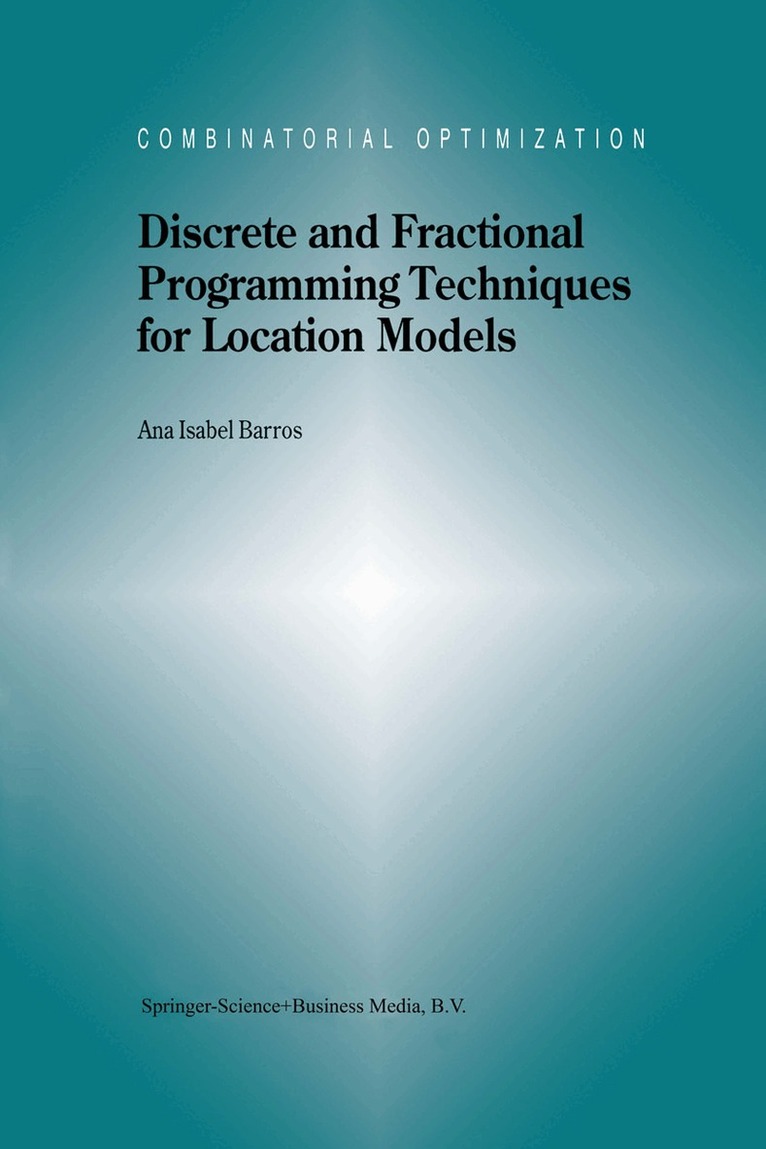
    Discrete and Fractional Programming Techniques for Location Models

    AvA.I. Barros

    Häftad, Engelska, 2013

    Del 3 i serien Combinatorial Optimization

    546 kr

    Beställningsvara. Skickas inom 10-15 vardagar. Fri frakt över 249 kr.

    Fler format och utgåvor

    Inbunden

    1 192 kr

    E-bok

    710 kr

    Beskrivning

    At first sight discrete and fractional programming techniques appear to be two com­ pletely unrelated fields in operations research. We will show how techniques in both fields can be applied separately and in a combined form to particular models in location analysis. Location analysis deals with the problem of deciding where to locate facilities, con­ sidering the clients to be served, in such a way that a certain criterion is optimized. The term "facilities" immediately suggests factories, warehouses, schools, etc. , while the term "clients" refers to depots, retail units, students, etc. Three basic classes can be identified in location analysis: continuous location, network location and dis­ crete location. The differences between these fields arise from the structure of the set of possible locations for the facilities. Hence, locating facilities in the plane or in another continuous space corresponds to a continuous location model while finding optimal facility locations on the edges or vertices of a network corresponds to a net­ work location model. Finally, if the possible set of locations is a finite set of points we have a discrete location model. Each of these fields has been actively studied, arousing intense discussion on the advantages and disadvantages of each of them. The usual requirement that every point in the plane or on the network must be a candidate location point, is one of the mostly used arguments "against" continuous and network location models.

    Produktinformation

    • Utgivningsdatum:2013-11-18
    • Mått:155 x 235 x 12 mm
    • Vikt:312 g
    • Format:Häftad
    • Språk:Engelska
    • Serie:Combinatorial Optimization
    • Antal sidor:180
    • Förlag:Springer-Verlag New York Inc.
    • ISBN:9781461368243

    Utforska kategorier

    • Optimering inom Naturvetenskap och teknik
    • Systemvetenskap och AI inom Data och IT
    • Programmeringsböcker inom Data och IT

    Innehållsförteckning

    • 1. Introduction. 2. Discrete Location Models. 3. Location Models and Fractional Programming. 4. Generalized Fractional Programming. 5. Summary and Remarks. Index.