Berkeley Forum in the Humanities - Böcker
Visar alla böcker i serien Berkeley Forum in the Humanities. Handla med fri frakt och snabb leverans.
13 produkter
13 produkter
422 kr
Skickas inom 10-15 vardagar
Theodor Adorno's Aesthetic Theory (1970) offers one of the most powerful and comprehensive critiques of art and of the discipline of aesthetics ever written. The work offers a deeply critical engagement with the history and philosophy of aesthetics and with the traditions of European art through the middle of the 20th century. It is coupled with ambitious claims about what aesthetic theory ought to be. But the cultural horizon of Adorno's Aesthetic Theory was the world of high modernism, and much has happened since then both in theory and in practice. Adorno's powerful vision of aesthetics calls for reconsideration in this light. Must his work be defended, updated, resisted, or simply left behind? This volume gathers new essays by leading philosophers, critics, and theorists writing in the wake of Adorno in order to address these questions. They hold in common a deep respect for the power of Adorno's aesthetic critique and a concern for the future of aesthetic theory in response to recent developments in aesthetics and its contexts.
391 kr
Skickas inom 10-15 vardagar
This volume of the Townsend Papers in the Humanities commemorates the twenty-fifth year of the Doreen B. Townsend Center for the Humanities at the University of California, Berkeley. As such, the volume is an attempt to capture the breadth and depth of lectures and events presented by the center. Many are revised versions of lectures and presentations organized in connection with the annual appointment of the Avenali Professor in the Humanities at Berkeley (generously funded by Joan and Peter Avenali), or Berkeley's Una's Lecturer (endowed in the memory of Una Smith Ross, Class of 1911); several are based on other events presented by the center over the years, such as the "Humanities Perspectives on Aging" program or the "Futures" lecture series organized to commemorate the center's tenth anniversary. All are the reflection of a public event before a live audience. We have chosen to retain references to the live event where they occur, though space limitations would not permit the inclusion of audience questions.
295 kr
Skickas inom 7-10 vardagar
Malcolm Bull offers a detailed analysis of nihilism in Nietzsche's works. Along with accompanying commentaries by Cascardi and Clark, he explores the significance of Nietzscheís views given the fact that a wide range of readers have come to embrace his ideas as new orthodoxy. There seem to be no anti-Nietzscheans today, but Bull demonstrates that this wide embrace of Nietzsche runs counter to the very meaning of nihilism as Nietzsche understood it.
914 kr
Skickas inom 10-15 vardagar
With the rise of cognitive science and the revolution in neuroscience, it is now commonplace to assume that the study of a human person—a thinking, feeling, acting subject—is ultimately the study of the human brain. In both Europe and the United States, massive state-funded research is focused on mapping the brain in all its remarkable complexity. The metaphors employed are largely technological: A wiring diagram of synaptic connectivity will lead to a better understanding of human behavior and perhaps insights into the breakdown of human personhood with diseases of the brain such as Alzheimer's. Alongside this technologized discourse of the brain as locus of human subjectivity we find another perspective, one that emphasizes its essential plasticity—in both the developmental sense and as a response to traumas such as strokes, tumors, or gunshot wounds.This collection of essays brings together a diverse range of scholars to investigate how the "neural subject" of the twenty-first century came to be. Taking approaches both historical and theoretical, they probe the possibilities and limits of neuroscientific understandings of human experience. Topics include landmark studies in the history of neuroscience, the relationship between neural and technological "pathologies," and analyses of contemporary concepts of plasticity and pathology in cognitive neuroscience. Central to the volume is a critical examination of the relationship between pathology and plasticity. Because pathology is often the occasion for neural reorganization and adaptation, it exists not in opposition to the brain's "normal" operation but instead as something intimately connected to our ways of being and understanding.
327 kr
Skickas inom 10-15 vardagar
With the rise of cognitive science and the revolution in neuroscience, it is now commonplace to assume that the study of a human person—a thinking, feeling, acting subject—is ultimately the study of the human brain. In both Europe and the United States, massive state-funded research is focused on mapping the brain in all its remarkable complexity. The metaphors employed are largely technological: A wiring diagram of synaptic connectivity will lead to a better understanding of human behavior and perhaps insights into the breakdown of human personhood with diseases of the brain such as Alzheimer's. Alongside this technologized discourse of the brain as locus of human subjectivity we find another perspective, one that emphasizes its essential plasticity—in both the developmental sense and as a response to traumas such as strokes, tumors, or gunshot wounds.This collection of essays brings together a diverse range of scholars to investigate how the "neural subject" of the twenty-first century came to be. Taking approaches both historical and theoretical, they probe the possibilities and limits of neuroscientific understandings of human experience. Topics include landmark studies in the history of neuroscience, the relationship between neural and technological "pathologies," and analyses of contemporary concepts of plasticity and pathology in cognitive neuroscience. Central to the volume is a critical examination of the relationship between pathology and plasticity. Because pathology is often the occasion for neural reorganization and adaptation, it exists not in opposition to the brain's "normal" operation but instead as something intimately connected to our ways of being and understanding.
1 021 kr
Skickas inom 10-15 vardagar
Over the last few decades, vibrant debates regarding post-secularism have found inspiration and provocation in the works of Sigmund Freud. A new interest in the interconnection of psychoanalysis, religion and political theory has emerged, allowing Freud's illuminating examination of the religious and mystical practices in "Obsessive Neurosis and Religious Practices," and the exegesis of the origins of ethics in religion in Totem and Taboo, to gain currency in recent debates on modernity. In that context, the pivotal role of Freud's masterpiece, Moses and Monotheism, is widely recognized. Freud and Monotheism brings together fundamental new contributions to discourses on Freud and Moses, as well as new research at the intersections of theology, political theory, and history in Freud's psychoanalytic work. Highlighting the broad impact of Moses and Monotheism across the humanities, the contributors hail from such diverse disciplines as philosophy, comparative literature, cultural studies, German studies, Jewish studies and psychoanalysis. Jan Assmann and Richard Bernstein, whose books pioneered the earlier debate that initiated the Freud and Moses discourse, seize the opportunity to revisit and revise their groundbreaking work. Gabriele Schwab, Gilad Sharvit, Karen Feldman, and Yael Segalovitz engage with the idiosyncratic, eccentric and fertile nature of the book as a Spӓtstil, and explore radical interpretations of Freud's literary practice, theory of religion and therapeutic practice. Ronald Hendel offers an alternative history for the Mosaic discourse within the biblical text, Catherine Malabou reconnects Freud's theory of psychic phylogenesis in Moses and Monotheism to new findings in modern biology and Willi Goetschel relocates Freud in the tradition of works on history that begins with Heine, while Joel Whitebook offers important criticisms of Freud's main argument about the advance in intellectuality that Freud attributes to Judaism.
322 kr
Skickas inom 7-10 vardagar
Over the last few decades, vibrant debates regarding post-secularism have found inspiration and provocation in the works of Sigmund Freud. A new interest in the interconnection of psychoanalysis, religion and political theory has emerged, allowing Freud's illuminating examination of the religious and mystical practices in "Obsessive Neurosis and Religious Practices," and the exegesis of the origins of ethics in religion in Totem and Taboo, to gain currency in recent debates on modernity. In that context, the pivotal role of Freud's masterpiece, Moses and Monotheism, is widely recognized. Freud and Monotheism brings together fundamental new contributions to discourses on Freud and Moses, as well as new research at the intersections of theology, political theory, and history in Freud's psychoanalytic work. Highlighting the broad impact of Moses and Monotheism across the humanities, the contributors hail from such diverse disciplines as philosophy, comparative literature, cultural studies, German studies, Jewish studies and psychoanalysis. Jan Assmann and Richard Bernstein, whose books pioneered the earlier debate that initiated the Freud and Moses discourse, seize the opportunity to revisit and revise their groundbreaking work. Gabriele Schwab, Gilad Sharvit, Karen Feldman, and Yael Segalovitz engage with the idiosyncratic, eccentric and fertile nature of the book as a Spӓtstil, and explore radical interpretations of Freud's literary practice, theory of religion and therapeutic practice. Ronald Hendel offers an alternative history for the Mosaic discourse within the biblical text, Catherine Malabou reconnects Freud's theory of psychic phylogenesis in Moses and Monotheism to new findings in modern biology and Willi Goetschel relocates Freud in the tradition of works on history that begins with Heine, while Joel Whitebook offers important criticisms of Freud's main argument about the advance in intellectuality that Freud attributes to Judaism.
297 kr
Skickas inom 7-10 vardagar
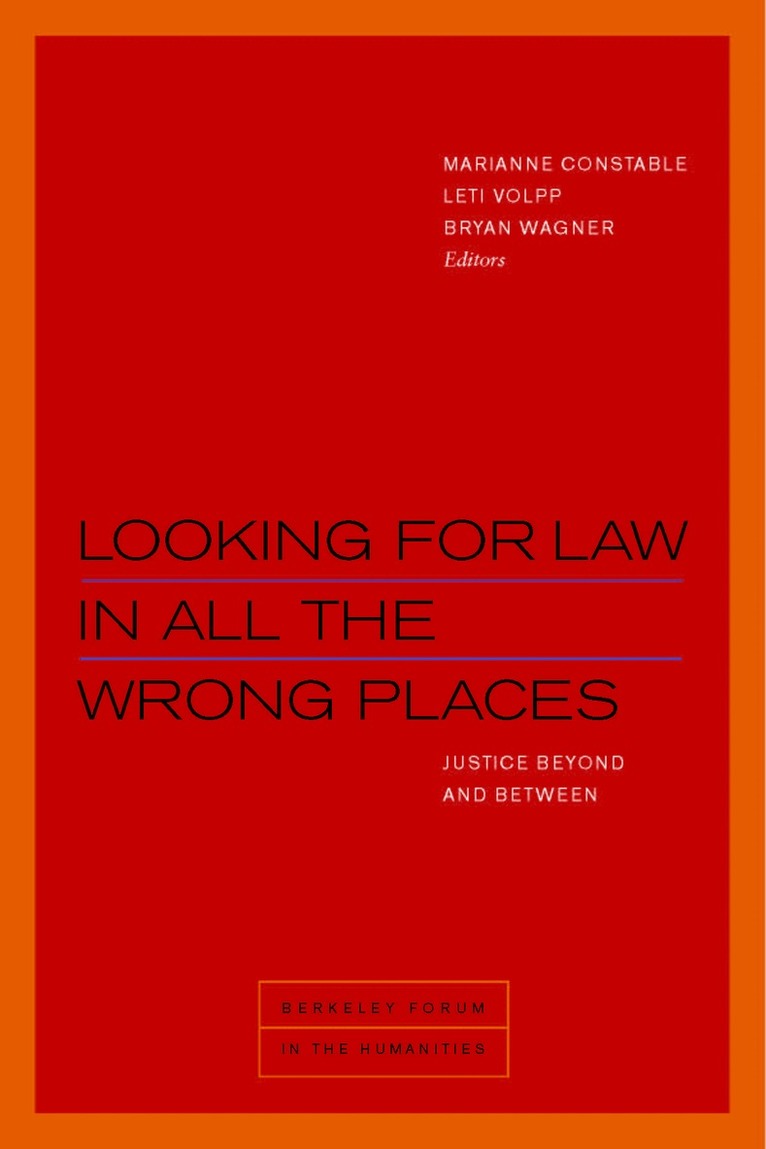
For many inside and outside the legal academy, the right place to look for law is in constitutions, statutes, and judicial opinions. This book looks for law in the "wrong places"—sites and spaces in which no formal law appears. These may be geographic regions beyond the reach of law, everyday practices ungoverned or ungovernable by law, or works of art that have escaped law's constraints.Looking for Law in All the Wrong Places brings together essays by leading scholars of anthropology, cultural studies, history, law, literature, political science, race and ethnic studies, religion, and rhetoric, to look at law from the standpoint of the humanities. Beyond showing law to be determined by or determinative of distinct cultural phenomena, the contributors show how law is itself interwoven with language, text, image, and culture.Many essays in this volume look for law precisely in the kinds of "wrong places" where there appears to be no law. They find in these places not only reflections and remains of law, but also rules and practices that seem indistinguishable from law and raise challenging questions about the locations of law and about law's meaning and function. Other essays do the opposite: rather than looking for law in places where law does not obviously appear, they look in statute books and courtrooms from perspectives that are usually presumed to have nothing to say about law.Looking at law sideways, or upside down, or inside out defamiliarizes law. These essays show what legal understanding can gain when law is denied its ostensibly proper domain.Contributors: Kathryn Abrams, Daniel Boyarin, Wendy Brown, Marianne Constable, Samera Esmeir, Daniel Fisher, Sara Ludin, Saba Mahmood, Rebecca McLennan, Ramona Naddaff, Beth Piatote, Sarah Song, Christopher Tomlins, Leti Volpp, Bryan Wagner
1 037 kr
Skickas inom 10-15 vardagar
For many inside and outside the legal academy, the right place to look for law is in constitutions, statutes, and judicial opinions. This book looks for law in the "wrong places"—sites and spaces in which no formal law appears. These may be geographic regions beyond the reach of law, everyday practices ungoverned or ungovernable by law, or works of art that have escaped law's constraints.Looking for Law in All the Wrong Places brings together essays by leading scholars of anthropology, cultural studies, history, law, literature, political science, race and ethnic studies, religion, and rhetoric, to look at law from the standpoint of the humanities. Beyond showing law to be determined by or determinative of distinct cultural phenomena, the contributors show how law is itself interwoven with language, text, image, and culture.Many essays in this volume look for law precisely in the kinds of "wrong places" where there appears to be no law. They find in these places not only reflections and remains of law, but also rules and practices that seem indistinguishable from law and raise challenging questions about the locations of law and about law's meaning and function. Other essays do the opposite: rather than looking for law in places where law does not obviously appear, they look in statute books and courtrooms from perspectives that are usually presumed to have nothing to say about law.Looking at law sideways, or upside down, or inside out defamiliarizes law. These essays show what legal understanding can gain when law is denied its ostensibly proper domain.Contributors: Kathryn Abrams, Daniel Boyarin, Wendy Brown, Marianne Constable, Samera Esmeir, Daniel Fisher, Sara Ludin, Saba Mahmood, Rebecca McLennan, Ramona Naddaff, Beth Piatote, Sarah Song, Christopher Tomlins, Leti Volpp, Bryan Wagner
1 542 kr
Skickas inom 10-15 vardagar
Today, an international new right has coalesced. Variously described as nativist, right-populist, alt-right, and neofascist, far-right movements in many countries have achieved electoral victories that not long ago seemed highly improbable. They have also developed a new cultural politics. Adapting tactics from the left, the new right has moved from decorum to transgression; from conservative propriety to the frank sexualization of political figures and positions; from appealing to the conscious normalcy of the "silent majority" to recasting itself as a protest movement of and for the aggrieved. These movements share a mandate for robust nationalism, yet they also cultivate a striking international solidarity. Who is the subject of this ethnonationalism? Many new right movements have in fact intensified or laid bare long-standing tendencies, but this volume seeks to address aspects of their cultural politics that raise new and urgent questions. How should we assess the new right's disconcerting appropriations of strategies of minoritarian resistance? How can we practice critique in the face of adversaries who claim to practice a critique of their own? How do apparently post-normative versions of nationalism give rise to heightened forms of militarism, incarceration, censorship, and inequality? How should we understand the temporality of ethnonationalism, which combines a romance with archaic tradition, an ethos of disruption driven by tech futurism frequently tinged with accelerationist pathos, and a kitschy nostalgia for a hazily defined recent past, when things were "greater" than they are now? Surveying nationalisms from Argentina, Brazil, France, Germany, India, Israel-Palestine, the United Kingdom, and the United States, Reaction Formations gives a critical account of contemporary ethnonationalist cultural politics, while drawing out counterstrategies for anti-fascist resistance.Contributors: Tyler Blakeney, Chiara Bottici, Joshua Branciforte, Gisela Catanzaro, Melinda Cooper, Julian Göpffarth, Ramsey McGlazer, Benjamin Noys, Bruno Perreau, Rahul Rao, Shaul Setter, and M. Ty
416 kr
Skickas inom 7-10 vardagar
Today, an international new right has coalesced. Variously described as nativist, right-populist, alt-right, and neofascist, far-right movements in many countries have achieved electoral victories that not long ago seemed highly improbable. They have also developed a new cultural politics. Adapting tactics from the left, the new right has moved from decorum to transgression; from conservative propriety to the frank sexualization of political figures and positions; from appealing to the conscious normalcy of the "silent majority" to recasting itself as a protest movement of and for the aggrieved. These movements share a mandate for robust nationalism, yet they also cultivate a striking international solidarity. Who is the subject of this ethnonationalism? Many new right movements have in fact intensified or laid bare long-standing tendencies, but this volume seeks to address aspects of their cultural politics that raise new and urgent questions. How should we assess the new right's disconcerting appropriations of strategies of minoritarian resistance? How can we practice critique in the face of adversaries who claim to practice a critique of their own? How do apparently post-normative versions of nationalism give rise to heightened forms of militarism, incarceration, censorship, and inequality? How should we understand the temporality of ethnonationalism, which combines a romance with archaic tradition, an ethos of disruption driven by tech futurism frequently tinged with accelerationist pathos, and a kitschy nostalgia for a hazily defined recent past, when things were "greater" than they are now? Surveying nationalisms from Argentina, Brazil, France, Germany, India, Israel-Palestine, the United Kingdom, and the United States, Reaction Formations gives a critical account of contemporary ethnonationalist cultural politics, while drawing out counterstrategies for anti-fascist resistance.Contributors: Tyler Blakeney, Chiara Bottici, Joshua Branciforte, Gisela Catanzaro, Melinda Cooper, Julian Göpffarth, Ramsey McGlazer, Benjamin Noys, Bruno Perreau, Rahul Rao, Shaul Setter, and M. Ty
1 127 kr
Skickas inom 10-15 vardagar
Breaking the Bronze Ceiling uncovers a glaring omission in our global memorial landscape—the conspicuous absence of women. Exploring this neglected narrative, the book emerges as the foremost guide to women's memorialization across diverse cultures and ages. As global memorials come under intense examination, with metropolises vying for a more inclusive recognition of female contributions, this book stands at the forefront of contemporary discussion.The book's thought-provoking essays artfully traverse the complex terrains of gender portrayal, urban tales, ancestral practices, and grassroots activism—all anchored in the bedrock of cultural remembrance. Rich in the range of cases discussed, the book sifts through multifaceted representations of women, from Marians to Liberties, to handmaidens, to particular historical women.Breaking the Bronze Ceiling offers a panoramic view of worldwide memorials, critically analyzing grandiose tributes while also honoring subtle gestures—be it evocative plaques, inspiring namesakes, or dynamic demonstrations. The book will be of interest to historians of art and architecture, as well as to activists, governmental bodies, urban planners, and NGOs committed to regional history and memory.More than a mere compilation, Breaking the Bronze Ceiling epitomizes a movement. The book comprehensively assesses the portrayal of women in public art and offers a fervent plea to address the severe underrepresentation of women in memorials.Contributors: Carolina Aguilera, Manuela Badilla, Daniel E. Coslett, Erika Doss, Tania Gutiérrez-Monroy, Daniel Herwitz, Katherine Hite, Lauren Kroiz, Ana María León, Fernando Luis Martínez Nespral, Pía Montealegre, Sierra Rooney, Daniela Sandler, Kirk Savage, Susan Slyomovics, Marita Sturken, Amanda Su, Dell Upton, Nathaniel Robert Walker, and Mechtild Widrich
309 kr
Skickas inom 7-10 vardagar
Breaking the Bronze Ceiling uncovers a glaring omission in our global memorial landscape—the conspicuous absence of women. Exploring this neglected narrative, the book emerges as the foremost guide to women's memorialization across diverse cultures and ages. As global memorials come under intense examination, with metropolises vying for a more inclusive recognition of female contributions, this book stands at the forefront of contemporary discussion.The book's thought-provoking essays artfully traverse the complex terrains of gender portrayal, urban tales, ancestral practices, and grassroots activism—all anchored in the bedrock of cultural remembrance. Rich in the range of cases discussed, the book sifts through multifaceted representations of women, from Marians to Liberties, to handmaidens, to particular historical women.Breaking the Bronze Ceiling offers a panoramic view of worldwide memorials, critically analyzing grandiose tributes while also honoring subtle gestures—be it evocative plaques, inspiring namesakes, or dynamic demonstrations. The book will be of interest to historians of art and architecture, as well as to activists, governmental bodies, urban planners, and NGOs committed to regional history and memory.More than a mere compilation, Breaking the Bronze Ceiling epitomizes a movement. The book comprehensively assesses the portrayal of women in public art and offers a fervent plea to address the severe underrepresentation of women in memorials.Contributors: Carolina Aguilera, Manuela Badilla, Daniel E. Coslett, Erika Doss, Tania Gutiérrez-Monroy, Daniel Herwitz, Katherine Hite, Lauren Kroiz, Ana María León, Fernando Luis Martínez Nespral, Pía Montealegre, Sierra Rooney, Daniela Sandler, Kirk Savage, Susan Slyomovics, Marita Sturken, Amanda Su, Dell Upton, Nathaniel Robert Walker, and Mechtild Widrich