Convergences: Inventories of the Present – Serie
Visar alla böcker i serien Convergences: Inventories of the Present. Handla med fri frakt och snabb leverans.
13 produkter
13 produkter
Del 24 - Convergences: Inventories of the Present
Decline and Fall of the Lettered City
Latin America in the Cold War
Häftad, Engelska, 2002
442 kr
Skickas inom 10-15 vardagar
The cultural Cold War in Latin America was waged as a war of values--artistic freedom versus communitarianism, Western values versus national cultures, the autonomy of art versus a commitment to liberation struggles--and at a time when the prestige of literature had never been higher. The projects of the historic avant-garde were revitalized by an anti-capitalist ethos and envisaged as the opposite of the republican state. The Decline and Fall of the Lettered City charts the conflicting universals of this period, the clash between avant-garde and political vanguard. This was also a twilight of literature at the threshold of the great cultural revolution of the seventies and eighties, a revolution to which the Cold War indirectly contributed. In the eighties, civil war and military rule, together with the rapid development of mass culture and communication empires, changed the political and cultural map.A long-awaited work by an eminent Latin Americanist widely read throughout the world, this book will prove indispensable to anyone hoping to understand Latin American literature and society. Jean Franco guides the reader across minefields of cultural debate and histories of highly polarized struggle. Focusing on literary texts by García Marquez, Vargas Llosa, Roa Bastos, and Juan Carlos Onetti, conducting us through this contested history with the authority of an eyewitness, Franco gives us an engaging overview as involving as it is moving.
Del 26 - Convergences: Inventories of the Present
Reflections on Exile and Other Essays
Häftad, Engelska, 2002
367 kr
Tillfälligt slut
With their powerful blend of political and aesthetic concerns, Edward W. Said's writings have transformed the field of literary studies. This long-awaited collection of literary and cultural essays, the first since Harvard University Press published The World, the Text, and the Critic in 1983, reconfirms what no one can doubt--that Said is the most impressive, consequential, and elegant critic of our time--and offers further evidence of how much the fully engaged critical mind can contribute to the reservoir of value, thought, and action essential to our lives and our culture.As in the title essay, the widely admired "Reflections on Exile," the fact of his own exile and the fate of the Palestinians have given both form and the force of intimacy to the questions Said has pursued. Taken together, these essays--from the famous to those that will surprise even Said's most assiduous followers--afford rare insight into the formation of a critic and the development of an intellectual vocation. Said's topics are many and diverse, from the movie heroics of Tarzan to the machismo of Ernest Hemingway to the shades of difference that divide Alexandria and Cairo. He offers major reconsiderations of writers and artists such as George Orwell, Giambattista Vico, Georg Lukacs, R. P. Blackmur, E. M. Cioran, Naguib Mahfouz, Herman Melville, Joseph Conrad, Walter Lippman, Samuel Huntington, Antonio Gramsci, and Raymond Williams. Invigorating, edifying, acutely attentive to the vying pressures of personal and historical experience, his book is a source of immeasurable intellectual delight.
550 kr
Skickas inom 3-6 vardagar
A celebration of the tenacious life of the enduring Irish classics, this book by one of Irish writing's most eloquent readers offers a brilliant and accessible survey of the greatest works since 1600 in Gaelic and English, which together have shaped one of the world's most original literary cultures.In the course of his discussion of the great seventeenth- and eighteenth-century Gaelic poems of dispossession, and of later work in that language that refuses to die, Declan Kiberd provides vivid and idiomatic translations that bring the Irish texts alive for the English-speaking reader.Extending from the Irish poets who confronted modernity as a cataclysm, and who responded by using traditional forms in novel and radical ways, to the great modern practitioners of such paradoxically conservative and revolutionary writing, Kiberd's work embraces three sorts of Irish classics: those of awesome beauty and internal rigor, such as works by the Gaelic bards, Yeats, Synge, Beckett, and Joyce; those that generate a myth so powerful as to obscure the individual writer and unleash an almost superhuman force, such as the Cuchulain story, the lament for Art O'Laoghaire, and even Dracula; and those whose power exerts a palpable influence on the course of human action, such as Swift's Drapier's Letters, the speeches of Edmund Burke, or the autobiography of Wolfe Tone. The book closes with a moving and daring coda on the Anglo-Irish agreement, claiming that the seeds of such a settlement were sown in the works of Irish literature.A delight to read throughout, Irish Classics is a fitting tribute to the works it reads so well and inspires us to read, and read again.
281 kr
Skickas inom 7-10 vardagar
The "world of letters" has always seemed a matter more of metaphor than of global reality. In this book, Pascale Casanova shows us the state of world literature behind the stylistic refinements--a world of letters relatively independent from economic and political realms, and in which language systems, aesthetic orders, and genres struggle for dominance. Rejecting facile talk of globalization, with its suggestion of a happy literary "melting pot," Casanova exposes an emerging regime of inequality in the world of letters, where minor languages and literatures are subject to the invisible but implacable violence of their dominant counterparts.Inspired by the writings of Fernand Braudel and Pierre Bourdieu, this ambitious book develops the first systematic model for understanding the production, circulation, and valuing of literature worldwide. Casanova proposes a baseline from which we might measure the newness and modernity of the world of letters--the literary equivalent of the meridian at Greenwich. She argues for the importance of literary capital and its role in giving value and legitimacy to nations in their incessant struggle for international power. Within her overarching theory, Casanova locates three main periods in the genesis of world literature--Latin, French, and German--and closely examines three towering figures in the world republic of letters--Kafka, Joyce, and Faulkner. Her work provides a rich and surprising view of the political struggles of our modern world--one framed by sites of publication, circulation, translation, and efforts at literary annexation.
Del 28 - Convergences: Inventories of the Present
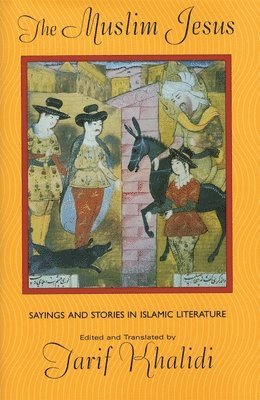
Muslim Jesus
Sayings and Stories in Islamic Literature
Häftad, Engelska, 2003
299 kr
Skickas inom 7-10 vardagar
This work presents in English translation the largest collection ever assembled of the sayings and stories of Jesus in Arabic Islamic literature. In doing so, it traces a tradition of love and reverence for Jesus that has characterized Islamic thought for more than a thousand years. An invaluable resource for the history of religions, the collection documents how one culture, that of Islam, assimilated the towering religious figure of another, that of Christianity. As such, it is a work of great significance for the understanding of both, and of profound implications for modern-day intersectarian relations and ecumenical dialogue.Tarif Khalidi's introduction and commentaries place the sayings and stories in their historical context, showing how and why this "gospel" arose and the function it served within Muslim devotion. The Jesus that emerges here is a compelling figure of deep and life-giving spirituality. The sayings and stories, some 300 in number and arranged in chronological order, show us how the image of this Jesus evolved throughout a millennium of Islamic history.
Del 32 - Convergences: Inventories of the Present
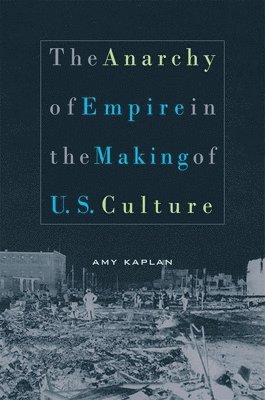
Anarchy of Empire in the Making of U.S. Culture
Häftad, Engelska, 2005
300 kr
Skickas inom 7-10 vardagar
The United States has always imagined that its identity as a nation is insulated from violent interventions abroad, as if a line between domestic and foreign affairs could be neatly drawn. Yet this book argues that such a distinction, so obviously impracticable in our own global era, has been illusory at least since the war with Mexico in the mid-nineteenth century and the later wars against Spain, Cuba, and the Philippines. In this book, Amy Kaplan shows how U.S. imperialism--from "Manifest Destiny" to the "American Century"--has profoundly shaped key elements of American culture at home, and how the struggle for power over foreign peoples and places has disrupted the quest for domestic order. The neatly ordered kitchen in Catherine Beecher's household manual may seem remote from the battlefields of Mexico in 1846, just as Mark Twain's Mississippi may seem distant from Honolulu in 1866, or W. E. B. Du Bois's reports of the East St. Louis Race Riot from the colonization of Africa in 1917. But, as this book reveals, such apparently disparate locations are cast into jarring proximity by imperial expansion. In literature, journalism, film, political speeches, and legal documents, Kaplan traces the undeniable connections between American efforts to quell anarchy abroad and the eruption of such anarchy at the heart of the empire.
Del 15 - Convergences: Inventories of the Present
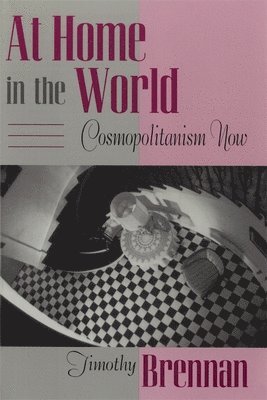
At Home in the World
Cosmopolitanism Now
Häftad, Engelska, 1997
517 kr
Skickas inom 10-15 vardagar
From every quarter we hear of a new global culture, postcolonial, hybrid, announcing the death of nationalism, the arrival of cosmopolitanism. But under the drumbeat attending this trend, Timothy Brennan detects another, altogether different sound. Polemical, passionate, certain to provoke, his book exposes the drama being played out under the guise of globalism. A bracing critique of the critical self-indulgence that calls itself cosmopolitanism, it also takes note of the many countervailing forces acting against globalism in its facile, homogenizing sense.The developments Brennan traces occur in many places--editorial pages, policy journals, corporate training manuals, and, primarily, in the arts. His subject takes him from George Orwell to Julia Kristeva, from Subcommandante Marcos to Julio Cortázar, from Ernst Bloch to contemporary apologists for transnational capitalism and "liberation management," from "third world" writing to the Nobel Prize, with little of critical theory or cultural studies left untouched in between. Brennan gives extended treatment to two exemplary figures: the Trinidadian writer C. L. R. James, whose work suggests an alternative approach to cultural studies; and the Cuban writer Alejo Carpentier, whose appreciation of Cuban popular music cuts through the usual distinctions between mass and elite culture.A critical call to arms, At Home in the World summons intellectuals and scholars to reinvigorate critical cultural studies. In stripping the false and heedless from the new cosmopolitanism, Brennan revitalizes the idea.
Del 33 - Convergences: Inventories of the Present
Secularism, Identity, and Enchantment
Inbunden, Engelska, 2014
525 kr
Skickas inom 10-15 vardagar
Del 18 - Convergences: Inventories of the Present
Chopin at the Boundaries
Sex, History, and Musical Genre
Häftad, Engelska, 1998
507 kr
Skickas inom 10-15 vardagar
The complex status of Chopin in our culture--he was a native Pole and adopted Frenchman, and a male composer writing in "feminine" genres--is the subject of Jeffrey Kallberg's absorbing book. Combining social history, literary theory, musicology, and feminist thought, Chopin at the Boundaries is the first book to situate Chopin's music within the construct of his somewhat marginal sexual identity and to explore how this should figure in our understanding of his compositional methods. Through this novel approach, Kallberg reveals a new Chopin, one situated precisely where questions of gender open up into the very important question of genre.
Del 17 - Convergences: Inventories of the Present
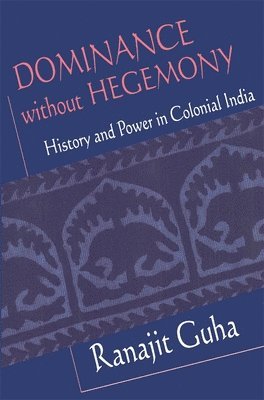
Dominance without Hegemony
History and Power in Colonial India
Häftad, Engelska, 1998
442 kr
Skickas inom 7-10 vardagar
What is colonialism and what is a colonial state? Ranajit Guha points out that the colonial state in South Asia was fundamentally different from the metropolitan bourgeois state which sired it. The metropolitan state was hegemonic in character, and its claim to dominance was based on a power relation in which persuasion outweighed coercion. Conversely, the colonial state was non-hegemonic, and in its structure of dominance coercion was paramount. Indeed, the originality of the South Asian colonial state lay precisely in this difference: a historical paradox, it was an autocracy set up and sustained in the East by the foremost democracy of the Western world. It was not possible for that non-hegemonic state to assimilate the civil society of the colonized to itself. Thus the colonial state, as Guha defines it in this closely argued work, was a paradox--a dominance without hegemony.Dominance without Hegemony had a nationalist aspect as well. This arose from a structural split between the elite and subaltern domains of politics, and the consequent failure of the Indian bourgeoisie to integrate vast areas of the life and consciousness of the people into an alternative hegemony. That predicament is discussed in terms of the nationalist project of anticipating power by mobilizing the masses and producing an alternative historiography. In both endeavors the elite claimed to speak for the people constituted as a nation and sought to challenge the pretensions of an alien regime to represent the colonized. A rivalry between an aspirant to power and its incumbent, this was in essence a contest for hegemony.
Del 11 - Convergences: Inventories of the Present
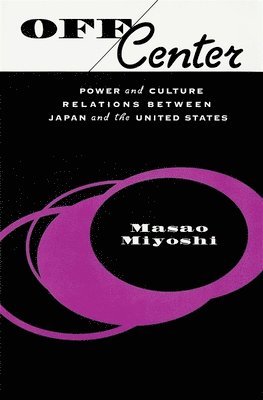
Off Center
Power and Culture Relations Between Japan and the United States
Häftad, Engelska, 1998
374 kr
Skickas inom 10-15 vardagar
What is the connection between the United States' imbalance of trade with Japan and the imbalance of translation in the other direction? Between Western literary critics' estimates of Japanese fiction and Japanese politicians' "America-bashing"? Between the portrayal of East-West relations in the film Merry Christmas, Mr. Lawrence and the terms of the GATT trade agreements?In this provocative study, Masao Miyoshi deliberately adopts an off-center perspective--one that restores the historical asymmetry of encounters between Japan and the United States, from Commodore Perry to Douglas MacArthur--to investigate the blindness that has characterized relations between the two cultures.Both nations are blinkered by complementary forms of ethnocentricity. The United States--or, more broadly, the Eurocentric West--believes its culture to be universal, while Japan believes its culture to be essentially unique. Thus American critics read and judge Japanese literature by the standards of the Western novel; Japanese politicians pay lip service to "free trade" while supporting protectionist policies at home and abroad.Miyoshi takes off from literature to range across culture, politics, and economics in his analysis of the Japanese and their reflections in the West; the fiction of Tanizaki, Mishima, Oe; trade negotiations; Japan bashing and America bashing; Emperor worship; Japanese feminist writing; the domination of transcribed conversation as a literary form in contemporary Japan. In his confrontation with cultural critics, Miyoshi does not spare "centrists" of either persuasion, nor those who refuse to recognize that "the literary and the economical, the cultural and the industrial, are inseparable."Yet contentious as this book can be, it ultimately holds out, by its example, hope for a criticism that can see beyond the boundaries of national cultures--without substituting a historically false "universal" culture--and that examines cultural convergences from a viewpoint that remains provocatively and fruitfully off center.
554 kr
Skickas inom 10-15 vardagar
Richard Poirier, one of America's most eminent critics, reveals in this book the creative but mostly hidden alliance between American pragmatism and American poetry. He brilliantly traces pragmatism as a philosophical and literary practice grounded in a linguistic skepticism that runs from Emerson and William James to the work of Robert Frost, Gertrude Stein, and Wallace Stevens, and on to the cultural debates of today.More powerfully than ever before, Poirier shows that pragmatism had its start in Emerson, the great example to all his successors of how it is possible to redeem even as you set out to change the literature of the past. Poirier demonstrates that Emerson—and later William James—were essentially philosophers of language, and that it is language that embodies our cultural past, an inheritance to be struggled with, and transformed, before being handed on to future generations. He maintains that in Emersonian pragmatist writing, any loss—personal or cultural—gives way to a quest for what he calls “superfluousness,” a kind of rhetorical excess by which powerfully creative individuals try to elude deprivation and stasis. In a wide-ranging meditation on what James called “the vague,” Poirier extols the authentic voice of individualism, which, he argues, is tentative and casual rather than aggressive and dogmatic.The concluding chapters describe the possibilities for criticism created by this radically different understanding of reading and writing, which are nothing less than a reinvention of literary tradition itself. Poirier's discovery of this tradition illuminates the work of many of the most important figures in American philosophy and poetry. His reanimation of pragmatism also calls for a redirection of contemporary criticism, so that readers inside as well as outside the academy can begin to respond to poetic language as the source of meaning, not to meaning as the source of language.
1 623 kr
Skickas inom 3-6 vardagar