Elements in Shakespeare and Text - Böcker
Visar alla böcker i serien Elements in Shakespeare and Text. Handla med fri frakt och snabb leverans.
10 produkter
10 produkter
269 kr
Skickas inom 7-10 vardagar
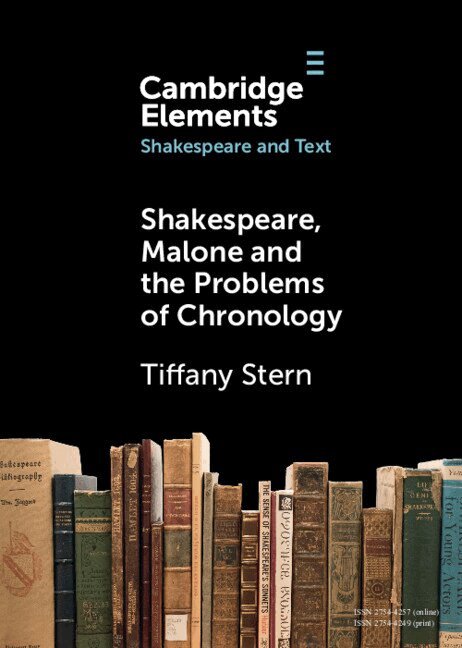
In 1778 Edmond Malone published his first contribution to Shakespeare scholarship, An Attempt to Ascertain the Order in which the Plays Attributed to Shakspeare were Written. He revised and republished it in 1790 and began a further revision of it which was printed posthumously in 1821. This Element will be on the three versions of Malone's Attempt and the way they created, shaped, focused, directed, and misdirected, our idea of the chronology and sequence of Shakespeare's plays. By showing Malone's impressive, fallible choices, adopted or adapted by later editors, it reveals how current Shakespeare editions are, in good and bad ways, Malonian at heart.
269 kr
Skickas inom 7-10 vardagar
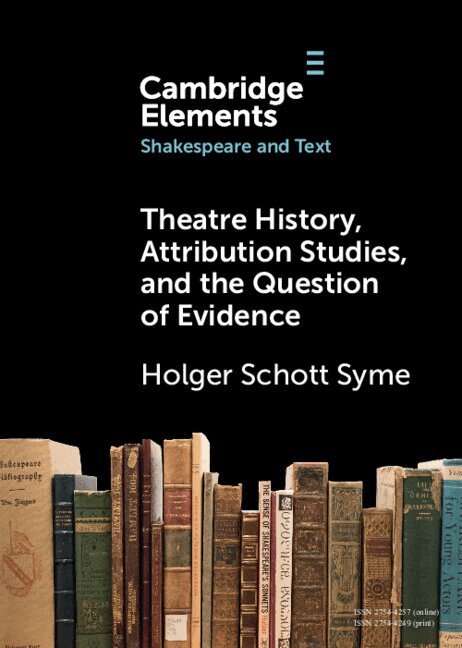
Over the past decade, attribution scholars have come to a consensus that Shakespeare wrote some of the additions printed in the 1602 quarto of Kyd's Spanish Tragedy. This new development in textual studies has far-reaching consequences for established theatre-historical narratives. Accounting for Shakespeare's involvement in The Spanish Tragedy requires us to rethink the history of two major theatre companies, the Admiral's and the Chamberlain's Men, and to reread much of the documentary record of late Elizabethan theatre. Modelling what a theatre-historical response to new attributionist arguments might look like, the author offers an in-depth reinterpretation of Philip Henslowe's records of new plays, develops a novel account of how theatre companies copied and adapted plays in one another's repertories (including a reconsideration of the 'Ur-Hamlet' and the two Shrew plays), and reconstructs an early modern cluster of Hieronimo plays that also allows us to reimagine Ben Jonson's career as an actor.
269 kr
Skickas inom 7-10 vardagar
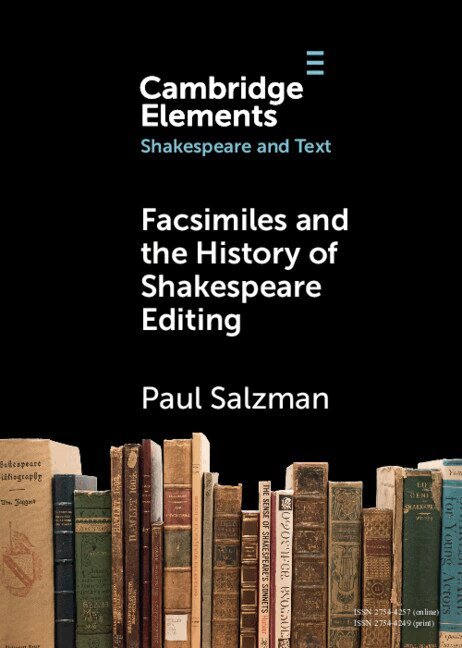
Is a facsimile an edition? In answering this question in relation to Shakespeare, and to early modern writing in general, the author explores the interrelationship between the beginning of the conventional process of collecting and editing Shakespeare's plays and the increasing sophistication of facsimiles. While recent scholarship has offered a detailed account of how Shakespeare was edited in the eighteenth century, the parallel process of the 'exact' reproduction of his texts has been largely ignored. The author will explain how facsimiles moved during the eighteenth and nineteenth century from hand drawn, traced, and type facsimiles to the advent of photographical facsimiles in the mid nineteenth century. Facsimiles can be seen as a barometer of the reverence accorded to the idea of an authentic Shakespeare text, and also of the desire to possess, if not original texts, then reproductions of them.
254 kr
Skickas inom 7-10 vardagar
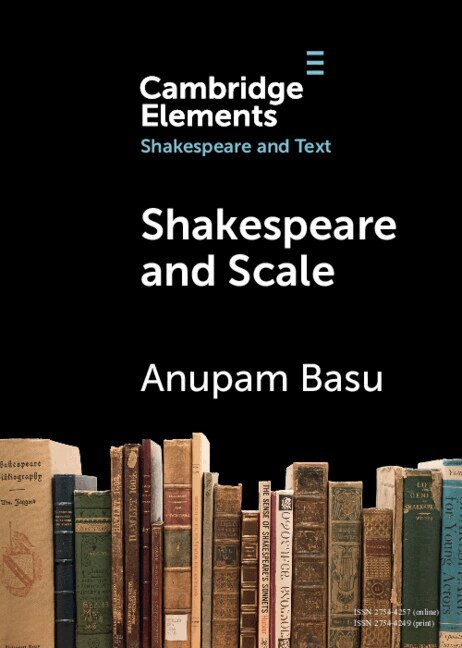
Scale has been the central promise of the digital turn. The creation of corpora such as EEBO and EEBO-TCP have eased the logistics of access to primary sources for scholars of Shakespeare and early English literature and culture and fundamentally altered the ways in which we retrieve, read, think about, and analyze texts. However, the large-scale curation of historical corpora poses unique challenges and requires scholarly insight and significant algorithmic intervention. In sections on 'Text,' 'Corpus,' 'Search,' and 'Discovery,' this Element problematizes the specific affordances of computation and scale as primary conceptual categories rather than incidental artifacts of digitization. From text-encoding and search to corpus-scale data visualization and machine-learning, it discusses a range of computational techniques that can facilitate corpus curation and enable exploratory, experimental modes of discovery that not only serve as tools to ease access but accommodate and respond to the demands of humanistic inquiry.
269 kr
Skickas inom 7-10 vardagar
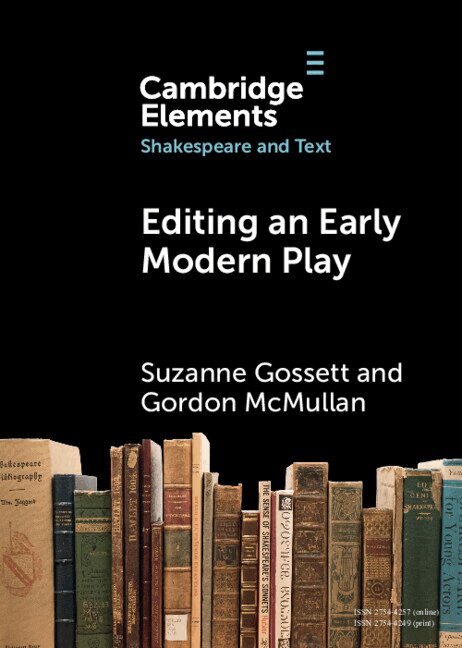
More than half a century ago Clifford Leech published a useful essay called 'On editing one's first play', intended to 'save newly commissioned editors from a sense of frustration and an expense of time' by providing 'some guiding-lines'. The intervening years have seen massive changes in attitudes towards editing and in the technical expertise required. Neither editor nor reader can any longer be assumed to be white, male and Christian, or trained in the classics and the Bible. Editing is now recognized as a crucial intersection between critical and textual theory. Yet the skills required are not usually taught in graduate schools, and many competent scholars are uncomfortable answering such questions as 'what do editors actually do when they edit an early modern play?' This Element focuses both on the practical steps of editing (e.g. choosing a base text, modernizing, emending, etc.) and the theoretical premises underlying editorial decisions.
269 kr
Skickas inom 7-10 vardagar
This Element investigates the framing 'texts' of Shakespeare's works in live theatre broadcasts produced by the Royal Shakespeare Company. Despite growing engagement from scholars of digital Shakespeares with the phenomenon of broadcast theatre and the aesthetics of filmed productions, the paratexts which accompany the live-streams − live or pre-recorded features, including interviews and short films − have largely been ignored. The Element considers how RSC live broadcasts of rarely performed, often critically maligned works are mediated for contemporary audiences, focusing on The Two Gentlemen of Verona (2014), Titus Andronicus (2017), and The Merry Wives of Windsor (2018). It questions the role of the theatre institution as a powerful broker in the (re)negotiation of hierarchies of value within Shakespeare's canon. Individual sections also trace the longer genealogies of paratextual value-narratives in print, proposing that broadcast paratexts be understood as participating in a broader history of Shakespearean paratexts in print and performance.
269 kr
Skickas inom 7-10 vardagar
Editing Archipelagic Shakespeare is a study of the power of names; more specifically, it is about the power of naming, asking who gets to choose names, for what reason, and to what effect. Shakespeare assigns names to over 1,200 characters and countless more sites and places, and these names, or versions of these names, have become familiar to generations of playgoers and play-readers. And because of their familiarity, Shakespeare's names, most frequently anglicized versions of non-English names, have been accepted and repeated without further consideration. Approaching names from an archipelagic perspective, and focusing upon how Irish, Scottish, and Welsh characters and places are written by Shakespeare and treated by editors, this Element offers an expansive, and far-reaching, case study for non-anglophone and global studies of Shakespeare, textual scholarship, and early modern drama.
269 kr
Skickas inom 7-10 vardagar
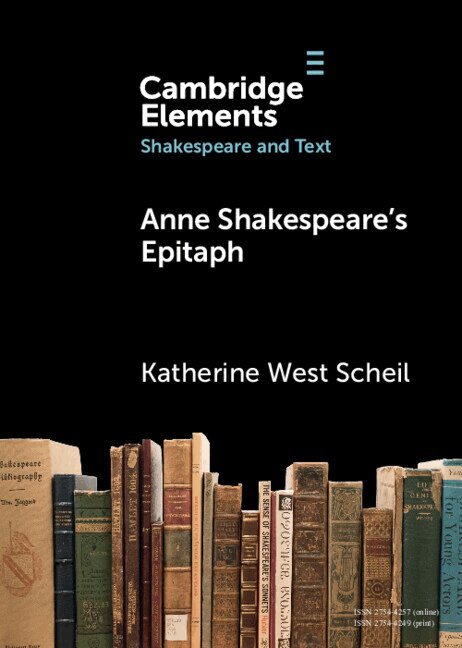
The Shakespeare family occupies five gravesites on the chancel steps at Holy Trinity Church in Stratford-upon-Avon. Anne Shakespeare's grave is the only one commemorated with a brass plaque and an epitaph in original Latin poetry, eulogizing her as a beloved mother, pious woman, and 'so great a gift'. For nearly four hundred years, this epitaph has remained largely unreadable to visitors, enabling a long history of undervaluing Anne's significant maternal role in the Shakespeare family. Anne Shakespeare's Epitaph offers a new reading of the content and the related material conditions and interpersonal connections behind this text. It provides new evidence about the identity of the engraver and suggests several possible scenarios for how the Shakespeare family came to memorialize Anne as a cherished maternal figure. This Element reinscribes the original significance of Anne's epitaph, and reclaims it as an important Shakespearean text that offers traces of a lost documentary record.
269 kr
Skickas inom 7-10 vardagar
This Element traces the history of Shakespearean bibliography from its earliest days to the present. With an emphasis on how we enumerate and find scholarship about Shakespeare, this Element argues that understanding bibliographies is foundational to how we research Shakespeare. From early modern catalogs of Shakespeare plays, to early bibliographers such as Albert Cohn (1827-1905) and William Jaggard (1868-1947), to present-day digital projects such as the online World Shakespeare Bibliography, this Element underscores how the taxonomic organization, ambit, and media of enumerative Shakespearean bibliography projects directly impact how scholars value and can use these resources. Ultimately, this Element asks us to rethink our assumptions about Shakespearean bibliography by foregrounding the labor, collaboration, technological innovations, and critical decisions that go into creating and sustaining bibliographies at all stages. This title is also available as Open Access on Cambridge Core.
269 kr
Kommande
This Element reconsiders the historical, theoretical, racial, ableist, and editorial problem of genealogy by analyzing to-be-spoken genealogies in two plays in the 1623 Shakespeare First Folio: the 'Salic Law' speech in Henry V and the 'seven sons' scene in Henry VI, Part Two. Both passages also exist in a significantly variant version in The Chronicle history of Henry the fift (1600) and The First Part of the Contention (1594). The differences between the two versions of the biological/bloodline genealogy have been central to the long-dominant theory of 'bad quartos'. That theory assumes that early modern chroniclers and playwrights shared the values of modern archival historians: they assume that Shakespeare prioritized accuracy over acting. The authors offer an alternative reading of genealogies written to be performed onstage as 'documentary effects', adapted for changing audiences in a new multimedia entertainment industry. This title is also available as Open Access on Cambridge Core.