Fondazione Rodolfo Debendetti Reports - Böcker
Visar alla böcker i serien Fondazione Rodolfo Debendetti Reports. Handla med fri frakt och snabb leverans.
9 produkter
9 produkter
1 304 kr
Skickas inom 5-8 vardagar
The great recession is changing the way many people live and the way they perceive their prospects for the near and more distant future. Its longer term consequences will not be known for some time, but something can be learned from the effect on individuals and households who experienced financial hardship. This volume is the first to use innovative survey data on the lives of Europeans to investigate the long term impact of financial hardship on earnings, standards of living, and health. The data provide a detailed account of the key events that have taken place over the course of the recession. It compares the well-being of individuals who were lucky to escape negative shocks to their income or their circumstances to the less fortunate who may have lost their job, faced divorce, or serious illness. The wide array of welfare state and social support provisions across different European countries adds an important policy angle to the analysis: has the welfare state, currently under heavy pressure, been able to provide an adequate safety net in the face of extended periods of financial difficulties, or has the family instead proven the ultimate source of support in difficult times?
1 566 kr
Skickas inom 7-10 vardagar
Using newly collected and existing data and modern econometric approaches, this book analyses the gender wage gap as well as less explored dimensions of discrimination such as religion, sexual orientation, and physical appearance. Part One focuses on gender. Using a newly collected database for Italy, it analyses the relevance of transition from school to work, and in particular the choice of college major, in determining the gender earning gap. It also analyses the role of family and of discrimination on the job as a potential source of this gap, using additional data from Spain and the US. Part Two analyses different forms of discrimination towards individuals in the labor market. In particular, it examines the potential for discrimination of sexual orientation, religion, and physical appearance and weight. The analysis is conducted by means of a survey of the existing literature and by an empirical analysis, using European data as well as Italian data collected through an experimental design.
2 131 kr
Skickas inom 5-8 vardagar
While Europe is certainly one of the richest and most educated areas of the world, some of the challenges faced by the old continent are staggering: low economic growth, structural difficulties in the labour market, and increasing international competition. Politicians and policymakers may advocate different means of overcoming the potential economic decline of Europe, but most agree that Europe needs to strengthen human capital, its ultimate competitive advantage in the world economy.This book looks at the accumulation of human capital from two perspectives, first through formal education and then professional training. It provides a useful summary of the key characteristics of education and training in Europe and also asks key questions about the fundamental problems with the current educational and training systems. More importantly, the book goes on to discuss which policies are necessary to make existing education and training systems more efficient, while also making higher skills available to a wider range of people.
Working Hours and Job Sharing in the EU and USA
Are Europeans Lazy? Or Americans Crazy?
Inbunden, Engelska, 2008
2 019 kr
Skickas inom 5-8 vardagar
In the last 50 years the gap in labour productivity between Europe and the US has narrowed considerably with estimates in 2005 suggesting a EU-US labour productivity gap of about 5 per cent. Yet, average per capita income in the EU is still about 30% lower than in the US. This persistent gap in income per capita can be almost entirely explained by Europeans working less than Americans.Why do Europeans work so little compared to Americans? What do they do with their spare time outside work? Can they be induced to work more without reducing labour productivity? If so, how? And what is the effect on well-being if policies are created to reward paid work as opposed to other potentially socially valuable activities, like childbearing? More broadly, should the state interfere at all when it comes to bargaining over working hours? This volume explores these questions and many more in an attempt to understand the changing nature of the hours worked in the USA and EU, as well as the effects of policies that impose working hour reductions.
2 658 kr
Skickas inom 3-6 vardagar
Increase in life expectancy is arguably the most remarkable by-product of modern economic growth. In the last 30 years we have gained roughly 2.5 years of longevity every decade, both in Europe and the United States. Successfully managing ageing and longevity over the next twenty years is one of the major structural challenges faced by policy makers in advanced economies, particularly in health spending, social security administration, and labour market institutions. This book looks closely into those challenges and identifies the fundamental issues at both the macroeconomic and microeconomic level.The first half of the book studies the macroeconomic relationships between health spending, technological progress in medical related sectors, economic growth, and welfare state reforms. In the popular press, longevity and population ageing are typically perceived as a tremendous burden. However, with a proper set of reforms, advanced economies have the option of transforming the enormous challenge posed by longevity into a long term opportunity to boost aggregate outcomes. The basic prerequisite of a healthy ageing scenario is a substantial structural reform in social security and in labour market institutions. The second part of the book looks closely into the microeconomic relationship between population ageing and productivity, both at the individual and at the firm level. There is surprisingly little research on such key questions. The book contributes to this debate in two ways. It presents a detailed analysis of the determinants of productivity, with a focus on both the long-run historical evolution and the cross sectional changes. It also uses econometric analysis to look into the determinants of the various dimensions of individual productivity. The volume concludes that the complex relationship between population ageing and longevity is not written in stone, and can be modified by properly designed choices.
1 722 kr
Skickas inom 5-8 vardagar
The ruling class plays a major role in society. It makes possible what would otherwise be infeasible, by removing constraints that may stand in the way of long-term growth. Historically, economists devoted far less attention than sociologists to the study of ruling classes. Using the theoretical tools of economists, this volume provides an understanding of what drives the formation of a ruling class, and the relationship between politics and business firms. Focusing on Italy, it uses labour economics to analyse the selection of the ruling class, the labour market of politicians, the allocation of managers' time, and their incentives, remunerations, and career paths. It draws on contributions from two teams of leading scholars and on research undertaken by the Fondazione Rodolfo DeBenedetti. Part I focuses on the labour market of politicians. It uses detailed information on personal characteristics, incomes, performance in office, and career paths (both before and after the Parliamentary mandate) of all the politicians elected to the Italian Lower Chamber (Camera) between 1948 and 2008. This is the first time that this information has been gathered and summarized in key indicators. Part II is devoted to the managerial class. It includes cross-country surveys of managers across a sample of European countries, surveys carried out in cooperation with the largest union of managers in the service sector, social security records, and, for the first time, surveys on the allocation of time for top executives.
Brain Drain and Brain Gain
The Global Competition to Attract High-Skilled Migrants
Inbunden, Engelska, 2012
2 106 kr
Skickas inom 5-8 vardagar
The worldwide race to attract talents is getting tougher. The US has been leading the race, with its ability to attract PhD candidates and graduates not only from emerging countries, but also from the European Union. However, a growing number of countries have adopted immigration policies specifically aimed at selecting and attracting skilled workers. This book describes the global competition to attract talents. It focuses in particular on two phenomena: the brain gain and brain drain associated with high-skilled migration. Part I provides an overview of immigration policies designed to draw in skilled workers. It describes the economic gains associated with skilled immigration in the destination countries and the main determinants of the inflows of skilled immigrants (such as wage premia on education and R&D spending). It also discusses why skill-selective immigration policies do not find more support in receiving countries and shows that interest groups are actively engaged in affecting policies towards skilled migrants. Part II examines the consequences of brain drain for the sending countries. It reviews the channels through which skilled emigration can affect the source countries and looks at remittances, return migration, diaspora externalities, and network effects that may compensate the sending countries for their loss of human capital. Contrary to traditional wisdom, the results indicate that most developing countries experience a net gain from skilled emigration.
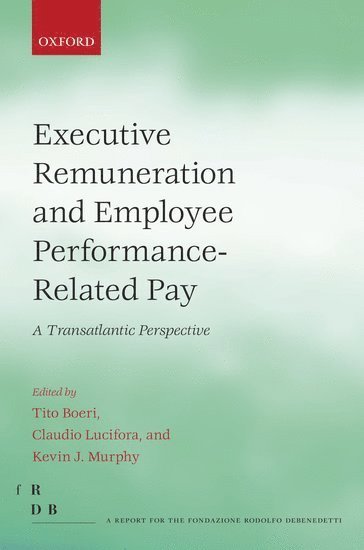
Executive Remuneration and Employee Performance-Related Pay
A Transatlantic Perspective
Inbunden, Engelska, 2013
1 682 kr
Skickas inom 7-10 vardagar
The recent financial crisis has created a public outcry over top-executive pay packages and has led to calls for reform of executive pay in Europe and the US. The current controversy is not the first - nor will it be the last - time that executive compensation has sparked outrage and led to regulation on both sides of the Atlantic. This volume compares US and European CEOs to trace the evolution of executive compensation, its controversies and its resulting regulations. It shows that many features of current executive compensation practices reflect the, often-unintended, consequences of regulatory responses to perceived abuses in top-executive pay, which frequently stem from relatively isolated events or situations. Regulation creates unintended (and usually costly) side effects and it is often driven by political agendas rather than shareholder value. Improvements in executive compensation are more likely to come from stronger corporate governance, and not through direct government intervention. The volume also examines the effects of incentive schemes and the patterns of performance related pay both within and across countries. It documents a number of empirical regularities and discusses whether government should intervene to support the implementation of incentive pay schemes. It argues that it makes little sense to undertake reform without detailed simulations of the effect on the economy under alternative economic scenarios, based on sound analysis and extensive discussion with labour, management, and government decision-makers.
1 803 kr
Skickas inom 7-10 vardagar
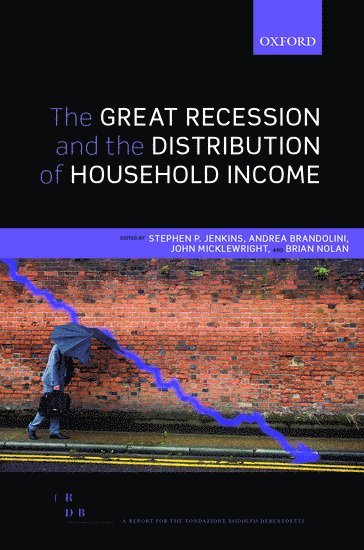
The so-called Great Recession that followed the global financial crisis at the end of 2007 was the largest economic downturn since the 1930s for most rich countries. To what extent were household incomes affected by this event, and how did the effects differ across countries? This is the first cross-national study of the impact of the Great Recession on the distribution of household incomes. Looking at real income levels, poverty rates, and income inequality, it focusses on the period 2007-9, but also considers longer-term impacts. Three vital contributions are made. First, the book reviews lessons from the past about the relationships between macroeconomic change and the household income distribution. Second, it considers the experience of 21 rich OECD member countries drawing on a mixture of national accounts, and labour force and household survey data. Third, the book presents case-study evidence for six countries: Germany, Ireland, Italy, Sweden, the UK, and the USA. The book shows that, between 2007 and 2009, government support through the tax and benefit system provided a cushion against the downturn, and household income distributions did not change much. But, after 2009, there is likely to be much greater change in incomes as a result of the fiscal consolidation measures that are being put into place to address the structural deficits accompanying the recession. The book's main policy lesson is that stabilisation of the household income distribution in the face of macroeconomic turbulence is an achievable policy goal, at least in the short-term.