Legal Theory Today - Böcker
Visar alla böcker i serien Legal Theory Today. Handla med fri frakt och snabb leverans.
19 produkter
19 produkter
394 kr
Skickas inom 10-15 vardagar
Law and Aesthetics draws on the work of poets as well as philosophers. Taking as its starting point Shelleys assertion that poets are unacknowledged legislators,the book suggests that there is a way of thinking that, as yet, has not been taken up by those who make use of literary aesthetics to understand law. The book tracks this aesthetic thinking through the failures of critical legal studies and stages an encounter with psychoanalysis, before suggesting that an aesthetics of law can be exhumed from Nietzsches work. The aesthetic is a call to the creative: fashion new law. A review of contemporary legal theory that makes use of aesthetic perspectives suggests that dissident and radical Nietzschean energies continue to animate legal thought. In the final chapter, an aesthetics of law is shown to make for an interruption of legal categories, and the generation of new legal relationships. The book concludes with a further meditation on Shelleys poetry, and a call to continue in the spirit of aesthetic reinvention.
1 113 kr
Skickas inom 10-15 vardagar
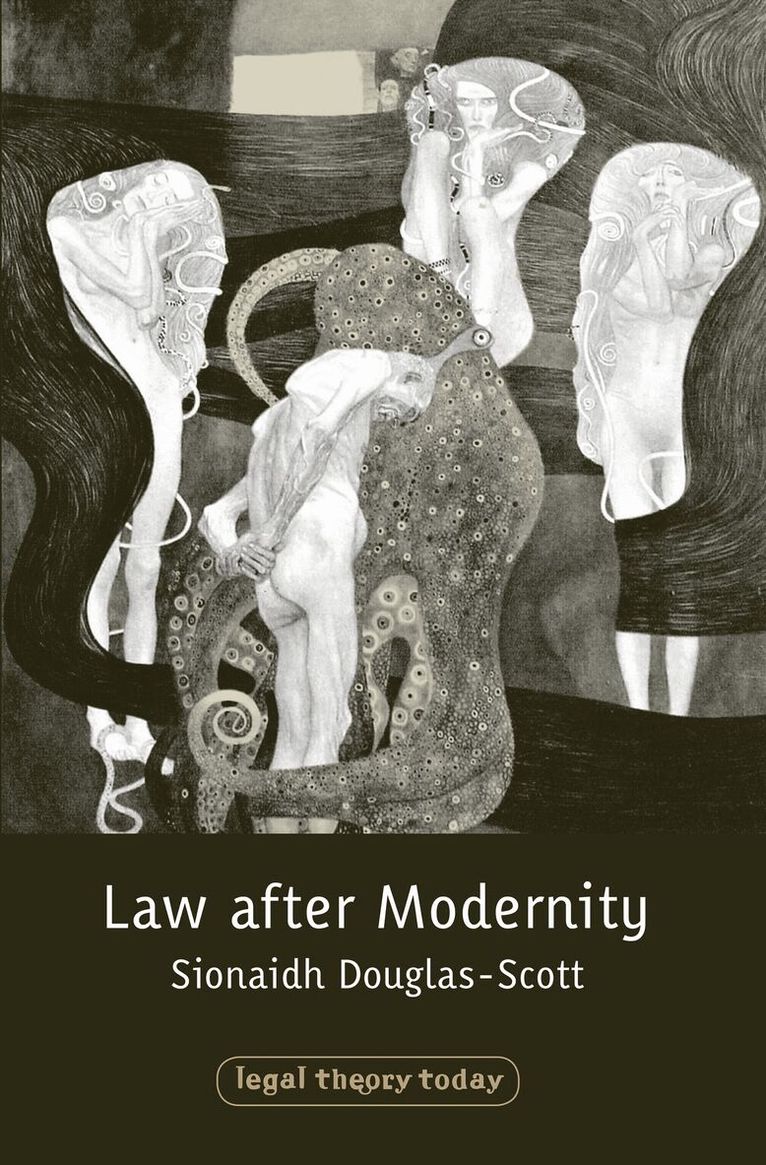
How can we characterise law and legal theory in the twenty-first century? Law After Modernity argues that we live in an age 'after Modernity' and that legal theory must take account of this fact. The book presents a dynamic analysis of law, which focusses on the richness and pluralism of law, on its historical embeddedness, its cultural contingencies, as well as acknowledging contemporary law's global and transnational dimensions. However, Law After Modernity also warns that the complexity, fragmentation, pluralism and globalisation of contemporary law may all too easily perpetuate injustice. In this respect, the book departs from many postmodern and pluralist accounts of law. Indeed, it asserts that the quest for justice becomes a crucial issue for law in the era of legal pluralism, and it investigates how it may be achieved. The approach is fresh, contextual and interdisciplinary, and, unusually for a legal theory work, is illustrated throughout with works of art and visual representations, which serve to re-enforce the messages of the book.
1 051 kr
Skickas inom 10-15 vardagar
What,precisely, is the relationship between legality and morality? Does legal validity rest upon moral validity? Are legal obligations moral obligations? For some years now schools of jurisprudential Naturalism and Positivism have become increasingly ambiguous in their responses to these questions. Olsen and Toddington argue that equivocation on the central issue here - that of obligation - has brought legal theory to the point where leading legal positivists and natural lawyers no longer retain significant differences. Instead, they allege, we are left with the remnants of what has always been, philosophically, a phoney war. The authors of this lucid and refreshing analysis of the concept of law, arguing from the perspectives of social science and political philosophy, show that jurisprudence must acknowledge that the political, the moral, and the legal are located within a continuum of practical reason, and that law's 'autonomy' from morality can not entail its 'separation' from it.
424 kr
Skickas inom 10-15 vardagar
If Raz and Dworkin disagree over how law should be characterised,how are we, their jurisprudential public, supposed to go about adjudicating between the rival theories which they offer us? To what considerations would those theorists themselves appeal in order to convince us that their accounts of law are accurate and successful? Moreover, what is it that makes an account of law successful? Evaluation and Legal Theory tackles methodological or meta-theoretical issues such as these, and does so via attempting to answer the question: to what extent, and in what sense, must a legal theorist make value judgements about his data in order to construct a successful theory of law? Dispelling the obfuscatory myth that legal positivism seeks a 'value-free' account of law, the author attempts to explain and defend Joseph Razs position that evaluation is essential to successful legal theory, whilst refuting John Finnis and Ronald Dworkins contentions that the legal theorist must morally evaluate and morally justify the law in order to properly explain its nature.The book does not claim to solve the many mysteries of meta-legal theory but does seek to contribute to and engender rigorous and focused debate on this topic.
990 kr
Skickas inom 10-15 vardagar
In almost every field of law,from tort and contract to environmental law and criminal justice, issues about 'risk' are increasingly of interest to lawyers. At the same time, there has been little general enquiry into the nature of the contact between law and risks. This book argues that ideas about risk have not traditionally been absent from law, as is sometimes supposed. Lawyers and legal theorists have used and conceptualised risk in particular ways, and ideas of risk have had significant influence in key elements of legal theory including questions of justice and responsibility. The book explores the conceptual place of risk across a number of fields of law; and identifies some significant challenges for law and legal theory arising from broader debates about risk. It therefore sheds light on areas that are under-explored despite current interest among lawyers, and aims to provide an accessible guide to emerging controversies and challenges for law in this area while explaining their significance.
351 kr
Skickas inom 10-15 vardagar
In almost every field of law,from tort and contract to environmental law and criminal justice, issues about 'risk' are increasingly of interest to lawyers. At the same time, there has been little general enquiry into the nature of the contact between law and risks. This book argues that ideas about risk have not traditionally been absent from law, as is sometimes supposed. Lawyers and legal theorists have used and conceptualised risk in particular ways, and ideas of risk have had significant influence in key elements of legal theory including questions of justice and responsibility. The book explores the conceptual place of risk across a number of fields of law; and identifies some significant challenges for law and legal theory arising from broader debates about risk. It therefore sheds light on areas that are under-explored despite current interest among lawyers, and aims to provide an accessible guide to emerging controversies and challenges for law in this area while explaining their significance.
1 051 kr
Skickas inom 10-15 vardagar
If Raz and Dworkin disagree over how law should be characterised,how are we, their jurisprudential public, supposed to go about adjudicating between the rival theories which they offer us? To what considerations would those theorists themselves appeal in order to convince us that their accounts of law are accurate and successful? Moreover, what is it that makes an account of law successful? Evaluation and Legal Theory tackles methodological or meta-theoretical issues such as these, and does so via attempting to answer the question: to what extent, and in what sense, must a legal theorist make value judgements about his data in order to construct a successful theory of law? Dispelling the obfuscatory myth that legal positivism seeks a 'value-free' account of law, the author attempts to explain and defend Joseph Raz's position that evaluation is essential to successful legal theory, whilst refuting John Finnis and Ronald Dworkin's contentions that the legal theorist must morally evaluate and morally justify the law in order to properly explain its nature.The book does not claim to solve the many mysteries of meta-legal theory but does seek to contribute to and engender rigorous and focused debate on this topic.
1 051 kr
Skickas inom 10-15 vardagar
This book develops the rudiments of a sociological perspective on state law and legal theory. It outlines a distinctive approach to theoretical enquiry that offers an improved understanding of law as a social and institutional phenomenon. The book draws upon Max Weber's sociological and juristic writings as a context in which to explore themes arising or selectively developed from a critical reassessment of key aspects of H.L.A. Hart's theory of law. The discussion initially centres around three problematical areas or 'Gordian Knots': essentially weaknesses in the analytical nucleus of The Concept of Law,matters of misplaced emphasis and other elements that, it is argued, have obscured fundamental aspects of a perceived social reality. Using the critique as a point of departure the book explores key issues that Hart merely touched upon or seemingly passed over: the role of the (sociologically inclined) jurist, the defensibility of an 'institutional insider's' perspective, the institutional behavioural dimension of the legal world, and the relational and social power dynamics of law-affected human behaviour.
351 kr
Skickas inom 10-15 vardagar
This book develops the rudiments of a sociological perspective on state law and legal theory. It outlines a distinctive approach to theoretical enquiry that offers an improved understanding of law as a social and institutional phenomenon. The book draws upon Max Weber's sociological and juristic writings as a context in which to explore themes arising or selectively developed from a critical reassessment of key aspects of H.L.A. Hart's theory of law. The discussion initially centres around three problematical areas or 'Gordian Knots': essentially weaknesses in the analytical nucleus of The Concept of Law,matters of misplaced emphasis and other elements that, it is argued, have obscured fundamental aspects of a perceived social reality. Using the critique as a point of departure the book explores key issues that Hart merely touched upon or seemingly passed over: the role of the (sociologically inclined) jurist, the defensibility of an 'institutional insider's' perspective, the institutional behavioural dimension of the legal world, and the relational and social power dynamics of law-affected human behaviour.
1 142 kr
Skickas inom 10-15 vardagar
Law and Aesthetics draws on the work of poets as well as philosophers. Taking as its starting point Shelleys assertion that poets are unacknowledged legislators,the book suggests that there is a way of thinking that, as yet, has not been taken up by those who make use of literary aesthetics to understand law. The book tracks this aesthetic thinking through the failures of critical legal studies and stages an encounter with psychoanalysis, before suggesting that an aesthetics of law can be exhumed from Nietzsches work. The aesthetic is a call to the creative: fashion new law. A review of contemporary legal theory that makes use of aesthetic perspectives suggests that dissident and radical Nietzschean energies continue to animate legal thought. In the final chapter, an aesthetics of law is shown to make for an interruption of legal categories, and the generation of new legal relationships. The book concludes with a further meditation on Shelleys poetry, and a call to continue in the spirit of aesthetic reinvention.
498 kr
Skickas inom 10-15 vardagar
Feminist critique has made a significant impact both in terms of informing our theoretical approach to law and politics as social phenomena, and in terms of encouraging the development of increased opportunities and protection for individual women. Despite its successes, however, feminist thought has suffered from internal disagreements and schisms. Whilst united by their commitment to highlight and undermine gender-based discrimination, disparate feminist theorists have disagreed over a range of issues central to that project. In particular, there has been long-standing feminist debate over the utility of legal reform tactics, the patriarchal nature of the State, and the legitimacy of woman-centred methodology and grand-theorising. The ferocity of these debates has intensified in contemporary times with the increasing reception of postmodern and pluralist analyses. Vehemently against the establishment of meta-narratives or essentialist accounts of generic womanhood, the postmodern insistence on subversion over critique, and on dislocation over collectivism, has severed an already fragile link between feminist theory and practice.Set against this backdrop, this book offers a critical re-appraisal of contemporary feminist legal and political theory. It re-visits key feminist debates over the origins of patriarchy, as well as over the role of liberalism and the rule of law in its creation and perpetuation. It re-evaluates feminist calls for the dislocation of legal reform strategies and rights-based claims. And it draws upon the work of 'mainstream' analytical jurists, as well as philosophers like Foucault and Wittgenstein, to re-cast the terrain around key concepts of power, identity and equality within feminist political theory.
486 kr
Skickas inom 10-15 vardagar
The aim of this book is to provide an overview of how economic analysis can enrich an understanding of law and can provide standards for its critical evaluation. It eschews a dogmatic approach, acknowledging that non-economic goals play an important part in the law. It is directed primarily at lawyers and law students, particularly those who hitherto have been sceptical of the uses and value of law and economics. It is not a conventional textbook in the sense that it does not deal systematically with different areas of law. Rather each chapter is built on a particular theme or set of themes, with examples drawn from across legal categories. The approach is discursive, anecdotal and analytical, reflecting the ideas and convictions developed during the author's 30 years working in the field of law and economics. Winner of the Hart SLSA Book Prize 2007 for an outstanding piece of socio-legal scholarship.
990 kr
Skickas inom 10-15 vardagar
This book offers a 'genealogical' explanation of law's normativity. The term 'genealogical' conveys a commitment to a non-metaphysical type of enquiry. While it explains how law, as a normative phenomenon, comes about, it does not seek to ground law's normativity in anything but the context of social interaction giving rise to it. Legal normativity is brought about on a daily basis. Whether in revolutionary circumstances or in the quotidian need for judges, lawmakers or citizens to balance law's demands with those of morality or prudence, our ability to bind ourselves through law ultimately depends on our capacity to articulate a better way of living together, and to commit ourselves to it. These efforts of assessment and articulation depend, in turn, on our conception of normative agency. Assert the need to trace the truth of ethical judgments to some independent moral 'facts' conditioning their objectivity, and you will get a different understanding of what it is we are doing when we dispute law's authority in the name of moral values.Tracing the truth of moral judgements back to our own social practices not only affects the nature of disagreement; it also dramatically increases our responsibility when, as lawmakers, judges, or citizens we 'take the law into our own hands' and confront it with our moral expectations.
375 kr
Skickas inom 10-15 vardagar
Niklas Luhmann's sociological theory treats law, along with politics, economics, media and ethics, as systems of communication. His theory not only offers profound and novel insights into the character of the legal system in modern society, but also provides an explanation for the role of jurisprudence as part of that legal system. In this work the authors seek to explore and develop Luhmann's claim that jurisprudence is part of law's self-description; a part of the legal system which, as a particular kind of legal communication, orientates legal operations by explaining law to itself. This approach has the potential to illuminate many of the interminable debates amongst and between different schools of jurisprudence on topics such as the origin and/or source of law, the nature of law's determinacy or indeterminacy, and the role of justice. The authors' introduction to Luhmann's systems theory concentrates on the concept of closure and the distinct disposition of law's openness to its environment.From this beginning, the book goes on to offer a sustained and methodical application of systems theory to some of the traditional forms of jurisprudence: natural law and its relationship with legal positivism, Dworkin's version of natural law, Kelsen's version of legal positivism, and Critical Legal Studies. This application of systems theory alters our perception of jurisprudence and better enables us to understand its role within law.
1 235 kr
Skickas inom 10-15 vardagar
In a community that takes rights seriously, consent features pervasively in both moral and legal discourse as a justifying reason: stated simply, where there is consent, there can be no complaint. However, without a clear appreciation of the nature of a consent-based justification, its integrity, both in principle and in practice, is liable to be compromised. This book examines the role of consent as a procedural justification, discussing the prerequisites for an adequate consent -- in particular, that an agent with the relevant capacity has made an unforced and informed choice, that the consent has been clearly signalled, and that the scope of the authorisation covers the act in question. It goes on to highlight both the Fallacy of Necessity (where there is no consent, there must be a wrong) and the Fallacy of Sufficiency (where there is consent, there cannot be a wrong). Finally, the extent to which the authority of law itself rests on consent is considered.If the familiarity of consent-based justification engenders confusion and contempt, the analysis in this book acts as a corrective, identifying a range of abusive or misguided practices that variously under-value or over-value consent, that fictionalise it or that are fixated by it, and that treat it too casually or too cautiously. In short, the analysis in Consent in the Law points the way towards recognising an important procedural justification for precisely what it is as well as giving it a more coherent application.
1 343 kr
Skickas inom 10-15 vardagar
In this long-awaited book, Antony Duff offers a new perspective on the structures of criminal law and criminal liability. His starting point is a distinction between responsibility (understood as answerability) and liability, and a conception of responsibility as relational and practice-based. This focus on responsibility, as a matter of being answerable to those who have the standing to call one to account, throws new light on a range of questions in criminal law theory: on the question of criminalization, which can now be cast as the question of what we should have to answer for, and to whom, under the threat of criminal conviction and punishment; on questions about the criminal trial, as a process through which defendants are called to answer, and about the conditions (bars to trial) given which a trial would be illegitimate; on questions about the structure of offences, the distinction between offences and defences, and the phenomena of strict liability and strict responsibility; and on questions about the structures of criminal defences.The net result is not a theory of criminal law; but it is an account of the structure of criminal law as an institution through which a liberal polity defines a realm of public wrongdoing, and calls those who perpetrate (or are accused of perpetrating) such wrongs to account.
547 kr
Skickas inom 10-15 vardagar
The perennial question posed by the philosophically-inclined lawyer is 'What is law?' or perhaps 'What is the nature of law?' This book poses an associated, but no less fundamental, question about law which has received much less attention in the legal literature. It is: 'Who is law for?' Whenever people go to law, they are judged for their suitability as legal persons. They are given or refused rights and duties on the basis of ideas about who matters. These ideas are basic to legal-decision making; they form the intellectual and moral underpinning of legal thought. They help to determine whether law is essentially for rational human beings or whether it also speaks to and for human infants, adults with impaired reasoning, the comotose, foetuses and even animals. Are these the right kind of beings to enter legal relationships and so become legal persons. Are they, for example, sufficiently rational, or sacred or simply human? Is law meant for them? This book reveals and evaluates the type of thinking that goes into these fundamental legal and metaphysical determinations about who should be capable of bearing legal rights and duties.It identifies and analyses four influential ways of thinking about law's person, each with its own metaphysical suppositions. One approach derives from rationalist philosophy, a second from religion, a third from evolutionary biology while the fourth is strictly legalistic and so endeavours to eschew metaphysics altogether. The book offers a clear, coherent and critical account of these complex moral and intellectual processes entailed in the making of legal persons.
541 kr
Skickas inom 10-15 vardagar
This is the paperback edition of Antony Duff's acclaimed new work on the structures of criminal law and criminal liability. His starting point is a distinction between responsibility (understood as answerability) and liability, and a conception of responsibility as relational and practice-based. This focus on responsibility, as a matter of being answerable to those who have the standing to call one to account, throws new light on a range of questions in criminal law theory: on the question of criminalisation, which can now be cast as the question of what we should have to answer for, and to whom, under the threat of criminal conviction and punishment; on questions about the criminal trial, as a process through which defendants are called to answer, and about the conditions (bars to trial) given which a trial would be illegitimate; on questions about the structure of offences, the distinction between offences and defences, and the phenomena of strict liability and strict responsibility; and on questions about the structures of criminal defences.The net result is not a theory of criminal law; but it is an account of the structure of criminal law as an institution through which a liberal polity defines a realm of public wrongdoing, and calls those who perpetrate (or are accused of perpetrating) such wrongs to account. "For a criminal law theorist, this book is simply a must read. Duff's sweeping coverage of criminal law-ranging from the act requirement to justifications and excuses-offers a structural edifice that is indispensible. Though one may not always agree with Duff, his original analysis and complex rethinking provides significant insights into the most central questions within criminal law theory. One cannot help but learn from Duff. And anyone who wishes to be taken seriously in criminal law theory will have to grapple with his arguments." Kimberley Kessler Ferzan, Criminal Justice Ethics, 2009 "Philosophers who specialize in normative inquiries but find the time to read only one book in criminal theory every few years should immediately place Answering for Crime at the very top of their pile.It is the best book to have appeared in the philosophy of criminal law in the last decade, and the finest book ever to have focused on the structure of criminal responsibility. Answering for Crime cements Antony Duff's reputation as one of the two most important philosophers of criminal law living in the Anglo-American world today...Answering for Crime is an exceedingly original work of legal philosophy written in a refreshingly accessible style...I believe that any future work on the structure of criminal responsibility and liability must begin with Duff's work. No existing book in the philosophy of criminal law can rival the breadth, scope, and sophistication contained in Duff's analysis. I admire Answering for Crime deeply and recommend it strongly not only to criminal theorists, but also to all philosophers interested in how criminal theory sheds light on normative inquiry generally." Douglas Husak, Law and Philosophy, 2009 "...the book is an ambitious one, and has implications for almost every aspect of criminal law theory...As was to be expected from one of the most philosophically sophisticated yet institutionally sensitive writers in the field of criminal law theory, Answering for Crime is a rich book that makes a very substantial contribution to the discipline...The argument is complex and, particularly in the early chapters, does not always make for easy reading; but the conception is clear, elegant, and fully worked through..." Nicola Lacey, New Criminal Law Review, 2009 "It covers so many important issues with such clarity and rigour that one review cannot possibly do it justice...What Duff says about crimes, but also his views about a whole range of other issues, are deeply thought out and important...Duff's book does more to articulate a clear and structured view of criminal responsibility than has been achieved to date and his account of criminal responsibility and liability, as well as of the central doctrines and practices of criminal responsibility, will have lasting significance for criminal lawyers and philosophers alike." Victor Tadros, Mind, 2009
1 113 kr
Skickas inom 10-15 vardagar
This book uses Niklas Luhmann's systems theory to explore how the legal system operates as one of modern society's subsystems.The authors demonstrate how this theory alters our understanding of some of the most important and controversial issues within law: the nature of judicial communication and legal argument; the claim that it can be right to disobey law; the character of legal pluralism and globalisation; time and its construction within law; the significance of the rule of law and human rights and the role of appeals to, and within, law.Systems theory enables the authors to demonstrate how the legal system observes its own operations through its own communications, and how this contrasts with the manner in which law is observed by other systems such as the media and politics.In this context the authors explore the constraints imposed by systems, in particular the legal system, upon the individuals who participate in them.