Making of Modern Freedom - Böcker
Visar alla böcker i serien Making of Modern Freedom. Handla med fri frakt och snabb leverans.
15 produkter
15 produkter
944 kr
Skickas inom 10-15 vardagar
A Stanford University Press classic.
944 kr
Skickas inom 10-15 vardagar
A Stanford University Press classic.
1 659 kr
Skickas inom 10-15 vardagar
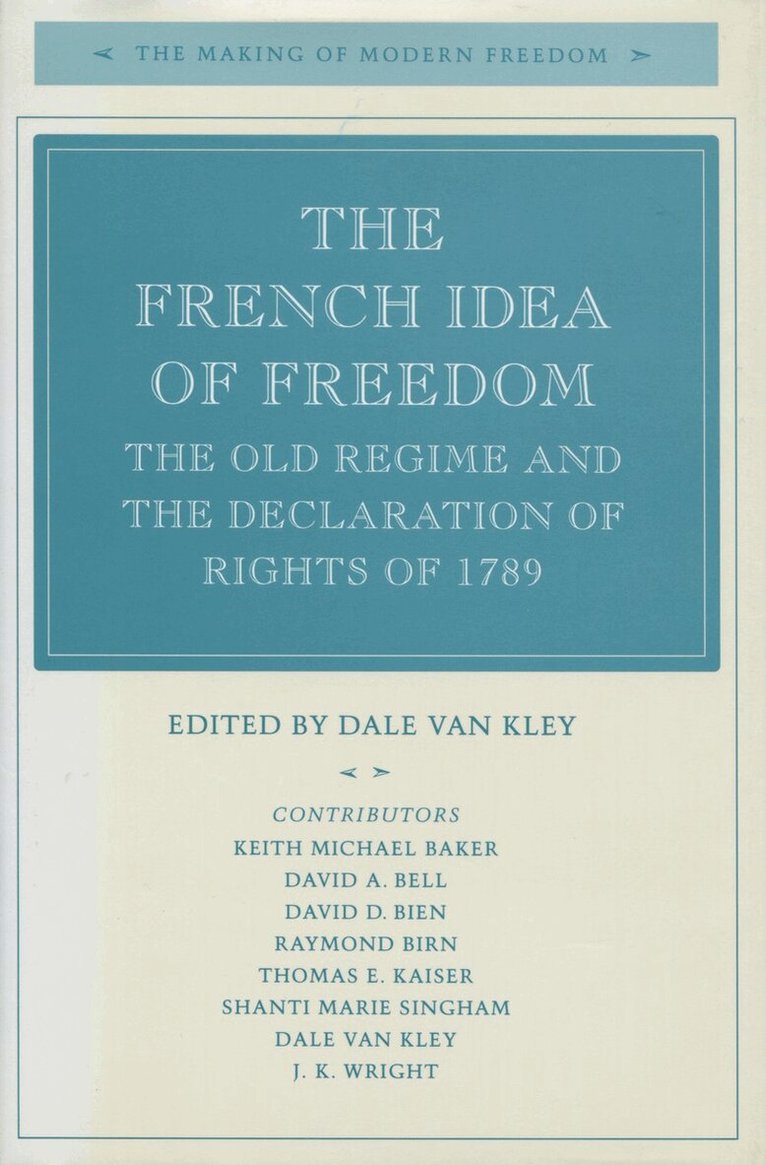
"The Declaration of the Rights of Man and the Citizen of 1789" is the French Revolution's best known utterance. By 1789, to be sure, England looked proudly back to the Magna Carta, the Petition of Right, and a bill of rights, and even the young American Declaration of Independence and the individual states' various declarations and bills of rights preceded the French Declaration. But the French deputies of the National Assembly tried hard, in the words of one of their number, not to receive lessons from others but rather "to give them" to the rest of the world, to proclaim not the rights of Frenchmen, but those "for all times and nations."The chapters in this book treat mainly the origins of the Declaration in the political thought and practice of the preceding three centuries that Tocqueville designated the "Old Regime." Among the topics covered are privileged corporations; the events of the three months preceding the Declaration; blacks, Jews, and women; the Assembly's debates on the Declaration; the influence of sixteenth-century notions of sovereignty and the separation of powers; the rights of the accused in legal practices and political trials from 1716 to 1789; the natural rights to freedom of religion; and the monarchy's "feudal" exploitation of the royal domain.
1 054 kr
Skickas inom 10-15 vardagar
This book examines republicanism in an Anglo-American and European context from the execution Charles I to the publication of Tom Paine's Common Sense. t gives weight not only to the thought of the theorists of republicanism but also the practical experience of republican governments in England, Geneva, the Netherlands, and Venice.The first six chapters of the book, along with David Wootton's Introduction, consider the meaning of republicanism and its historiography. From its theoretical conception to its historical development, contributors examine how thinkers the likes of Hobbes and Montesquieu discussed the key issues of virtue, commerce, and liberty in conjunction with republicanism, and to what extent republicanism was an inheritor of or departure from classical ideals.In the latter chapters of the book, contributors turn their attention from theory to application, turning to look at the experiences of seventeenth- and eighteenth-century republics such as Geneva, the Netherlands, and Venice.
916 kr
Skickas inom 10-15 vardagar
A Stanford University Press classic.
Devising Liberty
Preserving and Creating Freedom in the New American Republic
Inbunden, Engelska, 1995
1 549 kr
Skickas inom 10-15 vardagar
The nine chapters in this book focus on the various constitutional problems surrounding the need to provide simultaneously a sufficient degree of union and public authority to guarantee defense and order, and a sufficient degree of individual liberty to satisfy the demands and expectations of private citizens who were wary of the arbitrary powers of government.
888 kr
Skickas inom 10-15 vardagar
In the aftermath of the French Revolution, "freedom" came to have a host of meanings. This volume examines these contested visions of freedom both inside and outside of revolutionary situations in the nineteenth century, as each author explores and interprets the development of nineteenth-century political culture in a particular national context.The common focus is the struggle in various countries to define, advance, or delimit freedom after the French Revolution. The introductory chapter evokes the problematic relationships between reform and revolution and introduces themes that appear in subsequent chapters, though each chapter is a free-standing interpretive essay. Among the issues addressed are the growth of the public sphere and associational movements; battles over constitutionalism, parliamentary institutions, and the franchise; the role of the state in inhibiting or expanding citizenship and the rule of law; the resort to violence by parties of order or parties of change; and the intrusion of new social questions or ethnic conflicts into the political arena.
401 kr
Skickas inom 7-10 vardagar
"The Declaration of the Rights of Man and the Citizen of 1789" is the French Revolution's best known utterance. By 1789, to be sure, England looked proudly back to the Magna Carta, the Petition of Right, and a bill of rights, and even the young American Declaration of Independence and the individual states' various declarations and bills of rights preceded the French Declaration. But the French deputies of the National Assembly tried hard, in the words of one of their number, not to receive lessons from others but rather "to give them" to the rest of the world, to proclaim not the rights of Frenchmen, but those "for all times and nations."The chapters in this book treat mainly the origins of the Declaration in the political thought and practice of the preceding three centuries that Tocqueville designated the "Old Regime." Among the topics covered are privileged corporations; the events of the three months preceding the Declaration; blacks, Jews, and women; the Assembly's debates on the Declaration; the influence of sixteenth-century notions of sovereignty and the separation of powers; the rights of the accused in legal practices and political trials from 1716 to 1789; the natural rights to freedom of religion; and the monarchy's "feudal" exploitation of the royal domain.
970 kr
Skickas inom 10-15 vardagar
The subject of religious liberty in the nineteenth century has been defined by a liberal narrative that has prevailed since Mill and Macaulay to Trevelyan and Commager, to name only a few philosophers and historians who wrote in English. Underlying this narrative is a noble dream—liberty for every person, guaranteed by democratic states that promote social progress though not interfering with those broadly defined areas of life, including religion, that are properly the preserve of free individuals.At the end of the twentieth century, however, it becomes clear that religious liberty requires a more comprehensive, subtle, and complex definition than the liberal tradition affords, one that confronts such questions as gender, ethnicity, and the distinction between individual and corporate liberty. None of the authors in this volume finds the familiar liberal narrative an adequate interpretive context for understanding his particular subject. Some address the liberal tradition directly and propose modified versions; others approach it implicitly. All revise it, and all revise in ways that echo across the chapters.The topics covered are religious liberty in early America (Nathan O. Hatch), science and religious freedom (Frank M. Turner), the conflicting ideas of religious freedom in early Victorian England (J. P. Ellens), the arguments over theological innovation in the England of the 1860's (R. K. Webb), European Jews and the limits of religious freedom (David C. Itzkowitz), restrictions and controls on the practice of religion in Bismarck's Germany (Ronald J. Ross), the Catholic Church in nineteenth-century Europe (Raymond Grew), religious liberty in France, 1787-1908 (C. T. McIntyre), clericalism and anticlericalism in Chile, 1820-1920 (Simon Collier), and religion and imperialism in nineteenth-century Britain (Jeffrey Cox).
903 kr
Skickas inom 7-10 vardagar
Throughout recorded history, labor to produce goods and services has been a central concern of society, and questions surrounding the terms of labor—the arrangements under which labor is made to produce and to divide its product with others—are of great significance for understanding the past and the emergence of the modern world.For long periods, much of the world's labor could be considered under the coercive control of systems of slavery or of serfdom, with relatively few workers laboring under terms of freedom, however defined. Slavery and serfdom were systems that controlled not only the terms of labor, but also the more general issues of political freedom. The nine chapters in this volume deal with the general issues of the causes and consequences of the rise of so-called free labor in Europe, the United States, and the Caribbean over the past four to five centuries, and point to the many complications and paradoxical aspects of this change.The topics covered are European beliefs that rejected the enslavement of other Europeans but permitted the slavery of Africans (David Eltis), British abolitionism and the impact of emancipation in the British West Indies (Seymour Drescher), the consequences of the end of Russian serfdom (Peter Kolchin), the definition and nature of free labor as seen by nineteenth-century American workers (Leon Fink), the effects of changing legal and economic concepts of free labor (Robert J. Steinfeld), the antebellum American use of the metaphor of slavery (David Roediger), female dependent labor in the aftermath of American emancipation (Amy Dru Stanley), the contrast between individual and group actions in attempting to benefit individual laborers (David Brody), and the link between arguments concerning free labor and the actual outcomes for laborers in nineteenth-century America (Clayne Pope).
333 kr
Skickas inom 7-10 vardagar
This volume, one of the books in the "Making of Modern Freedom" series, is a collection of essays by eminent historians who explore the relationship between state finance and political development in fifteenth and sixteenth century Europe. They analyze how during this period European states were engaged in nearly continuous warfare and how those warfares produced fiscal crises. As a result, rulers were forced to enter into novel fiscal agreements with their subjects, often providing their subjects more political power, in exchange. The volume begins with two essays on England. David Harris Sacks traces the politics of government finance from the fifteenth century to the eve of the Civil War, and J. R. Jones carries the story forward into the eighteenth century, when representative government was jeopardized by new and powerful financial interests. The third essay, by Augustus J. Veenendaal, Jr., explains why the Netherlands' exceptional ability to raise money by taxes and loans allowed them to wage war without the severe financial difficultes experiencd by other European powers. Two essays on Spain by I. A. A. Thompson follow the changing fortunes of the Cortes of Castile, relating its role to the desperate manipulation of Spanish fiscal policy as it came into conflict with the dearly held liberties of Castilian citizens.The two final essays deal with the consequences of absolutism in France. Philip T. Hoffman details the fiscal effect of noble privileges and explores the political ramifications of the country's repeated financial crises, and Kathryn Norberg explains why the fiscal crisis of 1789 finally brought down the monarchy.
374 kr
Skickas inom 7-10 vardagar
The nine chapters in this book focus on the various constitutional problems surrounding the need to provide simultaneously a sufficient degree of union and public authority to guarantee defense and order, and a sufficient degree of individual liberty to satisfy the demands and expectations of private citizens who were wary of the arbitrary powers of government.
930 kr
Skickas inom 7-10 vardagar
This book examines the many different ways in which women achieved public standing and exercised political power in England from the middle of the eighteenth century to the present. It shows how rank, property, and inheritance could confer de facto power on privileged women, and how across the centuries the arrogance of birth and title empowered aristocratic women to overawe enfranchised men of lower social standing.The essays contribute to an ongoing "rethinking of the political," a consequence in part of the rediscovery of the work of Jürgen Habermas by political and social historians. For Habermas, the public sphere included print media and voluntary associations, and the contributors stress the extent of female engagement in political culture broadly conceived. However, they extend this definition of the public sphere further still to include the "private" world of family connections and friendship networks, within which political ideas were debated and new social practices played out.Many of the essays are inspired by a related effort to reintegrate radical female activists within their political milieu. Although feminist hagiography has accustomed us to see female activists as heroic outsiders rising sui generis from a hostile environment, recent research restores them to their intellectual and familial contexts. Finally, the contributors explore the limits and possibilities of women's citizenship both before and after winning the right to vote. Together, the essays tell a continuous and complex story, redefining political activity and reassessing the turning points of British political history.
888 kr
Skickas inom 10-15 vardagar
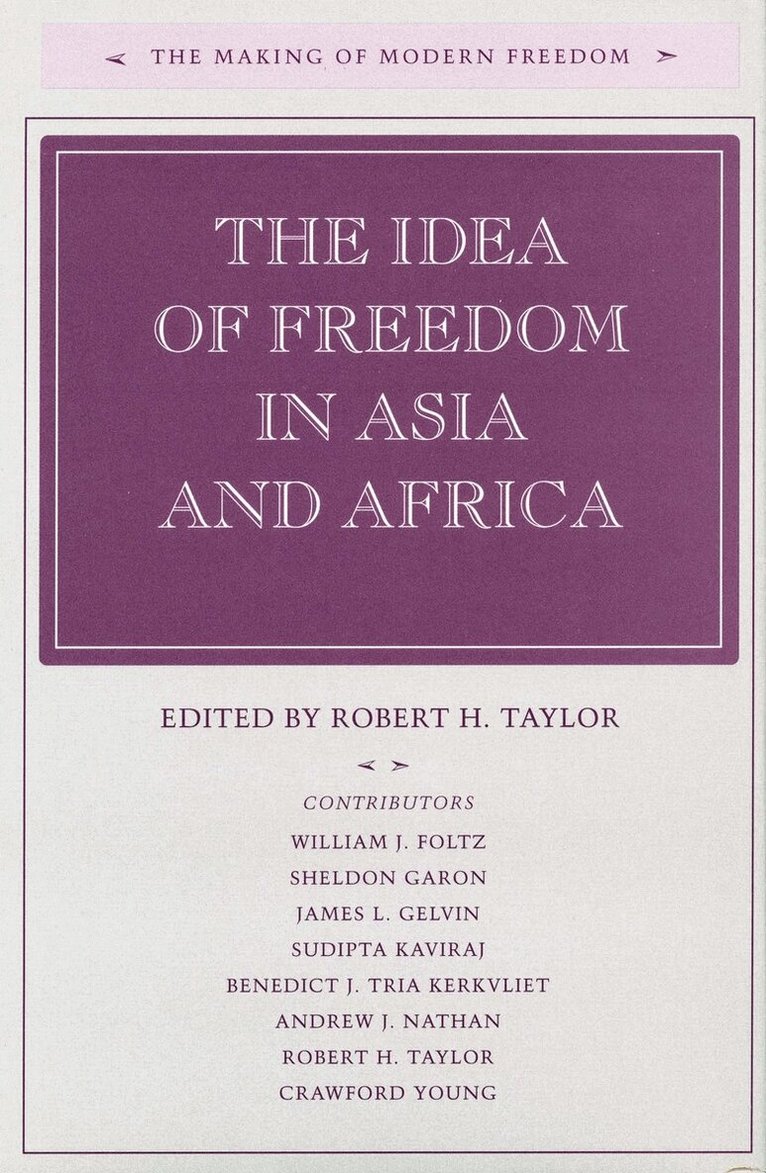
Universal ideas of freedom are to be found throughout the world's diverse intellectual and political traditions, spread by the global trade in ideas which has grown exponentially during the past 200 years. In Africa and Asia, the conceptualization of freedom for individuals and societies has been heavily influenced by the translation of specific European or American ideas of freedom into new political and social contexts. This volume represents a pioneering preliminary assessment of some of the causes and consequences of this process. Africa and Asia have too often been portrayed in Western accounts as having no historical purchase on ideas of freedom, but the chapters in this volume reveal that these societies have long had their own ideas about the proper degree of individual autonomy relative to the authority exercised by the state and other institutions. The topics covered here are ideas of freedom in Africa from the slave trade era through colonialism to the nationalism that followed World War II (Crawford Young); the many forms of freedom in the states of sub-Saharan Africa since independence (William J. Foltz); why certain concepts of freedom have been empowered and others not in the Arab states of Egypt, Syria, and Iraq (James L. Gelvin); the differing ideas of freedom in modern India for individuals and for specific social groups (Sudipta Kaviraj); the contrasting fates of ideas of freedom in Burma and Thailand (Robert H. Taylor); political struggles in the Philippines and Vietnam about the meaning and practice of freedom (Benedict J. Tria Kerkvliet); the evolution of the idea of freedom in Japan with respect to freedom of religion, freedom of the press, freedom of association, and the liberation of such unfree persons as prostitutes (Sheldon Garon); and the ways in which Chinese conceptions of political freedom resemble or depart from modern Western conceptions (Andrew J. Nathan).
406 kr
Skickas inom 10-15 vardagar
The fifteenth and final volume of the series The Making of Modern Freedom, this book explores a variety of issues surrounding questions of human rights and freedom in China. The chapters suggest very significant realms of freedom, with or without the protection of law, in the personal, social, and economic lives of people in China before the twentieth century. This was recognized, and partly codified, in the early twentieth century, when legal experts sought to establish a republic of laws and limits. The process of legal reform, however, would be placed firmly in the service of strengthening the post-imperial Chinese nation-state, culminating after 1949 in despotism unparalleled in Chinese history. Nevertheless, the last decades of the twentieth century and the first years of our own would witness a slow, steady, but unmistakable reassertion of realms of personal and communal autonomy that show, even in an era of strong states, at least the prospect of institutionalized freedoms.