New Directions in Cognitive Science - Böcker
Visar alla böcker i serien New Directions in Cognitive Science. Handla med fri frakt och snabb leverans.
18 produkter
18 produkter
561 kr
Skickas inom 3-6 vardagar
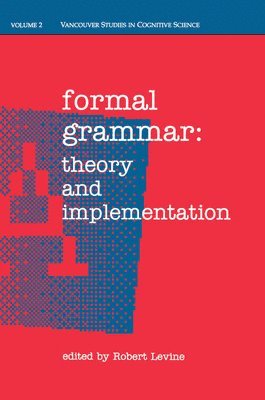
The second volume in the Vancouver Studies in Cognitive Science series, this collection presents recent work in the fields of phonology, morphology, semantics, and neurolinguistics. Its overall theme is the relationship between the contents of grammatical formalisms and their real-time realizations in machine or biological systems. Individual essays address such topics as learnability, implementability, computational issues, parameter setting, andneurolinguistic issues. Contributors include Janet Dean Fodor, Richard T. Oehrle, Bob Carpenter, Edward P. Stabler, Elan Dresher, Arnold Zwicky, Mary-Louis Kean, and Lewis P. Shapiro.
1 284 kr
Skickas inom 5-8 vardagar
This is the second volume in the Vancouver studies in Cognitive Science series, and also the second in a series of conferences hosted by the Cognitive Science Programme at Simon Fraser University devoted to the exploration of issues in cognition and the nature of mental representation.The volumes overall theme is the relationship between the contents of grammatical formalisms and their real-time realizations in machine or biological systems. The range of topics includes issues of learnability, implementary and computational issues, parameter setting, and neurolinguistic issues. The core subdisciplines of linguistics - syntax, semantics, morphology, and phonology - are all represented. The contributions are on the leading edge of research in these fields.
912 kr
Skickas inom 5-8 vardagar
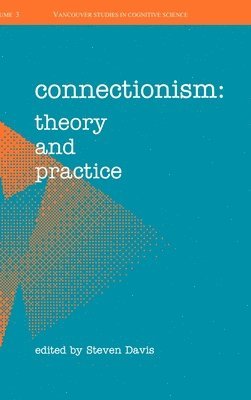
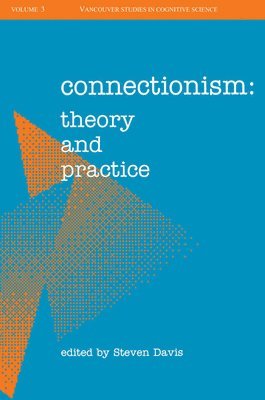
This is the third volume in the Vancouver Studies in Cognitive Science Series. It is based on a conference that was held in 1990, which was sponsored by the Cognitive Science Program and Linguistics Department of Simon Fraser University.Over the last decade, there has emerged a paradigm of cognitive modeling that has been hailed by many researchers as a radically new and promising approach to cognitive science. This new paradigm has come to be known by a number of names, including "connectionism", "neural networks", and "parallel distributed processing", (or PDP). This method of computation attempts to model the neural processes that are thought to underlie cognitive functions in human beings. Unlike the digital computation methods used by AI researchers, connectionist models claim to approximate the kind of spontaneous, creative and somewhat unpredicatable behavior of human agents. However, over the last few years, a heated controversy has arisen over the extent to which connectionist models are able to provide successful explanations for higher cognitive processes. A central theme of this book reviews the adequacy of recent attempts to implement higher cognitive processes in connectionist networks.
604 kr
Skickas inom 3-6 vardagar
This is the third volume in the Vancouver Studies in Cognitive Science Series. It is based on a conference that was held in 1990, which was sponsored by the Cognitive Science Program and Linguistics Department of Simon Fraser University.Over the last decade, there has emerged a paradigm of cognitive modeling that has been hailed by many researchers as a radically new and promising approach to cognitive science. This new paradigm has come to be known by a number of names, including "connectionism", "neural networks", and "parallel distributed processing", (or PDP). This method of computation attempts to model the neural processes that are thought to underlie cognitive functions in human beings. Unlike the digital computation methods used by AI researchers, connectionist models claim to approximate the kind of spontaneous, creative and somewhat unpredicatable behavior of human agents. However, over the last few years, a heated controversy has arisen over the extent to which connectionist models are able to provide successful explanations for higher cognitive processes. A central theme of this book reviews the adequacy of recent attempts to implement higher cognitive processes in connectionist networks.
912 kr
Skickas inom 5-8 vardagar
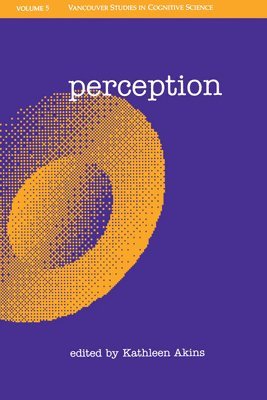
This is the fifth volume in the Vancouver Studies of Cognitive Science Series, an interdisciplinary series bringing together topics of interest to psychologists, philosophers, cognitive scientists, and linguists. Perception covers the problem of depth perception, the interaction of perception and memory, the perception of time, and principles of vision. All chapters focus on fundamental questions about the nature of visual perception.
1 635 kr
Skickas inom 5-8 vardagar
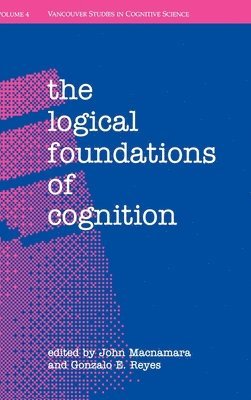
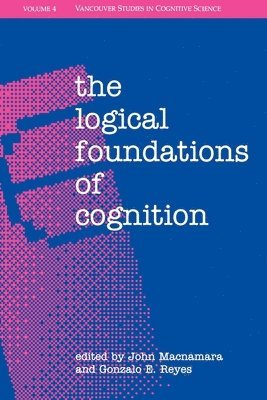
This fourth volume in the Vancouver Studies in Cognitive Science examines the role of logic in cognitive psychology in the light of recent developments. The chapters highlight the inadequacies of classical logic in its handling of ordinary language and reveal the prospect of applying the new theory of kinds to cognitive psychology, cognitive science, linguistics, the philosophy of language, and logic.
938 kr
Skickas inom 5-8 vardagar
This volume, the fourth in the Vancouver Studies in Cognitive Science published by OUP, examines the role of logic in cognitive psychology in light of recent developments. Gonzalo Reyes's new semantic theory has brought the fields of cognitive psychology and logic closer together, and has shed light on how children may master proper names and count nouns, and thus acquire knowledge. The chapters highlight the inadequacies of classical logic in its handling of ordinary language and reveals the prospects of applying the new theory of kinds to cognitive psychology, cognitive science, linguistics, the philosophy of language and logic.
1 269 kr
Skickas inom 5-8 vardagar
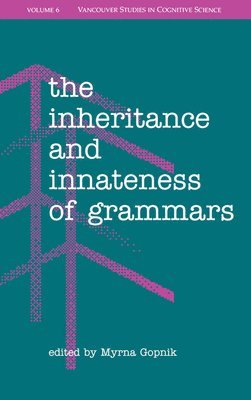
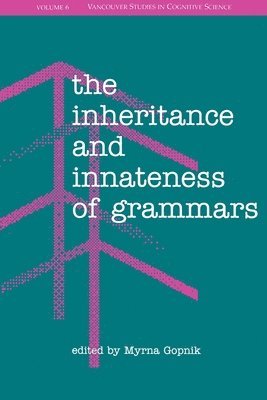
This volume, the sixth in the Vancouver series based on an annual conference at Simon Fraser University, collects papers that discuss the evidence and arguments regarding the inheritability and innateness of grammars. The evidence - which ranges from babies who are just beginning to learn the properties of their native language, to language-impaired adults who will never learn it - converges to show that whole precursors of language exist in other creatures, the abilities necessary for constructing fully fledged grammars are part of the biological endowment of human beings.
914 kr
Skickas inom 3-6 vardagar
This volume, the sixth in the Vancouver series based on an annual conference at Simon Fraser University, collects papers that discuss the evidence and arguments regarding the inheritability and innateness of grammars. The evidence - which ranges from babies who are just beginning to learn the properties of their native language, to language-impaired adults who will never learn it - converges to show that whole precursors of language exist in other creatures, the abilities necessary for constructing fully fledged grammars are part of the biological endowment of human beings.
826 kr
Skickas inom 3-6 vardagar
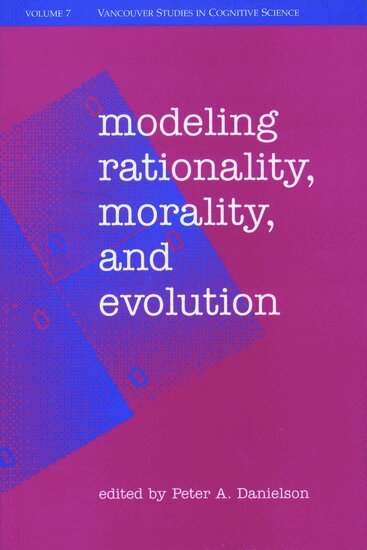
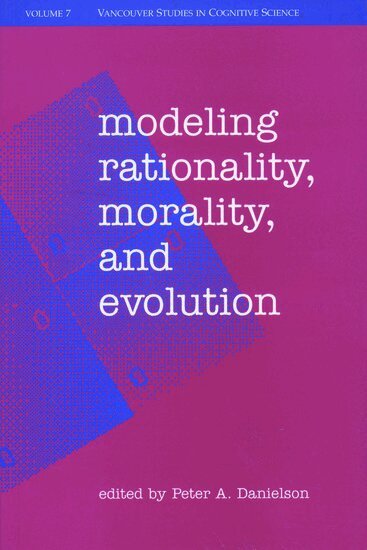
This collection focuses on questions that arise when morality is considered from the perspective of recent work on rational choice and evolution. Linking questions like "Is it rational to be moral?" to the evolution of cooperation in "The Prisoners Dilemma," the book brings together new work using models from game theory, evolutionary biology, and cognitive science, as well as from philosophical analysis. Among the contributors are leading figures in these fields, including David Gauthier, Paul M. Churchland, Brian Skyrms, Ronald de Sousa, and Elliot Sober.
1 287 kr
Skickas inom 5-8 vardagar
This collection focuses on questions that arise when morality is considered from the perspective of recent work on rational choice and evolution. Linking questions like "Is it rational to be moral?" to the evolution of cooperation in "The Prisoners Dilemma," the book brings together new work using models from game theory, evolutionary biology, and cognitive science, as well as from philosophical analysis. Among the contributors are leading figures in these fields, including David Gauthier, Paul M. Churchland, Brian Skyrms, Ronald de Sousa, and Elliot Sober.
2 411 kr
Skickas inom 5-8 vardagar
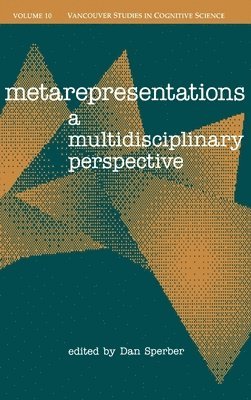
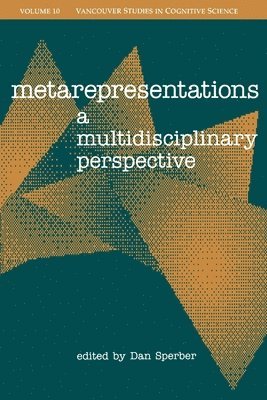
This volume in the Vancouver Studies in Cognitive Science series concerns metarepresentation: the construction and use of representations that represent other representations. Metarepresentations are ubiquitous among human beings, whenever we think or talk about mental states or linguistic acts, or theorize about the mind or language. This volume collects previously unpublished studies on the subject by an interdisciplinary group of contributors, including Daniel Dennett, Alvin Goldman, Keith Lehrer, Leda Cosmides and John Tooby.
1 688 kr
Skickas inom 5-8 vardagar
This volume in the Vancouver Studies in Cognitive Science series concerns metarepresentation: the construction and use of representations that represent other representations. Metarepresentations are ubiquitous among human beings, whenever we think or talk about mental states or linguistic acts, or theorize about the mind or language. This volume collects previously unpublished studies on the subject by an interdisciplinary group of contributors, including Daniel Dennett, Alvin Goldman, Keith Lehrer, Leda Cosmides and John Tooby.
2 019 kr
Skickas inom 5-8 vardagar
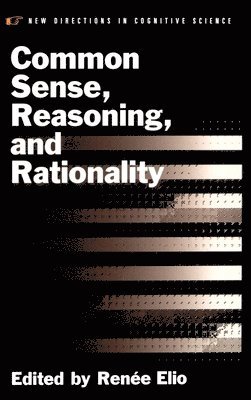
This is the 11th volume in the New Directions in Cognitive Science Series (formerly Vancover Studies in Cognitive Science). It addresses common sense, reasoning, and rationality, currently areas of considerable interdisciplinary interest and importance. While common sense and rationality have often been viewed as two distinct features in a unified cognitive map, this interdisciplinary volume - including essays from an outstanding group of established scholars - engages with this notion and comes up with novel and often paradoxical views of this relationship. It should appeal to philosophers, psychologists, cognitive scientists, and computer scientists interested in considering what constitutes human rationality, behaviour, and intelligence. This groundbreaking collection is at the forefront of Cognitive Science research, and promises to be of unprecedented influence across disciplines.
1 047 kr
Skickas inom 5-8 vardagar
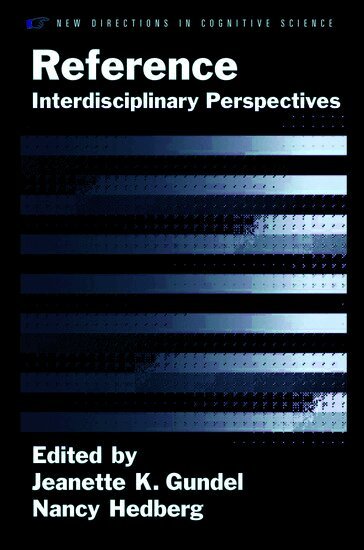
The ability to produce and understand referring expressions is basic to human language use and human cognition. Reference comprises the ability to think of and represent objects (both real and imagined/fictional), to indicate to others which of these objects we are talking about, and to determine what others are talking about when they use a nominal expression.The articles in this volume are concerned with some of the central themes and challenges in research on reference within the cognitive sciences - philosophy (including philosophy of language and mind, logic, and formal semantics), theoretical and computational linguistics, and cognitive psychology. The papers address four basic questions: What is reference? What is the appropriate analysis of different referring forms, such as pronouns vs. full noun phrases, demonstrative vs. personal pronouns, and overt vs. null/zero pronominal forms? Some of the papers assume and build on existing theories, such as Centering Theory and the Givenness Hierarchy framework; others propose their own models of reference understanding or production.The essays examine reference from a number of disciplinary and interdisciplinary perspectives, informed by different research traditions and employing different methodologies. While the contributors to the volume were primarily trained in one of four represented disciplines - computer science, linguistics, philosophy and psychology, and use methodologies typical of that discipline, each of them bridges more than one discipline in their methodology and/or their approach.
1 287 kr
Skickas inom 5-8 vardagar
A generic statement is a type of generalization that is made by asserting that a "kind" has a certain property. For example we might hear that marshmallows are sweet. Here, we are talking about the "kind" marshmallow and assert that individual instances of this kind have the property of being sweet. Almost all of our common sense knowledge about the everyday world is put in terms of generic statements. What can make these generic sentences be true even when there are exceptions? A mass term is one that does not "divide its reference;" the word water is a mass term; the word dog is a count term. In a certain vicinity, one can count and identity how many dogs there are, but it doesn't make sense to do that for water--there just is water present. The philosophical literature is rife with examples concerning how a thing can be composed of a mass, such as a statue being composed of clay. Both generic statements and mass terms have led philosophers, linguists, semanticists, and logicians to search for theories to accommodate these phenomena and relationships. The contributors to this interdisciplinary volume study the nature and use of generics and mass terms. Noted researchers in the psychology of language use material from the investigation of human performance and child-language learning to broaden the range of options open for formal semanticists in the construction of their theories, and to give credence to some of their earlier postulations--for instance, concerning different types of predications that are available for true generics and for the role of object recognitions in the development of count vs. mass terms. Relevant data also is described by investigating the ways children learn these sorts of linguistic items: children can learn how to sue generic statements correctly at an early age, and children are adept at individuating objects and distinguishing them from the stuff of which they are made also at an early age.
1 932 kr
Skickas inom 5-8 vardagar
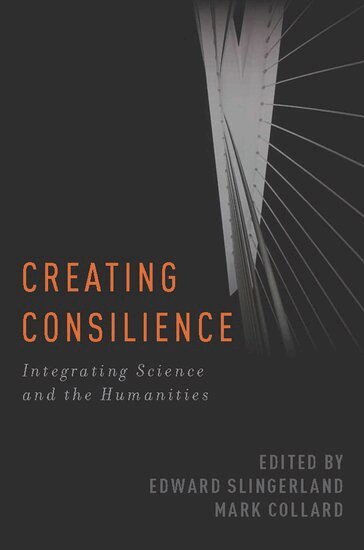
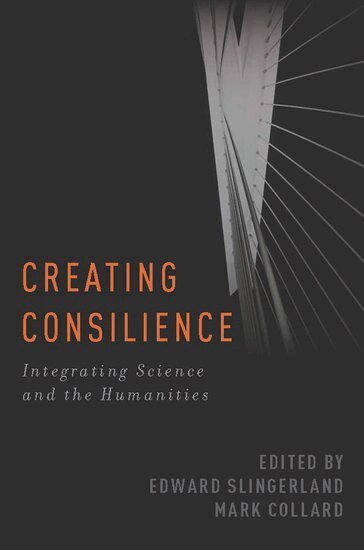
Calls for a "consilient" or "vertically integrated" approach to the study of human mind and culture have, for the most part, been received by scholars in the humanities with either indifference or hostility. One reason for this is that consilience has often been framed as bringing the study of humanistic issues into line with the study of non-human phenomena, rather than as something to which humanists and scientists contribute equally. The other major reason that consilience has yet to catch on in the humanities is a dearth of compelling examples of the benefits of adopting a consilient approach. Creating Consilience is the product of a workshop that brought together internationally-renowned scholars from a variety of fields to address both of these issues. It includes representative pieces from workshop speakers and participants that examine how adopting such a consilient stance -- informed by cognitive science and grounded in evolutionary theory -- would concretely impact specific topics in the humanities, examining each topic in a manner that not only cuts across the humanities-natural science divide, but also across individual humanistic disciplines. By taking seriously the fact that science-humanities integration is a two-way exchange, this volume takes a new approach to bridging the cultures of science and the humanities. The editors and contributors formulate how to develop a new shared framework of consilience beyond mere interdisciplinarity, in a way that both sides can accept.
603 kr
Skickas inom 5-8 vardagar
Calls for a "consilient" or "vertically integrated" approach to the study of human mind and culture have, for the most part, been received by scholars in the humanities with either indifference or hostility. One reason for this is that consilience has often been framed as bringing the study of humanistic issues into line with the study of non-human phenomena, rather than as something to which humanists and scientists contribute equally. The other major reason that consilience has yet to catch on in the humanities is a dearth of compelling examples of the benefits of adopting a consilient approach. Creating Consilience is the product of a workshop that brought together internationally-renowned scholars from a variety of fields to address both of these issues. It includes representative pieces from workshop speakers and participants that examine how adopting such a consilient stance -- informed by cognitive science and grounded in evolutionary theory -- would concretely impact specific topics in the humanities, examining each topic in a manner that not only cuts across the humanities-natural science divide, but also across individual humanistic disciplines. By taking seriously the fact that science-humanities integration is a two-way exchange, this volume takes a new approach to bridging the cultures of science and the humanities. The editors and contributors formulate how to develop a new shared framework of consilience beyond mere interdisciplinarity, in a way that both sides can accept.