• Fri frakt över 249 kr
  • •
  • Snabba leveranser
  • •
  • Billiga böcker
Kundservice

Du är på sajten för privatpersoner.

Företag, bibliotek eller offentlig verksamhet?

Du handlar på classic.bokus.com, där alla dina funktioner finns intakta.
Till classic.bokus.com
Bokus logotyp. Gå till startsidan.
  • Erbjudanden
  • Nyheter
  • Student
  • Topplistor
  • Barn & ungdom
  • Bokus Play
  • E-böcker
  • Pocketböcker
  • Spel & pussel

10% rabatt på allt med kod: NYSTART10 →

Sidfot

Mina sidor

    Hjälp

    • Kundservice
    • Vanliga frågor och svar
    • Frakt och leverans
    • Retur vid ångerrätt
    • Reklamera vara
    • Betalning
    • Köpvillkor
    • Allmänna villkor
    • Information om webbplatsens tillgänglighet

    Om Bokus

    • Om oss
    • Pressrum
    • För studenter
    • För företag
    • För bibliotek och offentlig verksamhet
    • För leverantörer
    • Hållbarhet

    Populärt

    • Aktuella erbjudanden
    • Presentkort
    • Studentlitteratur
    • Nya böcker
    • Topplistor
    • Signerade böcker
    • Engelska böcker

    Inspiration

    • Boktips
    • BookTok
    • Populära bokserier
    • Barnbokskaraktärer
    • Populära författare
    Logotyp för Bokus
    Följ oss på Facebook (extern länk)Följ oss på Instagram (extern länk)Följ oss på YouTube (extern länk)Följ oss på TikTok (extern länk)
    bokus @ CookiesAnpassa cookiesIntegritetspolicyKöpvillkor
    Till Citymail hemsida (extern länk)Till Budbee hemsida (extern länk)Till Postnord hemsida (extern länk)Till Schenker hemsida (extern länk)Till Early Bird hemsida (extern länk)Till Walleys hemsida (extern länk)
    1. Filosofi och religion
    2. Filosofi
    3. Filosofiska discipliner

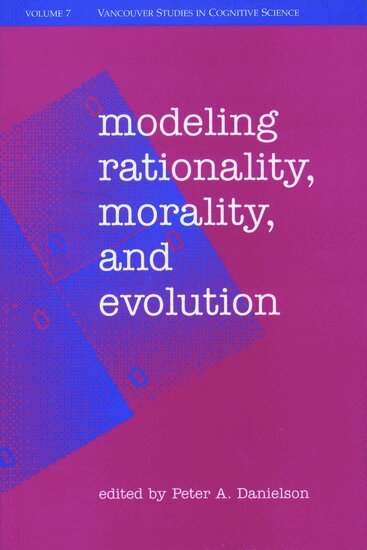
    Modeling Rationality, Morality, and Evolution

    AvPeter Danielson

    Inbunden, Engelska, 2000

    Del i serien New Directions in Cognitive Science

    725 kr

    Beställningsvara. Skickas inom 5-8 vardagar. Fri frakt över 249 kr.

    Fler format och utgåvor

    Häftad

    1 923 kr

    Beskrivning

    This collection focuses on questions that arise when morality is considered from the perspective of recent work on rational choice and evolution. Linking questions like "Is it rational to be moral?" to the evolution of cooperation in "The Prisoners Dilemma," the book brings together new work using models from game theory, evolutionary biology, and cognitive science, as well as from philosophical analysis. Among the contributors are leading figures in these fields, including David Gauthier, Paul M. Churchland, Brian Skyrms, Ronald de Sousa, and Elliot Sober.

    Produktinformation

    • Utgivningsdatum:2000-01-06
    • Mått:160 x 236 x 37 mm
    • Vikt:812 g
    • Format:Inbunden
    • Språk:Engelska
    • Serie:New Directions in Cognitive Science
    • Antal sidor:480
    • Förlag:OUP USA
    • ISBN:9780195125498

    Utforska kategorier

    • Filosofiska discipliner inom Filosofi och religion
    • Kognitiv psykologi inom Psykologi och pedagogik

    Recensioner i media

    Brings together leading figures in a line of great contemporary interest.

    Innehållsförteckning

    • Ackowledgements Contributors 1: Peter A. Danielson: Introduction Rationality 2: Edward F. McClennen: Rationality and Rules 3: David Gauthier: Intention and Deliberation 4: Michael E. Bratman: Following Through with One's Plans: Reply to David Gauthier 5: A. D. Irvine: How Braess' Paradox Solves Newcomb's Problem 6: Bryan R. Routledge: Economics of the Prisoner's Dilemma: A Background 7: Ronald de Sousa: Modeling Rationality: Normative or Descriptive? Modeling Social Interaction 8: Leslie Burkholder: Theorem 1 9: Louis Marinoff: The Failure of Success: Intrafamilial Exploitation in the Prisoner's Dilemma 10: Peter Kollock: Transforming Social Dilemmas: Group Identity and Co-Operation 11: Bernardo A. Huberman and Natalie S. Glance: Beliefs and Co-Operation 12: Paul M. Churchland: The Nueral Representation of the Social World Morality 13: David Schmidtz: Moral Dualism 14: Duncan MacIntosh: Categorically Rational Preferences and the Structure of Morality 15: William J. Talbott: Why We Need a Moral Equilibrium Theory 16: Chantale LaCasse and Don Ross: Morality's Last Chance Evolution 17: Brian Skyrms: Mutual Aid: Darwin Meets The Logic of Decision 18: Elliott Sober: Three Differences between Deliberation and Evolution 19: Peter A. Danielson: Evolutionary Models of Co-Operation Mechanisms: Artificial Morality and Genetic Programming 20: Giovanni Dosi, Luigi Marengo, Andrea Bassanini, and Marco Valente: Norms as Emergent Properties of Adaptive Learning: The Case of Economic Routines