New Threats to Freedom Series - Böcker
Visar alla böcker i serien New Threats to Freedom Series. Handla med fri frakt och snabb leverans.
8 produkter
8 produkter
197 kr
Skickas inom 11-20 vardagar
New Threats to Freedom In the twentieth century, free people faced a number of mortal threats,ranging from despotism, fascism, and communism to the looming menace of global terrorism. While the struggle against some of these overt dangers continues, some insidious new threats seem to have slipped past our intellectual defenses. These often unchallenged threats are quietly eroding our hard-won freedoms and, in some cases, are widely accepted as beneficial. In New Threats to Freedom, editor and author Adam Bellow has assembled an all-star lineup of innovative thinkers to challenge these insidious new threats. Some leap into already raging debates on issues such as Sharia law in the West, the rise of transnationalism, and the regulatory state. Others turn their attention to less obvious threats, such as the dogma of fairness, the failed promises of the blogosphere, and the triumph of behavioral psychology. These threats are very real and very urgent, yet this collection avoids projecting an air of doom and gloom. Rather, it provides a blueprint for intellectual resistance so that modern defenders of liberty may better understand their enemies, more effectively fight to preserve the meaning of freedom, and more surely carry its light to a new generation. What are the new threats to freedom? when has authority not claimed, when imposing trammels and curbs on liberty, that it does so for a wider good and a greater happiness?” -Christopher Hitchens “The regulatory state amounts to a regressive tax that penalizes small independent producers and protectsthe status quo.” -Max Borders “Europe tends to favor stability over democracy, America democracy over stability.” -Daniel Hannan “The value of free expression is perceived to be at odds with goals that were considered ‘more important,’ like inclusiveness, diversity, nondiscrimination, and tolerance.” -Greg Lukianoff “The masses cannot ultimately be free: only the individual can be.” -Robert D. Kaplan “That old bugbear of postwar sociology-the mob-self-is now a reality. In a participatory/popularity culture, the freedom to think and act for ourselves becomes harder and harder to achieve.” -Lee Siegel “As traditional marriage declines, the ranks of single women are growing, and increasingly these women are substituting the security of a husband with the security of the state.” -Jessica Gavora “Ending the freedom to fail is a mean-spirited attack on the freedom to succeed.” -Michael Goodwin “The only solution to the new threats to American press freedom lies in organized resistance.” -Katherine Mangu-Ward “The new behaviorism isn’t interested in protecting people’s freedom to choose; on the contrary, its core principle is the idea that only by allowing an expert elite to limit choice can individuals learn to break their bad habits.” -Christine Rosen “There’s a world of Travis Bickles out there, and they’re not driving cabs. They’re reading blogs.” -Ron Rosenbaum “The first amendment ensures not that speech will be fair, but that it will be free. It cannot be both.” -David Mamet Join the conversation about these issues at www.newthreatstofreedom.com
139 kr
Skickas inom 7-10 vardagar
In A Nation of Takers: America’s Entitlement Epidemic, one of our country’s foremost demographers, Nicholas Eberstadt, details the exponential growth in entitlement spending over the past fifty years. As he notes, in 1960, entitlement payments accounted for well under a third of the federal government’s total outlays. Today, entitlement spending accounts for a full two-thirds of the federal budget. Drawing on an impressive array of data and employing a range of easy-to-read, four-color charts, Eberstadt shows the unchecked spiral of spending on a range of entitlements, everything from Medicare to disability payments. But Eberstadt does not just chart the astonishing growth of entitlement spending, he also details the enormous economic and cultural costs of this epidemic. He powerfully argues that while this spending certainly drains our federal coffers, it also has a very real, long-lasting, negative impact on the character of our citizens. Also included in the book is a response from one of our leading political theorists, William Galston. In his incisive response, he questions Eberstadt’s conclusions about the corrosive effect of entitlements on character and offers his own analysis of the impact of American entitlement growth.
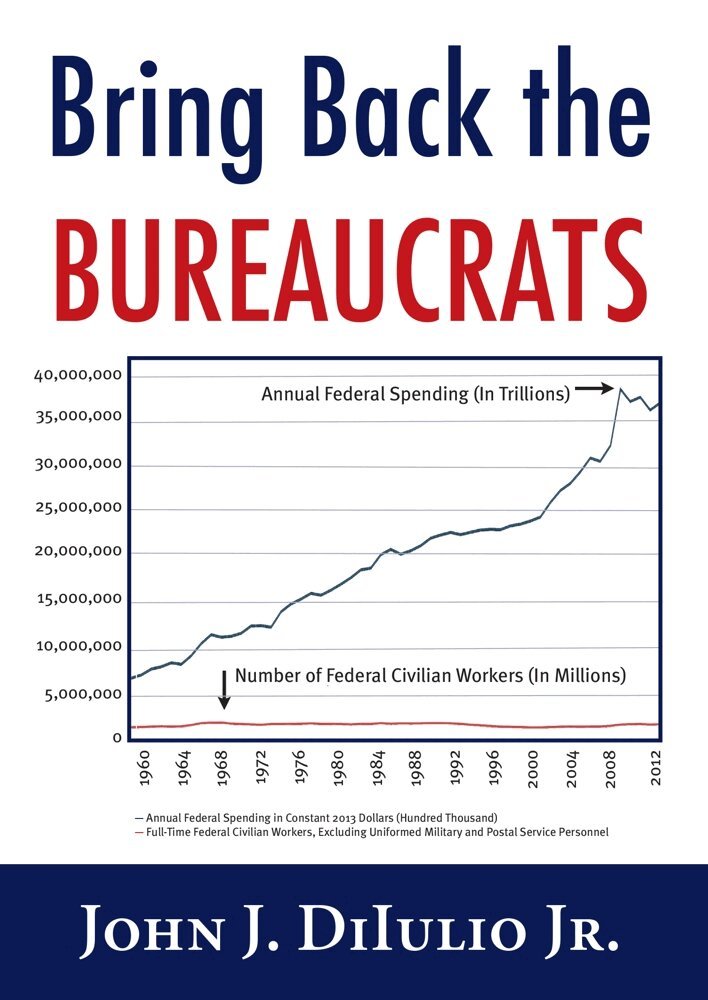
Bring Back the Bureaucrats
Why More Federal Workers Will Lead to Better (and Smaller!) Government
Häftad, Engelska, 2014
165 kr
Skickas inom 7-10 vardagar
In Bring Back the Bureaucrats, John J. DiIulio Jr., one of America’s most respected political scientists and an adviser to presidents in both parties, summons the facts and statistics to show us how America’s big government works and why reforms that include adding a million more people to the federal workforce by 2035 might help to slow government’s growth while improving its performance. Starting from the underreported reality that the size of the federal workforce hasn’t increased since the early 1960s, even though the federal budget has skyrocketed. The number of federal programs has ballooned; Bring Back the Bureaucrats tells us what our elected leaders won’t: there are not enough federal workers to work for our democracy effectively. DiIulio reveals that the government in America is Leviathan by Proxy, a grotesque form of debt-financed big government that guarantees terrible government. Washington relies on state and local governments, for-profit firms, and nonprofit organizations to implement federal policies and programs. Big-city mayors, defense industry contractors, nonprofit executives, and other national proxies lobby incessantly for more federal spending. This proxy system chokes on chores such as cleaning up toxic waste sites, caring for hospitalized veterans, collecting taxes, handling plutonium, and policing more than $100 billion annually in “improper payments.” The lack of competent, well-trained federal civil servants resulted in the failed federal response to Hurricane Katrina and the troubled launch of Obamacare’s “health exchanges.” Bring Back the Bureaucrats is further distinguished by the presence of E. J. Dionne Jr. and Charles Murray, two of the most astute voices from the political left and right, respectively, who offer their candid responses to DiIulio at the end of the book.
170 kr
Skickas inom 7-10 vardagar
Black civil rights leaders have long supported ethnic identity politics and prioritized the integration of political institutions, and seldom has that strategy been questioned. In False Black Power?, Jason L. Riley takes an honest, factual look at why increased black political power has not paid off in the ways that civil rights leadership has promised.Recent decades have witnessed a proliferation of black elected officials, culminating in the historic presidency of Barack Obama. However, racial gaps in employment, income, homeownership, academic achievement, and other measures not only continue but in some cases have even widened. While other racial and ethnic groups in America have made economic advancement a priority, the focus on political capital for blacks has been a disadvantage, blocking them from the fiscal capital that helped power upward mobility among other groups.Riley explains why the political strategy of civil rights leaders has left so many blacks behind. The key to black economic advancement today is overcoming cultural handicaps, not attaining more political power. The book closes with thoughtful responses from key thought leaders Glenn Loury and John McWhorter.
165 kr
Skickas inom 7-10 vardagar
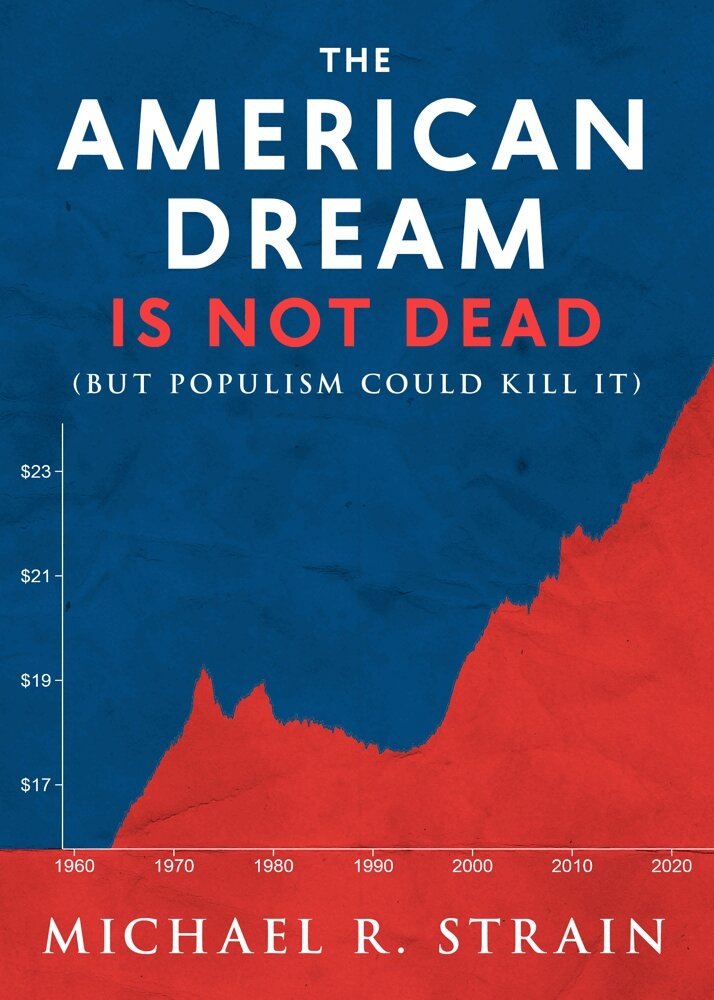
Populists on both sides of the political aisle routinely announce that the American Dream is dead. According to them, the game has been rigged by elites, workers can’t get ahead, wages have been stagnant for decades, and the middle class is dying. Michael R. Strain, director of economic policy studies at the American Enterprise Institute, disputes this rhetoric as wrong and dangerous. In this succinctly argued volume, he shows that, on measures of economic opportunity and quality of life, there has never been a better time to be alive in America. He backs his argument with overwhelming-and underreported-data to show how the facts favor realistic optimism.He warns, however, that the false prophets of populism pose a serious danger to our current and future prosperity. Their policies would leave workers worse off. And their erroneous claim that the American Dream is dead could discourage people from taking advantage of real opportunities to better their lives. If enough people start to believe the Dream is dead, they could, in effect, kill it. To prevent this self-fulfilling prophecy, Strain’s book is urgent reading for anyone feeling the pull of the populists. E. J. Dionne and Henry Olsen provide spirited responses to Strain’s argument.
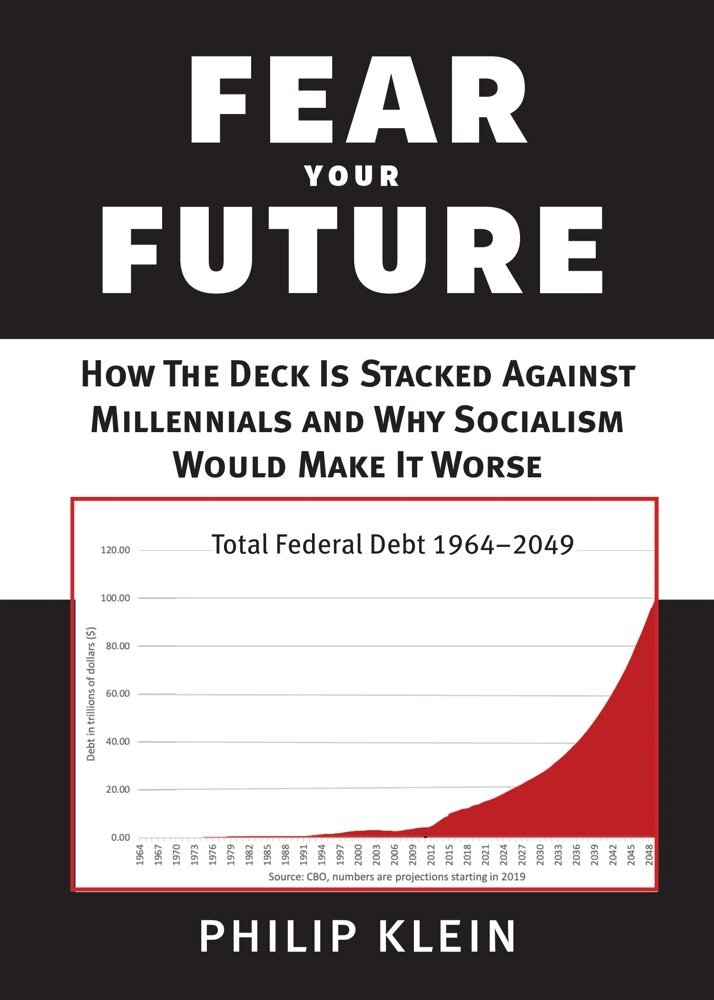
Fear Your Future
How the Deck Is Stacked Against Millennials and Why Socialism Would Make It Worse
Häftad, Engelska, 2019
170 kr
Skickas inom 11-20 vardagar
It’s become fashionable to demean millennials as the “snowflake” generation. Raised during the peace and prosperity of the ‘90s, they’re often perceived as carrying an entitlement mentality and being incapable of handling adversity. But Philip Klein sees them differently. Given the economic headwinds they faced at the start of their working lives, millennials have shown commendable fortitude. And as Klein argues, they will need to maintain this character strength going forward because further challenges loom in their future. The aftershocks of the Great Recession, the skyrocketing cost of living, and the titanic weight of student loan debt have made the American Dream seem to be forever retreating toward the horizon. As if that weren’t enough, millennials will face the largest federal debt in history as boomers retire and extract trillions of dollars from Social Security and Medicare-far more than they contributed. In this concise, data-driven book, Klein begins the work of brightening the future for millennials by analyzing the problem compassionately yet objectively. There are real reasons to worry about what lies ahead if nothing changes. But the facts laid out in Klein’s book can steer the conversation to realistic solutions.
170 kr
Skickas inom 11-20 vardagar
Economic inequality continues to be one of America’s most hotly debated topics. Still, there has been relatively little discussion of the fact that black-white gaps in joblessness, income, poverty and other measures were shrinking before the pandemic. Why was it happening, and why did this phenomenon go unacknowledged by so much media? In The Black Boom, Jason L. Riley-acclaimed Wall Street Journal columnist and senior fellow at the Manhattan Institute-digs into the data and concludes that the economic lives of black people improved significantly under policies put into place during the Trump administration. To acknowledge as much is not to endorse the 45th president but to champion policies that achieve a clear moral objective shared by most Americans. Riley argues that before the Covid-19 pandemic of 2020, the economic fortunes of blacks improved under Trump to an extent unseen under Obama and unseen going back several generations. Black unemployment and poverty reached historic lows, and black wages increased faster than white wages. Less inequality is something that everyone wants, but disapproval of Trump’s personality and methods too often skewed the media’s appraisal of effective policies advocated by his administration. If we're going to make real progress in improving the lives of low-income minorities, says Riley, we must look beyond our partisan differences at what works and keep doing it. Unfortunately, many press outlets were unable or unwilling to do that. Riley notes that political reporters were not unaware of this data. Instead, they chose to ignore or downplay it because it was inconvenient. In their view, Trump, because he was a Republican and because he was Trump, had it in for blacks, and thus his policy preferences would be harmful to minorities. To highlight that significant racial disparities were narrowing on his watch-that the administration’s tax and regulatory reforms were mainly boosting the working and middle classes rather than ‘the rich’-would have undermined a narrative that the media preferred to advance, regardless of its veracity.” As with previous books in our New Threats to Freedom series, The Black Boom includes two essays from prominent experts who take issue with the author’s perspective. Juan Williams, a veteran journalist, and Wilfred Reilly, a political scientist, contribute thoughtful responses to Riley and show that it is possible to share a deep concern for disadvantaged groups while disagreeing on how best to help them.
165 kr
Skickas inom 7-10 vardagar
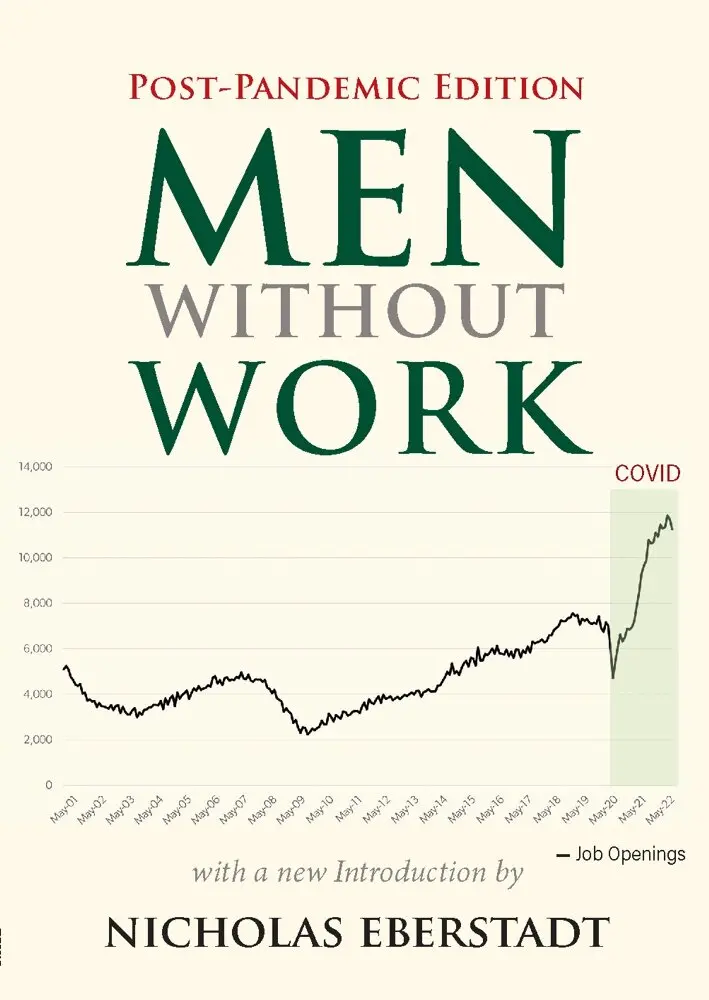
Nicholas Eberstadt’s landmark 2016 study, Men without Work, cast a spotlight on the collapse of work for men in modern America. Rosy reports of low unemployment rates and “full or near full employment” conditions, he contends, were overlooking a quiet, continuing crisis: Depression-era work rates for American men of “prime working age” (25–54).The grim truth: over six million prime-age men were neither working nor looking for work. Conventional unemployment measures ignored these labor force dropouts, but their ranks had been rising relentlessly for half a century. Eberstadt’s unflinching analysis was, in the words of The New York Times, “an unsettling portrait not just of male unemployment, but also of lives deeply alienated from civil society.”The famed American work ethic was once near universal: men of sound mind and body took pride in contributing to their communities and families. No longer, warned Eberstadt. And now-six years and one catastrophic pandemic later-the problem has not only worsened: it has seemingly been spreading among prime-age women and workers over fifty-five.In a brand new introduction, Eberstadt explains how the government’s response to Covid-19 inadvertently exacerbated the flight from work in America. From indiscriminate pandemic shutdowns to almost unconditional “unemployment” benefits, Americans were essentially paid not to work.Thus today, despite the vaccine rollouts, inexplicable numbers of working age men and women are sitting on the sidelines while over 11 million jobs go unfilled. Current low rates of unemployment, touted by pundits and politicians, are grievously misleading. The truth is that fewer prime-age American men are looking for readily available work than at any previous juncture in our history. And others may be catching the “Men Without Work” virus too.Given the devastating economic impact of the Covid calamity and the unforeseen aftershocks yet to come, this reissue of Eberstadt’s groundbreaking work is timelier than ever.