OUP/Humanities Research Centre of the Australian National University Series – serie
Visar alla böcker i serien OUP/Humanities Research Centre of the Australian National University Series. Handla med fri frakt och snabb leverans.
4 produkter
4 produkter
1 128 kr
Skickas inom 5-8 vardagar
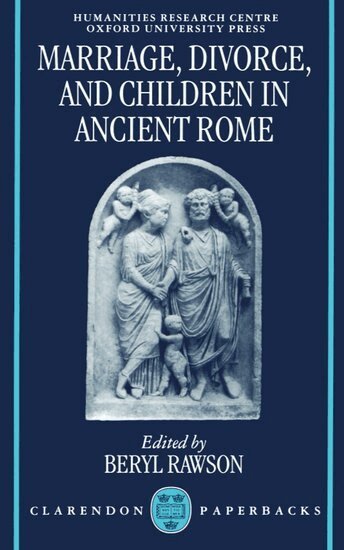
The family has played a central role in most societies, and the complexity and variety of that role has engaged the minds of scholars from a wide range of disciplines. Recent studies of ancient Rome have shown that the sentimental ideal of a core nuclear family was strong throughout the period, but that the reality was often different. This book looks in detail at many aspects of the composition and inner workings of the Roman family and provides an illuminating case-study of the sentimental ideal vis-à-vis everyday reality. The areas of study covered are adult-child relationships (Beryl Rawson), the frequency of divorce (Susan Treggiari), divorce and adoption as familial strategies (Mireille Corbier), remarriage and the structure of the upper-class Roman family (K. R. Bradley), the sentimental ideal of the Roman family (Suzanne Dixon), fathers and sons (Emiel Eyben), familial authority and obedience (Richard Saller), children of freedmen (P. R. C. Weaver), and the impact of domestic architecture with reference to Pompeii and Herculaneum (Andrew Wallace-Hadrill).
1 220 kr
Skickas inom 7-10 vardagar
The family continues to be seen as a central institution in Roman as well as modern, Western society. The Roman family is often used as a stereotype, sometimes of severity, sometimes of decadence, with its decline often cited as a cause of wider decline and fall. Definitions and concepts continue to be modified and nuanced, however, as the availability of new evidence and new methodologies make possible a much less simplistic picture. In this volume, the study of the family draws on a wide range of disciplines to develop the intertwined themes of status, sentiment, and space. For example, on status there are contributions about Junian Latins and a survey of senators' monuments, while sentiment is represented by a gloomy but convincing picture of old age, and a paper on the sentimental ideal which argues that conflict as well as concord is a feature of Roman life. One of the contributions on space examines who commemorates whom in Roman Italy, pointing up the regional variations in custom and the difficulties in tracing complete families. The final contributions focus on the house: how people lived in the Roman house, the use of the rooms, and the artefacts which might indicate this use.The book makes use of many types of evidence - from the legal and literary to the iconographical and archaeological. Visual and material evidence play an important role in reconstructing real lives in considerable colour and variety. The book moves beyond the city of Rome to the rest of Roman Italy and even into the provinces, just as Roman culture moved outwards and mingled with other cultures. Chronologically too there are new directions, towards the later Empire and Christianity. So, although the contributors do not abandon any of the territory already gained in Rome, literary and epigraphic sources, and the late Republic or early Empire, there is an exciting sense of new discovery.
1 420 kr
Skickas inom 5-8 vardagar
The family continues to be seen as a central institution in Roman as well as modern, Western society. The Roman family is often used as a stereotype, sometimes of severity, sometimes of decadence, with its decline often cited as a cause of wider decline and fall. Definitions and concepts continue to be modified and nuanced, however, as the availability of new evidence and new methodologies make possible a much less simplistic picture. In this volume, the study of family draws on a wide range of disciplines to develop the intertwined themes of status, sentiment, and space. For example, on status there are contributions about Junian Latins and a survey of senators' monuments, while sentiment is represented by a gloomy but convincing picture of old age and a paper on the sentimental ideal which argues that conflict as well as concord is a feature of family life. Space is represented, among others, by the contribution on who commemorates whom in Roman Italy, pointing up the regional variations in custom and the difficulties in tracing complete families. The final contributions focus on the house: how people lived in the Roman house, the use of rooms, and the artefacts that might indicate this use. The book makes use of many types of evidence from the legal and literary to the iconographical and archaeological. Visual and material evidence play an important role in reconstructing real lives in considerable colour and variety. The book moves beyond the city of Rome to the rest of Roman Italy and even into the provinces, just as Roman culture moved outwards and mingled with other cultures. Chronologically too there are new directions, towards the later Empire and Christianity. So, although the contributors do not abandon any of the territory already gained in Rome, nor literary and epigraphical sources, nor the late Republic or early Empire, there is an exciting sense of new discovery.
2 931 kr
Skickas inom 5-8 vardagar
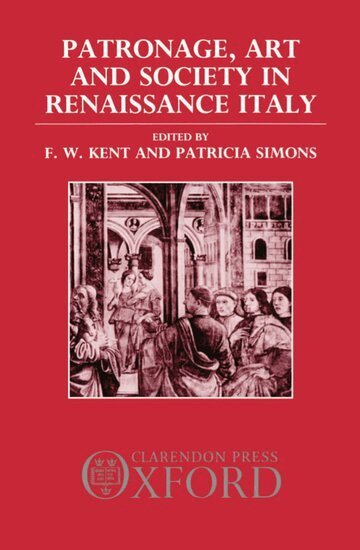
Patronage, in its broadest sense, has been established as one of the dominant social processes of pre-industrial Europe. This collection examines the role it played in the Italian Renaissance, focusing particularly upon Florence.Traditionally viewed simply as the context for the extraordinary artistic creativity of the Renaissance, patronage has more recently been examined by historians as a comprehensive system of patron-client structures which permeated society and social relations. The scattered research so far done on this broader concept of patronage is drawn together and extended in this new volume, derived from a conference held in Melbourne as part of 'Renaissance Year' in 1983. The essays, by art historians as well as historians, explore our new understanding of Renaissance Italy as a 'patronage society', and consider its implications for the study of art patronage and patron-client structures wherever they occur.