Oxford Studies in History of Economics – serie
Visar alla böcker i serien Oxford Studies in History of Economics. Handla med fri frakt och snabb leverans.
7 produkter
7 produkter
1 147 kr
Skickas inom 5-8 vardagar
It was only in the sixteenth century that texts began to refer to the significance of "economic activity"---of sustaining life. This was not because the ordinary business of life was thought unimportant, but because the principles governing economic conduct were thought to be obvious or uncontroversial. The subsequent development of economic writing thus parallels the development of capitalism in Western Europe. From the seventeenth to the twenty-first century there has been a constant shift in content, audience, and form of argument as the literature of economic argument developed. This book proposes that to understand the various forms that economic literature has taken, we need to adopt a more literary approach in economics specifically, to adopt the instruments and techniques of philology. This way we can conceive the history of economic thought to be an on-going work in progress, rather than the story of the emergence of modern economic thinking. This approach demands that we pay attention to the construction of particular texts, showing the work of economic argument in different contexts. In sum, we need to pay attention to the economy of the word. ^l The Economy of the Word is divided into three parts. The first explains what the term economy has meant from Antiquity to Modernity, coupling this conceptual history with an examination of how the idea of national income was turned into a number during the first half of the twentieth century. The second part is devoted to Adam Smith's Wealth of Nations, considering first the manner in which Smith deals with international trade, and then the way in which the book was read in the course of the nineteenth century. Part III examines the sources used by Karl Marx and Léon Walras in developing their economic analysis, drawing attention to their shared intellectual context in French political economy.
1 956 kr
Skickas inom 3-6 vardagar
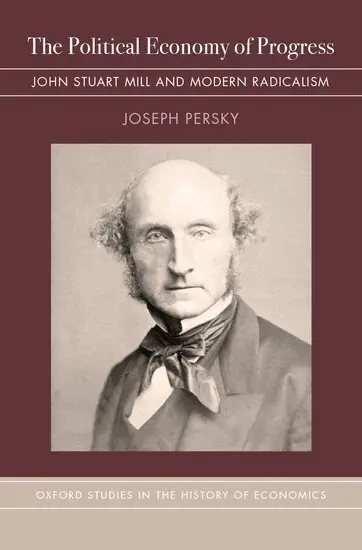
While there had been much radical thought before John Stuart Mill, Joseph Persky argues it was Mill, as he moved to the left, who provided the radical wing of liberalism with its first serious analytical foundation, a political economy of progress that still echoes today. A rereading of Mill's mature work suggests his theoretical understanding of accumulation led him to see laissez-faire capitalism as a transitional system. Deeply committed to the egalitarian precepts of the Enlightenment, Mill advocated gradualism and rejected revolutionary expropriation on utilitarian grounds: gradualism, not expropriation, promised meaningful long-term gains for the working classes. He endorsed laissez-faire capitalism because his theory of accumulation saw that system approaching a stationary state characterized by a great reduction in inequality and an expansion of cooperative production. These tendencies, in combination with an aggressive reform agenda made possible by the extension of the franchise, promised to provide a material base for social progress and individual development.The Political Economy of Progress goes on to claim that Mill's radical political economy anticipated more than a little of Marx's analysis of capitalism and laid a foundation for the work of Fabians and other gradualist radicals in the 20th century. More recently, modern philosophic radicals, such as Rawls, have deep links to this Millean political economy. These links are still worthy of development. In particular, a politically meaningful acceptance of Rawls's radical liberalism waits on a movement capable of re-engineering the workplace in a manner consistent with Mill's endorsement of worker management.
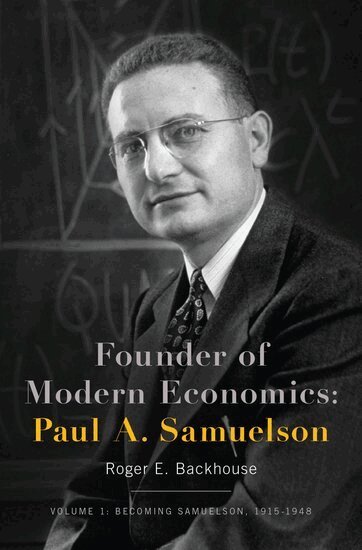
Founder of Modern Economics: Paul A. Samuelson
Volume 1: Becoming Samuelson, 1915-1948
Inbunden, Engelska, 2017
382 kr
Skickas inom 5-8 vardagar
Paul Samuelson was at the heart of a revolution in economics. He was "the foremost academic economist of the 20th century," according to the New York Times, and the first American to win the Nobel Prize in Economics. His work transformed the field of economics and helped give it the theoretical and mathematic rigor that increased its influence in business and policy making.In Founder of Modern Economics, Roger E. Backhouse explores the central importance of Samuelson's personality and social networks to understanding his intellectual development. This is the first of two volumes covering Samuelson's extended and productive life and career. This volume surveys Samuelson's early years growing up in the Midwest to his experiences at the University of Chicago and Harvard University, where leading scholars in economics and other disciplines stimulated and rewarded his curiosity. His thinking was influenced by the natural sciences and he understood that a critical, scientific approach increased insights into important social and economic questions. He realized that these questions could not be answered through rhetorical debate but required rigor. His "eureka" moment came, he said, when "a good fairy whispered to me that math was a skeleton key to solve age old problems in economics."Backhouse traces Samuelson's thinking from his early days to the publication of his groundbreaking book Foundations of Economic Analysis and Economics: An Introductory Analysis, which influenced generations of students. His work set the stage for economics to become a more cohesive and coherent discipline, based on mathematical techniques that provided surprising insights into many important topics, from business cycles to wage and unemployment rates, and from how competition influences trade to how tax rates affects tax collection. Founder of Modern Economics is a profound contribution to understanding how modern economics developed and the thinking of a revolutionary thinker.
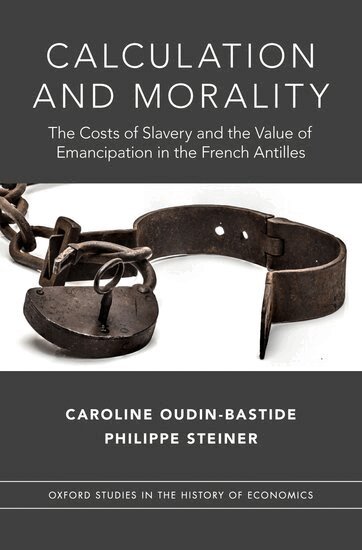
Calculation and Morality
The Costs of Slavery and the Value of Emancipation in the French Antilles
Inbunden, Engelska, 2019
1 164 kr
Skickas inom 5-8 vardagar
Debates about whether to maintain or abolish slavery revolved around two key values: the morality of enslaving other human beings and the economic benefits and costs of slavery as compared to free labor. Various and conflicting arguments were presented by abolitionists, colonists, and administrators in slave-holding societies, all of whom used calculations about the relative cost and productivity of slavery to defend their own point of view in an impassioned debate.In Calculation and Morality, Caroline Oudin-Bastide and Philippe Steiner consider how economic calculations, estimations, and arguments informed the long debate over French slavery between 1771 and 1848. They show how calculation was introduced into moral debate and became a critical social object in regard both to its consistency and its manifest effects. To do so they trace a process in which phenomena were classified into groups, becoming a category, and then how metrics and calculations were used to analyze the possible effects of emancipating slaves in French colonies. Abolitionists sought to demonstrate that it was in the interest of slaveowners and/or the entire nation to employ free labour in the colonies, and to show the irrationality of the colonial and metropolitan defenders of servitude; their aim was to enlighten various parties as to their real interest, and how that real interest coincided with justice. In turn, colonists accused those opposed to slavery of being blinded by their own philanthropic principles and insisted on the rationality of the slave system as the only means of meeting the interests of everyone, including slaves, at least in the short and medium term.Oudin-Bastide and Steiner closely examine the positions and reasoning of such influential French thinkers as Pierre Samuel Du Pont de Nemours, Anne Robert Jacques Turgot, Antoine Nicolas de Condorcet, Simonde de Sismondi, Jean Baptiste Say, and Alexis de Tocqueville. In doing so they shed light on the interaction of moral precepts and econonomic calculations in a trenchant study in the history of ideas.
1 289 kr
Skickas inom 5-8 vardagar
Utility is a key concept in the economics of individual decision-making. However, utility is not measurable in a straightforward way. As a result, from the very beginning there has been debates about the meaning of utility as well as how to measure it. This book is an innovative investigation of how these arguments changed over time.Measuring Utility reconstructs economists' ideas and discussions about utility measurement from 1870 to 1985, as well as their attempts to measure utility empirically. The book brings into focus the interplay between the evolution of utility analysis, economists' ideas about utility measurement, and their conception of what measurement in general means. It also explores the relationships between the history of utility measurement in economics, the history of the measurement of sensations in psychology, and the history of measurement theory in general. Finally, the book discusses some methodological problems related to utility measurement, such as the epistemological status of the utility concept and its measures.The first part covers the period 1870-1910, and discusses the issue of utility measurement in the theories of Jevons, Menger, Walras and other early utility theorists. Part II deals with the emergence of the notions of ordinal and cardinal utility during the period 1900-1945, and discusses two early attempts to give an empirical content to the notion of utility. Part III focuses on the 1945-1955 debate on utility measurement that was originated by von Neumann and Morgenstern's expected utility theory (EUT). Part IV reconstructs the experimental attempts to measure the utility of money between 1950 and 1985 within the framework provided by EUT.This historical and epistemological overview provides keen insights into current debates about rational choice theory and behavioral economics in the theory of individual decision-making and the philosophy of economics.
512 kr
Skickas inom 7-10 vardagar
Utility is a key concept in the economics of individual decision-making. However, utility is not measurable in a straightforward way. As a result, from the very beginning there has been debates about the meaning of utility as well as how to measure it. This book is an innovative investigation of how these arguments changed over time.Measuring Utility reconstructs economists' ideas and discussions about utility measurement from 1870 to 1985, as well as their attempts to measure utility empirically. The book brings into focus the interplay between the evolution of utility analysis, economists' ideas about utility measurement, and their conception of what measurement in general means. It also explores the relationships between the history of utility measurement in economics, the history of the measurement of sensations in psychology, and the history of measurement theory in general. Finally, the book discusses some methodological problems related to utility measurement, such as the epistemological status of the utility concept and its measures.The first part covers the period 1870-1910, and discusses the issue of utility measurement in the theories of Jevons, Menger, Walras and other early utility theorists. Part II deals with the emergence of the notions of ordinal and cardinal utility during the period 1900-1945, and discusses two early attempts to give an empirical content to the notion of utility. Part III focuses on the 1945-1955 debate on utility measurement that was originated by von Neumann and Morgenstern's expected utility theory (EUT). Part IV reconstructs the experimental attempts to measure the utility of money between 1950 and 1985 within the framework provided by EUT.This historical and epistemological overview provides keen insights into current debates about rational choice theory and behavioral economics in the theory of individual decision-making and the philosophy of economics.
2 372 kr
Skickas inom 3-6 vardagar
This book reconsiders the role of the Phillips curve in macroeconomic analysis in the first twenty years following the famous work by A W H Phillips, after whom it is named. It argues that the story conventionally told is entirely misleading. In that story, Phillips made a great breakthrough but his work led to a view that inflationary policy could be used systematically to maintain low unemployment, and that it was only after the work of Milton Friedman and Edmund Phelps about a decade after Phillips' that this view was rejected. On the contrary, a detailed analysis of the literature of the times shows that the idea of a negative relation between wage change and unemployment - supposedly Phillips' discovery - was commonplace in the 1950, as were the arguments attributed to Friedman and Phelps by the conventional story. And, perhaps most importantly there is scarcely any sign of the idea of the inflation-unemployment tradeoff promoting inflationary policy - either in the theoretical literature or in actual policymaking. The book demonstrates and identifies a number of main strands of the actual thinking of the 1950s, 1960s, and 1970s on the question of the determination of inflation and its relation to other variables.The result is not only a rejection of the Phillips curve story as it has been told, and a reassessment of the understanding of the economists of those years of macroeconomics, but also the construction of an alternative, and historically more authentic account of the economic theory of those times. A notable outcome is that the economic theory of the time was not nearly so naïve as it has been portrayed.