• Fri frakt över 249 kr
  • •
  • Snabba leveranser
  • •
  • Billiga böcker
Kundservice

Du är på sajten för privatpersoner.

Företag, bibliotek eller offentlig verksamhet?

Du handlar på classic.bokus.com, där alla dina funktioner finns intakta.
Till classic.bokus.com
Bokus logotyp. Gå till startsidan.
  • Erbjudanden
  • Nyheter
  • Student
  • Topplistor
  • Barn & ungdom
  • Bokus Play
  • E-böcker
  • Pocketböcker
  • Spel & pussel

10% rabatt på allt med kod: NYSTART10 →

Sidfot

Mina sidor

    Hjälp

    • Kundservice
    • Vanliga frågor och svar
    • Frakt och leverans
    • Retur vid ångerrätt
    • Reklamera vara
    • Betalning
    • Köpvillkor
    • Allmänna villkor
    • Information om webbplatsens tillgänglighet

    Om Bokus

    • Om oss
    • Pressrum
    • För studenter
    • För företag
    • För bibliotek och offentlig verksamhet
    • För leverantörer
    • Hållbarhet

    Populärt

    • Aktuella erbjudanden
    • Presentkort
    • Studentlitteratur
    • Nya böcker
    • Topplistor
    • Signerade böcker
    • Engelska böcker

    Inspiration

    • Boktips
    • BookTok
    • Populära bokserier
    • Barnbokskaraktärer
    • Populära författare
    Logotyp för Bokus
    Följ oss på Facebook (extern länk)Följ oss på Instagram (extern länk)Följ oss på YouTube (extern länk)Följ oss på TikTok (extern länk)
    bokus @ CookiesAnpassa cookiesIntegritetspolicyKöpvillkor
    Till Citymail hemsida (extern länk)Till Budbee hemsida (extern länk)Till Postnord hemsida (extern länk)Till Schenker hemsida (extern länk)Till Early Bird hemsida (extern länk)Till Walleys hemsida (extern länk)
    1. Samhälle och politik
    2. Samhälle och kultur
    3. Kultur och medier
    4. Kulturvetenskap

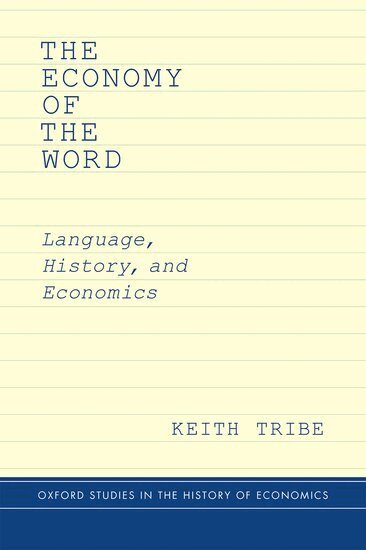
    The Economy of the Word

    Language, History, and Economics

    AvKeith Tribe

    Inbunden, Engelska, 2015

    Del i serien Oxford Studies in History of Economics

    1 923 kr

    Beställningsvara. Skickas inom 5-8 vardagar. Fri frakt över 249 kr.

    Beskrivning

    It was only in the sixteenth century that texts began to refer to the significance of "economic activity"---of sustaining life. This was not because the ordinary business of life was thought unimportant, but because the principles governing economic conduct were thought to be obvious or uncontroversial. The subsequent development of economic writing thus parallels the development of capitalism in Western Europe. From the seventeenth to the twenty-first century there has been a constant shift in content, audience, and form of argument as the literature of economic argument developed. This book proposes that to understand the various forms that economic literature has taken, we need to adopt a more literary approach in economics specifically, to adopt the instruments and techniques of philology. This way we can conceive the history of economic thought to be an on-going work in progress, rather than the story of the emergence of modern economic thinking. This approach demands that we pay attention to the construction of particular texts, showing the work of economic argument in different contexts. In sum, we need to pay attention to the economy of the word. ^l The Economy of the Word is divided into three parts. The first explains what the term economy has meant from Antiquity to Modernity, coupling this conceptual history with an examination of how the idea of national income was turned into a number during the first half of the twentieth century. The second part is devoted to Adam Smith's Wealth of Nations, considering first the manner in which Smith deals with international trade, and then the way in which the book was read in the course of the nineteenth century. Part III examines the sources used by Karl Marx and Léon Walras in developing their economic analysis, drawing attention to their shared intellectual context in French political economy.

    Produktinformation

    • Utgivningsdatum:2015-04-02
    • Mått:163 x 239 x 27 mm
    • Vikt:590 g
    • Format:Inbunden
    • Språk:Engelska
    • Serie:Oxford Studies in History of Economics
    • Antal sidor:352
    • Förlag:OUP USA
    • ISBN:9780190211615

    Utforska kategorier

    • Kulturvetenskap inom Samhälle och politik
    • Ekonomisk historia inom Ekonomi och Ledarskap

    Mer om författaren

    After doing his graduate work in the social and political sciences in Cambridge during the 1970s, Keith Tribe spent most of the first half of the 1980s in Germany studying the development of eighteenth-century German economics, and developing an interest in the work of Max Weber. During this period he was also a member of the Department of Economics at Keele University, where he taught until leaving university employment in 2002. Since then he has worked as a professional rowing coach and as a translator.

    Recensioner i media

    He keeps it lively, not arcane; he is witty and rarely tedious. The prose is interesting and engaging for its readers better educated. This is a book that can be read by non-specialists for enlightenment, enjoyment, and pleasure.

    Innehållsförteckning

    • 1. Introduction: Not a Method, But a Grammar ; PART I: WORD AND NUMBER ; 2. The Word: Economy ; 3. The Measurement of Economic Activity and the Growth Metric: Constructing National Income in Britain, 1907-1941 ; PART II: READING - RECEPTION ; 4. Reading "Trade" in The Wealth of Nations ; 5. Das Adam Smith Problem and the Origins of Smith Scholarship ; PART III: ECONOMICS AS THE THEORY OF INDUSTRIAL SOCIETY ; 6. Karl Marx's Critique of Political Economy: A Critique ; 7. "The Price is Right": le prix juste and the Algebra of Action ; 8. Sources, Arguments, and Prospect