Palgrave Handbooks of Literature and Science – serie
Visar alla böcker i serien Palgrave Handbooks of Literature and Science. Handla med fri frakt och snabb leverans.
4 produkter
4 produkter
3 405 kr
Skickas inom 10-15 vardagar
It does not cast the literary and the scientific as distinct, but rather as productively in-distinct cultural practices: for the two dozen new essays collected here, the presiding concern is no longer to ask how literary writers react to scientific writers, but rather to study how literary and scientific practices are imbricated.
Palgrave Handbook of Twentieth and Twenty-First Century Literature and Science
Inbunden, Engelska, 2020
2 665 kr
Skickas inom 10-15 vardagar
This handbook illustrates the evolution of literature and science, in collaboration and contestation, across the twentieth and twenty-first centuries. The essays it gathers question the charged rhetoric that pits science against the humanities while also demonstrating the ways in which the convergence of literary and scientific approaches strengthens cultural analyses of colonialism, race, sex, labor, state formation, and environmental destruction.The broad scope of this collection explores the shifting relations between literature and science that have shaped our own cultural moment, sometimes in ways that create a problematic hierarchy of knowledge and other times in ways that encourage fruitful interdisciplinary investigations, innovative modes of knowledge production, and politically charged calls for social justice. Across units focused on epistemologies, techniques and methods, ethics and politics, and forms and genres, the chapters address problems rangingacross epidemiology and global health, genomics and biotechnology, environmental and energy sciences, behaviorism and psychology, physics, and computational and surveillance technologies.Chapter 19 is available open access under a Creative Commons Attribution 4.0 International License via link.springer.com.
Palgrave Handbook of Twentieth and Twenty-First Century Literature and Science
Häftad, Engelska, 2021
2 665 kr
Skickas inom 10-15 vardagar
This handbook illustrates the evolution of literature and science, in collaboration and contestation, across the twentieth and twenty-first centuries. The essays it gathers question the charged rhetoric that pits science against the humanities while also demonstrating the ways in which the convergence of literary and scientific approaches strengthens cultural analyses of colonialism, race, sex, labor, state formation, and environmental destruction.The broad scope of this collection explores the shifting relations between literature and science that have shaped our own cultural moment, sometimes in ways that create a problematic hierarchy of knowledge and other times in ways that encourage fruitful interdisciplinary investigations, innovative modes of knowledge production, and politically charged calls for social justice. Across units focused on epistemologies, techniques and methods, ethics and politics, and forms and genres, the chapters address problems rangingacross epidemiology and global health, genomics and biotechnology, environmental and energy sciences, behaviorism and psychology, physics, and computational and surveillance technologies.Chapter 19 is available open access under a Creative Commons Attribution 4.0 International License via link.springer.com.
2 970 kr
Kommande
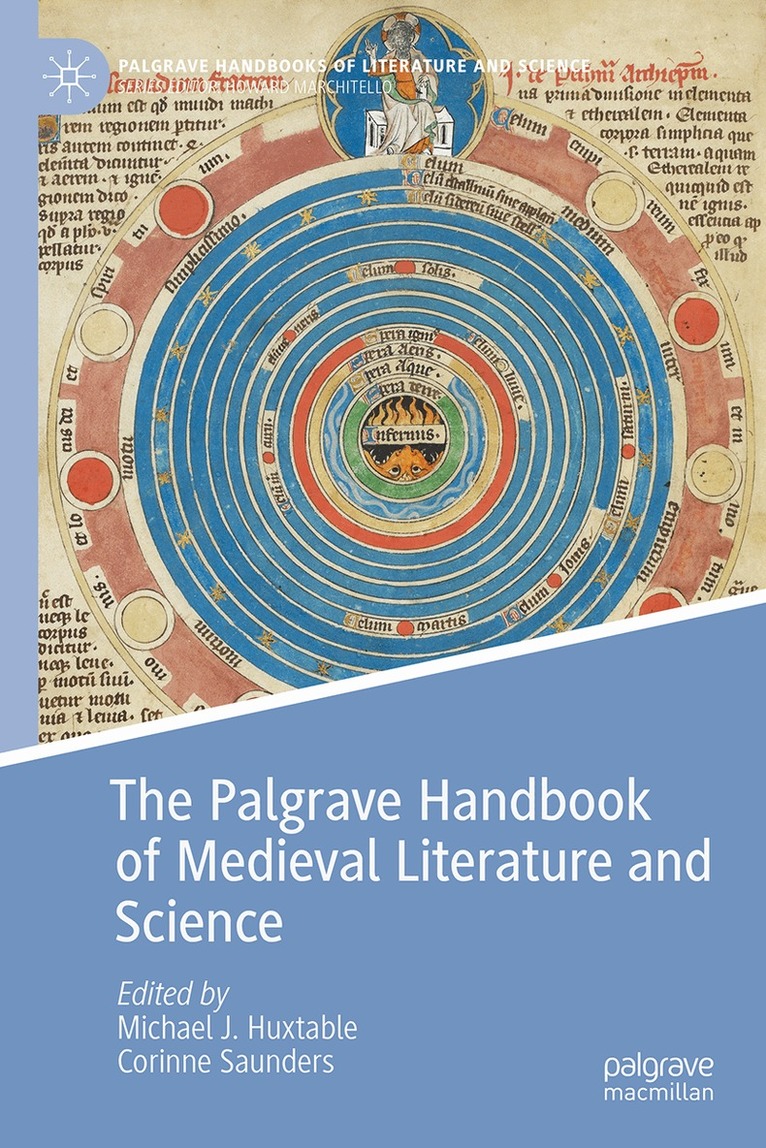
This handbook presents a comprehensive series of originally commissioned essays exploring how key topics in natural philosophy and related discourses (what we now call “science”) from the early medieval period to the fifteenth century were reflected, refracted, and transformed by writers in the Middle Ages working within a range of genres from heroic verse, maxim and riddle to romance, dream vision, moral tale and allegory. The volume spans the fields of astronomy, astrology, and cosmology; physics, mathematics, and metaphysics; geography and meteorology; flora, fauna, and the natural world; and the human body, mind, and medicine. Each section commences with contextual essays by specialists in these disciplines, exploring the key concepts, sources and influences that comprise medieval scientia—the knowledge or understanding acquired by study. Subsequent chapters consider medieval science’s transmission, interpretation, transformation, and recirculation in literary genres and texts from the early medieval period to the fifteenth century. The volume also includes individual case studies treating key authors. While the focus is on English literature and thought, this is situated within a wider international context of cultural exchange, taking account of the classical inheritance, Germanic and Scandinavian traditions, medieval European intellectual culture, and the transmission of knowledge from the Islamic world. Authors illuminate how medieval attitudes to science challenged traditional divisions and binaries and the creative means through which writers across genres drew on ideas related to science and natural philosophy to shape their work. The volume resonates with contemporary ideas concerning the dynamic relationship of human and natural worlds, the nature of embodied being in the world, and the fluidity of animal and human, body and mind, human and technology.“This magnificent panoply of thirty-four essays by a distinguished cast of contributors reminds one of the ambition with which medieval and Renaissance encyclopedists brought together vast amounts of information within a single work. The range of topics covered is impressive indeed, as is the fact that materials in both Latin and several vernaculars are given ample space, thereby ensuring that diverse sources of knowledge are respected. Fine detail and nuance are not lost in the process of reaching general overviews. The writing is cogent, accessible, and appealing. Each chapter offers a significant scholarly contribution in its own right, while opening the door to further study of the given subject. This collection is set fair to be the initial go-to volume for anyone interested in the many intersections of medieval literature and science.”—Alastair Minnis, Douglas Tracy Smith Professor Emeritus of English, Yale University, USA“In The Palgrave Handbook to Medieval Literature and Science, Huxtable and Saunders have assembled a 'who’s who' of medievalists—ranging from early career researchers to éminences grises—who offer a wide-ranging survey of the many ways that premodern scientific learning was represented in literary form, from alchemy and astronomy to medicine and physics. While Old and Middle English literary history has pride of place, chapters on Latin, French, Italian, and Norse literature round out the volume, making it an essential element on the medievalist’s bookshelf.”—Suzanne Conklin Akbari, Professor, Institute for Advanced Study, USA“Engaging and instructive for scholars and general readers alike, this collection of studies illuminates the deep background of a wide range of the imaginative literature of English and the Western Middle Ages. Medieval science, from cosmology to psychology, was grounded in God, but by starting from literary texts this book provides ready access to what at first might seem an alien way of thinking.”—Helen Cooper, Emeritus Professor of Medieval and Renaissance English, University of Cambridge, UK“This is a remarkable volume which manages to skilfully tread that most difficult of fine lines between serious academic rigour and accessibility. The editors are to be highly commended for bringing together and organising 34 wide-ranging chapters from an international field of high calibre scholars working in the area of medieval studies. The task of collating such diverse subjects as astronomy in Old English Boethius, medieval geography and sense experience in Chaucer (to name but a few) might rightly be regarded as herculean, but this volume has pulled it off with considerable panache. I know of no other work that quite so successfully manages to set out and explore the intersection of medieval literature and science and it is surely set to become the go to text on the subject for anyone interested in this area of history.”—Jack P. Cunningham, Professor of Ecclesiastical History, Lincoln Bishop University, UK