Public Worlds - Böcker
Visar alla böcker i serien Public Worlds. Handla med fri frakt och snabb leverans.
13 produkter
13 produkter
298 kr
Skickas inom 10-15 vardagar
A look at citizenship through the lens of performance.In a modern world of vast migrations and relocations, the rights-and rites-of citizenship are increasingly perplexing, and ever more important. This book asks how citizenship is enacted when all the world’s the stage.Kung Fu cinema, soul music, plays, and speeches are some of the media May Joseph considers as expressive negotiations for legal and cultural citizenship. Nomadic Identities combines material culture and historical approaches to forge connections between East Africa, India, Britain, the Caribbean, and the United States in the struggles for democratic citizenship. Exploring the notion of nomadic citizenship as a modern construct, Joseph emphasizes culture as the volatile mise-en-scÈne through which popular conceptions of local and national citizenship emerge. Joseph, an Asian African from Tanzania, brings a personal insight to the question of how citizenship is expressed-particularly the nomadic, conditional citizenship related to histories of migrancy and the tenuous status of immigrants. Nomadic Identities investigates the metaphoric, literal, and performed possibilities available in different arenas of the everyday through which individuals and communities experience citizenship, successfully or not. A unique inquiry into contemporary experiences of migrancy linking Tanzania, Britain, and the United States, this book blends political theory, performance studies, cultural studies, and historical writing. It offers vignettes that describe the official and informal cultural transactions that designate citizenship under the globalizing forces of decolonization, the cold war, and transnational networks.Crossing the globe, Nomadic Identities provides fresh insights into the contemporary phenomena of territorial displacement and the resulting local and transnational movements of people.
252 kr
Skickas inom 7-10 vardagar
Examines the role of imagination in the cultural development of our shrinking world.The world is growing smaller. Every day we hear this idea expressed and witness its reality in our lives-through the people we meet, the products we buy, the foods we eat, and the movies we watch. In this bold look at the cultural effects of a shrinking world, leading cultural theorist Arjun Appadurai places these challenges and pleasures of contemporary life in a broad global perspective. Offering a new framework for the cultural study of globalization, Modernity at Large shows how the imagination works as a social force in today's world, providing new resources for identity and energies for creating alternatives to the nation-state, whose era some see as coming to an end. Appadurai examines the current epoch of globalization, which is characterized by the twin forces of mass migration and electronic mediation, and provides fresh ways of looking at popular consumption patterns, debates about multiculturalism, and ethnic violence. He considers the way images-of lifestyles, popular culture, and self-representation-circulate internationally through the media and are often borrowed in surprising (to their originators) and inventive fashions. Appadurai simultaneously explores and explodes boundaries-between how we imagine the world and how that imagination influences our self-understanding, between social institutions and their effects on the people who participate in them, between nations and peoples that seem to be ever more homogeneous and yet ever more filled with differences. Modernity at Large offers a path to move beyond traditional oppositions between culture and power, tradition and modernity, global and local, pointing out the vital role imagination plays in our construction of the world of today-and tomorrow.
298 kr
Skickas inom 7-10 vardagar
266 kr
Skickas inom 7-10 vardagar
A consideration of what the culture of Hong Kong tells us about the state of the world at the fin-de-siÈcle.On June 30, 1997, Hong Kong as we know it will disappear, ceasing its singular and ambiguous existence as a colonial holdover and becoming part of the People’s Republic of China. In an intriguing and provocative exploration of its cinema, architecture, photography, and literature, Ackbar Abbas considers what Hong Kong, with its unique relations to decolonization and disappearance, can teach us about the future of both the colonial city and the global city. The culture of Hong Kong encompasses Jackie Chan and John Woo, British colonial architecture and postmodern skyscrapers. Ironically, it was not until they were faced with the imposition of Mainland power-with the signing of the Sino-British Joint Agreement in 1984-that the denizens of the colony began the search for a Hong Kong identity. According to Abbas, Hong Kong’s peculiar lack of identity is due to its status as “not so much a place as a space of transit,” whose residents think of themselves as transients and migrants on their way from China to somewhere else. Abbas explores the way Hong Kong’s media saturation changes its people’s experience of space so that it becomes abstract, dominated by signs and images that dispel memory, history, and presence.Hong Kong disappears through simple dualities such as East/West and tradition/modernity. What is missing from a view of Hong Kong as merely a colony is the paradox that Hong Kong has benefited from and made a virtue of its dependent colonial status, turning itself into a global and financial city and outstripping its colonizer in terms of wealth.Combining sophisticated theory and a critical perspective, this rich and thought-provoking work captures the complex situation of the metropolis that is contemporary Hong Kong. Along the way, it challenges, entertains, and makes an important contribution to our thinking about the surprising processes and consequences of colonialism.Copublished with Hong Kong University Press
272 kr
Skickas inom 7-10 vardagar
An exploration of women’s public expression--in China and beyond.How are the public and political lives of Chinese women constrained by states and economies? And how have pockets of women’s consciousness come to be produced in and disseminated from this traditionally masculine milieu? The essays in this volume examine the possibilities for a public sphere for Chinese women, one that would emerge from concrete historical situations and local contexts and also cut across the political boundaries separating the Mainland, Taiwan, Hong Kong, and the West.The challenges of this project are taken up in essays on the legacy of state feminism on the Mainland as contrasted with a grassroots women’s movement in Taiwan; on the role of the capitalist consumer economy in the emerging lesbian movement in Taiwan; and on the increased trafficking of women as brides, prostitutes, and mistresses between the Mainland and wealthy male patrons in Taiwan and Hong Kong. The writers’ examples of masculine domination in the media include the reformulation of Chinese women in Fifth Generation films for a transnational Western male film audience and the portrayal of Mainland women in Taiwanese and Hong Kong media. The contributors also consider male nationalism as it is revealed through both international sports coverage on television and in a Chinese television drama. Other works examine a women’s museum, a telephone hotline in Beijing, the films of Hong Kong filmmaker Ann Hui, the transnational contacts of a Taiwanese feminist organization, the diaspora of Mainland women writers, and the differences between Chinese and Western feminist themes.Contributors: Susan Brownell, U of Missouri; Virginia Cornue; Dai Jinhua, Beijing U; Kathleen Erwin; Elaine Yee Lin Ho, Hong Kong U; Lee Yuan-chen, Tamkang U; Li Xiaojiang, Zhengzhou U and Henan U; Lisa Rofel, U of California, Santa Cruz; Tze-lan Deborah Sang, U of Oregon; Shu-mei Shih, UCLA; Zhang Zhen. ISBN 0-8166-3145-X Cloth $49.95xxISBN 0-8166-3146-8 Paper $19.95x336 pages 9 black-and-white photos 5 7/8 x 9 FebruaryPublic Worlds Series, volume 4Translation inquiries: University of Minnesota Press
272 kr
Skickas inom 7-10 vardagar
In Mexico, as elsewhere, the national space, that network of places where the people interact with state institutions, is constantly changing. How it does so, how it develops, is a historical process-a process that Claudio Lomnitz exposes and investigates in this book, which develops a distinct view of the cultural politics of nation building in Mexico. Lomnitz highlights the varied, evolving, and often conflicting efforts that have been made by Mexicans over the past two centuries to imagine, organize, represent, and know their country, its relations with the wider world, and its internal differences and inequalities. Firmly based on particulars and committed to the specificity of such thinking, this book also has broad implications for how a theoretically informed history can and should be done.An exploration of Mexican national space by way of an analysis of nationalism, the public sphere, and knowledge production, Deep Mexico, Silent Mexico brings an original perspective to the dynamics of national cultural production on the periphery. Its blending of theoretical innovation, historical inquiry, and critical engagement provides a new model for the writing of history and anthropology in contemporary Mexico and beyond.Public Worlds Series, volume 9
313 kr
Skickas inom 7-10 vardagar
Proposes an entirely new socially and politically conscious way of readingAto Quayson explores a practice of reading that oscillates rapidly between domains-the literary-aesthetic, the social, the cultural, and the political-in order to uncover the mutually illuminating nature of these domains. He does this not to assert the often repeated postmodernist view that there is nothing outside the text, but to outline a method of reading he calls calibrations: a form of close reading of literature with what lies beyond it as a way of understanding structures of transformation, process, and contradiction that inform both literature and society.Quayson surveys a wide array of texts-ranging from Bob Marley lyrics, Toni Morrison’s work, Walter Benjamin’s Theses on the Philosophy of History, and Althusser’s reflections on political economy-and treats a broad range of themes: the comparative structures of alienation in literature and anthropology, cultural heroism as a trope in African society and politics, literary tragedy as a template for reading the life and activism of Ken Saro-Wiwa, trauma and the status of citizenship in post-apartheid South Africa, representations of physical disability, and the clash between enchanted and disenchanted time in postcolonial texts.
272 kr
Skickas inom 7-10 vardagar
It is one thing to comprehend how culture makes its way through the world in those cases where something old is reproduced in the same physical shape-where, for example, a song is sung or a story retold. It is another thing altogether, as Greg Urban demonstrates, to think about cultural motion when something new is created-a new song or a new story. And this, the creating of new culture, is the overarching value of the contemporary world, as well as the guiding principle of the capitalist entrepreneur. From the Declaration of Independence to the movie Babe, from the Amazon River to the film studio, from microscopic studies of the words making up myths and books to the large-scale forces of conquest, conversion, and globalization that drive history, Urban follows the clues to a startling revelation: "metaculture" makes the modern, entrepreneurial form of culture possible. In Urban’s work we see how metaculture, in its relationship to newness, explains the peculiar shape of modern society and its institutions, from the prevalence of taste and choice to the processes of the public sphere, to the centrality of persuasion and hegemony within the nation.
272 kr
Skickas inom 7-10 vardagar
A timely look at how our globalized era has reconfigured experiences of belonging.What happens to a sense of belonging when national and regional governments, religious organizations, community groups, political parties, and corporations become unstable and incoherent, as they have in these nationalist and postnationalist times? From a richly interdisciplinary perspective, the authors examine notions of citizenship and cultural hybridization, migration and other forms of mobility, displacements and ethnic cleansing, and the nature of national belonging in a world turning ever more fluid, aided by transnational flows of capital, information, people, and ideas. Contributors: Seyla Benhabib, Yale; John A. Hall, McGill U; Ulf Hannerz, Stockholm U; Jeffrey Herf, U of Maryland; Michael Herzfeld, Harvard; Richard Jenkins, U of Sheffield, UK; Mark Juergensmeyer, U of California, Santa Barbara; Riva Kastoryano, Center for International Studies and Research (CERI), Paris; MichÈle Lamont, Princeton; Benjamin Lee, Rice U; Orvar LÖfgren, U of Lund, Sweden; Philip Schlesinger, U of Stirling, Scotland; Yasemin NuhÕglu Soysal, U of Essex, UK; Ray Taras, Tulane U; James Tully, U of Victoria, British Columbia.
276 kr
Skickas inom 10-15 vardagar
The lack of peace in Sri Lanka is commonly portrayed as a consequence of a violent, ethnonationalist conflict between the Sinhalese majority and the Tamil minority. Viewed in this light, resolution could be attained through conflict management. But, as Qadri Ismail reveals, this is too simplistic an understanding and cannot produce lasting peace. Abiding by Sri Lanka examines how the disciplines of anthropology, history, and literature treat the Sri Lankan ethnic conflict. Anthropology, Ismail contends, approaches Sri Lanka as an object from an "outside" and western point of view. History, addressing the conflict from the "inside," abides by the place and so promotes change that is nationalist and exclusive. Neither of these fields imagines an inclusive community. Literature, Ismail argues, can. With close readings of texts that "abide" by Sri Lanka, texts that have a commitment to it, Ismail demonstrates that the problems in Sri Lanka raise fundamental concerns for us all regarding the relationship between democracies and minorities. Recognizing the structural as well as political tendencies of representative democracies to suppress minorities, Ismail rethinks democracy by redefining the concept of the minority perspective, not as a subject-position of numerical insignificance, but as a conceptual space that opens up the possibility for distinction without domination and, ultimately, peace. Qadri Ismail is associate professor of English at the University of Minnesota. He has also been a journalist in Sri Lanka.
262 kr
Skickas inom 10-15 vardagar
What would an Islamic modernism look like? The question is a pressing one, as cultures rebel against modernity in its almost exclusively European forms. Alev Cinar's groundbreaking examination of contemporary Turkey, which stands at the threshold of East and West, of religious and secular nationalism, explores modernity through daily practices and the social construction of identity and political agency in relation to nationalism, secularism, and Islam. Focusing on developments of the 1990s, Modernity, Islam, and Secularism in Turkey argues that Islamist ideology generated an alternative modernization project, which applied the same strategies and techniques as that of the modernizing state to produce and institutionalize its own version of an equally thorough nationalist program. Using local details and debates - including a fascinating discussion of veiling as symbolic of both the "liberation" of Western appearance and the Islamists' struggle to rescue their nation's culture - Cinar reveals modernity as a transformative intervention in bodies, places, and times.Bringing a much-needed critical theory approach to bear on the politics of an Islamic nation, Cinar's work introduces a new way of conceptualizing modernity based on the analysis of a non-Western context.
276 kr
Skickas inom 10-15 vardagar
Small Nation, Global Cinema engages the effects of globalization from the perspective of small nations. Focusing her study on the specific cultural context of the international film market, Mette Hjort argues that the New Danish Cinema presents an opportunity to understand the effects of globalization within the culture and economy of a privileged small nation. Hjort offers two key strategies underwriting the transformation and globalization of contemporary Danish cinema—the processes of cultural circulation and the psychological efficacy of heritage. Exploring the Dogma 95 movement initiated by Lars von Trier and Thomas Vinterberg as well as films by Erik Clausen, Gabriel Axel, Henning Carlsen, and Ole Bornedal, among others, Hjort examines means for cinematic globalization specific to Denmark, but then evolves her investigation into a truly comparative framework encompassing references to Hong Kong, Latin America, and Hollywood filmmaking. Providing a fresh way of looking at cultural influence in the era of globalization, Hjort's concept of "small" nation points as much to the dynamics of recognition, indifference, and participation as it does to more common measures of population size, economic strength, or linguistic reach. Mette Hjort is professor of intercultural studies at Aalborg University.
289 kr
Skickas inom 10-15 vardagar
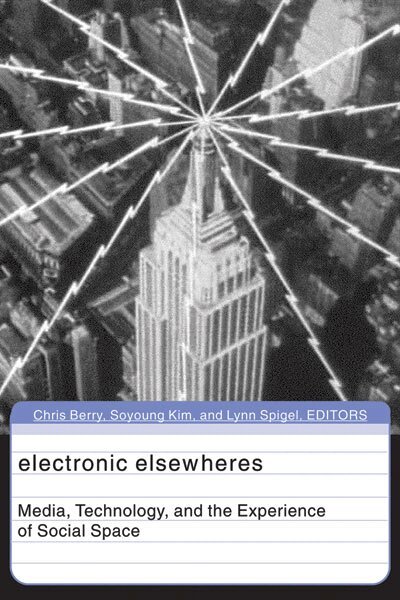
Media do not simply portray places that already exist; they actually produce them. In exploring how world populations experience "place" through media technologies, the essays included here examine how media construct the meanings of home, community, work, nation, and citizenship.Tracing how media reconfigure the boundaries between public and private-and global and local-to create "electronic elsewheres," the essays investigate such spaces and identities as the avatars that women are creating on Web sites, analyze the role of satellite television in transforming Algerian neighborhoods, inquire into the roles of radio and television in Israel and India, and take a skeptical look at the purported novelty of the "new media home."Contributors: Asu Aksoy, Istanbul Bilgi U; Charlotte Brunsdon, U of Warwick; Ratiba Hadj-Moussa, York U (Toronto); Tamar Liebes-Plesner, Hebrew U; David Morley, Goldsmiths, U of London; Lisa Nakamura, U of Illinois; Arvind Rajagopal, New York U; Kevin Robins, Goldsmiths, U of London; Jeffrey Sconce, Northwestern U; Marita Sturken, New York U; and Shunya Yoshimi, U of Tokyo.