Seminars of Jacques Derrida - Böcker
Visar alla böcker i serien Seminars of Jacques Derrida. Handla med fri frakt och snabb leverans.
15 produkter
15 produkter
787 kr
Skickas inom 7-10 vardagar
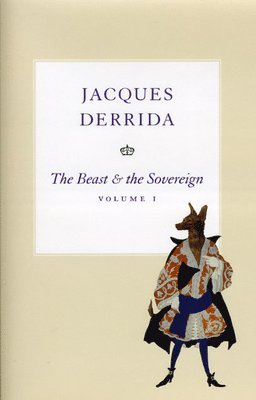
When he died in 2004, Jacques Derrida left behind a vast legacy of unpublished material, much of it in the form of written lectures. With "The Beast and the Sovereign, Volume I", the University of Chicago Press inaugurated an ambitious series, edited by Geoffrey Bennington and Peggy Kamuf, translating these important works into English. This volume, now in paperback, launched the series with Derrida's exploration of the persistent association of animality with sovereignty. "The Beast and The Sovereign" are connected, he contends, because neither animals nor kings are subject to the law - the sovereign stands above it, while the beast falls outside the law from below. An astonishing array of texts - from La Fontaine's fable "The Wolf and the Lamb" to Machiavelli's "Prince" - come into critical play as Derrida focuses in on questions of force, right, justice, and philosophical interpretations of the limits between man and animal.
259 kr
Skickas inom 7-10 vardagar
When he died in 2004, Jacques Derrida left behind a vast legacy of unpublished material, much of it in the form of written lectures. With "The Beast and the Sovereign, Volume I", the University of Chicago Press inaugurated an ambitious series, edited by Geoffrey Bennington and Peggy Kamuf, translating these important works into English. This volume, now in paperback, launched the series with Derrida's exploration of the persistent association of animality with sovereignty. "The Beast and The Sovereign" are connected, he contends, because neither animals nor kings are subject to the law - the sovereign stands above it, while the beast falls outside the law from below. An astonishing array of texts - from La Fontaine's fable "The Wolf and the Lamb" to Machiavelli's "Prince" - come into critical play as Derrida focuses in on questions of force, right, justice, and philosophical interpretations of the limits between man and animal.
330 kr
Skickas inom 7-10 vardagar
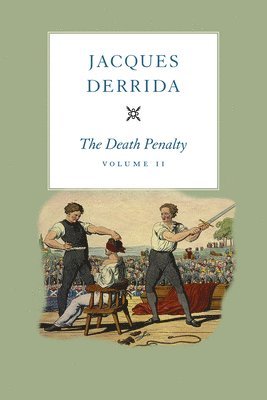
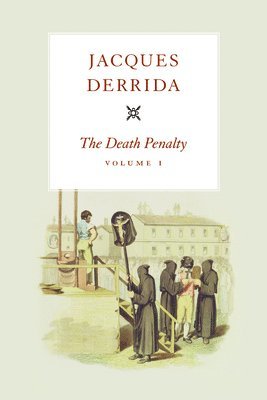
In this newest installment in Chicago's series of Jacques Derrida's seminars, the renowned philosopher attempts one of his most ambitious goals: the first truly philosophical argument against the death penalty. While much has been written against the death penalty, Derrida contends that Western philosophy is massively, if not always obviously, complicit with a logic in which a sovereign state has the right to take a life. Haunted by this notion, he turns to the key places where such logic has been established - and to the place it has been most effectively challenged: literature. With his signature genius and patient yet dazzling readings of an impressive breadth of texts, Derrida examines everything from the Bible to Plato to Camus to Jean Genet, with special attention to Kant and post-World War II juridical texts, to draw the landscape of death penalty discourses. Keeping clearly in view the death rows and execution chambers of the United States, he shows how arguments surrounding cruel and unusual punishment depend on what he calls an "anaesthesial logic," which has also driven the development of death penalty technology from the French guillotine to lethal injection.Confronting a demand for philosophical rigor, he pursues provocative analyses of the shortcomings of abolitionist discourse. Above all, he argues that the death penalty and its attendant technologies are products of a desire to put an end to one of the most fundamental qualities of our finite existence: the radical uncertainty of when we will die. Arriving at a critical juncture in history - especially in the United States, one of the last Christian-inspired democracies to resist abolition - The Death Penalty is both a timely response to an important ethical debate and a timeless addition to Derrida's esteemed body of work.
385 kr
Skickas inom 7-10 vardagar
In the first volume of his extraordinary analysis of the death penalty, Jacques Derrida began a journey toward an ambitious end: the first truly philosophical argument against the death penalty. Exploring an impressive breadth of thought, he traced a deeply entrenched logic throughout the whole of Western philosophy that has justified the state's right to take a life. He also marked literature as a crucial place where this logic has been most effectively challenged. In this second and final volume, Derrida builds on these analyses toward a definitive argument against capital punishment. Of central importance in this second volume is Kant's explicit justification of the death penalty in the Metaphysics of Morals. Thoroughly deconstructing Kant's position which holds the death penalty as exemplary of the eye-for-an-eye Talionic law Derrida exposes numerous damning contradictions and exceptions.Keeping the current death penalty in the United States in view, he further explores the "anesthesial logic" he analyzed in volume one, addressing the themes of cruelty and pain through texts by Robespierre and Freud, reading Heidegger, and in a fascinating, improvised final session the nineteenth-century Spanish Catholic thinker Donoso Cortes. Ultimately, Derrida shows that the rationality of the death penalty as represented by Kant involves an imposition of knowledge and calculability on a fundamental condition of non-knowledge that we don't otherwise know what or when our deaths will be. In this way, the death penalty acts out a phantasm of mastery over one's own death. Derrida's thoughts arrive at a particular moment in history: when the death penalty in the United States is the closest it has ever been to abolition, and yet when the arguments on all sides are as confused as ever. His powerful analysis will prove to be a paramount contribution to this debate as well as a lasting entry in his celebrated oeuvre.
259 kr
Skickas inom 7-10 vardagar
Following on from The Beast and the Sovereign, Volume I, this book extends Jacques Derrida's exploration of the connections between animality and sovereignty. In this second year of the seminar, originally presented in 2002 2003 as the last course he would give before his death, Derrida focuses on two markedly different texts: Heidegger's 1929 1930 course The Fundamental Concepts of Metaphysics, and Daniel Defoe's Robinson Crusoe. As he moves back and forth between the two works, Derrida pursuesthe relations between solitude, insularity, world, violence, boredom and death as they supposedly affect humans and animals in different ways. Hitherto unnoticed or underappreciated aspects of Robinson Crusoe are brought out in strikingly original readings of questions such as Crusoe's belief in ghosts, his learning to pray, his parrot Poll, and his reinvention of the wheel. Crusoe's terror of being buried alive or swallowed alive by beasts or cannibals gives rise to a rich and provocative reflection on death, burial, and cremation, in part provoked by a meditation on the death of Derrida's friend Maurice Blanchot.Throughout, these readings are juxtaposed with interpretations of Heidegger's concepts of world and finitude to produce a distinctively Derridean account that will continue to surprise his readers.
307 kr
Skickas inom 7-10 vardagar
Theory and Practice is a series of nine lectures that Jacques Derrida delivered at the École Normale Supérieure in 1976 and 1977. The topic of “theory and practice” was associated above all with Marxist discourse and particularly the influential interpretation of Marx by Louis Althusser. Derrida’s many questions to Althusser and other thinkers aim at unsettling the distinction between thinking and acting. Derrida’s investigations set out from Marx’s “Theses on Feuerbach,” in particular the eleventh thesis, which has often been taken as a mantra for the “end of philosophy,” to be brought about by Marxist practice. Derrida argues, however, that Althusser has no such end in view and that his discourse remains resolutely philosophical, even as it promotes the theory/practice pair as primary values. This seminar also draws fascinating connections between Marxist thought and Heidegger and features Derrida’s signature reconsideration of the dichotomy between doing and thinking. This text, available for the first time in English, shows that Derrida was doing important work on Marx long before Specters of Marx. As with the other volumes in this series, it gives readers an unparalleled glimpse into Derrida’s thinking at its best—spontaneous, unpredictable, and groundbreaking.
243 kr
Skickas inom 7-10 vardagar
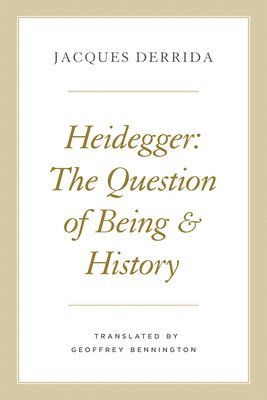
Few philosophers held greater fascination for Jacques Derrida than Martin Heidegger, and in this book we get an extended look at Derrida's first real encounters with him. Delivered over nine sessions in 1964 and 1965 at the cole Normale Sup rieure, these lectures offer a glimpse of the young Derrida first coming to terms with the German philosopher and his magnum opus, Being and Time. They provide not only crucial insight into the gestation of some of Derrida's primary conceptual concerns--indeed, it is here that he first uses, with some hesitation, the word "deconstruction"--but an analysis of Being and Time that is of extraordinary value to readers of Heidegger or anyone interested in modern philosophy. Derrida performs an almost surgical reading of the notoriously difficult text, marrying pedagogical clarity with patient rigor and acting as a lucid guide through the thickets of Heidegger's prose. At this time in intellectual history, Heidegger was still somewhat unfamiliar to French readers, and Being and Time had only been partially translated into French. Here Derrida mostly uses his own translations, giving his own reading of Heidegger that directly challenges the French existential reception initiated earlier by Sartre. He focuses especially on Heidegger's Destruktion (which Derrida would translate both into "solicitation" and "deconstruction") of the history of ontology, and indeed of ontology as such, concentrating on passages that call for a rethinking of the place of history in the question of being, and developing a radical account of the place of metaphoricity in Heidegger's thinking. This is a rare window onto Derrida's formative years, and in it we can already see the philosopher we've come to recognize--one characterized by a bravura of exegesis and an inventiveness of thought that are particularly and singularly his.
393 kr
Skickas inom 7-10 vardagar
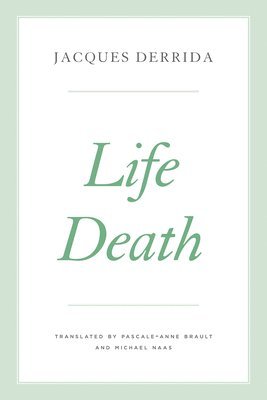
One of Jacques Derrida's richest and most provocative works, Life Death challenges and deconstructs one of the most deeply rooted dichotomies of Western thought: life and death. Here Derrida rethinks the traditional philosophical understanding of the relationship between life and death, undertaking multidisciplinary analyses of a range of topics, including philosophy, linguistics, and the life sciences. In seeking to understand the relationship between life and death, he engages in close readings of Freudian psychoanalysis, the philosophy of Nietzsche and Heidegger, French geneticist Francois Jacob, and epistemologist Georges Canguilhem.Derrida gave his "Life Death" seminar over fourteen sessions between 1975 and 1976 at the Ecole normale superieure in Paris as part of the preparation for students studying for the agregation, a notoriously competitive qualifying exam. The theme for the exam that year was "Life and Death," but Derrida made a critical modification to the title by dropping the coordinating conjunction. The resulting title of Life Death poses a philosophical question about the close relationship between life and death. Derrida argues that death must be considered neither as the opposite of life nor as the truth or fulfillment of it, but rather as that which both limits life and makes it possible. Through these captivating sessions, Derrida thus not only questions traditional understandings of the relationship between life and death, but also ultimately develops a new way of thinking about what he calls "life death."
362 kr
Skickas inom 7-10 vardagar
An inquiry into the problematic of perjury, or lying, and forgiveness from one of the most influential philosophers of the twentieth century. “One only ever asks forgiveness for what is unforgivable.” From this contradiction begins Perjury and Pardon, a two-year series of seminars given by Jacques Derrida at the École des hautes études en sciences sociales in Paris in the late 1990s. In these sessions, Derrida focuses on the philosophical, ethical, juridical, and political stakes of the concept of responsibility. His primary goal is to develop what he calls a “problematic of lying” by studying diverse forms of betrayal: infidelity, denial, false testimony, perjury, unkept promises, desecration, sacrilege, and blasphemy.Although forgiveness is a notion inherited from multiple traditions, the process of forgiveness eludes those traditions, disturbing the categories of knowledge, sense, history, and law that attempt to circumscribe it. Derrida insists on the unconditionality of forgiveness and shows how its complex temporality destabilizes all ideas of presence and even of subjecthood. For Derrida, forgiveness cannot be reduced to repentance, punishment, retribution, or salvation, and it is inseparable from, and haunted by, the notion of perjury. Through close readings of Kant, Kierkegaard, Shakespeare, Plato, Jankélévitch, Baudelaire, and Kafka, as well as biblical texts, Derrida explores diverse notions of the “evil” or malignancy of lying while developing a complex account of forgiveness across different traditions.
362 kr
Skickas inom 7-10 vardagar
An exploration of the political dimensions of forgiveness and repentance from Jacques Derrida. Perjury and Pardon is a two-year seminar series given by Jacques Derrida at the École des hautes études en sciences sociales in Paris during the late 1990s. In these sessions, Derrida focuses on the philosophical, ethical, juridical, and political stakes of the concept of responsibility. His primary goal is to develop what he calls a “problematic of lying” by studying diverse forms of betrayal: infidelity, denial, false testimony, perjury, unkept promises, desecration, sacrilege, and blasphemy.This volume covers the seminar’s second year when Derrida explores the political dimensions of forgiveness and repentance. Over eight sessions, he discusses Hegel, Augustine, Levinas, Arendt, and Benjamin as well as Bill Clinton’s impeachment and Nelson Mandela and Desmond Tutu’s testimonies before the Truth and Reconciliation Commission. The seminars conclude with an extended reading of Henri Thomas’s 1964 novel Le Parjure.
224 kr
Skickas inom 7-10 vardagar
The seventh in our series of Derrida's seminars, Life Death provides interdisciplinary reflections on the relationship of life and death—now in paperback.One of Jacques Derrida’s most provocative works, Life Death deconstructs a deeply rooted dichotomy of Western thought: life and death. In rethinking the relationship between life and death, Derrida undertakes a multi-disciplinary analysis of a range of topics across philosophy, linguistics, and the life sciences. Derrida gave this seminar over fourteen sessions between 1975 and 1976 at the École normale supérieure in Paris to prepare students for the agrégation, a notoriously competitive exam. The theme for the exam that year was “Life and Death,” but Derrida made a critical modification to the title by dropping the coordinating conjunction. The resulting title of Life Death poses a philosophical question about the close relationship between life and death. Through close readings of Freudian psychoanalysis, the philosophy of Nietzsche and Heidegger, French geneticist François Jacob, and epistemologist Georges Canguilhem, Derrida argues that death must be considered neither as the opposite of life nor as the truth or fulfillment of it, but rather as that which both limits life and makes it possible. Derrida thus not only questions traditional understandings of the relationship between life and death but also ultimately develops a new way of thinking about what he calls “life death.”
362 kr
Skickas inom 7-10 vardagar
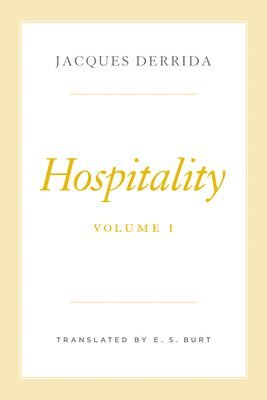
Jacques Derrida explores the ramifications of what we owe to others.Hospitality reproduces a two-year seminar series delivered by Jacques Derrida at the École des hautes études en sciences sociales in Paris between 1995 and 1997. In these lectures, Derrida asks a series of related questions about responsibility and “the foreigner”: How do we welcome or turn away the foreigner? What does the idea of the foreigner reveal about kinship and the state, particularly in relation to friendship, citizenship, migration, asylum, assimilation, and xenophobia? Derrida approaches these questions through readings of several classical texts as well as modern texts by Heidegger, Arendt, Camus, and others. Central to his project is a rigorous distinction between conventional, finite hospitality, with its many conditions, and the aspirational idea of hospitality as something offered unconditionally to the stranger. This volume collects the first year of the seminar.
243 kr
Skickas inom 7-10 vardagar
Now in paperback, nine lectures from Jacques Derrida that challenge the influential Marxist distinction between thinking and acting.Theory and Practice is a series of nine lectures that Jacques Derrida delivered at the École Normale Supérieure in 1976 and 1977. The topic of “theory and practice” was associated above all with Marxist discourse and particularly the influential interpretation of Marx by Louis Althusser. Derrida’s many questions to Althusser and other thinkers aim at unsettling the distinction between thinking and acting. Derrida’s investigations set out from Marx’s “Theses on Feuerbach,” in particular the eleventh thesis, which has often been taken as a mantra for the “end of philosophy,” to be brought about by Marxist practice. Derrida argues, however, that Althusser has no such end in view and that his discourse remains resolutely philosophical, even as it promotes the theory/practice pair as primary values. This seminar also draws fascinating connections between Marxist thought and Heidegger and features Derrida’s signature reconsideration of the dichotomy between doing and thinking. This text, available for the first time in English, shows that Derrida was doing important work on Marx long before Specters of Marx. As with the other volumes in this series, it gives readers an unparalleled glimpse into Derrida’s thinking at its best—spontaneous, unpredictable, and groundbreaking.
362 kr
Skickas inom 7-10 vardagar
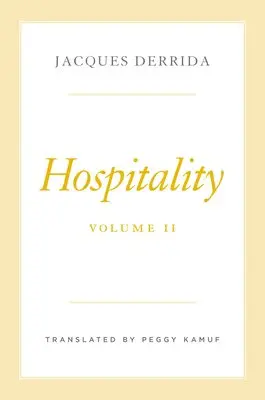
Jacques Derrida explores the ramifications of what we owe to others.Hospitality reproduces a two-year seminar series delivered by Jacques Derrida at the École des hautes études en sciences sociales in Paris between 1995 and 1997. In these lectures, Derrida asks a series of related questions about responsibility and “the foreigner”: How do we welcome or turn away the foreigner? What does the idea of the foreigner reveal about kinship and the state, particularly in relation to friendship, citizenship, migration, asylum, assimilation, and xenophobia? Central to his project is a rigorous distinction between conventional, finite hospitality, with its many conditions, and the aspirational idea of hospitality as something offered unconditionally to the stranger. This volume collects the second year of the seminar, which considers an Islamic problematic of hospitality, the relevance of forgiveness, and the work of Emmanuel Levinas.
519 kr
Kommande
Jacques Derrida explores the ramifications of what we owe to others.Hospitality reproduces a two-year seminar series delivered by Jacques Derrida at the École des hautes études en sciences sociales in Paris between 1995 and 1997. In these lectures, Derrida asks a series of related questions about responsibility and “the foreigner”: How do we welcome or turn away the foreigner? What does the idea of the foreigner reveal about kinship and the state, particularly in relation to friendship, citizenship, migration, asylum, assimilation, and xenophobia? Derrida approaches these questions through readings of several classical texts as well as modern texts by Heidegger, Arendt, Camus, and others. Central to his project is a rigorous distinction between conventional, finite hospitality, with its many conditions, and the aspirational idea of hospitality as something offered unconditionally to the stranger. This volume collects the first year of the seminar.