Geoffrey Bennington - Böcker
Visar alla böcker från författaren Geoffrey Bennington. Handla med fri frakt och snabb leverans.
15 produkter
15 produkter
350 kr
Skickas inom 7-10 vardagar
Geoffrey Bennington sets out here to write a systematic account of the thought of Jacques Derrida. Responding to Bennington's text at every turn is Derrida's own, excerpts from his life and thought that resist circumscription. Together these texts, as a dialogue and a contest, constitute a critical introduction to one of the leading philosophers of the 20th century. Bennington's account of Derrida leads the reader through the philosopher's work on language and writing, and through more mysterious themes of signature, sexual difference, law, and affirmation. Seeking to escape this systematic rendering - in fact, to prove it impossible - Derrida interweaves Bennington's text with surprising and disruptive "periphrases": reflections on his mother's death agony, commentaries on St. Augustine's "Confessions", memories of childhood, remarks on Judaism, and references to his collaborator's efforts.
306 kr
Skickas inom 7-10 vardagar
Theory and Practice is a series of nine lectures that Jacques Derrida delivered at the École Normale Supérieure in 1976 and 1977. The topic of “theory and practice” was associated above all with Marxist discourse and particularly the influential interpretation of Marx by Louis Althusser. Derrida’s many questions to Althusser and other thinkers aim at unsettling the distinction between thinking and acting. Derrida’s investigations set out from Marx’s “Theses on Feuerbach,” in particular the eleventh thesis, which has often been taken as a mantra for the “end of philosophy,” to be brought about by Marxist practice. Derrida argues, however, that Althusser has no such end in view and that his discourse remains resolutely philosophical, even as it promotes the theory/practice pair as primary values. This seminar also draws fascinating connections between Marxist thought and Heidegger and features Derrida’s signature reconsideration of the dichotomy between doing and thinking. This text, available for the first time in English, shows that Derrida was doing important work on Marx long before Specters of Marx. As with the other volumes in this series, it gives readers an unparalleled glimpse into Derrida’s thinking at its best—spontaneous, unpredictable, and groundbreaking.
243 kr
Skickas inom 7-10 vardagar
A significant event in Derrida scholarship, this book marks the first publication of his long-lost philosophical text known only as "Geschlecht III." The third, and arguably the most significant, piece in his four-part Geschlecht series, it fills a gap that has perplexed Derrida scholars. The series centers on Martin Heidegger and the enigmatic German word Geschlecht, which has several meanings pointing to race, sex, and lineage. Throughout the series, Derrida engages with Heidegger's controversial oeuvre to tease out topics of sexual difference, nationalism, race, and humanity. In Geschlecht III, he calls attention to Heidegger's problematic nationalism, his work's political and sexual themes, and his promise of salvation through the coming of the "One Geschlecht," a sentiment that Derrida found concerningly close to the racial ideology of the Nazi party.Amid new revelations about Heidegger's anti-Semitism and the contemporary context of nationalist resurgence, this third piece of the Geschlecht series is timelier and more necessary than ever. Meticulously edited and expertly translated, this volume brings Derrida's mysterious and much awaited text to light.
243 kr
Skickas inom 7-10 vardagar
Now in paperback, nine lectures from Jacques Derrida that challenge the influential Marxist distinction between thinking and acting.Theory and Practice is a series of nine lectures that Jacques Derrida delivered at the École Normale Supérieure in 1976 and 1977. The topic of “theory and practice” was associated above all with Marxist discourse and particularly the influential interpretation of Marx by Louis Althusser. Derrida’s many questions to Althusser and other thinkers aim at unsettling the distinction between thinking and acting. Derrida’s investigations set out from Marx’s “Theses on Feuerbach,” in particular the eleventh thesis, which has often been taken as a mantra for the “end of philosophy,” to be brought about by Marxist practice. Derrida argues, however, that Althusser has no such end in view and that his discourse remains resolutely philosophical, even as it promotes the theory/practice pair as primary values. This seminar also draws fascinating connections between Marxist thought and Heidegger and features Derrida’s signature reconsideration of the dichotomy between doing and thinking. This text, available for the first time in English, shows that Derrida was doing important work on Marx long before Specters of Marx. As with the other volumes in this series, it gives readers an unparalleled glimpse into Derrida’s thinking at its best—spontaneous, unpredictable, and groundbreaking.
756 kr
Skickas inom 10-15 vardagar
One of the most significant contemporary thinkers in continental philosophy, Jacques Derrida’s work continues to attract heated commentary among philosophers, literary critics, social and cultural theorists, architects and artists. This major new work by world renowned Derrida scholar and translator, Geoffrey Bennington, presents incisive new readings of both Derrida and interpretations of his work.Part one sets out Derrida’s work as a whole and examines its relevance to, and ‘interruption’ of, the traditional domains of ethics, politics and literature. The second part of the book presents compelling insights into some important motifs in Derrida’s work, such as death, friendship, psychoanalysis, time and endings. The final section introduces trenchant appraisals of other influential accounts of Derrida’s work. This influential and original contribution to the literature on Derrida is marked by a commitment to clarity and accuracy, but also by a refusal to simplify Derrida’s often difficult thought.
321 kr
Skickas inom 11-20 vardagar
This book, newly available in paperback, gathers essays written by Geoffrey Bennington since the death of his friend Jacques Derrida in 2004. All continue the ongoing work of elucidating difficult and complex thought, often enough with reference to Derrida's persistent interrogation of the concepts of life and death, mourning and melancholia, and what he sometimes calls 'half-mourning'. Not Half No End relates this 'ethical' interruption of mourning to the persistent but still ill-understood motif of interrupted teleology, which, it is argued here, is definitive of deconstruction in general. This suspension or interruption of the end (which is none other than differance 'itself') has all manner of consequences for our thinking, and for how we attempt to categorize that thinking (as epistemological, ethical, political or aesthetic, for example). Not Half No End moves through all these domains, and the whole of Derrida's rich and varied corpus, in a weave of styles - from the expository and analytic to the autobiographical and confessional - in the ongoing process of deconstruction.Key Features* New collection of essays by major theorist* Expanded readings of late texts by Derrida* Research monograph on mourning and melancholy* First consideration of the legacy of Derrida by a co-author
1 520 kr
Skickas inom 7-10 vardagar
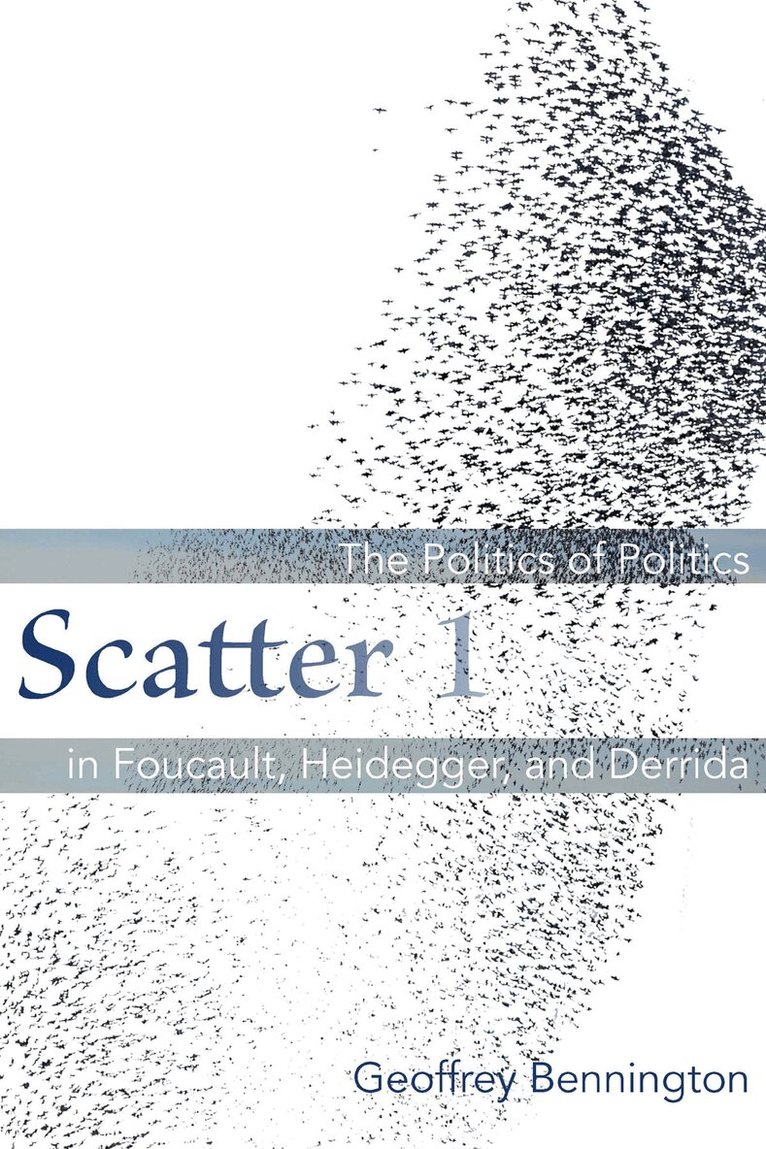
What if political rhetoric is unavoidable, an irreducible part of politics itself? In contrast to the familiar denunciations of political horse-trading, grandstanding, and corporate manipulation from those lamenting the crisis in liberal democracy, this book argues that the "politics of politics," usually associated with rhetoric and sophistry, is, like it or not, part of politics from the start.Denunciations of the sorry state of current politics draw on a dogmatism and moralism that share an essentially metaphysical and Platonic ground. Failure to deconstruct that ground generates a philosophically and politically debilitating selfrighteousness that this book attempts to understand and undermine.After a detailed analysis of Foucault's influential late concept of parrhesia, which is shown to be both philosophically and politically insufficient, close readings of Heidegger, Kierkegaard, and Derrida trace complex relations between sophistry, rhetoric, and philosophy; truth and untruth; decision; madness and stupidity in an exploration of the possibility of developing an affirmative thinking of politics that is not mortgaged to the metaphysics of presence.It is suggested that Heidegger's complex accounts of truth and decision must indeed be read in close conjunction with his notorious Nazi commitments but nevertheless contain essential insights that many strident responses to those commitments ignore or repress. Those insights are here developed—via an ambitious account of Derrida's often misunderstood interruption of teleology—into a deconstructive retrieval of the concept of dignity.This lucid and often witty account of a crucial set of developments in twentieth-century thought prepares the way for a more general re-reading of the possibilities of political philosophy that will be undertaken in Volume 2 of this work, under the sign of an essential scatter that defines the political as such.
462 kr
Skickas inom 7-10 vardagar
What if political rhetoric is unavoidable, an irreducible part of politics itself? In contrast to the familiar denunciations of political horse-trading, grandstanding, and corporate manipulation from those lamenting the crisis in liberal democracy, this book argues that the "politics of politics," usually associated with rhetoric and sophistry, is, like it or not, part of politics from the start.Denunciations of the sorry state of current politics draw on a dogmatism and moralism that share an essentially metaphysical and Platonic ground. Failure to deconstruct that ground generates a philosophically and politically debilitating selfrighteousness that this book attempts to understand and undermine.After a detailed analysis of Foucault's influential late concept of parrhesia, which is shown to be both philosophically and politically insufficient, close readings of Heidegger, Kierkegaard, and Derrida trace complex relations between sophistry, rhetoric, and philosophy; truth and untruth; decision; madness and stupidity in an exploration of the possibility of developing an affirmative thinking of politics that is not mortgaged to the metaphysics of presence.It is suggested that Heidegger's complex accounts of truth and decision must indeed be read in close conjunction with his notorious Nazi commitments but nevertheless contain essential insights that many strident responses to those commitments ignore or repress. Those insights are here developed—via an ambitious account of Derrida's often misunderstood interruption of teleology—into a deconstructive retrieval of the concept of dignity.This lucid and often witty account of a crucial set of developments in twentieth-century thought prepares the way for a more general re-reading of the possibilities of political philosophy that will be undertaken in Volume 2 of this work, under the sign of an essential scatter that defines the political as such.
1 567 kr
Skickas inom 11-20 vardagar
Frontier: the border between two countries; the limits of civilization; the bounds of established knowledge; a new field of activity. At a time when all borders, boundaries, margins, and limits are being—often violently—challenged, erased, or reinforced, we must rethink the concept of frontier itself. But is there even such a concept? Through an original and imaginative reading of Kant, Geoffrey Bennington casts doubt upon the conceptual coherence of borders.The frontier is the very element of Kant's thought yet the permanent frustration of his conceptuality. Bennington brings out the frontier's complex, abyssal, fractal structure that leaves a residue of violence in every frontier and complicates Kant's most rational arguments in the direction of cosmopolitanism and perpetual peace.Neither a critique of Kant nor a return to Kant, this book proposes a new reflection on philosophical reading, for which thinking the frontier is both essential and a recurrent, fruitful, interruption.
462 kr
Skickas inom 7-10 vardagar
Frontier: the border between two countries; the limits of civilization; the bounds of established knowledge; a new field of activity. At a time when all borders, boundaries, margins, and limits are being—often violently—challenged, erased, or reinforced, we must rethink the concept of frontier itself. But is there even such a concept? Through an original and imaginative reading of Kant, Geoffrey Bennington casts doubt upon the conceptual coherence of borders.The frontier is the very element of Kant's thought yet the permanent frustration of his conceptuality. Bennington brings out the frontier's complex, abyssal, fractal structure that leaves a residue of violence in every frontier and complicates Kant's most rational arguments in the direction of cosmopolitanism and perpetual peace.Neither a critique of Kant nor a return to Kant, this book proposes a new reflection on philosophical reading, for which thinking the frontier is both essential and a recurrent, fruitful, interruption.
1 695 kr
Skickas inom 10-15 vardagar
This book deconstructs the whole lineage of political philosophy, showing the ways democracy abuts and regularly undermines the sovereignist tradition across a range of texts from the Iliad to contemporary philosophy.Politics is an object of perennial difficulty for philosophy—as recalcitrant to philosophical mastery as is philosophy's traditional adversary, poetry. That difficulty makes it an attractive topic for any deconstructive approach to the tradition from which we inherit our language and our concepts. Scatter 2 pursues that deconstruction, often starting with, and sometimes departing from, the work of Jacques Derrida by attending to the concepts of sovereignty on the one hand and democracy on the other. The book begins by following the fate of a line from Homer's Iliad, where Odysseus asserts that "the rule of many is no good thing, let there be one ruler, one king." The line, Bennington shows, is quoted, misquoted, and progressively Christianized by Aristotle, Philo Judaeus, Suetonius, the early Church Fathers, Aquinas, Dante, Ockham, Marsilius of Padua, Jean Bodin, Etienne de la Boétie, up to Carl Schmitt and Erik Peterson, and even one of the defendants at the Nuremberg trials, before being discussed by Derrida himself. In the book's second half, Bennington begins again with Plato and Aristotle and tracks the concept of democracy as it regularly abuts and undermines that sovereignist tradition. In detailed readings of Hobbes and Rousseau, Bennington develops a notion of "proto-democracy" as a possible name for the scatter that underlies and drives the political as such and that will always prevent politics from achieving its aim of bringing itself to an end.
359 kr
Skickas
This book deconstructs the whole lineage of political philosophy, showing the ways democracy abuts and regularly undermines the sovereignist tradition across a range of texts from the Iliad to contemporary philosophy.Politics is an object of perennial difficulty for philosophy—as recalcitrant to philosophical mastery as is philosophy's traditional adversary, poetry. That difficulty makes it an attractive topic for any deconstructive approach to the tradition from which we inherit our language and our concepts. Scatter 2 pursues that deconstruction, often starting with, and sometimes departing from, the work of Jacques Derrida by attending to the concepts of sovereignty on the one hand and democracy on the other. The book begins by following the fate of a line from Homer's Iliad, where Odysseus asserts that "the rule of many is no good thing, let there be one ruler, one king." The line, Bennington shows, is quoted, misquoted, and progressively Christianized by Aristotle, Philo Judaeus, Suetonius, the early Church Fathers, Aquinas, Dante, Ockham, Marsilius of Padua, Jean Bodin, Etienne de la Boétie, up to Carl Schmitt and Erik Peterson, and even one of the defendants at the Nuremberg trials, before being discussed by Derrida himself. In the book's second half, Bennington begins again with Plato and Aristotle and tracks the concept of democracy as it regularly abuts and undermines that sovereignist tradition. In detailed readings of Hobbes and Rousseau, Bennington develops a notion of "proto-democracy" as a possible name for the scatter that underlies and drives the political as such and that will always prevent politics from achieving its aim of bringing itself to an end.
314 kr
Skickas inom 3-6 vardagar
Written by Jacques Derrida's leading English-language translator and collaborator, this invigorating and intelligent volume displays the continuing power and versatility of deconstruction, presenting it as the most important intellectual movement of our time. Geoffrey Bennington develops a devastating critique of many attempts to clarify or criticize deconstructive thought, and elaborates its potential through original readings of, amongst others, Rousseau, Kant, Hegel, Freud, De Man and Lyotard. While he is principally concerned with a defence of deconstruction in fields where it has long since demonstrated its critical prowess, Bennington also emphasizes its political dimension. Deconstruction is a political thinking, he argues, because it entails an irreducible opening to alterity (if only in the form of reading); and this opening, where the other always might arrive as an event on the frontier of my experience, is a place for legislation.
2 009 kr
Skickas inom 3-6 vardagar
In two volumes, Geoffrey Bennington and Kas Saghafi present the majority of Jacques Derrida’s untranslated, and previously uncollected, essays and interviews. Dating mostly from 1992 to 2004, these writings offer a fuller picture of Derrida’s biography, theoretical engagements and the stakes of his social and political investments. In the interviews in Essays, Interviews, and Interventions by Jacques Derrida: Thinking What Comes, Volume 1, Derrida proposes the foundation of a new European political culture, discusses the strengths of Nelson Mandela, and reflects on the archive. He also considers his experience of political life, his relationship to institutions (particularly the Collège international de philosophie), and his views on ‘intellectualism’. Whether writing about public health, Palestine, or the notion of the promise, Derrida is razor-sharp and impassioned. These volumes allow significant insight into his mature thought.
1 311 kr
Skickas inom 7-10 vardagar
In two volumes, Geoffrey Bennington and Kas Saghafi present the majority of Jacques Derrida’s untranslated, and previously uncollected, essays and interviews. Dating mostly from 1992 to 2004, these writings offer a fuller picture of Derrida’s biography, theoretical engagements and the stakes of his social and political investments. Institutions, Inventions, and Inscriptions by Jacques Derrida: Thinking What Comes, Volume 2 collects Derrida’s writings on friends including Emmanuel Levinas, Alain David, Louis Marin, Marie-Louise Mallet, Safaa Fathy, Mathieu Bénézet and Jos Joliet. It also features interviews that illuminate his experience at school, his writing habits, the relation he saw between philosophical discourse to the ‘poetic’, and his views on the singularity of literature and fiction. Whether writing about racism and anti-Semitism, filiation and fidelity, or hospitality and responsibility, Derrida is razor-sharp and impassioned. These volumes allow significant insight into his mature thought.