SUNY series on the Sublime - Böcker
Visar alla böcker i serien SUNY series on the Sublime. Handla med fri frakt och snabb leverans.
5 produkter
5 produkter
463 kr
Tillfälligt slut
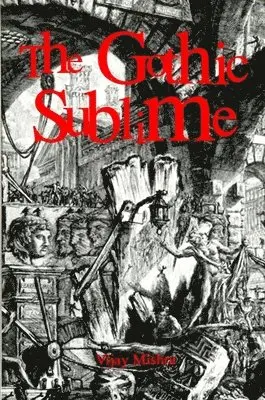
This book reads the Gothic corpus with a thoroughly postmodern critical apparatus, pointing out that the Gothic Sublime anticipates our own doomed desire to pass beyond the hyperreal. A highly sophisticated theoretical reading of key texts of the Gothic, this book allows the reader to re-live the Gothic, not simply as a nostalgic relic or a pre-romantic aberration, but as a living presence that has strong resonances with the postmodern condition.
440 kr
Tillfälligt slut
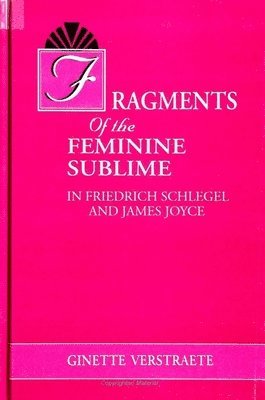
Traces the early German Romantic origins of Joyce's modern and postmodern innovation of the novel.This is the first book to extensively study Joyce's work in the context of Germanic Romantic literary theory. It illustrates how Joyce's modern and postmodern innovation of the novel finds its theoretical roots in Friedrich Schlegel's conception of the Romantic, fragmentary novel. Verstraete discusses the relevance of Schlegel's early Romanticism to the young Joyce's essays on symbolic-realistic drama and argues that what has traditionally been described as Joyce's personal appropriation of Hegel's dialectics can better be understood in terms of Schlegel's ironic approach to philosophy. She relates Schlegel's concepts of irony and of the fragment to his feminist critique of nineteenth-century bourgeois art, and of Kant's categories of the beautiful and the sublime. She argues that Schlegel's ironization of the sublime yields a rhetorical subversion of the opposition between male artist and female model, art and reality, as well as between the sublime and the beautiful. Verstraete illustrates this critical and political force of what she calls the "feminine sublime" at work in Schlegel's essays on Greek comedy and in his novel Lucinde. The book demonstrates how the Romantic (feminine) sublime, as the site where autonomous art generates its own critique, offers us the tools with which to interpret Joyce's postmodern innovations of Romantic art.
440 kr
Tillfälligt slut
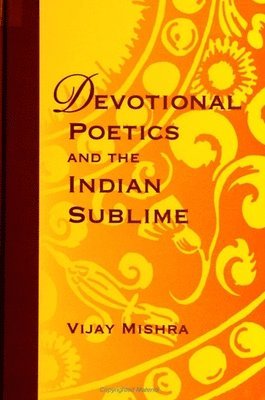
Combines Western theories of the sublime (from Longinus to Lyotard) with indigenous Indian modes of reading in order to construct a comprehensive theory of both the Indian sublime and Indian devotional verse.The last two decades of the twentieth century have been marked by an immense revival of interest in the sublime. The sublime has been periodized (and "trans-periodized"), gendered, politicized, and even made into a commodity with specific social and economic effects. Yet past studies have used Western texts as their archives. This book dramatically shifts the focus by examining a major instance of a non-Western sublime: the Hindu Brahman.Devotional Poetics and the Indian Sublime examines European theories of the sublime, reads them off against contemporary critical uses of the term (notably by Lyotard and Paul de Man), and proposes that the Hindu Brahman constitutes an instance of one of the most fully developed of all sublimes. Mishra argues that the negative aesthetics of Brahman (and the largely decentered rhetoric of Hinduism generally) is part of this massive culture's use of the category of the sublime (and not the beautiful) to speak about a moment when the mind is confronted with an idea too large to be presented to consciousness. The book then examines the case of one of India's dominant literary genres-devotional verse-to show that once the category of the sublime is grasped (or seen as the undertheorized category of Indian aesthetics), it soon becomes clear that this massive genre is also predicated upon Brahman, the Absolute, as the sublime object of (impossible) desire. It is the first book to offer a comprehensive theory of both the Indian sublime and Indian devotional verse.
562 kr
Tillfälligt slut
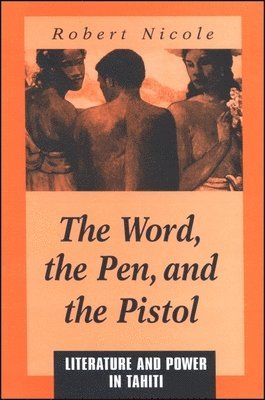
This postcolonial study explores the Western myth of Tahiti as a paradise, as well as the complex and diverse ways the Maohi people have responded to this myth.The Word, The Pen, and the Pistol explores the relationships between history, power, knowledge, and certain cultural productions such as literature in colonial and postcolonial contexts. Borrowing from the theoretical works of Michel Foucault and Edward Said, the book reveals in the French colonial territory of French Polynesia the complicit relationship between imperialism and colonial texts, between the image of Tahiti as "paradise on earth" and other instruments of management, and between discourses such as the "Noble Savage" and various technologies of discipline and ordering. In particular, the book discusses the role that such men as Buffon, Rousseau, Bouganville, Loti, Gauguin, and Gobineau and institutions such as science, phrenology, scholarship, racism, travel literature, education, and tourism played in creating, supporting, authorizing, disseminating and enforcing certain images of the Polynesian. The book simultaneously details the complex and diverse responses of Maohi people to these romanticized Western discourses and reconstructs the spaces used by them to inscribe their resistance.
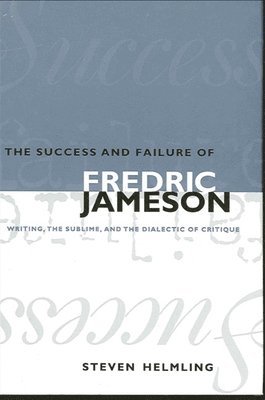
Success and Failure of Fredric Jameson
Writing, the Sublime, and the Dialectic of Critique
Häftad, Engelska, 2000
394 kr
Skickas inom 11-20 vardagar
A critical overview of the work of Fredric Jameson, with an emphasis on his notoriously difficult writing style.This is the first book to provide a critical overview of the work and career, as a whole, of the Marxist culture-critic Fredric Jameson, foremost among American intellectuals and a vanguard figure in the "theory movement" of the past three decades. Steven Helmling identifies major themes and traces both continuity and change in Jameson's engagement with the challenges presented by continental theory from the 1950s to the present. Instead of approaching Jameson's work by circumventing his notoriously difficult writing style, as many have chosen to do, Helmling takes at face value Jameson's insistence that the success and failure of critique are conditioned on how it is written. Jameson insists on a "dialectical prose" that not merely analyzes but enacts or performs the contradictions of its subjects, resulting in an agitating, dramatic, and compelling style that questions the very success or failure of critique itself. Style is thus regarded both as a salient feature of the writing, and as a problem for critical practice in general. Besides illuminating an oeuvre that's far from fully understood, the book makes a timely contribution to the current, "What was theory?" discussion.