• Fri frakt över 249 kr
  • •
  • Snabba leveranser
  • •
  • Billiga böcker
Kundservice

Du är på sajten för privatpersoner.

Företag, bibliotek eller offentlig verksamhet?

Du handlar på classic.bokus.com, där alla dina funktioner finns intakta.
Till classic.bokus.com
Bokus logotyp. Gå till startsidan.
  • Erbjudanden
  • Nyheter
  • Student
  • Topplistor
  • Barn & ungdom
  • Bokus Play
  • E-böcker
  • Pocketböcker
  • Spel & pussel

10% rabatt på allt med kod: NYSTART10 →

Sidfot

Mina sidor

    Hjälp

    • Kundservice
    • Vanliga frågor och svar
    • Frakt och leverans
    • Retur vid ångerrätt
    • Reklamera vara
    • Betalning
    • Köpvillkor
    • Allmänna villkor
    • Information om webbplatsens tillgänglighet

    Om Bokus

    • Om oss
    • Pressrum
    • För studenter
    • För företag
    • För bibliotek och offentlig verksamhet
    • För leverantörer
    • Hållbarhet

    Populärt

    • Aktuella erbjudanden
    • Presentkort
    • Studentlitteratur
    • Nya böcker
    • Topplistor
    • Signerade böcker
    • Engelska böcker

    Inspiration

    • Boktips
    • BookTok
    • Populära bokserier
    • Barnbokskaraktärer
    • Populära författare
    Logotyp för Bokus
    Följ oss på Facebook (extern länk)Följ oss på Instagram (extern länk)Följ oss på YouTube (extern länk)Följ oss på TikTok (extern länk)
    bokus @ CookiesAnpassa cookiesIntegritetspolicyKöpvillkor
    Till Citymail hemsida (extern länk)Till Budbee hemsida (extern länk)Till Postnord hemsida (extern länk)Till Schenker hemsida (extern länk)Till Early Bird hemsida (extern länk)Till Walleys hemsida (extern länk)
    1. Skönlitteratur
    2. Litteraturvetenskap

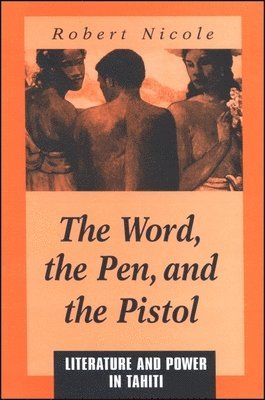
    Word Pen, and the Pistol

    Literature and Power in Tahiti

    AvRobert Nicole

    Häftad, Engelska, 2000

    Del i serien SUNY series on the Sublime

    447 kr

    Tillfälligt slut

    Beskrivning

    This postcolonial study explores the Western myth of Tahiti as a paradise, as well as the complex and diverse ways the Maohi people have responded to this myth.The Word, The Pen, and the Pistol explores the relationships between history, power, knowledge, and certain cultural productions such as literature in colonial and postcolonial contexts. Borrowing from the theoretical works of Michel Foucault and Edward Said, the book reveals in the French colonial territory of French Polynesia the complicit relationship between imperialism and colonial texts, between the image of Tahiti as "paradise on earth" and other instruments of management, and between discourses such as the "Noble Savage" and various technologies of discipline and ordering. In particular, the book discusses the role that such men as Buffon, Rousseau, Bouganville, Loti, Gauguin, and Gobineau and institutions such as science, phrenology, scholarship, racism, travel literature, education, and tourism played in creating, supporting, authorizing, disseminating and enforcing certain images of the Polynesian. The book simultaneously details the complex and diverse responses of Maohi people to these romanticized Western discourses and reconstructs the spaces used by them to inscribe their resistance.

    Produktinformation

    • Utgivningsdatum:2000-11-02
    • Mått:150 x 228 x 15 mm
    • Vikt:340 g
    • Format:Häftad
    • Språk:Engelska
    • Serie:SUNY series on the Sublime
    • Antal sidor:240
    • Förlag:State University of New York Press
    • ISBN:9780791447406

    Utforska kategorier

    • Litteraturvetenskap inom Skönlitteratur
    • Kulturvetenskap inom Samhälle och politik

    Mer om författaren

    Robert Nicole is Lecturer in History/Politics at the University of the South Pacific, Suva, Fiji.

    Recensioner i media

    "Those who have thought of Tahiti and other Pacific places as vacation paradises will be forced by Nicole's book into introspection about the nature, genealogies, and tenacity of Pacific Island fantasies and desires. That is, this book will make it impossible to look at Tahiti the same way, and will be useful in forcing the reader to rethink Pacific discourses in other contexts. Nicole's work is invaluable in keeping its gaze squarely on the mechanisms of colonialism from the point of contact to the present. He shows in as concrete a way as possible how Tahiti has been made into an abstraction, or a degrading sexist and racist tourist fantasy." — Paul Lyons, University of Hawaii at Manoa

    Innehållsförteckning

    • Acknowledgments 1. Discourse or Intercourse: The Political Economy of Truth 2. Tracing the Myth of TahitiIslands, Paradise, and the WestUtopias and Noble SavagesEmerging Discourses of the South Pacific OtherBuffon and Rousseau: Science, Philosophy, and Racism 3. Bougainville: Actualizing TahitiDescription: Island Gardens and Fair FemalesAnalysis: Laboratories and Guinea Pigs 4. Discursive Sedimentation: Enchantment and RacismAn Interlude with the SavageLawyers, Journalists, Theologians, and Plagiarizers: Salon LiteratureA Piece of Wood in One Hand, a Dagger in the OtherGunboat Diplomacy in Tahiti and Exotic Literature in Paris 5. Dreamers and PilgrimsAnthropology, Business, and GunsLoti: Desiring the OtherGauguin: Inscribing the OtherSegalen: Speaking for the Other 6. (De)Regulating the MythAssimilation: Institutional Control and the Colonization of the MindAuthoritative Reports and Poetic Songs: Two Sides of the Same CoinTOMB: Tourism, Media, and the Bomb 7. Toward a Literature of LiberationCollaboration or ResistanceWriting: Technological Colonialism or Collective EmpowermentMaohi Literature in FrenchThe Vahine RepliesToward a Literature of Liberation NotesBibliographyIndex