The Cambridge History of Classical Literature – serie
Visar alla böcker i serien The Cambridge History of Classical Literature. Handla med fri frakt och snabb leverans.
9 produkter
9 produkter
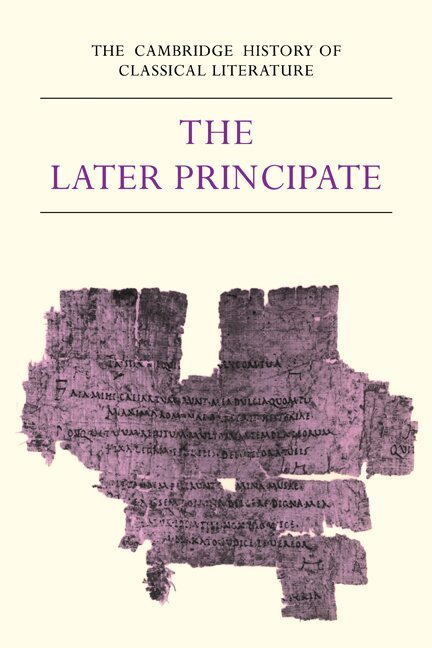
The Cambridge History of Classical Literature: Volume 2, Latin Literature, Part 5, The Later Principate
Häftad, Engelska, 1983
554 kr
Skickas inom 7-10 vardagar
In the two centuries covered by this volume, from about AD 250 to 450, the Roman Empire suffered a period of chaos followed by drastic administrative and military reorganization. Simultaneously Christianity emerged as a new religious force, to be first recognized by Constantine and then eventually to become the official religion of the Roman state. The old pagan culture continued to provide the basis for education and the staple literary diet of the leisured classes; but it now had perforce to coexist and indeed to compete with a new, specifically Christian-oriented literature. These and associated developments are reflected in the Latin books of the period. Of the traditional forms and genres, some atrophied, some were transformed and invigorated; and yet others, such as autobiography in something like the modern sense, emerged in response to the pressures of the times. Professor Browning's masterly and comprehensive survey is mostly concerned with pagan literature, but takes into account Christian texts written in classical forms and directed at classically educated readers. The volume ends with a chapter on Apuleius by Professor Walsh, followed by a brief Epilogue from the same hand, sketching the part played by classical studies in the formation of the Latin literature of the Middle Ages.
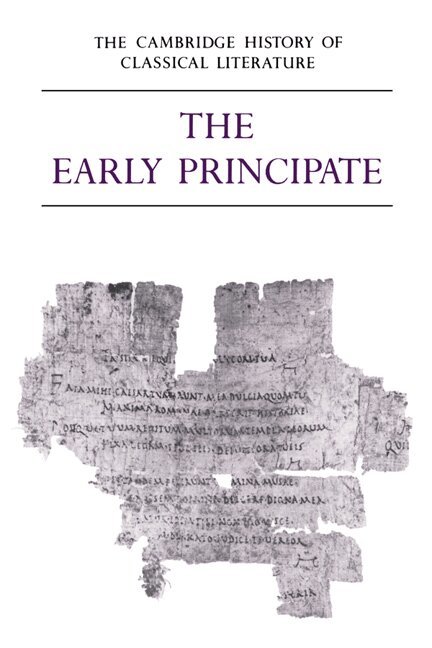
The Cambridge History of Classical Literature: Volume 2, Latin Literature, Part 4, The Early Principate
Häftad, Engelska, 1983
741 kr
Skickas inom 7-10 vardagar
'Perfection is finality; finality is death'. The poets and prose writers of the first and early second centuries AD were not deterred by the towering stature of their Augustan predecessors from attempting new and often brilliant variations on the now traditional themes and genres. The so-called 'Silver' Age of Latin literature has tended to be characterized in terms of dismissive or question- begging stereotypes - 'decadent', 'rhetorical', 'baroque', 'mannerist' - as a substitute for close critical argument. From the sympathetic but searching appraisals in this volume the best writers of the age - Lucan, Seneca, Statius, Juvenal, Tacitus - emerge as men having something important to say and not merely technicians preoccupied with the most extravagant or paradoxical way of saying it. Complementary to these central figures as giving the age its special character and atmosphere are the minor poets, the satirists, the scholars and rhetoricians, the lesser historians, epistolographers and technical writers, whose varied activity provides the background to the main developments. The whole offers a detailed portrait of the literary interests of an age that was of necessity becoming increasingly more conscious of the past and of the problems of coping with its cultural heritage.
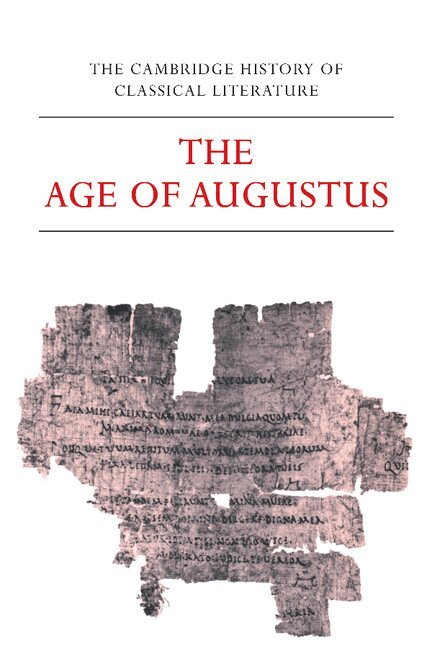
The Cambridge History of Classical Literature: Volume 2, Latin Literature, Part 3, The Age of Augustus
Häftad, Engelska, 1983
772 kr
Skickas inom 7-10 vardagar
The sixty years between 43 BC, when Cicero was assassinated, and AD 17, when Ovid died in exile and disgrace, saw an unexampled explosion of literary creativity in Rome. Fresh ground was broken in almost every existing genre, and a new kind of specifically Roman poetry, the personal love-elegy, was born, flourished, and succumbed to its own success. Latin literature now became, in the familiar modern sense of the word, classical: a balanced fusion of what was best and most stimulating in earlier Greek and Roman writing, charged with new and original life by the individual genius of, most particularly, Virgil, Horace and Ovid. Augustan literature, conventionally viewed as the expression in writing of the age itself - political and social stability reflected in artistic equilibrium - turns out on a close and critical reading to have been subject to the same stresses and strains as the society in and for which it was produced. In appraising the monumental literary achievements of the age the underlying tensions and contradictions are not ignored. The critical discussions in this volume do full justice to the complexity and subtlety of the literature itself.
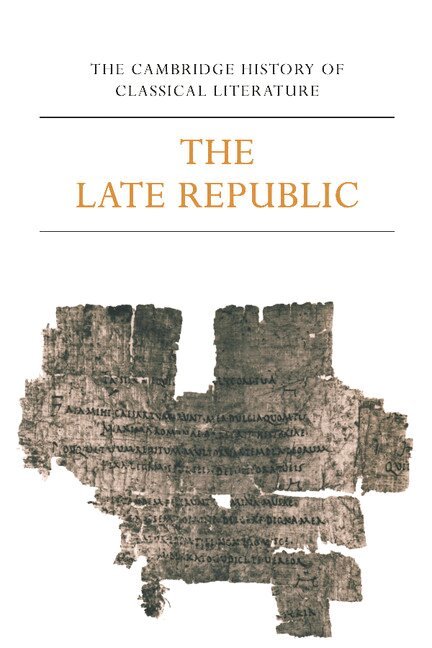
The Cambridge History of Classical Literature: Volume 2, Latin Literature, Part 2, The Late Republic
Häftad, Engelska, 1983
600 kr
Skickas inom 7-10 vardagar
This volume covers a relatively short span of time, rather less than the first three-quarters of the first century BC; but it was an age of profoundly important developments, with enduring consequences for the subsequent history of Latin literature. Original and innovative in widely differing ways as was the work of Lucretius, Sallust and Caesar in particular, the scene is dominated, historically, by two figures: Cicero and Catullus. Cicero was a politician and a man of affairs as well as a man of latters, whose vast literary output reflects a range of intellectual interests unparalleled among surviving Roman writers; creator of a prose style the Quintilian regarded as synonymous with eloquence itself; and better known to us, from his letters, as a human being, than any other figure from classical antiquity. Catullus was a poet, single-mindedly devoted to fostering the tradition of learned Alexandrian poetry at Rome; the author of one slender volume of verse that has attracted more critical attention in proportion to its size than any other ancient poetry-book; and the lover of Lesbia. In these chapters it is shown how these, and other, Roman writers of genius continued the process of transforming their traditional Greek models into new and vigorous Latin forms, with lasting effects for oratory, historiography, and the higher genres of poetry.
The Cambridge History of Classical Literature: Volume 2, Latin Literature, Part 1, The Early Republic
Häftad, Engelska, 1983
554 kr
Skickas inom 7-10 vardagar
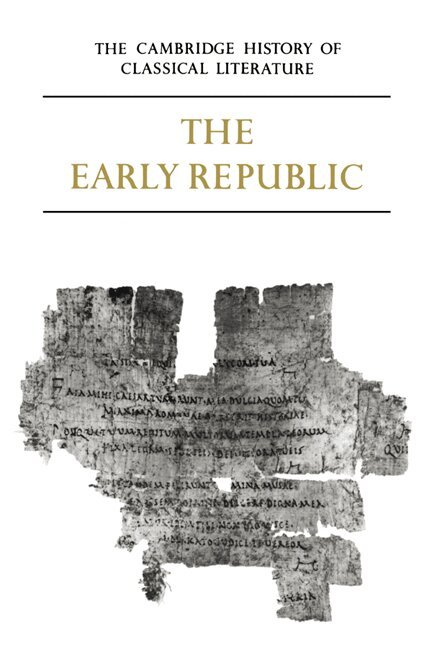
In the third century BC Rome embarked on the expansion which was ultimately to leave her mistress of the Mediterranean world. As part of that expansion a national literature arose, springing from the union of native linguistic energy with Greek literary forms. Shortly after the middle of the century the first Latin play took the stage; by 100 BC most of the important genres invented by the Greeks - epic, tragedy, comedy, historiography, oratory - were solidly established in their adoptive Roman forms, and a new genre, satire, had been born. The chapters in this volume describe and analyse the process of creative adaptation which shaped the beginnings of Latin literature and laid the foundations for its future development as one of the great literatures of the world. Essential background is provided by introductory chapters on readers and critics in the Roman world. In these are described the form of the books themselves and the conditions under which they were produced, circulated and read. The whole volume offers an indispensable introduction to the understanding of the nature and quality of Latin literature.
The Cambridge History of Classical Literature: Volume 1, Greek Literature, Part 1, Early Greek Poetry
Häftad, Engelska, 1989
772 kr
Skickas inom 7-10 vardagar
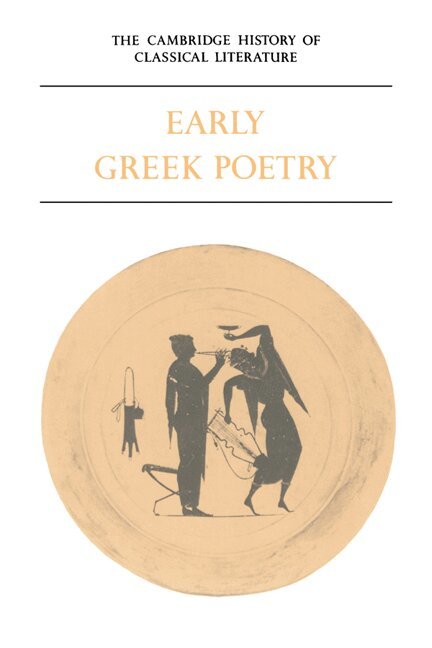
The period from the eighth to the fifth centuries B.C. was one of extraordinary creativity in the Greek-speaking world. Poetry was a public and popular medium, and its production was closely related to developments in contemporary society. At the time when the city states were acquiring their distinctive institutions epic found the greatest of all its exponents in Homer, and lyric poetry for both solo and choral performance became a genre which attracted poets of the first rank, writers of the quality of Sappho, Alcaeus and Pindar, whose influence on later literature was to be profound. This volume covers the epic tradition, the didactic poems of Hesiod and his imitators, and the wide-ranging work of the iambic, elegiac and lyric poets of what is loosely called the archaic age. The contributors make use of recent papyrus finds (particularly in the case of Archilochus and Stesichorus) to fill out the picture of a cosmopolitan and highly sophisticated literary culture which had not yet found its intellectual centre in Athens.
The Cambridge History of Classical Literature: Volume 1, Greek Literature, Part 2, Greek Drama
Häftad, Engelska, 1989
554 kr
Skickas inom 7-10 vardagar
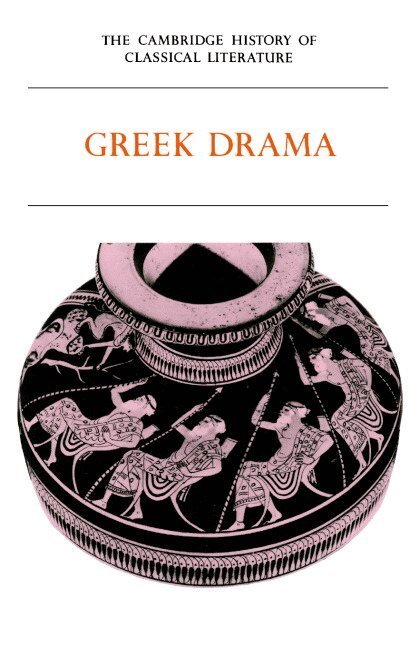
This series provides individual textbooks on early Greek poetry, on Greek drama, on philosophy, history and oratory, and on the literature of the Hellenistic period and of the Empire. A chapter on books and readers in the Greek world concludes Part IV. Each part has its own appendix of authors and works, a list of works cited, and an index.
The Cambridge History of Classical Literature: Volume 1, Greek Literature, Part 3, Philosophy, History and Oratory
Häftad, Engelska, 1989
741 kr
Skickas inom 7-10 vardagar
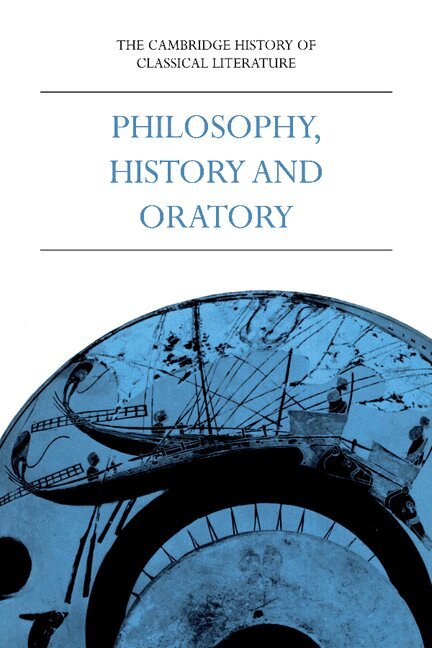
This volume ranges in time over a very long period and covers the Greeks' most original contributions to intellectual history. It begins and ends with philosophy, but it also includes major sections on historiography and oratory. Although each of these areas had functions which in the modern world would not be considered 'Literary', the ancients made a less sharp distinction between intellectual and artistic production, and the authors included in this volume are some of Europe's most powerful stylists: Plato, Herodotus, Thucydides and Demosthenes.
The Cambridge History of Classical Literature: Volume 1, Greek Literature, Part 4, The Hellenistic Period and the Empire
Häftad, Engelska, 1989
834 kr
Skickas inom 7-10 vardagar
This series provides individual textbooks on early Greek poetry, on Greek drama, on philosophy, history and oratory, and on the literature of the Hellenistic period and of the Empire. Each part has its own appendix of authors and works, a list of works cited, and an index. This volume studies the revolutionary movement represented by the more creative of the Hellenistic poets and finally the very rich range of authors surviving from the imperial period, with rhetoric and the novel contributing a distinctive flavour to the culture of the time. Appropriately enough, the volume closes with a survey of books and readers in the ancient world, which draws attention to the bookish nature of Greek literature from the Hellenistic period onwards and points forward to its survival into the Middle Ages.