Václav Havel Series - Böcker
Visar alla böcker i serien Václav Havel Series. Handla med fri frakt och snabb leverans.
7 produkter
7 produkter
193 kr
Skickas inom 7-10 vardagar
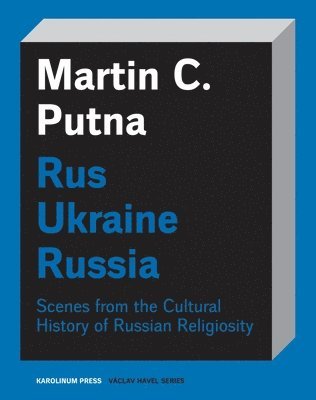
An outspoken opponent of pro-Russian, authoritarian, and far-right streams in contemporary Czech society, Martin C. Putna received a great deal of media attention when he ironically dedicated the Czech edition of Rus–Ukraine–Russia to Miloš Zeman—the pro-Russian president of the Czech Republic. This sense of irony, combined with an extraordinary breadth of scholarly knowledge, infuses Putna’s book.Examining key points in Russian cultural and spiritual history, Rus–Ukraine–Russia is essential reading for those wishing to understand the current state of Russia and Ukraine—the so-called heir to an “alternative Russia.” Putna uses literary and artistic works to offer a rich analysis of Russia as a cultural and religious phenomenon: tracing its development from the arrival of the Greeks in prehistoric Crimea to its invasion by “little green men” in 2014; explaining the cultural importance in Russ of the Vikings as well as Pussy Riot; exploring central Russian figures from St. Vladimir the Great to Vladimir Putin.Unique in its postcolonial perspective, this is not merely a history of Russia or of Russian religion. This book presents Russia as a complex mesh of national, religious, and cultural (especially countercultural) traditions—with strong German, Mongol, Jewish, Catholic, Polish, and Lithuanian influences—a force responsible for creating what we identify as Eastern Europe.
164 kr
Skickas inom 7-10 vardagar
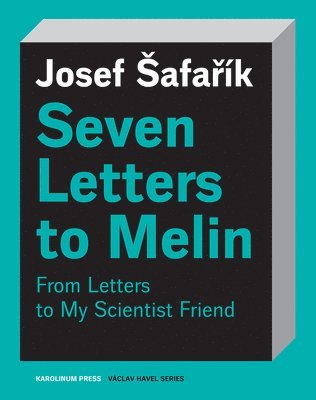
Josef Šafařík’s Seven Letters to Melin is an exploration of man’s alienation from nature—and from himself—in the modern technological age. Conceived as a series of letters to Melin, an engineer who believes in the value of science and technical progress, the book grows skeptical of such endeavors, while also examining mankind’s search for meaning in life. To help uncover this meaning, Šafařík posits a dichotomy between spectator and participant. The role of participant is played by Robert, an artist who has committed suicide. The spectator, embodied by the scientist Melin, views the world from a distance and searches for explanations, while the artist-participant creates the world through his own active engagement. Through these exchanges, Šafařík argues for the primacy of artistic creativity over scientific explanation, of truth over accuracy, of internal moral agency over an externally imposed social morality, and of personal religious belief over organized church-going. Šafařík is neither anti-scientific nor anti-rational; however, he argues that science has limited power, and he rejects the idea of science that denies meaning and value to what cannot be measured or calculated. Šafařík’s critiques of technology, the wage economy, and increased professionalization make him an important precursor to the philosophy of deep ecology. This book was also a major influence on the Czech president Václav Havel; in this new translation it will find a fresh cohort of readers interested in what makes us human.
203 kr
Skickas inom 7-10 vardagar
A close read of the rich collections of texts left behind by Václav Havel, one of the most important Czech thinkers and leaders of the twentieth century. No one in Czech politics or culture could match the international stature of Václav Havel at the time of his death in 2011. In the years since his passing, his legacy has only grown, as developments in the Czech Republic and elsewhere around the world continue to show the importance of his work and writing against a range of political and social ills, from autocratic brutality to messianic populism.This book looks squarely at the heart of Havel’s legacy: the rich corpus of texts he left behind. It analyzes the meanings of key concepts in Havel’s core vocabulary: truth, power, civilsociety, home, appeal, indifference, hotspot, theatre, prison, and responsibility. Where do these concepts appear in Havel’s oeuvre? What part do they play in his larger intellectual project? How might we understand Havel’s focus on these concepts as a centerpiece of his contribution to contemporary thought? How does Havel’s particular perspective on the meaning of these concepts speak to us in the here and now? The ten contributors use a variety of methodological tools to examine the meaning of these concepts, drawing on a diversity of disciplines: political science and political philosophy, historical and cultural analysis, discourse/textual analysis, and linguistic-corpus analysis.
Why So Easily . . . Some Family Reasons for the Velvet Revolution
A Sociological Essay
Häftad, Engelska, 2023
169 kr
Skickas inom 7-10 vardagar
A famed essay examines the Velvet Revolution from a sociological perspective. Thirty-two years after its initial publication, this respected sociological essay, written in the history-making years of 1989 and 1990, is available for the first time in English. The essay tells the story of a despotic Socialist state expropriating the family (and with it the private sphere of life) only to be colonized by the very thing it expropriated forty years later. The essay plunges the reader into the pivotal time of the Velvet Revolution and provides valid explanations for the grassroots causes of the old regime’s downfall, examining the private aspirations and strategies of highly disparate groups of nameless social actors of the old regime that eventually sapped almost everyone of any interest in keeping the regime afloat.
301 kr
Kommande
Analyzes the historical significance of the Soviet invasion of Czechoslovakia. This book addresses different aspects of the Soviet army’s twenty-year presence in Czechoslovakia between 1968 and 1991. It explores the circumstances of the Soviet settling in the country, immediately related to the invasion of the Warsaw Pact armies in August 1968; its active interference in the political developments in the early stage of the “normalization” era; and the universal support provided by the normalization era regime. It examines the darker side of this support when the constant favoring of Soviet interests—often to the detriment of the local population and the environment—went hand in hand with the resignation of the Czechoslovak state to lawfulness and the execution of effective administration on its territory. Based on extensive local and national primary sources, the volume describes the often problematic coexistence of the Soviet garrisons and local inhabitants, who did not have sufficient protection at the central level. In this context, it points out the contradictory logic that framed the mutual coexistence: the official policy of friendship on the one hand and the counter-intelligence protection of Soviet military premises on the other. Marie Cerná records the traces that the presence of the Soviet army left in the collective memory and examines the circumstances of its departure from the country in 1990 and 1991, which began immediately after the change of the political regime. She presents the long-term presence of the Soviet army as a fundamentally political and politicized matter, which was first the subject of power controversies and later of propaganda and intentional manipulation.
273 kr
Kommande
This collection of Cold War essays and reflections enthralls any reader seeking a pointed dissection of the Soviet style of government and thinking.In an engaging style, not lacking in irony and detachment, Milan Šimečka describes the process of restoring order and its result—so-called real socialism—in a brilliant analysis of the “normalization” regime in Czechoslovakia that came to power after the Soviet-led invasion that crushed the Prague Spring of 1968. These poignant reflections and essays coincided with Šimečka’s first-hand experience of the consequences of the time’s political and cultural purges. This second edition of Cold War classics, first written between 1975 and 1977, with a new preface from Martin Šimečka and afterword from Jonathan Bolton, highlights chilling parallels with contemporary political developments and current civic and ethical questions.
Architects of Long Change
The Expert Roots of Post-Socialism in Czechoslovakia (1980–1995)
Häftad, Engelska, 2026
414 kr
Kommande
A thorough retort to the idea that the West led the transition from communism to liberal democracy.Architects of Long Change examines expert forms of governance and their legitimization before 1989, as well as the transfer of expert knowledge and practices of political and social management during the democratic transition. The contributors argue that so-called neoliberal governance was not solely the result of imported Western political and cultural models, but was also shaped by intellectual, mental, and sociocultural continuities from the period of late socialism. These continuities—and the broader hypothesis of a “long systemic change” spanning from 1980 to 1995—are explored through case studies in legal science, sociology, urban planning, environmental studies, psychotherapy, and business management. Architects of Long Change offers a novel perspective on the late communist dictatorship, the democratic revolution of 1989, and the early development of liberal democracy and capitalism in Czechoslovakia and later the Czech Republic.