Verbum Domini - Böcker
Visar alla böcker i serien Verbum Domini. Handla med fri frakt och snabb leverans.
7 produkter
7 produkter
309 kr
Skickas inom 7-10 vardagar
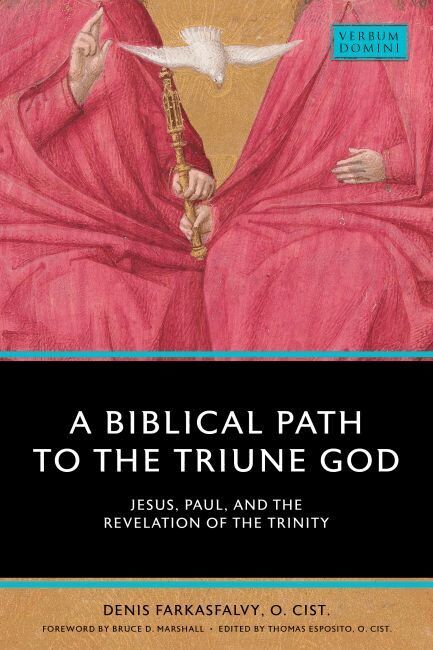
This short volume, finished just before Denis Farkasfalvy's death in 2020, serves effectively as his last theological testament. In A Biblical Path to the Triune God, the Cistercian abbot identifies the earliest biblical witnesses to the Church's teaching about God, formulated at the Council of Nicaea, as Father, Son, and Holy Spirit.Jesus' famous praise of the Father, found almost word-for-word in Matthew 11:25-27 and Luke 10:21-22, is Farkasfalvy's point of departure for his bold assertion that in the earliest sources, we find abundant evidence that "it was not Jesus who revealed his own divine sonship; rather, the Father revealed it to those whom Jesus had chosen and were open to respond in faith." Farkasfalvy demonstrates that Jesus reveals his relationship to the Father in terms of intimate and experiential knowledge, transforming the procreative metaphor of filiation from the physical (as in the Psalms and 2 Samuel 7) to the epistemological realm of knowledge, what he calls "love within cognitive dimensions." Just decades after Jesus' ministry, numerous independent apostolic witnesses, from the Synoptic Gospels and John to Paul (especially Romans 1:1-4 and Galatians 1:15-16), indicate a robust and widespread understanding of the Father's self-disclosure in Jesus the Son.Farkasfalvy concludes his brief but intense reflection by outlining how a single organic process of revelation binds together the Father and the Son, and then extends that loving communion to believers in the Spirit, a communion made possible only by the incarnate Son's crucifixion and subsequent glorification. This book accomplishes the admirable feat of showing that far from being the invention of later centuries, the Trinitarian doctrine of the Church is firmly rooted in the very first reflections on Jesus' ministry and mystery by the biblical authors.
297 kr
Skickas inom 11-20 vardagar
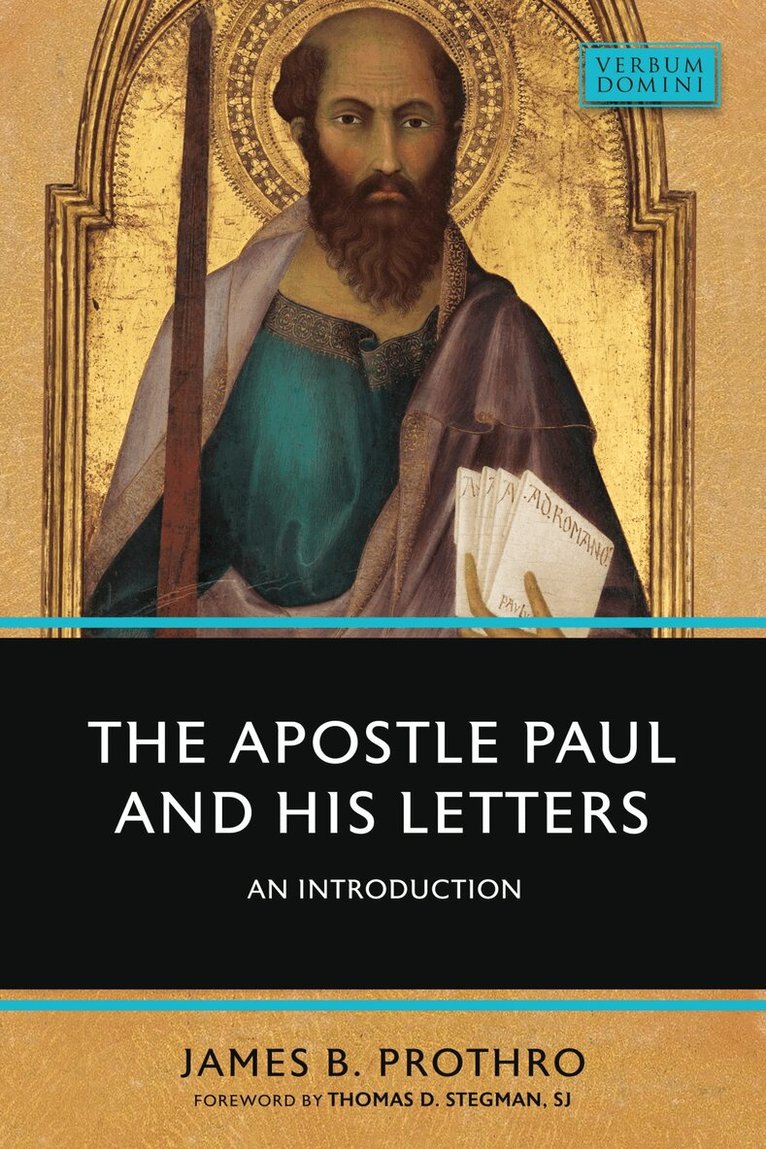
The letters of the Apostle Paul are central witnesses to the Christian faith and to the earliest history of Christianity. And yet, when students, preachers, and others turn to Paul, they find many things ""hard to understand"" (2 Peter 3:16) in these ancient writings.James Prothro’s new book aims to help readers see the Apostle’s faith and hope at work as he evangelized the nations. Steeped in up-to-date scholarship and a passion for the gospel Paul preached, Prothro draws readers into Paul’s life and letters in order to help them hear the Apostle’s voice. The book’s chapters offer introductions to Paul’s background, life, and legacy; an introduction to ancient letter writing; a guide to understanding Paul’s theology across the letters; a survey of the portrait of Paul in the Book of Acts; separate treatments of each letter’s background and purpose; treatments of key theological topics in each letter and a thorough outline of each letter showing its arguments and how they make sense.Prothro introduces complex matters with clarity, balance, and an inviting style. He not only offers answers but models how to ask questions, helping us reason through Paul’s letters as ancient documents and as Christian Scripture. This book will prove a valuable introduction for those who study, teach, and preach these biblical books.
366 kr
Skickas inom 10-15 vardagar
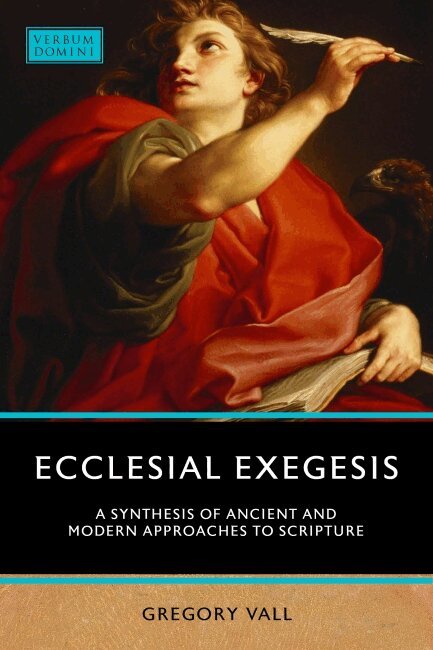
There is broad support today for the idea that biblical scholarship ought to be informed by the faith of the Church and serve the life of the Church. In a word, it should be ecclesial. There is far less agreement, however, when one asks how this goal is to be achieved and what ecclesial exegesis ought to look like. In 1988, Joseph Ratzinger put forth his "Method C" proposal, calling for the development of a new exegetical and hermeneutical synthesis. This would be neither a retreat to the patristic-medieval approach (Method A) nor the continued hegemony of the historical-critical approach (Method B). The latter must be purified of its positivism through a transformational encounter with the former, so that the gifts of both might be released for the life of the Church. Such a synthesis, Ratzinger claimed, would require the philosophical, theological, exegetical, and hermeneutical work of "at least a whole generation" of scholars.Gregory Vall has devoted over thirty years to the development of ecclesial exegesis, and the present volume represents the mature fruit of his labor. Over against those who treat Dei Verbum as Vatican II's endorsement of the historical-critical method, he demonstrates that the dogmatic constitution actually points to something very much like Ratzinger's Method C. Employing a dialogic movement between the inductive-exegetical and the deductive-dogmatic, Vall offers nine studies that bring to the surface issues such as the relationship between Old Testament and New Testament, literal sense and spiritual sense, and Scripture and Tradition. While Vall brings theological knowledge and hermeneutical skill to the quest for Method C, he also provides a great deal of valuable exegesis of both testaments. Ecclesial Exegesis is not simply another book of theory. It demonstrates how Method C can be done.
309 kr
Skickas inom 7-10 vardagar
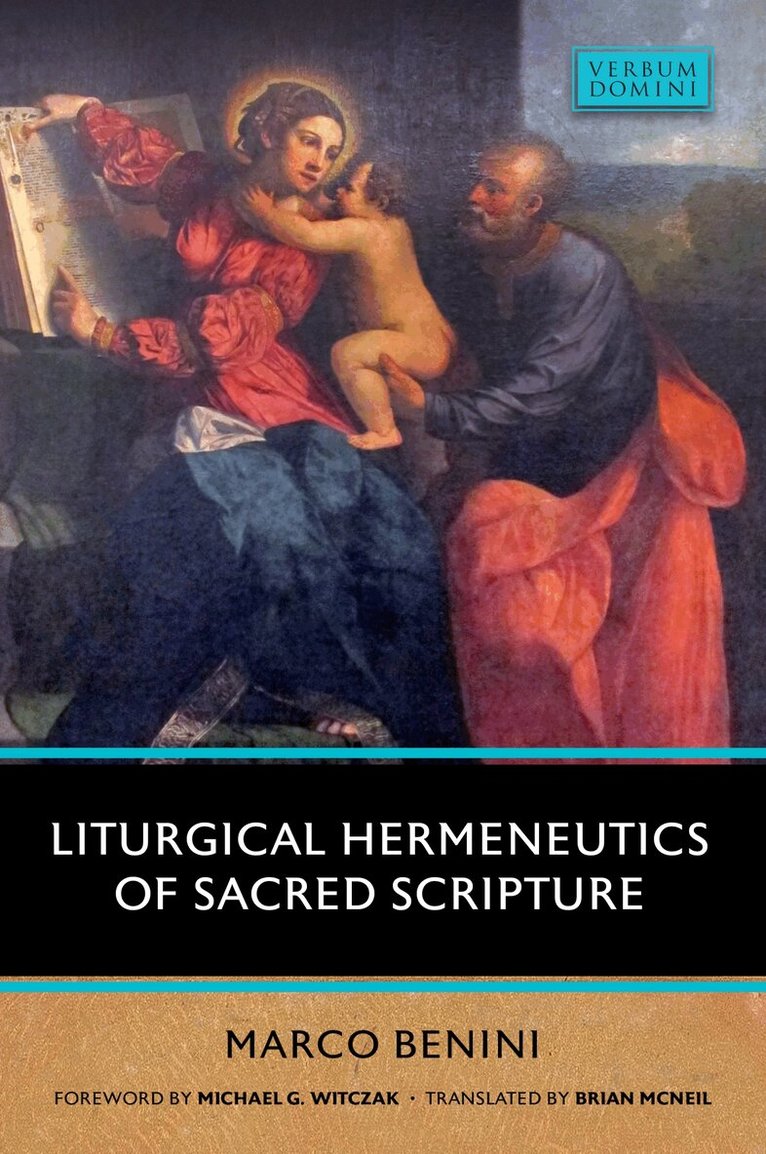
The purpose of this book is to explore what a liturgical approach to the Bible looks like and what hermeneutical implications this might have: How does the liturgy celebrate, understand, and communicate Scripture? The starting point is Pope Benedict's affirmation that ""a faith-filled understanding of sacred Scripture must always refer back to the liturgy"" (Verbum Domini 52).The first part of the book (based on SC 24) provides significant examples to demonstrate: The liturgical order of readings intertextually combines Old Testament and New Testament readings using manifold hermeneutical principles, specifically how the psalms show the wide range of interpretations the liturgy employs. Prayers are biblically inspired and help to appropriate Scripture personally. The hymns convey Scripture in a poetic way. Signs and actions such as foot-washing or the Ephphetha rite enact Scripture. The study considers the Mass, the sacraments and the Liturgy of the Hours.In the second part, Benini systematically focuses on the various dimensions of liturgical hermeneutics of the Bible, which emerge from the first part. The study reflects the approaches the liturgy offers to Scripture and its liturgical reception. It explores theological aspects such as the unity of the two Testaments in Christ's paschal mystery or the anamnesis as a central category in both Scripture and liturgy. The liturgy does not understand Scripture primarily as a document of the past, but celebrates it as a current and living ""Word of the Lord,"" as a medium of encounter with God: Scripture is sacramental.Liturgical Hermeneutics of Sacred Scripture seeks to contribute not only to the comparison of the Roman, Ambrosian, and Byzantine Rite regarding the Word of God, but most of all to the overall ""liturgical approach"" to Scripture. As such, it promotes an interdisciplinary dialogue of liturgical and biblical studies.
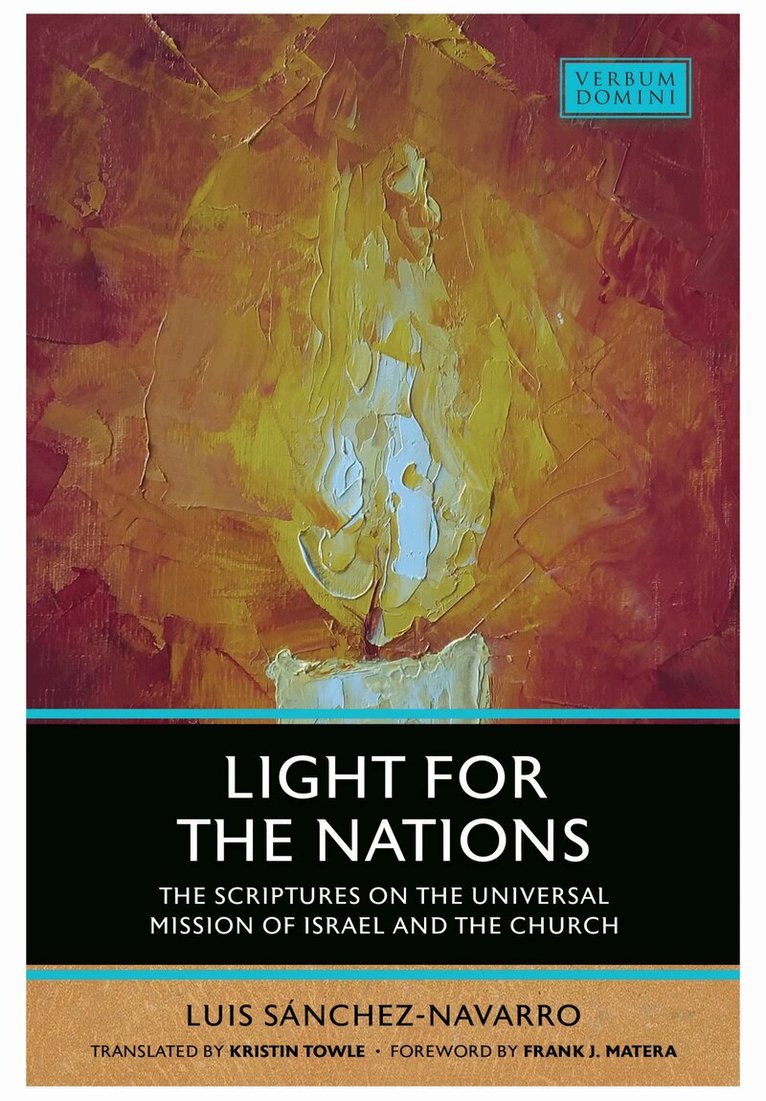
Light for the Nations
The Scriptures on the Universal Mission of Israel and the Church
Häftad, Engelska, 2024
309 kr
Skickas inom 7-10 vardagar
Universality belongs to the very being of the catholic Church. This claim of the Gospel is rooted in the ministry of Jesus, witnessed to by the canonical Gospels and the other books of the New Testament, all of which present the universal openness of salvation as a fulfillment of the Scriptures of Israel. In this book, after addressing the universality of salvation in the writings of the Old Covenant, we examine the differentiated and concordant witness of the synoptic Gospels, John and Paul, as well as the Letter to the Hebrews and the Apocalypse. In this way, we intend to show how this apostolic witness responds to the will of the Lord Jesus, while highlighting its harmony with Torah, Prophets and Writings.Light for the Nations, by reviewing the main biblical passages on the universal dimension of salvation, aims to show how the fact that the Gospel of Jesus Christ has a claim to universality does not diminish, but rather enhances, the importance of the people of the first Covenant: Israel is called to be an active mediator of salvation. The canonical perspective is based on a differentiated exegetical study of each testimony. The scope is broad, since this theme of biblical theology is also relevant for Christology and soteriology, for anthropology and for ecclesiology. The main contribution lies in showing how the various biblical testimonies, in their diversity (which is fully taken into account), offer at the same time a concurring testimony on this fundamental question of Christian theology, forming a true symphony within its polyphony.
Light for the Nations
The Scriptures on the Universal Mission of Israel and the Church
Inbunden, Engelska, 2024
912 kr
Skickas inom 10-15 vardagar
Universality belongs to the very being of the catholic Church. This claim of the Gospel is rooted in the ministry of Jesus, witnessed to by the canonical Gospels and the other books of the New Testament, all of which present the universal openness of salvation as a fulfillment of the Scriptures of Israel. In this book, after addressing the universality of salvation in the writings of the Old Covenant, we examine the differentiated and concordant witness of the synoptic Gospels, John and Paul, as well as the Letter to the Hebrews and the Apocalypse. In this way, we intend to show how this apostolic witness responds to the will of the Lord Jesus, while highlighting its harmony with Torah, Prophets and Writings.Light for the Nations, by reviewing the main biblical passages on the universal dimension of salvation, aims to show how the fact that the Gospel of Jesus Christ has a claim to universality does not diminish, but rather enhances, the importance of the people of the first Covenant: Israel is called to be an active mediator of salvation. The canonical perspective is based on a differentiated exegetical study of each testimony. The scope is broad, since this theme of biblical theology is also relevant for Christology and soteriology, for anthropology and for ecclesiology. The main contribution lies in showing how the various biblical testimonies, in their diversity (which is fully taken into account), offer at the same time a concurring testimony on this fundamental question of Christian theology, forming a true symphony within its polyphony.
347 kr
Kommande
This newest volume in the CUA Press Verbum Domini series by the late Professor Romano Penna, represents a synthesis of Penna's thought, which often engaged with the question of Christian originality. The relationship between Law and liberty is a theme that effectively runs like a red thread through the "grand narrative" of the Bible. Law and liberty represent two values that mutually call forth one another and require thorough and nuanced reflection on multiple levels.The book offers a biblical-theological journey that enables the reader to grasp the central aspects of the Law-liberty dialectic and to focus on the uniqueness of the Christian message. Through engagement with the Greek and Jewish cultural backgrounds, Romano Penna demonstrates the richness of the Law understood as a gift from God and embraced as a commitment to responsible living—a commitment that presupposes the gift of a new kind of liberty and demands existential involvement.In the message of Jesus of Nazareth and in its Pauline reinterpretation, one perceives how the dialectic between Law and liberty reveals the "filial" condition of the Christian. It is precisely the ability to understand and synthesize the Law-liberty pairing that defines Christian conduct and its testimonial power. The originality of Christianity can be well summarized by the expression "free because children". This phrase encapsulates an unprecedented vision and an extraordinary fecundity, much needed by humanity in our time.