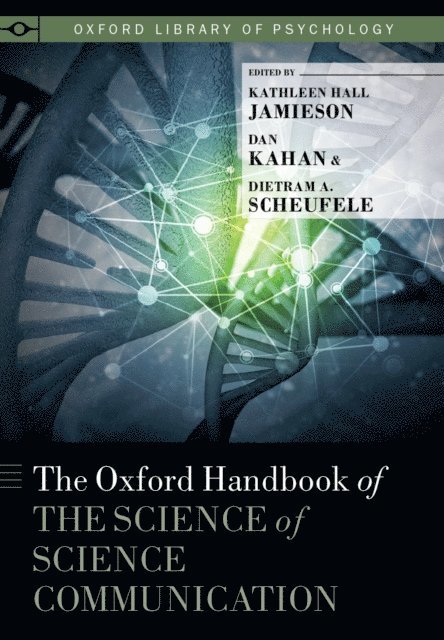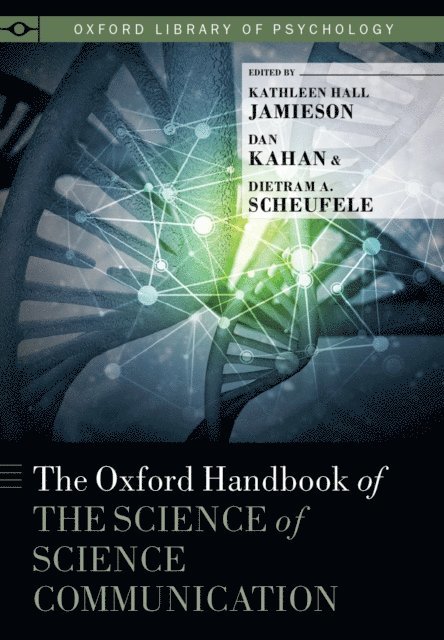
The Oxford Handbook of the Science of Science Communication
AvKathleen Hall Jamieson,Dan Kahan
Del i serien Oxford Library of Psychology
2 046 kr
Beställningsvara. Skickas inom 5-8 vardagar. Fri frakt över 249 kr.
Beskrivning
Produktinformation
- Utgivningsdatum:2017-07-06
- Mått:257 x 183 x 30 mm
- Vikt:1 111 g
- Format:Inbunden
- Språk:Engelska
- Serie:Oxford Library of Psychology
- Antal sidor:512
- Förlag:OUP USA
- ISBN:9780190497620
Utforska kategorier
Mer om författaren
Kathleen Hall Jamieson is the Elizabeth Ware Packard Professor at the Annenberg School for Communication of the University of Pennsylvania and the Walter and Leonore Annenberg Director of its Annenberg Public Policy Center. The author of four award winning Oxford University Press books on political and press communications, she is co-founder of FactCheck.org, which researches the veracity of claims made by political players. Its SciCheck feature was launched in 2015 to expose the misuse of scientific evidence in political discourse.Dan Kahan is the Elizabeth K. Dollard Professor of Law and Professor of Psychology at Yale Law School. He is a member of the Cultural Cognition Project, an interdisciplinary team of scholars who use empirical methods to examine the impact of group values on perceptions of risk and science communication.Dietram A. Scheufele is the John E. Ross Professor in Science Communication and Vilas Distinguished Achievement Professor at the University of Wisconsin-Madison and in the Morgridge Institute for Research. His research deals with the interface of media, policy, and public opinion. Scheufele has co-chaired the National Academies of Sciences, Engineering, and Medicine's Roundtable on Public Interfaces of the Life Sciences, and vice-chaired the recent Academies' consensus report on "Communicating science effectively: A research agenda."
Recensioner i media
For scholars interested in science communication, the handbook is a valuable tool for understanding both emerging and established topics. For others, it is a sign that the science of science communication has become an academic field in its own right.
Innehållsförteckning
- Introduction: Why Science Communication?Editors - Dan Kahan, Dietram Scheufele, and Kathleen Hall Jamieson Part I: THE SCIENCE OF COMMUNICATING SCIENCE 1. The Need for a Science of Science Communication: Communicating Science's Values and Norms Kathleen Hall Jamieson - Elizabeth Ware Packard Professor of Communication and Director, Annenberg Public Policy Center - University of Pennsylvania 2. Overview of the Science of Science CommunicationHeather Akin - Annenberg Public Policy Center Postdoctoral Fellow in Science of Science of Communication - University of Pennsylvania Dietram Scheufele - John E. Ross Professor of Science Communication and Vilas Distinguished Achievement Professor - University of Wisconsin-Madison, and Morgridge Institute for Research 3. On the Sources of Ordinary Science Knowledge and Extraordinary Science IgnoranceDan Kahan - Elizabeth K. Dollard Professor of Law and Professor of Psychology - Yale University 4. How Changing Media Structures Are Affecting Science News CoverageMike S. Schäfer - Professor of Science Communication - University of Zürich, Switzerland 5. What the Public Thinks and Knows about Science: And Why It MattersWilliam Hallman - Professor of Human Ecology - Rutgers University 6. Scientific Controversies: Can the Science of Science Communication Provide Management Guidance or only Analysis?Bruce Lewenstein - Professor of Science Communication - Cornell University 7. A Recap: The Science of Communicating ScienceJoseph Hilgard - Annenberg Public Policy Center Postdoctoral Fellow in Science of Science of Communication - University of Pennsylvania Nan Li - Assistant Professor of Agricultural Education and Communications - Texas Tech University Part II: IDENTIFYING AND OVERCOMING CHALLENGES TO SCIENCE FEATURED IN ATTACKS ON SCIENCE 8. Science as "Broken" vs. Science as "Self-Correcting": How Retractions and Peer-Review Problems are Exploited to Attack ScienceJoseph Hilgard - Annenberg Public Policy Center Postdoctoral Fellow in Science of Science of Communication - University of Pennsylvania Kathleen Hall Jamieson - Elizabeth Ware Packard Professor of Communication and Director, Annenberg Public Policy Center - University of Pennsylvania 9. Publication Bias in Science: What is it, Why is it Problematic, and How Can It Be Addressed?Andrew Brown - Scientist, Nutrition and Obesity Research Center and Office of Energetics - University of Alabama at Birmingham Tapan Mehta - Assistant Professor in Health Services Administration and Associate Scientist, Nutrition Obesity Research Center - University of Alabama at Birmingham David Allison - Quetelet Endowed Professor of Public Health, Associate Dean for Science, and Director, Office of Energetics - University of Alabama at Birmingham 10. Statistical Biases in Science Communication: What We Know About Them and How They Can Be AddressedJohn Ioannidis - C.F. Rehnborg Chair in Disease Prevention, Professor of Medicine, and Director, Stanford Prevention Research Center (SPRC) - Stanford University 11. Is there a Hype Problem in Science? If So, How is it Addressed?Peter Weingart - Professor Emeritus and former Director, Center for Interdisciplinary Research - University of Bielefeld, Germany 12. Is there a Retraction Problem? And, If So, What Do We Know About How It Is and Can Be Addressed?Adam Marcus - Co-Founder - Retraction Watch; Managing Editor - Gastroenterology & Endoscopy News and Anesthesiology News Ivan Oransky - Co-Founder - Retraction Watch; Vice President and Global Editorial Director - MedPage Today 13. A Recap: Identifying and Overcoming Challenges to Science Featured in Attacks on ScienceJoseph Hilgard - Annenberg Public Policy Center Postdoctoral Fellow in Science of Science of Communication - University of Pennsylvania PART III: SCIENCE COMUNICATION IN ACTION: FAILURES & SUCCESSES 14. A Comparative Study of Communication about Food Safety Before, During and After the "Mad Cow" CrisisMatteo Ferrari - Assistant Professor of Private Law - University of Trento, Italy 15. Cross-National Comparative Communication and Deliberation about the Risks of Nanotechnologies Nick Pidgeon - Professor of Environmental Psychology and Director, Understanding Risk Research Group - Cardiff University, Wales Barbara Herr Harthorn - Professor of Anthropology, Director, NSF Center for Nanotechnology in Society, and group leader, NSF/EPA UC Center for Environmental Implications of Nanotechnology - University of California, Santa Barbara Terre Satterfield -Professor of Culture, Risk and the Environment and Director, Institute for Resources, Environment and Sustainability - University of British Columbia, Canada Christina Demski - Professor of Social & Environmental Psychology and Research Associate, Understanding Risk Research Group - Cardiff University, Wales 16. Communications about Biotechnologies and GMOs across Europe Heinz Bonfadelli - Professor Emeritus - University of Zürich, Switzerland 17. A Tale of Two Vaccines - and their Science Communication EnvironmentsDan Kahan - Elizabeth K. Dollard Professor of Law and Professor of Psychology - Yale University Asheley Landrum - Annenberg Public Policy Center Postdoctoral Fellow in Science of Science of Communication - University of Pennsylvania 18. A Recap: Science Communication in ActionHeather Akin - Annenberg Public Policy Center Postdoctoral Fellow in Science of Science of Communication - University of Pennsylvania PART IV: THE ROLES OF ELITE INTERMEDIARIES IN COMMUNICATING SCIENCE19. Science Communication at Scientific InstitutionsTiffany Lohwater - Director of Meetings and Public Engagement - American Association for the Advancement of Science Martin Storksdieck - Professor and Director, Center for Research on Lifelong STEM Learning - Oregon State University 20. The Role of Scholarly Presses and JournalsBarbara Kline Pope - Executive Director for Communications - The National Academies; Executive Director - National Academies Press Elizabeth Marincola - Chief Executive Officer - Public Library of Science (PLOS) 21. The Role of Governmental Organizations in Communicating About Regulating ScienceJeffery Morris - National Program Director for Nanotechnology - Environmental Protection Agency 22. Science Communication and Museums' Changing RolesVictoria Cain - Assistant Professor of History - Northeastern University Karen Rader - Associate Professor of History - Virginia Commonwealth University 23. The Role of Funding Organizations: FoundationsElizabeth Good Christopherson - President and Chief Executive Officer - Rita Allen Foundation 24. Promoting Popular Understanding of Science and Health through Social NetworksBrian Southwell - Director, Center for Communication Science - RTI International; Adjunct Professor (Energy Initiative) - Duke University; Research Professor (Media & Journalism) and Adjunct Associate Professor (Health Behavior) - University of North Carolina at Chapel Hill 25. Designing Public Deliberation at the Intersection of Science and Public PolicyJohn Gastil - Head and Professor of Communication Arts and Sciences and Political Science - Pennsylvania State University 26. Translating Science into Policy and Legislation: Evidence-informed Policy MakingJason Gallo - Science and Technology Policy Analyst - Science and Technology Policy Institute 27. A Recap: The Role of Intermediaries in Communicating Science: A SynthesisAsheley Landrum - Annenberg Public Policy Center Postdoctoral Fellow in Science of Science of Communication - University of Pennsylvania Part V: THE ROLE, POWER, AND PERIL OF MEDIA FOR THE COMMUNICATION OF SCIENCE 28. The (Changing) Nature of Scientist-Media Interactions: A Cross National Analysis Sara Yeo - Assistant Professor of Communication - University of Utah Dominique Brossard - Professor and Chair, Department of Life Sciences Communication - University of Wisconsin-Madison 29. New Models of Knowledge-Based JournalismMatthew Nisbet - Associate Professor of Communication Studies, and Affiliate Associate Professor of Public Policy and Urban Affairs - Northeastern University Declan Fahy - Professor of Communication - Dublin City University 30. Citizens Making Sense of Science Issues: Supply and Demand Factors for Science News and Information in the Digital AgeMichael Xenos - CAPs Professor and Department Chair, Department of Communication Arts - University of Wisconsin-Madison 31. The Changing Popular Images of ScienceDavid Kirby - Senior Lecturer in Science Communication Studies - University of Manchester, England 32. What Do We Know About the Entertainment Industry's Portrayal of Science? How Does It Affect Public Attitudes Toward Science?James Shanahan - Professor and Dean, Media School - Indiana University 33. How Narrative Functions in Entertainment to Communicate ScienceMartin Kaplan - Norman Lear Professor of Entertainment, Media and Society and Director, Norman Lear Center - University of Southern California Michael Dahlstrom - Associate Professor of Journalism and Communication Iowa State University 34. Assumptions about Science in Satirical News and Late Night ComedyLauren Feldman - Associate Professor of Communication and Information - Rutgers University 35. A Recap: The Role, Power, and Peril of Media for the Communication of ScienceNan Li - Assistant Professor of Agricultural Education and Communications - Texas Tech University Robert Lull - Annenberg Public Policy Center Postdoctoral Fellow in Science of Science of Communication - University of Pennsylvania Part VI: CHALLENGES IN COMMUNICATING SCIENCE IN A POLARIZED ENVIRONMENT 36. Countering False Beliefs: An Analysis of the Evidence and Recommendations of Best Practices for the Retraction and Correction of Scientific MisinformationMan-pui Sally Chan - Postdoctoral Research Associate, Psychology - University of Illinois at Urbana-Champaign Christopher Jones - Annenberg Public Policy Center Postdoctoral Fellow (2014-16) - University of Pennsylvania Dolores Albarracin - Professor of Psychology and Business - University of Illinois at Urbana-Champaign 37. Using Frames to Make Scientific Communication More EffectiveJames Druckman - Payson S. Wild Professor of Political Science and Faculty Fellow, Institute for Policy Research - Northwestern University Arthur Lupia - Hal R. Varian Professor of Political Science - University of Michigan 38. Philosophical Impediments to Citizens' Use of ScienceJonathan Baron - Professor of Psychology - University of Pennsylvania. 39. Overcoming Confirmation and Blind Spot Bias When Communicating ScienceKate Kenski - Associate Professor of Communication and Government & Public Policy - University of Arizona 40. Understanding and Overcoming Selective Exposure and Judgement When Communicating About ScienceNatalie (Talia) Jomini Stroud - Associate Professor of Communication Studies and Assistant Director of Research, Annette Strauss Institute for Civic Life - University of Texas at Austin 41. Overcoming Innumeracy and the Use of Heuristics When Communicating ScienceEllen Peters - Professor of Psychology and Director, Behavioral Decision Making Initiative - Ohio State University 42. Overcoming Biases in Processing of Time Series Data about ClimateBruce Hardy - Assistant Professor of Strategic Communication - Temple University Kathleen Hall Jamieson - Elizabeth Ware Packard Professor of Communication and Director, Annenberg Public Policy Center - University of Pennsylvania 43. Understanding and Overcoming Fear of the Unnatural in Discussion of GMOsRobert Lull - Annenberg Public Policy Center Postdoctoral Fellow in Science of Science of Communication - University of Pennsylvania Dietram Scheufele - John E. Ross Professor of Science Communication and Vilas Distinguished Achievement Professor - University of Wisconsin-Madison, and Morgridge Institute for Research 44. Protecting or Polluting the Science Communication Environment? The Case of Childhood VaccinesDan Kahan - Elizabeth K. Dollard Professor of Law and Professor of Psychology - Yale University 45. Overcoming False Causal Attribution: Debunking the MMR-Autism AssociationNan Li - Assistant Professor of Agricultural Education and Communications - Texas Tech University Talia Stroud - Associate Professor of Communication Studies and Assistant Director of Research, Annette Strauss Institute for Civic Life - University of Texas at Austin Kathleen Hall Jamieson - Elizabeth Ware Packard Professor of Communication - Annenberg School for Communication and Director, Annenberg Public Policy Center - University of Pennsylvania 46. Overcoming the Challenges of Communicating Uncertainty Across National ContextsMichael Siegrist - Professor of Consumer Behavior and Head of Institute for Environmental Decisions - ETH Zürich, Switzerland Christina Hartmann - Professor of Consumer Behavior, Department of Health Sciences and Technology - ETH Zürich, Switzerland 47. A Recap: Heuristics, Biases, Values and Other Challenges to Communicating ScienceHeather Akin - Annenberg Public Policy Center Postdoctoral Fellow in Science of Science of Communication - University of Pennsylvania Asheley Landrum - Annenberg Public Policy Center Postdoctoral Fellow in Science of Science of Communication - University of Pennsylvania Conclusion: On the Horizon: The Changing Science Communication EnvironmentEditors - Dietram Scheufele, Kathleen Hall Jamieson, and Dan Kahan Index
Du kanske också är intresserad av
Realizing the Promise and Minimizing the Perils of AI for Science and the Scientific Community
Kathleen Hall Jamieson, Bill Kearney, Anne-Marie Mazza
339 kr
Democracy amid Crises
Matthew Levendusky, Josh Pasek, Bruce Hardy, R. Lance Holbert, Kate Kenski, Yotam Ophir, Andrew Renninger, Daniel Romer, Dror Walter, Ken Winneg, Kathleen Hall Jamieson
1 146 kr
Presidential Campaigns
Kathleen Hall Jamieson, Matthew Miller, Kathleen Hall Jamieson, Matthew Miller
476 kr