• Fri frakt över 249 kr
  • •
  • Snabba leveranser
  • •
  • Billiga böcker
Kundservice

Du är på sajten för privatpersoner.

Företag, bibliotek eller offentlig verksamhet?

Du handlar på classic.bokus.com, där alla dina funktioner finns intakta.
Till classic.bokus.com
Bokus logotyp. Gå till startsidan.
  • Erbjudanden
  • Nyheter
  • Student
  • Topplistor
  • Barn & ungdom
  • Bokus Play
  • E-böcker
  • Pocketböcker
  • Spel & pussel

Må bättre, för mindre! Upp till 50% rabatt på hälsoböcker

Sidfot

Mina sidor

    Hjälp

    • Kundservice
    • Vanliga frågor och svar
    • Frakt och leverans
    • Retur vid ångerrätt
    • Reklamera vara
    • Betalning
    • Köpvillkor
    • Allmänna villkor
    • Information om webbplatsens tillgänglighet

    Om Bokus

    • Om oss
    • Pressrum
    • För studenter
    • För företag
    • För bibliotek och offentlig verksamhet
    • För leverantörer
    • Hållbarhet

    Populärt

    • Aktuella erbjudanden
    • Presentkort
    • Studentlitteratur
    • Nya böcker
    • Topplistor
    • Signerade böcker
    • Engelska böcker

    Inspiration

    • Boktips
    • BookTok
    • Populära bokserier
    • Barnbokskaraktärer
    • Populära författare
    Logotyp för Bokus
    Följ oss på Facebook (extern länk)Följ oss på Instagram (extern länk)Följ oss på YouTube (extern länk)Följ oss på TikTok (extern länk)
    bokus @ CookiesAnpassa cookiesIntegritetspolicyKöpvillkor
    Till Citymail hemsida (extern länk)Till Budbee hemsida (extern länk)Till Postnord hemsida (extern länk)Till Schenker hemsida (extern länk)Till Early Bird hemsida (extern länk)Till Walleys hemsida (extern länk)
    1. Samhälle och politik
    2. Politik och statsskick
    3. Politiska partier

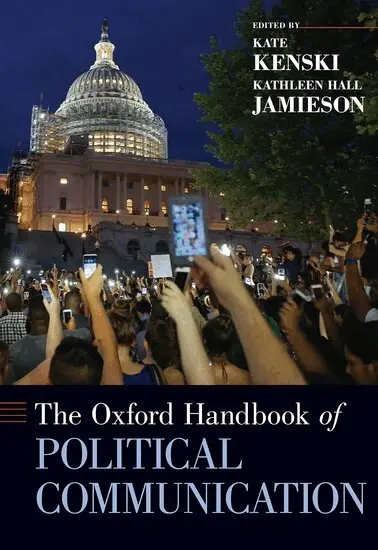
    The Oxford Handbook of Political Communication

    AvKate Kenski,Kathleen Hall Jamieson

    Inbunden, Engelska, 2017

    Del i serien Oxford Handbooks

    2 571 kr

    Beställningsvara. Skickas inom 5-8 vardagar. Fri frakt över 249 kr.

    Beskrivning

    As a field of rich theoretical development and practical application, political communication has expanded over the past fifty years. Since its development shaped by the turmoil of the World Wars and suspicion of new technologies such as film and radio, the discipline has become a hybrid field largely devoted to connecting the dots between political rhetoric, politicians and leaders, voters' opinions, and media exposure to better understand how any one aspect can affects the others. The Oxford Handbook of Political Communication provides contexts for viewing the field of political communication, examines political discourse, media, and considers political communication's evolution inside the altered political communication landscape. Kate Kenski and Kathleen Hall Jamieson bring together some of the most groundbreaking scholars in the field to reflect upon their areas of expertise to address the importance of their areas of study to the field, the major findings to date, including areas of scholarly disagreement, on the topics, the authors' perspectives, and unanswered questions for future research to address. Their answers reveal that political communication is a hybrid with complex ancestry, permeable boundaries and interests that overlap with those of related fields such as political sociology, public opinion, rhetoric, neuroscience and the new hybrid on the quad, media psychology. This comprehensive review of the political communication literature is designed to become the first reference for scholars and students interested in the study of how, why, when, and with what effect humans make sense of symbolic exchanges about sharing and shared power. The sixty-two chapters in The Oxford Handbook of Political Communication contain an overview of past scholarship while providing critical reflection of its relevance in a changing media landscape and offering agendas for future research and innovation.

    Produktinformation

    • Utgivningsdatum:2017-08-24
    • Mått:249 x 175 x 63 mm
    • Vikt:1 792 g
    • Format:Inbunden
    • Språk:Engelska
    • Serie:Oxford Handbooks
    • Antal sidor:976
    • Förlag:OUP USA
    • ISBN:9780199793471

    Utforska kategorier

    • Politiska partier inom Samhälle och politik
    • Politiska ideologier och rörelser inom Samhälle och politik
    • Statsvetenskap och politisk teori inom Samhälle och politik

    Mer om författaren

    Kate Kenski (Ph.D., University of Pennsylvania) is an Associate Professor of Communication and Government & Public Policy at the University of Arizona where she teaches political communication, public opinion, and research methods. Kathleen Hall Jamieson (Ph.D., University of Wisconsin-Madison) is the Elizabeth Ware Packard Professor of Communication at the Annenberg School for Communication of the University of Pennsylvania and Director of its Annenberg Public Policy Center.

    Innehållsförteckning

    • INTRODUCTION 1. Political Communication: Then, Now, and Beyond - Kathleen Hall Jamieson, University of Pennsylvania and Kate Kenski, University of Arizona CONTEXTS FOR VIEWING THE FIELD OF POLITICAL COMMUNICATION2. Creating the Hybrid Field of Political Communication: A Five-Decade-Long Evolution of the Concept of Effects - Kathleen Hall Jamieson, University of Pennsylvania3. The Shape of Political Communication - Jay G. Blumler, University of Maryland4. A Typology of Media Effects - Shanto Iyengar, Stanford University5. The Power of Political Communication - Michael Tesler, Brown University, and John Zaller, University of California, Los Angeles6. Nowhere to Go: Some Dilemmas of Deliberative Democracy - Elihu Katz, University of Pennsylvania7. How to Think Normatively about News and Democracy - Michael Schudson, Columbia University POLITICAL DISCOURSE: HISTORY, GENRES, AND THE CONSTRUCTION OF MEANING 8. Not a Fourth Estate but a Second Legislature - Roderick P. Hart, University of Texas at Austin, and Rebecca LaVally, California State University, Sacramento 9. Presidential Address - Kevin Coe, University of Utah10. Political Messages and Partisanship - Sharon E. Jarvis, University of Texas at Austin11. Political Advertising - Timothy W. Fallis, University of Pennsylvania12. Political Campaign Debates - David S. Birdsell, Baruch College (CUNY)13. Niche Communication in Political Campaigns-Laura Lazarus Frankel, Duke University, and D. Sunshine Hillygus, Duke University14. The Functional Theory of Political Campaign Communication - William L. Benoit, Ohio University15. The Political Uses and Abuses of Civility and Incivility, Kathleen Hall Jamieson, Allyson Volinsky and Ilana Weitz, University of Pennsylvania, and Kate Kenski, University of Arizona16. The Politics of Memory - Nicole Maurantonio, University of Richmond MEDIA AND POLITICAL COMMUNICATIONPolitical Systems, Institutions, and Media17. Freedom of the Press: Theories and Realities - Doris Graber, University of Illinois at Chicago 18. Press-Government Relations in a Changing Media Environment - W. Lance Bennett, University of Washington19. News Media as Political Institutions - Robert W. McChesney, University of Illinois at Urbana-Champaign, and Victor Pickard, New York University20. Measuring Spillovers in Markets for Local Public Affairs Coverage - James T. Hamilton, Stanford University21. Comparative Political Communication Research - Claes de Vreese, University of Amsterdam 22. Media Responsiveness During Times of Crisis - Carol Winkler, Georgia State University23. The U.S. Media, Foreign Policy, and Public Support for War - Sean Aday, George Washington University24. Journalism and the Public-Service Model: In Search of an Ideal - Stephen Coleman, University of Leeds Construction and Effects25. The Gatekeeping of Political Messages - Pamela J. Shoemaker, Syracuse University, Philip R. Johnson, Syracuse University, and Jaime R. Riccio, Syracuse University26. The Media Agenda: Who (or What) Sets It? - David H. Weaver, Indiana University and Jihyang Choi27. Game versus Substance in Political News - Thomas E. Patterson, Harvard University28. Going Institutional: The Making of Political Communications - Lawrence R. Jacobs, University of Minnesota 29. Theories of Media Bias - S. Robert Lichter, George Mason University30. Digital Media And Perceptions Of Source Credibility In Political Communication - Andrew J. Flanagin, University of California, Santa Barbara, and Miriam J. Metzger, University of California, Santa Barbara31. Candidate Traits and Political Choice - Bruce W. Hardy, University of Pennsylvania32. Political Communication, Information Processing, and Social Groups - Nicholas Valentino, University of Michigan, and L. Matthew Vandenbroek, The Mellman Group33. Civic Norms and Communication Competence: Pathways to Socialization and Citizenship - Dhavan V. Shah, University of Wisconsin, Kjerstin Thorson, University of Southern California, Chris Wells, University of Wisconsin, Nam-jin Lee, College of Charleston, and Jack McLeod, University of Wisconsin34. Framing Inequality in Public Policy Discourse: The Nature of Constraint - Oscar H. Gandy, Jr., University of Pennsylvania35. Political Communication: Insights from Field Experiments - Donald P. Green, Columbia University, Allison Carnie, Yale University, and Joel Middleton, New York University Political Communication and Cognition36. Communication Modalities and Political Knowledge - William P. Eveland, Jr., The Ohio State University, and R. Kelly Garrett, The Ohio State University37. Selective Exposure Theories - Natalie Jomini Stroud, University of Texas at Austin38. The Hostile Media Effect - Lauren Feldman, Rutgers University 39. Public and Elite Perceptions of News Media in Politics - Yariv Tsfati, University of Haifa40. The Media and the Fostering of Political (Dis)Trust - Michael Barthel, University of Washington, and Patricia Moy, University of Washington41. Cultivation and the Construction of Political Reality - Patrick E. Jamieson, University of Pennsylvania, and Daniel Romer, University of Pennsylvania42. Uses & Gratifications - R. Lance Holbert, University of South Carolina43. The State of Framing Research: A Call for New Directions - Dietram Scheufele, University of Wisconsin and Shanto Iyengar, Stanford University44. Agenda Setting Theory: The Frontier Research Questions - Maxwell McCombs, University of Texas at Austin, and Sebastián Valenzuela, Catholic University of Chile45. Implicit Political Attitudes: When, How, Why, With What Effects - Dan Cassino, Fairleigh Dickinson University, Milton Lodge, SUNY at Stony Brook, and Charles Taber, SUNY at Stony Brook46. Affect and Political Choice - Ann N. Crigler, University of Southern California, and Parker R. Hevron, Texas Woman's University INTERPERSONAL AND SMALL GROUP POLITICAL COMMUNICATION47. Two-Step Flow, Diffusion, and the Role of Social Networks in Political Communication - Brian Southwell, RTI International and University of North Carolina at Chapel Hill48. Taking Interdependence Seriously: Platforms for Understanding Political Communication - Robert Huckfeldt, University of California, Davis49. Disagreement in Political Discussion - Lilach Nir, Hebrew University of Jerusalem 50. The Internal Dynamics and Political Power of Small Group Deliberation - John Gastil, University of Washington, Katherine R. Knobloch, Colorado State University, and Jason Gilmore, University of Washington51. Ethnography of Politics and Political Communication: Studies in Sociology and Political Science - Eeva Luhtakallio, University of Helsinki, and Nina Eliasoph, University of Southern California52. Self-censorship, the Spiral of Silence, and Contemporary Political Communication - Andrew Hayes, Ohio State University, and Jörg Matthes, University of Zurich53. Collective Intelligence: The Wisdom and Foolishness of Deliberating Groups - Joseph Cappella, Jingwen Zhang, and Vincent Price, University of Pennsylvania THE ALTERED POLITICAL COMMUNICATION LANDSCAPE54. Broadcasting versus Narrowcasting: Do Mass Media Exist in the 21st Century? - Miriam J. Metzger, University of California, Santa Barbara 55. Online News Consumption in the U.S. and Ideological Extremism - Kenneth M. Winneg, University of Pennsylvania, Daniel M. Butler, Yale University, Saar Golde, Revolution Analytics, Darwin W. Miller III, RAND Corporation, and Norman H. Nie, Stanford University and the University of Chicago 56. New Media and Political Campaigns - Diana Owen, Georgetown University 57. Political Discussion and Deliberation Online - Jennifer Stromer-Galley, Syracuse University58. The Political Effects of Entertainment Media - Michael X. Delli Carpini, University of Pennsylvania59. Theories and Effects of Political Humor: Discounting Cues, Gateways, and the Impact of Incongruities - Dannagal G. Young, University of Delaware60. Music as Political Communication - John Street, University of East Anglia61. Conditions for Political Accountability in a High-Choice Media Environment - Markus Prior, Princeton University CONCLUSION62. Political Communication: Looking Ahead - Kate Kenski, University of Arizona and Kathleen Hall Jamieson, University of Pennsylvania