• Fri frakt över 249 kr
  • •
  • Snabba leveranser
  • •
  • Billiga böcker
Kundservice

Du är på sajten för privatpersoner.

Företag, bibliotek eller offentlig verksamhet?

Du handlar på classic.bokus.com, där alla dina funktioner finns intakta.
Till classic.bokus.com
Bokus logotyp. Gå till startsidan.
  • Erbjudanden
  • Nyheter
  • Student
  • Topplistor
  • Barn & ungdom
  • Bokus Play
  • E-böcker
  • Pocketböcker
  • Spel & pussel

Må bättre, för mindre! Upp till 50% rabatt på hälsoböcker

Sidfot

Mina sidor

    Hjälp

    • Kundservice
    • Vanliga frågor och svar
    • Frakt och leverans
    • Retur vid ångerrätt
    • Reklamera vara
    • Betalning
    • Köpvillkor
    • Allmänna villkor
    • Information om webbplatsens tillgänglighet

    Om Bokus

    • Om oss
    • Pressrum
    • För studenter
    • För företag
    • För bibliotek och offentlig verksamhet
    • För leverantörer
    • Hållbarhet

    Populärt

    • Aktuella erbjudanden
    • Presentkort
    • Studentlitteratur
    • Nya böcker
    • Topplistor
    • Signerade böcker
    • Engelska böcker

    Inspiration

    • Boktips
    • BookTok
    • Populära bokserier
    • Barnbokskaraktärer
    • Populära författare
    Logotyp för Bokus
    Följ oss på Facebook (extern länk)Följ oss på Instagram (extern länk)Följ oss på YouTube (extern länk)Följ oss på TikTok (extern länk)
    bokus @ CookiesAnpassa cookiesIntegritetspolicyKöpvillkor
    Till Citymail hemsida (extern länk)Till Budbee hemsida (extern länk)Till Postnord hemsida (extern länk)Till Schenker hemsida (extern länk)Till Early Bird hemsida (extern länk)Till Walleys hemsida (extern länk)
    1. Samhälle och politik
    2. Politik och statsskick
    3. Internationella relationer

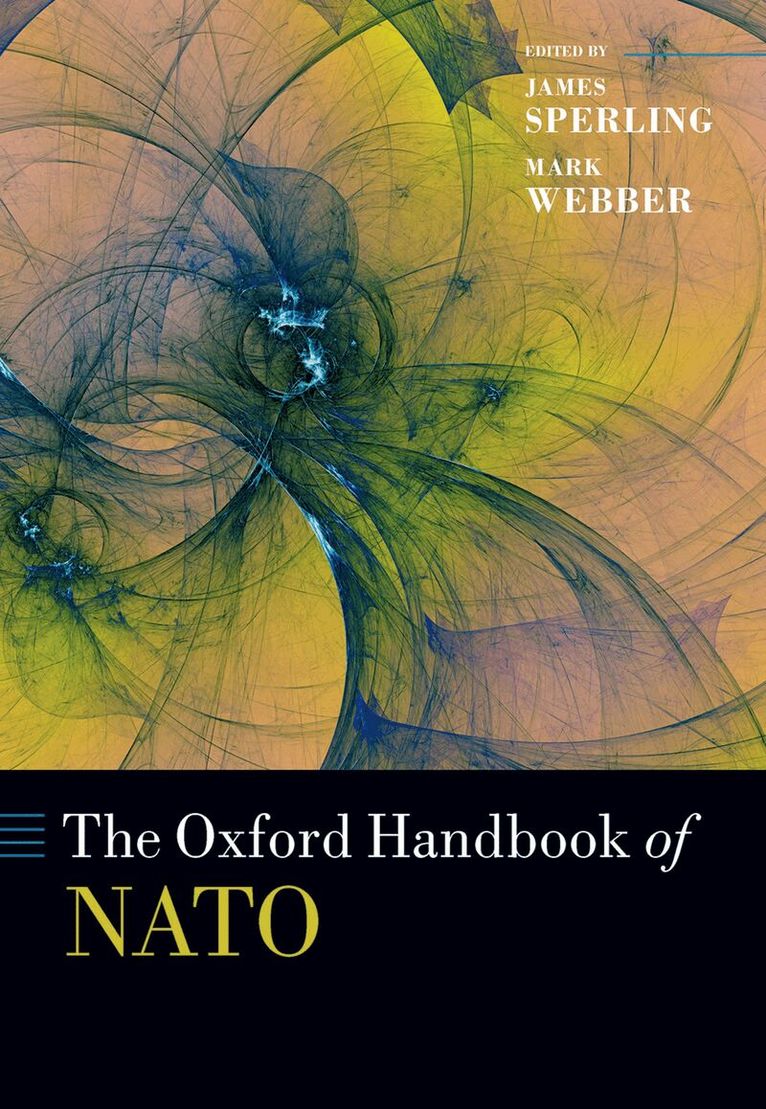
    The Oxford Handbook of NATO

    AvJames Sperling,Mark Webber

    Inbunden, Engelska, 2025

    Del i serien Oxford Handbooks

    2 689 kr

    Beställningsvara. Skickas inom 5-8 vardagar. Fri frakt över 249 kr.

    Beskrivning

    The North Atlantic Treaty Organization (NATO) has since its foundation in 1949 been the principal body of the Western security order, and remains as important in the 2020s as it was in the 1950s. This Handbook offers the most extensive treatment of the Alliance published in the last two decades, providing detailed coverage of NATO allies, policies, and organizational structures. It brings together internationally renowned scholars who interrogate NATO's actions from historical, theoretical, and empirical perspectives.The Handbook is divided into nine parts. Following an introductory part offering a thematic overview of NATO, framed by different approaches to domestic politics and global order, the second part explores three broad questions - what is NATO for, who is NATO for, and whither NATO? Part Three is more expressly theoretical, providing multi-perspectival analyses of the Alliance. Part Four then turns to how NATO works as a political-military alliance. Parts Five and Six are concerned with what NATO does in practical terms - how it addresses a wide range of security threats and what operations it has mounted in response. Part Seven looks at some of NATO's most significant allies including France, Germany, Italy, Poland, Turkey, the United Kingdom, and the United States. Part Eight, meanwhile, is concerned with partnerships and key relationships beyond NATO's membership - looking at Australia, Georgia, Ukraine, Russia, China, the European Union, and the European neutrals as well as ties to states in the Gulf, the Middle East, and North Africa. The final part of the volume offers reflections on NATO's recent past and possible lines of future development.

    Produktinformation

    • Utgivningsdatum:2025-02-20
    • Mått:252 x 158 x 176 mm
    • Vikt:1 851 g
    • Format:Inbunden
    • Språk:Engelska
    • Serie:Oxford Handbooks
    • Antal sidor:1 004
    • Förlag:OUP OXFORD
    • ISBN:9780198851196

    Utforska kategorier

    • Internationella relationer inom Samhälle och politik

    Mer om författaren

    James Sperling is Professor Emeritus in the Department of Political Science at the University of Akron, having previously taught at Davidson College and at the James Madison College, Michigan State University. He was named Fernand Braudel Senior Fellow at the European University Institute and Visiting Fellow at the Institute of Advanced Study at the University of Bologna.Mark Webber is Professor of International Politics at the University of Birmingham. He was Head of the School of Government at Birmingham from 2011 to 2019 and Chair/Honorary President of the British International Studies Association (BISA) from 2019 to 2023. He is a non-resident fellow at the NATO Defence College in Rome.

    Innehållsförteckning

    • Part I. Context 1: James Sperling and Mark Webber: Understanding NATO 2: Trine Flockhart: Global Order 3: Stephanie C. Hofmann and Michael John Williams: Domestic Politics Part II. Questions 4: Michael Clarke: What is NATO for (Redux)? 5: Andrew T. Wolff: Who is NATO for? 6: Stanley R. Sloan: Whither NATO? A History of NATO's Futures Part III. Perspectives 7: Seth A. Johnston: Realisms 8: Sebastian Harnisch and Florian Böller: Liberalisms 9: Alexandra Gheciu: Security Community: Identity, Practices, and Trust 10: Katharine A. M. Wright: Gender 11: Rita Floyd: Securitization, Desecuritization, and Just Securitization 12: Maria Mälksoo: Risk, Resilience, and Resistance 13: Gabi Schlag: Visual Discourses of Identity Making 14: Jordan Becker: Strategic Culture Part IV. Strategy, Policy, and Command 15: R. James Orr: The North Atlantic Treaty 16: Lawrence Freedman and Jeffrey H. Michaels: Strategy 17: John R. Deni: Doctrine 18: Sebastian Mayer: The International Staff 19: Paal Sigurd Hilde: Military and Command Structures 20: Maryann Foster: Defence Planning and Force Generation 21: Ian Davis: Representation and Decision-making 22: Ryan C. Hendrickson: The Secretary General Part V. Deterrence, Defence, and Security 23: David S. Yost: Nuclear Deterrence 24: Stephan Frühling: Ballistic Missile Defence 25: Jens Ringsmose: Conventional Force Posture 26: Julian Lindley-French: Cybrid Warfare 27: Jamie Shea: Non-Traditional Security Threats 28: Cornelia Baciu: COVID-19, Crisis Management, and Civil Emergency Response 29: James Sperling: Emerging and Disruptive Technologies 30: Benjamin Zyla: Burden-sharing Part VI. Operations 31: Jonathan Marcus: Bosnia 32: Martin A. Smith: Kosovo 33: Kjell Engelbrekt and Braxton Palmer: Libya 34: Sten Rynning: Afghanistan 35: Brooke A. Smith-Windsor: Maritime Operations 36: Thierry Tardy: Counter-terrorism and Projecting Stability 37: Linde Desmaele and Luis Simón: Forward Deployment and Reassurance Part VII. Key Allies 38: James Goldgeier: The United States 39: Andrew M. Dorman and Matthew Uttley: The United Kingdom 40: Olivier Schmitt: France 41: Tom Dyson: Germany 42: Luca Ratti: Italy 43: Wojciech Lorenz: Poland 44: Tarik Oguzlu: Turkey Part VIII. Key Relationships 45: Magnus Petersson: Partnerships 46: Richard G. Whitman: The European Union 47: Andrew Cottey: The European Neutrals 48: Tracey German: Georgia and Ukraine 49: Alessandro Marrone: The Mediterranean Dialogue 50: Eleonora Ardemagni: The Istanbul Cooperation Initiative 51: Ben Schreer: Australia 52: Roland Dannreuther: Russia 53: Andrew Cottey and Mark Webber: China Part IX. Conclusion 54: Alexander Moens and Alexandra Richards: NATO's Redoubled Relevance