• Fri frakt över 249 kr
  • •
  • Snabba leveranser
  • •
  • Billiga böcker
Kundservice

Du är på sajten för privatpersoner.

Företag, bibliotek eller offentlig verksamhet?

Du handlar på classic.bokus.com, där alla dina funktioner finns intakta.
Till classic.bokus.com
Bokus logotyp. Gå till startsidan.
  • Erbjudanden
  • Nyheter
  • Student
  • Topplistor
  • Barn & ungdom
  • Bokus Play
  • E-böcker
  • Pocketböcker
  • Spel & pussel

10% rabatt på allt med kod NYSTART10 →

Sidfot

Mina sidor

    Hjälp

    • Kundservice
    • Vanliga frågor och svar
    • Frakt och leverans
    • Retur vid ångerrätt
    • Reklamera vara
    • Betalning
    • Köpvillkor
    • Allmänna villkor
    • Information om webbplatsens tillgänglighet

    Om Bokus

    • Om oss
    • Pressrum
    • För studenter
    • För företag
    • För bibliotek och offentlig verksamhet
    • För leverantörer
    • Hållbarhet

    Populärt

    • Aktuella erbjudanden
    • Presentkort
    • Studentlitteratur
    • Nya böcker
    • Topplistor
    • Signerade böcker
    • Engelska böcker

    Inspiration

    • Boktips
    • BookTok
    • Populära bokserier
    • Barnbokskaraktärer
    • Populära författare
    Logotyp för Bokus
    Följ oss på Facebook (extern länk)Följ oss på Instagram (extern länk)Följ oss på YouTube (extern länk)Följ oss på TikTok (extern länk)
    bokus @ CookiesAnpassa cookiesIntegritetspolicyKöpvillkor
    Till Citymail hemsida (extern länk)Till Budbee hemsida (extern länk)Till Postnord hemsida (extern länk)Till Schenker hemsida (extern länk)Till Early Bird hemsida (extern länk)Till Walleys hemsida (extern länk)
    1. Ekonomi och Ledarskap
    2. Nationalekonomi

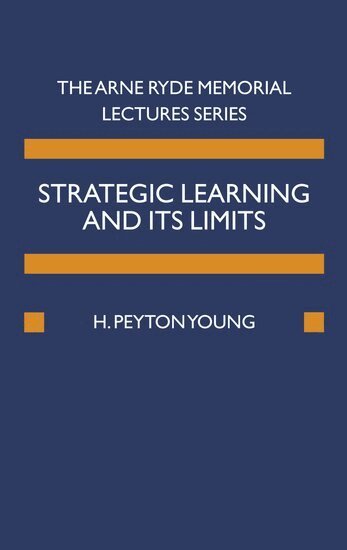
    Strategic Learning and its Limits

    AvH. Peyton Young

    Inbunden, Engelska, 2004

    Del i serien Ryde Lectures

    1 275 kr

    Beställningsvara. Skickas inom 5-8 vardagar. Fri frakt över 249 kr.

    Fler format och utgåvor

    E-bok

    888 kr

    E-bok

    789 kr

    Beskrivning

    In this concise book based on his Arne Ryde Lectures in 2002, Young suggests a conceptual framework for studying strategic learning and highlights theoretical developments in the area. He discusses the interactive learning problem; reinforcement and regret; equilibrium; conditional no-regret learning; prediction, postdiction, and calibration; fictitious play and its variants; Bayesian learning; and hypothesis testing.Young's framework emphasizes the amount of information required to implement different types of learning rules, criteria for evaluating their performance, and alternative notions of equilibrium to which they converge. He also stresses the limits of what can be achieved: for a given type of game and a given amount of information, there may exist no learning procedure that satisfies certain reasonable criteria of performance and convergence.In short, Young has provided a valuable primer that delineates what we know, what we would like to know, and the limits of what we can know, when we try to learn about a system that is composed of other learners.

    Produktinformation

    • Utgivningsdatum:2004-11-04
    • Mått:146 x 224 x 16 mm
    • Vikt:353 g
    • Format:Inbunden
    • Språk:Engelska
    • Serie:Ryde Lectures
    • Antal sidor:176
    • Förlag:OUP OXFORD
    • ISBN:9780199269181

    Utforska kategorier

    • Nationalekonomi inom Ekonomi och Ledarskap
    • Optimering inom Naturvetenskap och teknik
    • Psykologiska teorier och skolor inom Psykologi och pedagogik

    Mer om författaren

    H. Peyton Young is Senior Fellow in Economic Studies and Governance Studies and Co-Director of the Center on Social and Economic Dynamics at the Brookings Institution. He is also Scott and Barbara Black Professor of Economics at Johns Hopkins University and a Member of the Science Steering Committee at the Santa Fe Institute. His main areas of research and expertise are game theory, the design of legislative systems, public sector pricing, social norms, and public policy, in all of which he has published extensively.

    Innehållsförteckning

    • 1. The Interactive Learning Problem ; 2. Reinforcement and Regret ; 3. Equilibrium ; 4. Conditional No-Regret Learning ; 5. Prediction, Postdiction, and Calibration ; 6. Fictitious Play and Its Variants ; 7. Bayesian Learning ; 8. Hypothesis Testing ; 9. Conclusion