• Fri frakt över 249 kr
  • •
  • Snabba leveranser
  • •
  • Billiga böcker
Kundservice

Du är på sajten för privatpersoner.

Företag, bibliotek eller offentlig verksamhet?

Du handlar på classic.bokus.com, där alla dina funktioner finns intakta.
Till classic.bokus.com
Bokus logotyp. Gå till startsidan.
  • Erbjudanden
  • Student
  • Topplistor
  • Barn & ungdom
  • Bokus Play
  • E-böcker
  • Ljudböcker
  • Pocketböcker
  • Spel och pussel

5% studentrabatt – använd koden KURSBOK27 →

Sidfot

Mina sidor

    Hjälp

    • Kundservice
    • Vanliga frågor och svar
    • Frakt och leverans
    • Retur vid ångerrätt
    • Reklamera vara
    • Betalning
    • Köpvillkor
    • Allmänna villkor
    • Information om webbplatsens tillgänglighet

    Om Bokus

    • Om oss
    • Pressrum
    • För studenter
    • För företag
    • För bibliotek och offentlig verksamhet
    • För leverantörer
    • Hållbarhet

    Populärt

    • Aktuella erbjudanden
    • Presentkort
    • Studentlitteratur
    • Nya böcker
    • Topplistor
    • Signerade böcker
    • Engelska böcker

    Inspiration

    • Boktips
    • BookTok
    • Barnbokskaraktärer
    • Populära författare
    Logotyp för Bokus
    Följ oss på Facebook (extern länk)Följ oss på Instagram (extern länk)Följ oss på YouTube (extern länk)Följ oss på TikTok (extern länk)
    bokus @ CookiesAnpassa cookiesIntegritetspolicyKöpvillkor
    Till Citymail hemsida (extern länk)Till Budbee hemsida (extern länk)Till Postnord hemsida (extern länk)Till Schenker hemsida (extern länk)Till Early Bird hemsida (extern länk)Till Walleys hemsida (extern länk)
    1. Samhälle och politik
    2. Politik och statsskick
    3. Statsskick och politiska processer
    4. Val och folkomröstningar

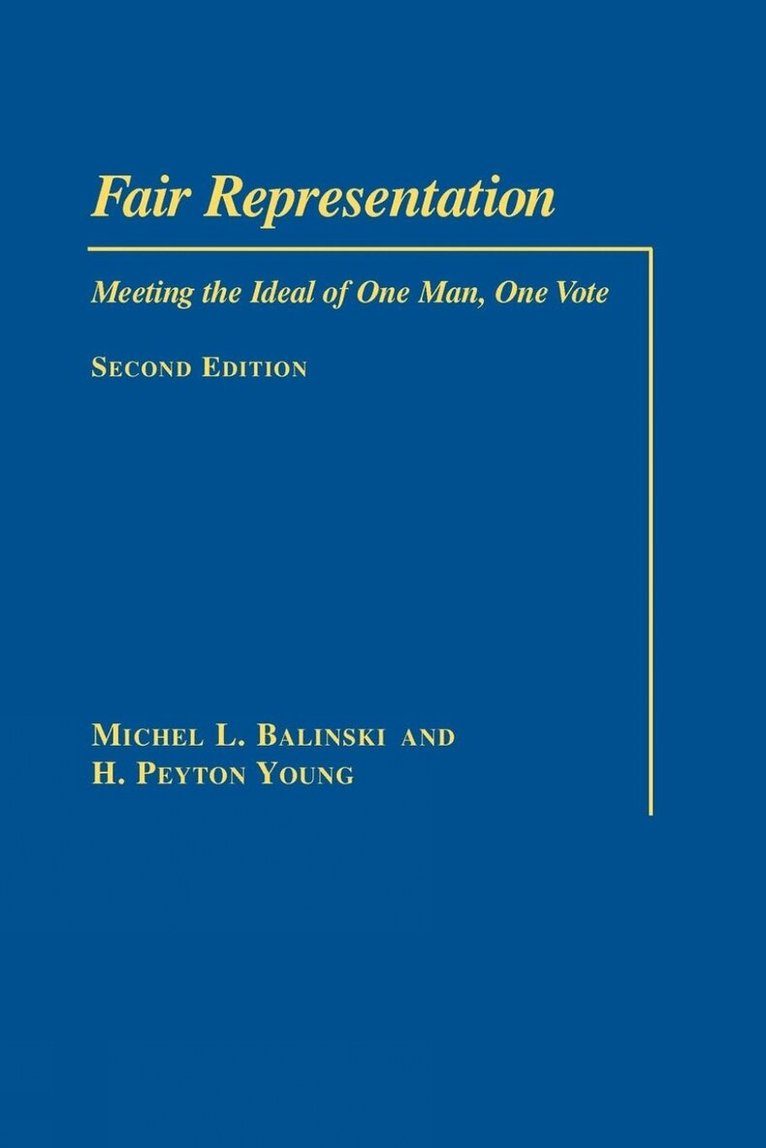
    Fair Representation

    Meeting the Ideal of One Man, One Vote

    AvMichel L. Balinski,H. Peyton Young

    Häftad, Engelska, 2001

    297 kr

    Beställningsvara. Skickas inom 10-15 vardagar. Fri frakt över 249 kr.

    Fler format och utgåvor

    E-bok

    317 kr

    Beskrivning

    The issue of fair representation will take center stage as U.S. congressional districts are reapportioned based on the 2000 Census. Using U.S. history as a guide, the authors develop a theory of fair representation that establishes various principles for translating state populations—or vote totals of parties—into a fair allocation of congressional seats. They conclude that the current apportionment formula cheats the larger states in favor of the smaller, contrary to the intentions of the founding fathers and compromising the Supreme Court's ""one man, one vote"" rulings. Balinski and Young interweave the theoretical development with a rich historical account of controversies over representation, and show how many of these principles grew out of political contests in the course of United States history. The result is a work that is at once history, politics, and popular science. The book—updated with data from the 1980 and 1990 Census counts—vividly demonstrates that apportionment deals with the very substance of political power.

    Produktinformation

    • Utgivningsdatum:2001-09-20
    • Mått:151 x 228 x 14 mm
    • Vikt:331 g
    • Format:Häftad
    • Språk:Engelska
    • Antal sidor:192
    • Upplaga:2
    • Förlag:Bloomsbury Publishing Plc
    • ISBN:9780815701118

    Utforska kategorier

    • Val och folkomröstningar inom Samhälle och politik

    Mer om författaren

    "Michel L. Balinski is the former director of the Laboratoire d'Econométrie of the Ecole Polytechnique in Paris, the founding editor of the journal Mathematical Programming. and is a noted authority on mathematical optimization and operations research. H. Peyton Young is a senior fellow in the Economic Studies program at the Brookings Institution and Scott and Barbara Black professor of economics at Johns Hopkins University. He is the author of several books, including Individual Strategy and Social Structure (Princeton, 1998) and Equity in Theory and Practice (Princeton, 1994)."

    Recensioner i media

    "The definitive account-and solution-of the 200-year-old apportionment problem. The book is political analysis at its bestEdward Tufte, Yale University" —Edward Tufte, Yale University, 1/11/2001