• Fri frakt över 249 kr
  • •
  • Snabba leveranser
  • •
  • Billiga böcker
Kundservice

Du är på sajten för privatpersoner.

Företag, bibliotek eller offentlig verksamhet?

Du handlar på classic.bokus.com, där alla dina funktioner finns intakta.
Till classic.bokus.com
Bokus logotyp. Gå till startsidan.
  • Erbjudanden
  • Nyheter
  • Student
  • Topplistor
  • Barn & ungdom
  • Bokus Play
  • E-böcker
  • Pocketböcker
  • Spel & pussel

10% rabatt på allt med kod: NYSTART10 →

Sidfot

Mina sidor

    Hjälp

    • Kundservice
    • Vanliga frågor och svar
    • Frakt och leverans
    • Retur vid ångerrätt
    • Reklamera vara
    • Betalning
    • Köpvillkor
    • Allmänna villkor
    • Information om webbplatsens tillgänglighet

    Om Bokus

    • Om oss
    • Pressrum
    • För studenter
    • För företag
    • För bibliotek och offentlig verksamhet
    • För leverantörer
    • Hållbarhet

    Populärt

    • Aktuella erbjudanden
    • Presentkort
    • Studentlitteratur
    • Nya böcker
    • Topplistor
    • Signerade böcker
    • Engelska böcker

    Inspiration

    • Boktips
    • BookTok
    • Populära bokserier
    • Barnbokskaraktärer
    • Populära författare
    Logotyp för Bokus
    Följ oss på Facebook (extern länk)Följ oss på Instagram (extern länk)Följ oss på YouTube (extern länk)Följ oss på TikTok (extern länk)
    bokus @ CookiesAnpassa cookiesIntegritetspolicyKöpvillkor
    Till Citymail hemsida (extern länk)Till Budbee hemsida (extern länk)Till Postnord hemsida (extern länk)Till Schenker hemsida (extern länk)Till Early Bird hemsida (extern länk)Till Walleys hemsida (extern länk)
    1. Språk och ordböcker
    2. Språkvetenskap och lingvistik

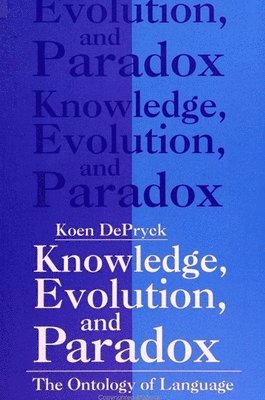
    Knowledge, Evolution and Paradox

    The Ontology of Language

    AvKoen DePryck

    Häftad, Engelska, 1993

    Del i serien SUNY series, The Margins of Literature

    394 kr

    Tillfälligt slut

    Beskrivning

    An exploration of language, knowledge, and evolution that unifies philosophy, science, and paradox into a single transformative vision of reality.What if the deepest problems of philosophy—language, mind, time, evolution, and reality itself—were not separate puzzles, but expressions of a single underlying structure?In Knowledge, Evolution and Paradox, Koen DePryck advances a bold and integrative framework that challenges the limits of postmodern skepticism and fragmented academic discourse. Drawing on insights from iterative, chaotic, and probabilistic processes in nature and computation, DePryck proposes a new way to understand how meaning, knowledge, and reality co-emerge through language.At its core, this work confronts enduring philosophical tensions:How can multiple disciplinary "worlds" belong to one world?How do language-games relate across apparent incommensurability?What is the role of paradox and self-reference in thought and reality?And how can mind and consciousness be understood as embodied, evolving phenomena?DePryck develops an ambitious interdisciplinary synthesis that bridges the sciences and humanities, offering not only a critique of postmodern limits but a constructive alternative grounded in evolutionary and systemic thinking.

    Produktinformation

    • Utgivningsdatum:1993-08-24
    • Mått:148 x 226 x 12 mm
    • Vikt:272 g
    • Format:Häftad
    • Språk:Engelska
    • Serie:SUNY series, The Margins of Literature
    • Antal sidor:184
    • Förlag:State University of New York Press
    • ISBN:9780791415344

    Utforska kategorier

    • Språkvetenskap och lingvistik inom Språk och ordböcker

    Mer om författaren

    Koen DePryck is President of the Institute of Knowledge Management in Dilbeek, Belgium.

    Recensioner i media

    "It is already clear that postmodernism is an unsatisfactory view of the world: the skepticism, antifoundationalism, and distrust of any form of narrative or argument that has characterized this last phase of modernism cannot long resist its own corrosive critique. What view of the world will succeed postmodernism? To answer this question, it is necessary to take up several challenges abandoned along the way as metaphysical, insoluble in terms of the contemporary science, or politically formidable: the problem of how different disciplinary worlds can belong to the same world, the problem of the apparent incommensurability of different language-games, the problem of the nature of time, the problem of how mind and consciousness can be embodied in the physical brain, the problem of origins and evolution, and above all, the problem of time."Koen DePryck's book, in a remarkable synthesis, lays the groundwork for an answer. Using new concepts derived from the study of iterative, chaotic, and probabilistic processes in nature and in the computer, he develops a way of looking at both the sciences and the humanities that fully meets the concerns of the mainstream of modern philosophy, while opening up whole new areas of research. This book joins a handful of important and daring new works that have recently broken with the current conventional wisdom of the humanities, and that chart the altered shape of the academy as it will exist in the twenty-first century." — Frederick Turner, Founders Professor of Arts and Humanities, University of Texas at Dallas

    Innehållsförteckning

    • Illustrations Acknowledgments 1. Introduction 2. An Interdisciplinary Framework 3. The Question Concerning Language 4. Paradoxes and Self-Reference 5. Performing the Language of Evolution 6. Probabilities and Beyond Notes Bibliography Index