• Fri frakt över 249 kr
  • •
  • Snabba leveranser
  • •
  • Billiga böcker
Kundservice

Du är på sajten för privatpersoner.

Företag, bibliotek eller offentlig verksamhet?

Du handlar på classic.bokus.com, där alla dina funktioner finns intakta.
Till classic.bokus.com
Bokus logotyp. Gå till startsidan.
  • Erbjudanden
  • Nyheter
  • Student
  • Topplistor
  • Barn & ungdom
  • Bokus Play
  • E-böcker
  • Pocketböcker
  • Spel & pussel

10% rabatt på allt med kod: NYSTART10 →

Sidfot

Mina sidor

    Hjälp

    • Kundservice
    • Vanliga frågor och svar
    • Frakt och leverans
    • Retur vid ångerrätt
    • Reklamera vara
    • Betalning
    • Köpvillkor
    • Allmänna villkor
    • Information om webbplatsens tillgänglighet

    Om Bokus

    • Om oss
    • Pressrum
    • För studenter
    • För företag
    • För bibliotek och offentlig verksamhet
    • För leverantörer
    • Hållbarhet

    Populärt

    • Aktuella erbjudanden
    • Presentkort
    • Studentlitteratur
    • Nya böcker
    • Topplistor
    • Signerade böcker
    • Engelska böcker

    Inspiration

    • Boktips
    • BookTok
    • Populära bokserier
    • Barnbokskaraktärer
    • Populära författare
    Logotyp för Bokus
    Följ oss på Facebook (extern länk)Följ oss på Instagram (extern länk)Följ oss på YouTube (extern länk)Följ oss på TikTok (extern länk)
    bokus @ CookiesAnpassa cookiesIntegritetspolicyKöpvillkor
    Till Citymail hemsida (extern länk)Till Budbee hemsida (extern länk)Till Postnord hemsida (extern länk)Till Schenker hemsida (extern länk)Till Early Bird hemsida (extern länk)Till Walleys hemsida (extern länk)
    1. Skönlitteratur
    2. Litteraturvetenskap
    3. Litteraturteori

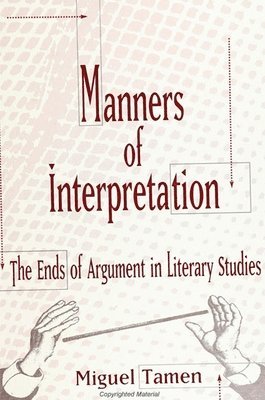
    Manners of Interpretation

    The Ends of Argument in Literary Studies

    AvMiguel Tamen

    Häftad, Engelska, 1993

    Del i serien SUNY series, The Margins of Literature

    449 kr

    Tillfälligt slut

    Beskrivning

    Philosophy and literary theory have devoted a great deal of their analysis to the problem of the origin and modalities of argumentation, but there has been an almost total lack of interest in the question of its procedural limits. Manners of Interpretation is an essay on ways of ending interpretations in literary studies as well as on patterns of controversy and consensus in the humanities. Tamen examines two major families of indisputable arguments in post-Enlightenment literary criticism and addresses the question of how one recognizes the proper time to use a given argument, especially and specifically an indisputable argument. The former aim leads to a tentative history of the constitution of literary theory as a set of identifiable ways of using arguments. The latter, meanwhile, points to a theory of argument and controversy and to a contribution to the discussion of human activities that, in spite of not being teachable, are nevertheless learnable. Such a theory seems to be particularly relevant both to the study of the interpretive dimension of literary criticism as it is now practiced and also to the knowledge and description of an area of the humanities that has often been neglected.

    Produktinformation

    • Utgivningsdatum:1993-08-24
    • Mått:152 x 229 x 25 mm
    • Vikt:318 g
    • Format:Häftad
    • Språk:Engelska
    • Serie:SUNY series, The Margins of Literature
    • Antal sidor:211
    • Förlag:State University of New York Press
    • ISBN:9780791415047

    Utforska kategorier

    • Litteraturteori inom Skönlitteratur

    Mer om författaren

    Miguel Tamen is Assistant Professor in the Department of Romance Literatures and Graduate Program in Literary Theory, University of Lisbon. He is the author of Hermenêutica e mal-estar.

    Recensioner i media

    "The literary and language theoreticians whom Tamen analyzes, together with the categories he devises in which to contain his discussion of hermeneutics, philology and how each attempts to limit its own potentiality for disagreement with its premises and methods, are all very apt and important to the current debates over literary theory. Over all, Tamen's familiarity with his field, with the original languages of the texts he uses, and his sheer critical intelligence are, well, awesome." — Mili Clark, SUNY Buffalo

    Innehållsförteckning

    • Postscript Acknowledgments 1. The Theoretical Eye 2. The Constitution of the Reading Subject 3. The Appeal to the Author 4. The Best Part of Language 5. Manners of Interpretation and the Ends of Interpretation Notes Works Cited Index