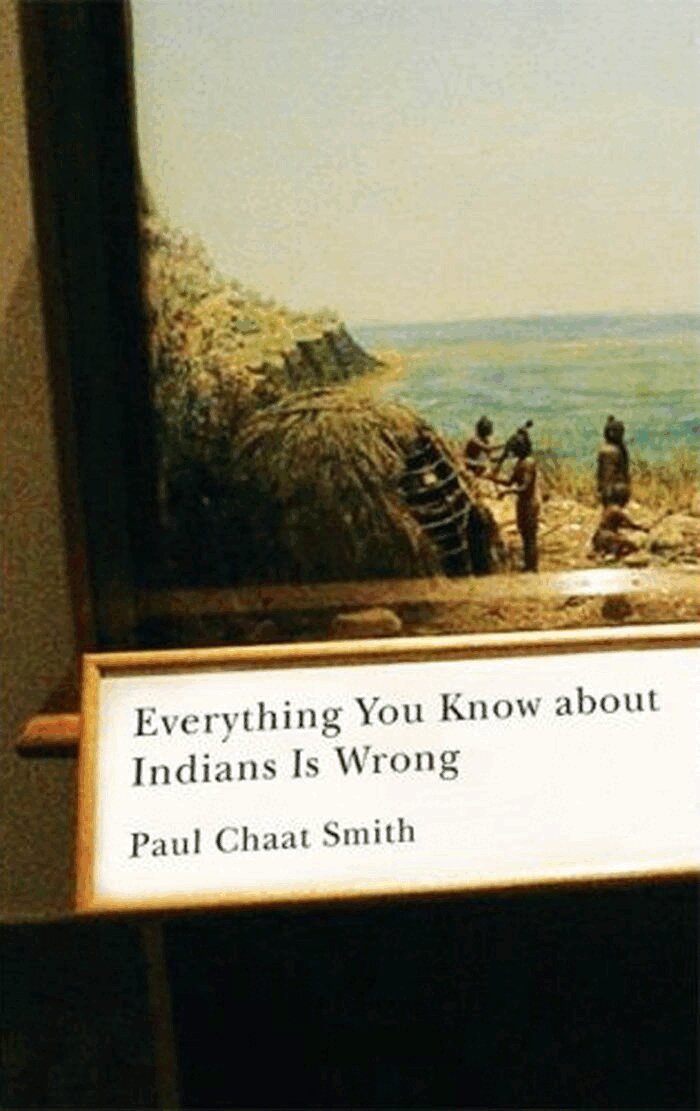
"In Everything You Know about Indians Is Wrong, Paul Chaat Smith pulls no punches and delivers not a few body blows. Smith's clear and at times sardonic voice expresses everything Indians might have wanted to say but up to now didn't feel they could. Through references to contemporary and popular touchstones he sweeps away generations of sentimentality, nostalgia and accommodation that mark the relationship of Indians to the mainstream. We may flinch at his analyses where there are no innocents, no villains, but we cannot hide. Smith pushes the 'minority experience' past victimhood and infantilization to self-agency and determination."—Lowery Stokes Sims, former curator, Museum of Arts and Design "After reading Everything You Know about Indians is Wrong by Paul Chaat Smith, I said, 'A clever connect!' Wounded Knee Massacre – winning of the West! Movies, an American past time – all that Indian land stolen – all those Indians killed! Celebrating liars, thieves, killers – a literal cultural force? Just to make movies? I then re-read a passage where Smith refers to Indigenous artists at Venice Biennale: 'This symposium won't be measured by how many Indians are in Venice. It will be measured by something much harder to quantify. What matters is . . . whether we can build new understandings of what it means to be human in the twenty-first century. It isn't about us talking and you listening; it's about an engagement that moves our collective understanding forward.' Truly, that's what will acknowledge, validate, and confirm our Existence as Indigenous peoples. And this may even help us to rethink the word-concept of 'Indian.' Smith's very articulate book is highly recommended!"—Simon J. Ortiz, author of Out There Somewhere and Woven Stone "Amusing and enlightening."—Publishers Weekly "With acerbic wit and unflinching honesty, social critic Smith offers a collection of essays that were written over approximately a 15-year period. It is an eclectic collection that chronicles the evolution of his views on the politics of being a Native American, beginning with his obvious naivete as a committed activist within the American Indian Movement to his present employment with the federal government. No target is safe from his pointed barbs, not even himself. The explanation of how quickly his views toward the creation of the National Museum of the American Indian changed when the practicality of needing employment entered the equation is alone worth the price of the book. In addition to being an entertaining read, this book gives one much to consider as Smith challenges many of the tropes that too many authors utilize when writing about native peoples."—Library Journal "While making sometimes heartening and at other times unsettling critical observations on conditions surrounding American Indians in historical and modern contexts, [Smith] conveys his observations in a casual, frequently funny and smart conversational form. Reading the book is almost like listening to a well seasoned, somewhat cynical old friend talking about something for which he deeply cares."—Win Awenen Nisototung "In this rigorously insightful collection of essays written between 1992 to 2008, Smith, a wry, sharp-edged cultural critic, and associate curator for the National Museum of the American Indian, addresses the myriad ironic complexities of American Indian reality."—Washington Post "Within Everything You Know about Indians Is Wrong . . . is a call to native artists to refuse to play the invented romantic, mythological and other clichéd roles assigned to them by others, and to demand 'honesty in their own work and that of others that truly honors the outrageous story of our continued existence.'"—Washington Post "It's a very entertaining read; while it does critique at times the (often) disputed role Indians have had in the U.S., it also explores with dry wit and humor how today's media portrays 'the noble savage.' The book walks the line between skepticism and empathy, and at the end the reader has to admit that the book title is indeed, accurate."—WeLoveDC.com "The book is a nice, wild ride on Smith's stream of consciousness as he shares his stories of an aching, but thankful heart."—Cherokee One Feather "Everything You Know about Indians Is Wrong, a satisfyingly complex book by Paul Chaat Smith, who maintains that although we are considered somehow primitive and simple we are actually oceans of terrifying complexity. And this book, too, is so complicated that I found my emotions were all mixed up. Irony, laughter, rage, weariness. A mixture – a complex character trait but as one of my character flaws is a vague obscurity I appreciated the harsh wit and intelligence in these essays. A recommendation with many stars after it."—Louise Erdrich, Birchbark Books Blog "This book achieves a balancing act that will be the envy of Indigenous authors, myself among them. Its articulate demonstration of the utter absurdities, past and present, of the culturally embedded representations of Native Americans charms rather than alienates its (non-Indigenous) audience. . . . His expose uses razor sharp observations, clarity of language, self-deprecating authorial tone and clever juxtapositions of humour and tragedy to blunt the power to take umbrage as a dismissive response. The book makes its searing critique engaging and irrefutable."—International Journal of Critical Indigenous Studies "His lively prose, which shifts from the scholarly to the colloquial (sometimes within the same paragraph), and his insistent engagement with and awareness of his audience make this a compelling and vibrant collection of essays that should find a broad reading audience."—Sarita Cannon, Neomaricanist "Smith provides an engaging and direct commentary about the experiences and history of Native Americans."—Multicultural Review "If Paul Chaat Smith ever needs another job—he's currently a curator at the National Museum of the American Indian at the Smithsonian‚ he would make an excellent stand-up comic. Unexpectedly, his latest book, Everything You Know about Indians Is Wrong, is a funny and painful collection of essays about a deeply serious subject: the ways in which Indian stereotypes infiltrate culture, damaging Indians and Non-Indians alike."—High Country News "It's lucky for us that Smith, a Comache born in West Texas, refuses to shut up. His insights on film are sharp and startling."—High Country News