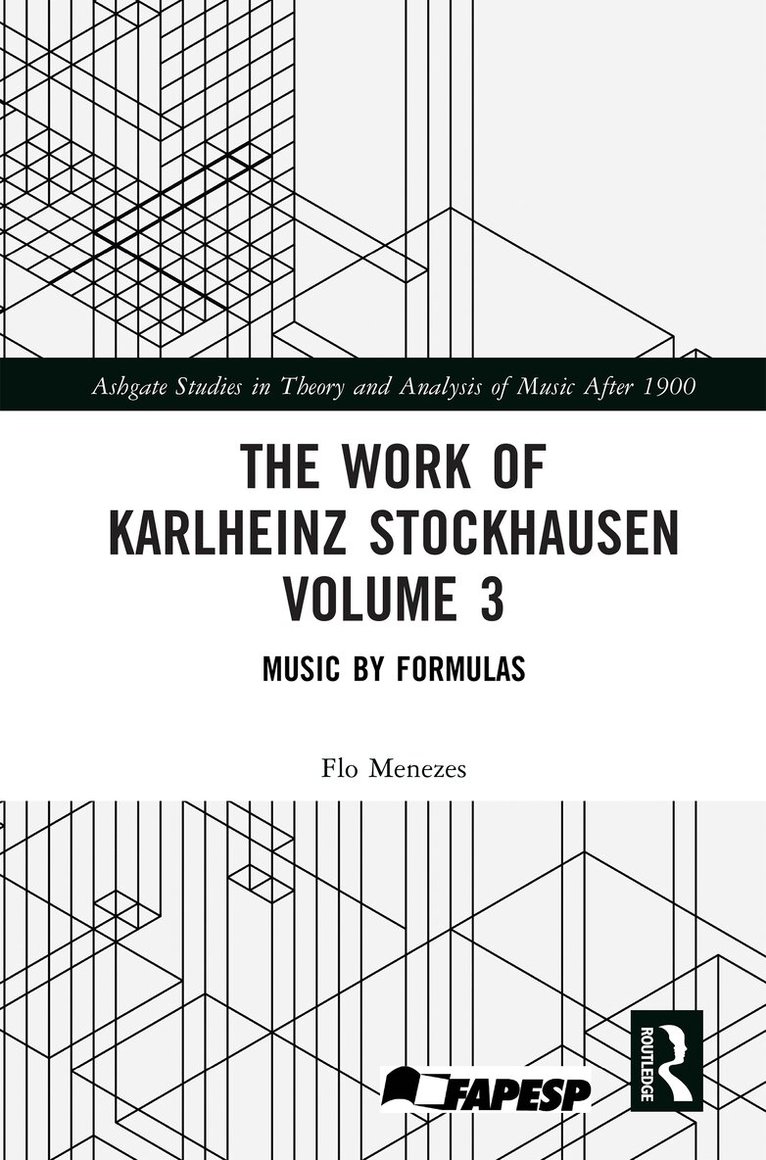
2 325 kr
Kommande
Beskrivning
Produktinformation
- Utgivningsdatum:2026-07-31
- Mått:156 x 234 x undefined mm
- Vikt:453 g
- Format:Inbunden
- Språk:Engelska
- Serie:Ashgate Studies in Theory and Analysis of Music After 1900
- Antal sidor:424
- Förlag:Taylor & Francis Ltd
- ISBN:9781032547145
Utforska kategorier
Mer om författaren
Flo Menezes is a Full Professor at the São Paulo State University (Unesp), Brazil. He studied composing at the University of São Paulo as well as the Studio fur Elektronische Musik in Cologne, Germany. He specialized at Centro di Sonologia Computazionale of Padua, Italy, completed his doctorate in Belgium in 1992 on Luciano Berio, under the supervision of Henri Pousseur, and postdoctoral fellow at the Paul Sacher Foundation. At Stockhausen's invitation, he taught analysis at the Kürten Courses in Germany. As a composer, his works have been performed by leading ensembles and orchestras around the world and he has received many awards for composition, including the Prix Ars Electronica, Austria (1995) and Giga-Hertz-Preis of Karlsruhe/Freiburg, Germany (2007), with Pierre Boulez and Wolfgang Rihm on the jury.
Recensioner i media
‘Anyone interested in the evolution of post-World War II music, particularly in terms of musical structure and thought, will find profound insight in the detailed analysis of the music of German composer Karlheinz Stockhausen.Spanning three volumes, the analysis covers distinct phases of Stockhausen's work, from structural serialism, intuitive music, and moment-form, to his later development of formula-composition, culminating in the monumental work Licht, Stockhausen’s seven-day opera cycle. Flo Menezes, who personally knew several key composers of the second half of the 20th century, including Luciano Berio, Henry Pousseur, and Pierre Boulez, taught analysis classes at the Stockhausen Summer School in Kürten, Germany. Menezes even surprised Stockhausen by revealing structural insights in Studie 2 that the composer himself had not been aware of.Although Menezes’ writings primarily focus on Stockhausen's work, readers will find it to be a profound treatise on composition in the second half of the 20th century.’Hans Tutschku, Fanny P. Mason Professor of Music, Harvard University
Innehållsförteckning
- Enchantments,MANTRA (1970), 31.1. Composition by Formula (Formel-Komposition), 31.2. The Formula of MANTRA, 31.3. The Structure of the Formula, 31.4. The Scales and Formula Projections: Profile Composition, 31.5. The Ring Modulation, 31.6. The Structural Constellation of the Global Form of MANTRA, 31.7. The Use of Antique Cymbals and Wood Blocks, 31.8. "Morseing": The Fascination for Aperiodicity, 31.9. The Inserts in MANTRA, 31.10. Flaw or Deviation?, 31.11. Theme and Variations?, 31.12. The Place of MANTRA in Stockhausen's Work,TRANS (1971), 32.1. The Oneiric Function and the Lights in TRANS, 32.2. The Spatial Arrangement of the Instruments: Between Visuality and Acousmatics, 32.3. The Transcendental Meditation Has a Color, 32.4. The Form of TRANS, 32.5. Inserts in TRANS: The Beginning of Scenic Music, 32.6. Unusual Aspects of the Writing (Notation) and Musical Scripture of TRANS,“Am Himmel wandre ich...” (Indianerlieder) (1972),Melodies,INORI (1973-74) and “Vortrag über HU” (1974), 35.1. When the Analysis Becomes a Work, 35.2. The Urgestalt or INORI Formula, 35.3. The Arrangement of the Musicians on Stage, 35.4. The Scales of Dynamics in INORI, 35.5. The Strict Link Between Gestures of Solo Mimes and Sounds, 35.6. Unraveling the Formula, 35.7. The Tempos and the Projection of the Formula in Global Form, 35.8. Analysis of INORI's Main Parts, 35.8.1. Rhythmus, 35.8.2. Dynamik, 35.8.3. Melodie, 35.8.4. Harmonie, 35.8.5. Polyphonie, 35.9. Polyphony or Heterophony?, 35.10. Against the Grain of History? Mystique, Rigor and Delicacy in INORI,MUSIK IM BAUCH (1974-75), TIERKREIS (1974-75) and SIRIUS (1975-77),HARLEKIN and DER KLEINE HARLEKIN (1975), 37.1. Intertextualities and Militant Didacticism, 37.2. Regarding Form and Its Development, 37.3. HARLEKIN’s Formula, 37.4. Directional Profile Projection, 37.5. DER KLEINE HARLEKIN: A Rare Gesture of Temporal Contraction,JUBILÄUM (1977), 38.1. In Contrast to Melody: A Chordal Formula, 38.2. The Intervals Under the Magnifying Glass, 38.3. Musical Scripture by Layers and Global Form,IN FREUNDSCHAFT (1977-78), 39.1. A Formula That Unfolds: From Melody to Latent Polyphony, 39.2. Form and Its Deconstructive Introduction, 39.3. The Trill as a Metaphor for Coitus and the Three Layers of the Piece, 39.4. The Cycles and Their Concentric Directionality, 39.5. The Interchangeability of Cycles and the Irregularities as a Compositional Strategy, 39.6. The Explosions: How One Insert Emancipates Itself Within Another, 39.7. Eroticism at Scriptural Level,DER JAHRESLAUF (1977) and JAHRESLAUF (1977/1990-91), 40.1. The Illuminated Access Door to LICHT, 40.2. An Agonistic View of Nature, 40.3. Multiple Temporalities and the Scenic Arrangement of the Work, 40.4. Theater Music, 40.5. The Formal Scheme, 40.6. A Music Without Formula Evoking Past Formulas, 40.7. A Very Simple Writing for a Very Complex Scripture,Introduction to LICHT – Die sieben Tage der Woche (1977-2003), 41.1. Thematic of LICHT, 41.2. The Influence of the Urantia Book, 41.3. Dantesque Roots, 41.4. A Polysemic Structuring of the Joycean Type, 41.5. Recontextualizing the Opera, 41.5.1. The Authorship of the Libretto and the Relationship with Operatic Arbitrariness, 41.5.2. The Absence of a Story and Its Apotheosis, 41.5.3. The Choice of Leading Characters, 41.5.4. Multiple Spaces: Theatrical Music Everywhere, 41.5.5. Multiple Architectures?, 41.6. LICHT’s Scenes as the Apogee of Moment-Form, 41.7. The LICHT Superformula: Themes and Variations?, 41.8. The Superformula Unraveled in Its Intervallic and Directional Structure, 41.9. The Superformula in Its Final Matrix Configuration and the Projection Technique, 41.10. Criticism of the Omnipresence of the Superformula, 41.11. DONNERSTAG aus LICHT (1978-1980), 41.12. SAMSTAG aus LICHT (1981-1983), 41.13. MONTAG aus LICHT (1984-1988), 41.14. DIENSTAG aus LICHT (1977; 1987-1991), 41.15. FREITAG aus LICHT (1991-1994), 41.16. MITTWOCH aus LICHT (1995-1997), 41.17. SONNTAG aus LICHT (1998-2003),Introduction to KLANG – Die 24 Stunden des Tages (2004-2007), 42.1. Farewell to Formulas, 42.2. From Love to Sound... and to Every Moment, 42.3. LICHT’s Synesthesia in the Hours Strand, 42.4. The KLANG Series of 24 Notes, 42.5. The 21 Hours of KLANG, 42.6. The First Four Hours of KLANG, 42.7. The 5th Hour of KLANG, HARMONIEN, and the 1st Subcycle, 42.8. COSMIC PULSES and the Farewell to Sound, 42.9. The 2nd Subcycle and the Arrival at PARADISE, 42.10. KLANG: Stockhausen’s Requiem for Himself,Personæ
Mer från samma serie
György Ligeti's Le Grand Macabre: Postmodernism, Musico-Dramatic Form and the Grotesque
Peter Edwards
651 kr
Musical Thought and Spiritual Lives of Heinrich Schenker and Arnold Schoenberg
Matthew Arndt
632 kr
Du kanske också är intresserad av
György Ligeti's Le Grand Macabre: Postmodernism, Musico-Dramatic Form and the Grotesque
Peter Edwards
651 kr
György Ligeti's Le Grand Macabre: Postmodernism, Musico-Dramatic Form and the Grotesque
Peter Edwards
2 386 kr
Perspectives on Greek Musical Modernism
Eva Mantzourani, Costas Tsougras, Petros Vouvaris
2 176 kr