Del i serien IEEE Press Series on Power and Energy Systems
1 495 kr
Beställningsvara. Skickas inom 7-10 vardagar. Fri frakt över 249 kr.
Beskrivning
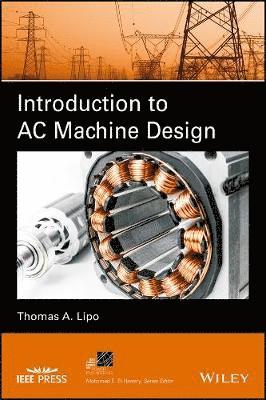
The only book on the market that emphasizes machine design beyond the basic principles of AC and DC machine behaviorAC electrical machine design is a key skill set for developing competitive electric motors and generators for applications in industry, aerospace, and defense. This book presents a thorough treatment of AC machine design, starting from basic electromagnetic principles and continuing through the various design aspects of an induction machine. Introduction to AC Machine Design includes one chapter each on the design of permanent magnet machines, synchronous machines, and thermal design. It also offers a basic treatment of the use of finite elements to compute the magnetic field within a machine without interfering with the initial comprehension of the core subject matter.Based on the author’s notes, as well as after years of classroom instruction, Introduction to AC Machine Design: Brings to light more advanced principles of machine design—not just the basic principles of AC and DC machine behaviorIntroduces electrical machine design to neophytes while also being a resource for experienced designersFully examines AC machine design, beginning with basic electromagnetic principles Covers the many facets of the induction machine designIntroduction to AC Machine Design is an important text for graduate school students studying the design of electrical machinery, and it will be of great interest to manufacturers of electrical machinery.
Produktinformation
- Utgivningsdatum:2017-12-29
- Mått:155 x 236 x 36 mm
- Vikt:907 g
- Format:Inbunden
- Språk:Engelska
- Serie:IEEE Press Series on Power and Energy Systems
- Antal sidor:544
- Förlag:John Wiley & Sons Inc
- ISBN:9781119352167
Utforska kategorier
Mer om författaren
THOMAS A. LIPO, PhD is an Emeritus Professor at the University of Wisconsin-Madison and also a Research Professor at Florida State University. He has published over 700 technical papers as well as 52 patents, 5 books, and 8 book chapters. Dr. Lipo is a Life Fellow of IEEE, and recipient of the IEEE Medal in Power Engineering. He previously co-published Pulse Width Modulation for Power Converters: Principles and Practice with Wiley-IEEE Press.
Innehållsförteckning
- Preface and Acknowledgments xiiiList of Principal Symbols xvAbout the Author xxiiiChapter 1 Magnetic Circuits 11.1 Biot–Savart Law 11.2 The Magnetic Field B 21.3 Example—Computation of Flux Density B 31.4 The Magnetic Vector Potential A 51.5 Example—Calculation of Magnetic Field from the Magnetic Vector Potential 61.6 Concept of Magnetic Flux 71.7 The Electric Field E 91.8 Ampere’s Law 101.9 Magnetic Field Intensity H 121.10 Boundary Conditions for B and H 151.11 Faraday’s Law 171.12 Induced Electric Field Due to Motion 181.13 Permeance, Reluctance, and the Magnetic Circuit 191.14 Example—Square Toroid 231.15 Multiple Circuit Paths 231.16 General Expression for Reluctance 241.17 Inductance 271.18 Example—Internal Inductance of a Wire Segment 281.19 Magnetic Field Energy 291.20 The Problem of Units 311.21 Magnetic Paths Wholly in Iron 331.22 Magnetic Materials 351.23 Example—Transformer Structure 371.24 Magnetic Circuits with Air Gaps 401.25 Example—Magnetic Structure with Saturation 421.26 Example—Calculation for Series–Parallel Iron Paths 431.27 Multiple Winding Magnetic Circuits 441.28 Magnetic Circuits Applied to Electrical Machines 461.29 Effect of Excitation Coil Placement 481.30 Conclusion 50Reference 50Chapter 2 The MMF and Field Distribution of an AC Winding 512.1 MMF and Field Distribution of a Full-Pitch Winding for a Two Pole Machine 512.2 Fractional Pitch Winding for a Two-Pole Machine 542.3 Distributed Windings 562.4 Concentric Windings 622.5 Effect of Slot Openings 642.6 Fractional Slot Windings 672.7 Winding Skew 702.8 Pole Pairs and Circuits Greater than One 732.9 MMF Distribution for Three-Phase Windings 732.10 Concept of an Equivalent Two-Phase Machine 762.11 Conclusion 77References 77Chapter 3 Main Flux Path Calculations Using Magnetic Circuits 793.1 The Main Magnetic Circuit of an Induction Machine 793.2 The Effective Gap and Carter’s Coefficient 803.3 The Effective Length 843.4 Calculation of Tooth Reluctance 863.5 Example 1—Tooth MMF Drop 893.6 Calculation of Core Reluctance 943.7 Example 2—MMF Drop Over Main Magnetic Circuit 1023.8 Magnetic Equivalent Circuit 1113.9 Flux Distribution in Highly Saturated Machines 1123.10 Calculation of Magnetizing Reactance 1163.11 Example 3—Calculation of Magnetizing Inductance 1203.12 Conclusion 123References 124Chapter 4 Use of Magnetic Circuits in Leakage Reactance Calculations 1254.1 Components of Leakage Flux in Induction Machines 1254.2 Specific Permeance 1274.3 Slot Leakage Permeance Calculations 1294.4 Slot Leakage Inductance of a Single-Layer Winding 1344.5 Slot Leakage Permeance of Two-Layer Windings 1354.6 Slot Leakage Inductances of a Double-Cage Winding 1374.7 Slot Leakage Inductance of a Double-Layer Winding 1394.8 End-Winding Leakage Inductance 1444.8.1 Method of Images 1444.8.2 End-Winding Leakage Inductance of Random-Wound Coils 1474.8.3 End-Winding Leakage Inductance of a Coil with Stator Iron Treated as a Perfect Conductor 1484.8.4 End-Winding Leakage Inductance of a Coil with Stator Iron Treated as Air 1504.8.5 End-Winding Leakage Inductance per Phase 1534.8.6 End-Winding Leakage of Form-Wound Coils 1534.8.7 Squirrel-Cage End-Winding Inductance 1554.9 Stator Harmonic or Belt Leakage 1564.10 Zigzag Leakage Inductance 1594.11 Example 4—Calculation of Leakage Inductances 1644.12 Effective Resistance and Inductance Per Phase of Squirrel-Cage Rotor 1714.13 Fundamental Component of Rotor Air Gap MMF 1754.14 Rotor Harmonic Leakage Inductance 1774.15 Calculation of Mutual Inductances 1814.16 Example 5—Calculation of Rotor Leakage Inductance Per Phase 1864.17 Skew Leakage Inductance 1874.18 Example 6—Calculation of Skew Leakage Effects 1894.19 Conclusion 190References 190Chapter 5 Calculation of Induction Machine Losses 1935.1 Introduction 1935.2 Eddy Current Effects in Conductors 1945.3 Calculation of Stator Resistance 2035.4 Example 7—Calculation of Stator and Rotor Resistance 2055.5 Rotor Parameters of Irregularly Shaped Bars 2125.6 Categories of Electrical Steels 2165.7 Core Losses Due to Fundamental Flux Component 2175.8 Stray Load and No-Load Losses 2225.9 Calculation of Surface Iron Losses Due to Stator Slotting 2285.10 Calculation of Tooth Pulsation Iron Losses 2375.11 Friction and Windage Losses 2445.12 Example 8—Calculation of Iron Loss Resistances 2445.13 Conclusion 250References 250Chapter 6 Principles of Design 2516.1 Design Factors 2516.2 Standards for Machine Construction 2526.3 Main Design Features 2556.4 The D2L Output Coefficient 2586.4.1 Essen’s Rule 2596.4.2 Magnetic Shear Stress 2616.4.3 The Aspect Ratio 2656.4.4 Base Impedance 2686.5 The D3L Output Coefficient 2696.6 Power Loss Density 2776.7 The D2.5L Sizing Equation 2776.8 Choice of Magnetic Loading 2786.8.1 Maximum Flux Density in Iron 2796.8.2 Magnetizing Current 2806.9 Choice of Electric Loading 2816.9.1 Voltage Rating 2816.9.2 Current Density Constraints 2826.9.3 Representative Values of Current Density 2856.10 Practical Considerations Concerning Stator Construction 2876.10.1 Random Wound vs. Formed Coil Windings 2886.10.2 Delta vs. Wye Connection 2896.10.3 Lamination Insulation 2906.10.4 Selection of Stator Slot Number 2906.10.5 Choice of Dimensions of Active Material for NEMA Designs 2916.10.6 Selection of Wire Size 2926.10.7 Selection of Air Gap 2936.11 Rotor Construction 2936.11.1 Slot Combinations to Avoid 2946.11.2 Rotor Heating During Starting or Under Stalled Conditions 2946.12 The Design Process 2956.13 Effect of Machine Performance by a Change in Dimension 2996.14 Conclusion 302References 302Chapter 7 Thermal Design 3057.1 The Thermal Problem 3057.2 Temperature Limits and Maximum Temperature Rise 3067.3 Heat Conduction 3077.3.1 Simple Heat Conduction Through a Rectangular Plate 3087.3.2 Heat Conduction Through a Cylinder 3097.3.3 Heat Conduction with Simple Internal Heat Generation 3117.3.4 Example 9—Stator Winding Heating 3137.3.5 One-Dimensional Conductive Heat Flow with Distributed Internal Heat Generation 3147.3.6 Two- and Three-Dimensional Conductive Heat Flow with Internal Distributed Heat Generation 3167.3.7 Application of Two-Dimensional Heat Flow to Stator Teeth 3177.3.8 Radial Heat Flow Over Solid Cylinder with Internal Heat Generation 3187.3.9 Heat Flow Over Cylindrical Shell with Internal Distributed Heat Generation 3207.4 Heat Convection on Plane Surfaces 3257.5 Heat Flow Across the Air Gap 3277.6 Heat Transfer by Radiation 3287.7 Cooling Methods and Systems 3297.7.1 Surface Cooling by Air 3297.7.2 Internal Cooling 3297.7.3 Cooling in a Circulatory System 3297.7.4 Cooling with Liquids 3307.7.5 Direct Gas Cooling 3307.7.6 Gas as a Cooling Medium 3317.7.7 Liquids as a Cooling Medium 3327.8 Thermal Equivalent Circuit 3337.9 Example 10—Heat Distribution of 250 HP Induction Machine 3387.9.1 Heat Inputs 3397.9.2 Thermal Resistances 3427.10 Transient Heat Flow 3537.10.1 Externally Generated Heat 3537.10.2 Internally Generated Heat—Stalled Operation 3547.10.3 Thermal Instability 3567.11 Conclusion 357References 357Chapter 8 Permanent Magnet Machines 3598.1 Magnet Characteristics 3598.2 Hysteresis 3628.3 Permanent Magnet Materials 3648.4 Determination of Magnet Operating Point 3668.5 Sinusoidally FED Surface PM Motor 3698.6 Flux Density Constraints 3738.7 Current Density Constraints 3768.8 Choice of Aspect Ratio 3778.9 Eddy Current Iron Losses 3778.9.1 Eddy Current Tooth Iron Losses 3788.9.2 Eddy Current Yoke Iron Losses 3798.10 Equivalent Circuit Parameters 3808.10.1 Magnetizing Inductance 3818.10.2 Current Source 3828.10.3 Eddy Current Iron Loss Resistance 3828.10.4 Alternate Equivalent Circuit 3838.11 Temperature Constraints and Cooling Capability 3838.12 Magnet Protection 3848.12.1 Magnet Protection for Maximum Steady-State Current 3848.12.2 Magnet Protection for Transient Conditions 3868.13 Design for Flux Weakening 3878.14 PM Motor with Inset Magnets 3898.14.1 Short-Circuit Protection 3928.14.2 Flux Weakening 3928.15 Cogging Torque 3938.16 Ripple Torque 3948.17 Design Using Ferrite Magnets 3948.18 Permanent Machines with Buried Magnets 3958.18.1 PM Machines with Buried Circumferential Magnets 3968.19 Conclusion 399Acknowledgment 400References 400Chapter 9 Electromagnetic Design of Synchronous Machines 4019.1 Calculation of Useful Flux Per Pole 4019.2 Calculation of Direct and Quadrature Axis Magnetizing Inductance 4029.3 Determination of Field Magnetizing Inductance 4119.4 Determination of d-Axis Mutual Inductances 4189.5 Calculation of Rotor Pole Leakage Permeances 4209.6 Stator Leakage Inductances of a Salient Pole Synchronous Machine 4249.6.1 Zigzag or Tooth-Top Leakage Inductance of Salient Pole Machines 4249.7 The Amortisseur Winding Parameters 4289.8 Mutual and Magnetizing Inductances of the Amortisseur Winding 4359.9 Direct Axis Equivalent Circuit 4359.10 Referral of Rotor Parameters to the Stator 4389.11 Quadrature Axis Circuit 4419.12 Power and Torque Expressions 4469.13 Magnetic Shear Stress 4499.14 Field Current Profile 4519.15 Conclusion 453References 453Chapter 10 Finite-Element Solution of Magnetic Circuits 45510.1 Formulation of the Two-Dimensional Magnetic Field Problem 45510.2 Significance of the Vector Potential 45810.3 The Variational Method 45910.4 Nonlinear Functional and Conditions for Minimization 46010.5 Description of the Finite-Element Method 46510.6 Magnetic Induction and Reluctivity in the Triangle Element 46710.7 Functional Minimization 46810.8 Formulation of the Stiffness Matrix Equation 47210.9 Consideration of Boundary Conditions 47410.10 Step-By-Step Procedure for Solving the Finite-Element Problem 47610.11 Finite-Element Modeling of Permanent Magnets 48210.12 Conclusion 48510.A Appendix 486References 487Appendix A Computation of Bar Current 489Appendix B FEM Example 493Index 505
Hoppa över listan


Mer från samma serie
Del 60
Integration of Distributed Generation in the Power System
Math H. J. Bollen, Fainan Hassan
Inbunden
1 661 kr
Handbook of Large Turbo-Generator Operation and Maintenance
Geoff Klempner, Isidor Kerszenbaum
Inbunden
2 043 kr
Del 33
Del 41
Del 42
Real-Time Stability Assessment in Modern Power System Control Centers
S. C. Savulescu
Inbunden
1 642 kr
Del 43
Del 44
Del 47
Del 48
Del 50
Hoppa över listan


Du kanske också är intresserad av
Del 18
- Signerad!
- -30%
- -22%
Del 1
- -30%
Del 1
- Nyhet
Hjärnans akilleshälar : hur din hjärna lurar dig, och vad du kan göra åt det
Anders Hansen
Inbunden
289 kr
- Signerad!
Del 7
- -30%
Del 1
- Nyhet
- -30%