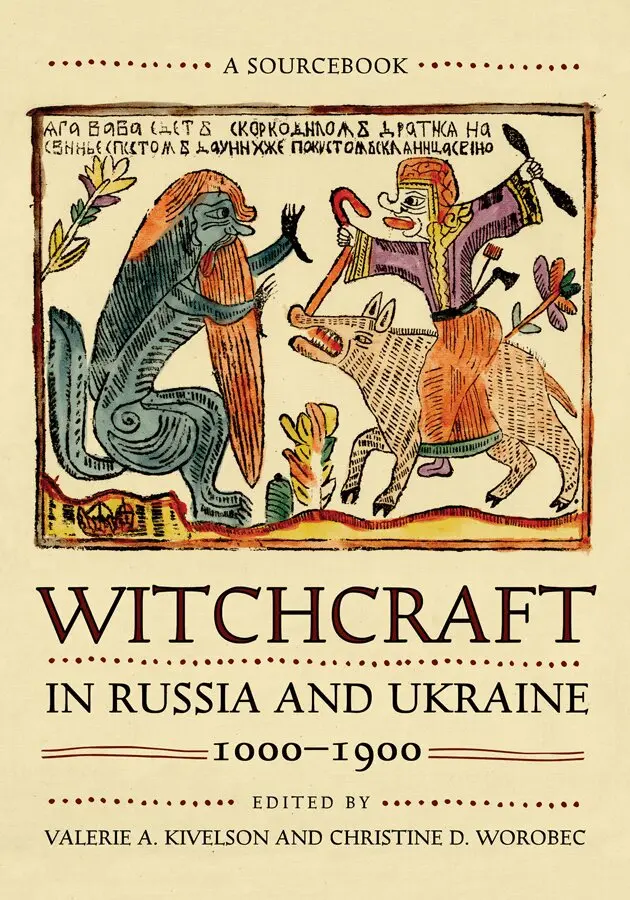
Witchcraft in Russia and Ukraine, 1000–1900
A Sourcebook
AvValerie A. Kivelson,Christine D. Worobec
1 558 kr
Beställningsvara. Skickas inom 10-15 vardagar. Fri frakt över 249 kr.
Beskrivning
Produktinformation
- Utgivningsdatum:2020-11-15
- Mått:178 x 254 x 37 mm
- Vikt:1 361 g
- Format:Inbunden
- Språk:Engelska
- Serie:NIU Series in Slavic, East European, and Eurasian Studies
- Antal sidor:540
- Förlag:Cornell University Press
- ISBN:9781501750649
- Utmärkelser:Runner-up for Early Slavic Studies Association Book Prize 2020 (United States)
Utforska kategorier
Mer om författaren
Valerie A. Kivelson is Thomas N. Tentler Collegiate Professor of History and Arthur F. Thurnau Professor of History at the University of Michigan. She is the author of Cartographies of Tsardom, Desperate Magic, and Autocracy in the Provinces.Christine D. Worobec is Distinguished Research Professor Emerita at Northern Illinois University. She is the author of Possessed and Peasant Russia.
Recensioner i media
This substantial volume by two leading scholars in the field is a major contribution to the study of witchcraft in Russia and Ukraine and to the study of witchcraft in general, which often omits these regions. Overall, this is a tremendously useful book for students of witchcraft history, especially non-Slavists, and all historians of Russian and Ukrainian culture would do well to have it on their bookshelves.(Russian Review) [This book] allows us to see dozens of examples[,] each presented in English translation with extensive coverage that provides a great introduction to the topic, even for a person unfamiliar with the subject. [This] is an extremely important and well-made sourcebook that should be read not only by religion and history scholars studying witch trials, but also by a wide range of historians studying the medieval, early modern, and modern ages in general.(Magic, Ritual, and Witchcraft) For any serious scholar of Russian and Ukrainian witchcraft and magic, this volume is a 'must read.'... Scholars of folklore and popular culture also will find much of value.(Folklorica) Valerie Kivelson and Christine Worobec number among the leading scholars who study the history of witchcraft in Russia and Ukraine. Scholars of witchcraft outside the area of Russian and Ukrainian studies can use this volume as an entrée into that milieu.(Folklorica) Kivelson and Christine Worobec have succeeded in editing a similarly impressive broad collection of documents that spans nine centuries related to witchcraft in Russia and Ukraine.Kivelson and Worobec have put together a truly astounding piece of scholarship that will be of great service to scholars and students throughout the world wishing to know more about the prevalence and special characteristics of witchcraft in the Eastern Slavic realms of Russia and Ukraine.Witchcraft in Russia and Ukraine is an essential work for specialists in many fields of the cultural and social history of Russia and Ukraine since 1000.(Slavonic and East European Review)
Innehållsförteckning
- IntroductionPart I: HISTORICAL EVOLUTION, LAW, AND PROSECUTION1. Early Accounts of Witchcraft, Sorcery, and Magic in Medieval Rus1.1. Pagan Soothsayers and Magicians in the Primary Chronicle1.2. "Maybe, but God Knows": Sorcery in the Novgorodian Chronicle (1227)1.3. Bishop Serapion of Vladimir Condemns Belief in Witchcraft (1274)1.4. St. Alimpii and the Leper Who Consulted Magicians (Kyivan Patericon)2. Witchcraft and Politics in Muscovy and the Hetmanate2.1. The Death of Maria of Tver, Ivan III's First Wife, by Witchcraft (1467)2.2. Witchcraft Accusations against Grand Princess Sofia Paleologue (1497)2.3. Witchcraft Accusations against Grand Princess Solomonia Saburova (1525)2.4. Trials of Maksim the Greek for Treason, Heresy, and Sorcery (1525 & 1531)2.5. The Great Moscow Fire and the Sprinkling of Human Hearts by the Tsar's Grandmother, Anna Glinskaia (1547)2.6. Ivan Peresvetov's 1549 Tale about Sorcery at Court in the Final Days of the Byzantine Empire (Excerpts from the "Greater Petition")2.7. Jerome Horsey on Witchcraft at the Court of Ivan IV (the Terrible)2.8. The Vicious Sorcerer Eleazar Bomelius Described in a Russian Chronicle2.9. Sorcery Allegations from Ivan the Terrible's Correspondence with Prince Kurbskii and Kurbskii's History of the Grand Prince of Moscow2.10. Loyalty Oaths2.11. Grigorii Kotoshikhin and Samuel Collins on the Alleged Poisoning or Bewitchment of Tsar Aleksei Mikhailovich's First Betrothed, and on Bewitchment at Weddings (1647)2.12. Hetman Ivan Briukhovetskii's Burning of Witches (1666)2.13. Political Sorcery against the Prussian King (1760)3. Laws and Guidelines concerning the Prosecution of Witchcraft, Late Twelfth Century to 18853.1. Byzantine Church Law and Its Echoes in RussiaKormchaia kniga, 1653Excerpt from a court case from the late 1660s containing a fragment of the KormchaiaChurch Statute of Iaroslav the Wise (late twelfth/early thirteenth century)Russian Orthodox penitential listings involving sorcery and magic (fourteenth—early nineteenth centuries)The Domostroi: A household handbook of the mid-sixteenth century3.2. Excerpts from Charles V's 1532 Constitutio Criminalis Carolina and the 1559 Polish Version3.3. Procedures for the Courts and Affairs of Towns under Magdeburg Law under the Polish Crown (1559)3.4. Questions and Answers from the Moscow Church Council (Stoglav) of 15513.5. Ivan IV's 1552 Law on Witchcraft3.6. 1589 Law on the Honor of Witches3.7. 1648 Decree against Devilish Conduct3.8. Sobornoe ulozhenie: The Conciliar Law Code of 16493.9. Aleksei Mikhailovich's Decree Prohibiting Witchcraft and Activities Repellent to God (1653)3.10. "Newly Established Articles on Robbery, Brigandage, and Murder" (1669)3.11. Grigorii Kotoshikhin on Muscovite Judicial Process, Torture, and Execution (1660s)3.12. Peter I's 1715 Decree against Shriekers (the Demonically Possessed)3.13. Peter I's 1716 Military Statute and Suggested Revisions to Its Religious Articles (1725)3.14. Excerpts from the Spiritual Regulation (1721)3.15. Holy Synod's Decree against the Swimming of Individuals (1721)3.16. Empress Anna Ioannovna's Decree against Wizardry (1731)3.17. Catherine II's 1767 Instructions to the Legislative Commission and the Holy Synod's Response3.18. Senate's Ruling Admonishing Judges (1770)3.19. Catherine II's Decrees (1775 and 1782)3.20. Excerpts from the Criminal Laws: 1842, 1845, and 1885 editions4. Witchcraft Trials' Processes (Charges and Countercharges) and Extralegal Prosecution of Witchcraft: Complete RecordsA: Polish-Lithuanian Commonwealth (PLC) and The Hetmanate4.1. Andrei Kurbskii's Sorcery Allegations against His Wife, Marina Andreevna Golshanskaia, in Divorce Proceedings (1578)4.2. False Accusation of Witchcraft against Siemionowa Pauciutina, a Cossack Woman (1634)4.3. Swimming of Witches in Podillia (1711)4.4. Witchcraft and Infanticide (1753)B: Muscovy and Imperial Russia4.5. The Trial of the Old Peasant Woman Baba Daritsa and Others (1647)4.6. A Case of Suspicious Roots: Rogataia Baba and the Use of Torture (1647–48)4.7. A Mass Outbreak of Possession in the Town of Lukh (1656–60)4.8. The 1758 Trial of Chamberlain Petr Vasilevich Saltykov4.9. The 1764–65 Case against the Peasant Ekaterina Ivanova for Dabbling in Witchcraft4.10. An Epidemic of Demonic Possession in a Urals Foundry Town (1839–40)4.11. The 1853 Case against the Serf Gerasim Fedotov for Witchcraft4.12. The Mob Murder of Agrafena Dmitrievna Chindiaikina, a Suspected Witch (1880)4.13. A Woman Accused of Sorcery Has Her Day in Court (Early 1900s)Part II: MAGICAL PRACTICES, EVERYDAY MATTERS,AND THE POWER OF WORDS: TRIAL EXCERPTS5. Healing and Harming5.1. Consultation with the Doctors of the Apothecary Chancellery (1628)5.2. A Case of Enchanted Brew (1653)5.3. Healing or Cursing? Mysterious Ingredients Raise Suspicion (1658)5.4. The Bewitchment of Priest David and His Family by Their Domestic Workers (1676)5.5. Witchcraft Suspected as the Cause of a Child's Death (PLC, 1732)5.6. A Case of Milk Magic: Borrowed Pots and Bewitched Cows (PLC, 1728–31)5.7. An Alleged Murder by Way of Witchcraft (1844–45)5.8. No Place Is Safe from This Witch: The Case against Agafia Poliarpova (1848–49)6. Sex/Love/Anti-Love Magic6.1. A Case of Peasant Women's Love Magic and Vengeance, Shatsk (1647)6.2. Bewitchment at Weddings (1648)6.3. Iatsykha Polyveichykha Seeks to Bewitch her Husband's Lover (Hetmanate, 1675)6.4. A Case of Rape and Spells to Inflame Desire (Semen Aigustov, Borovsk, 1689)6.5. A Wife Suspected of Witchcraft: The Case of Anna Grekowiczewa (PLC, 1717)6.6. Seeking a Witch or Sorcerer to Kill a Husband? (PLC, 1742)7. Power Relations and Hierarchy7.1. "Making My Master and All Women Bend to My Will": A Case of Subversive Spells (1648)7.2. The Serf Woman Onuitka Avenges Ill-Treatment by the Estate Bailiff (1658)7.3. The Servant Motruna Perysta Accused of Bewitching Her Master's Family (PLC, 1730)7.4. How to Make All Authorities Subservient: The Magical Notebooks of Defrocked Priest Petr Osipov (1732)7.5. A Matter of a Love Potion and Sexual Pursuit of a Menial by His Mistress, Lady Ruszkowska (PLC, 1749)7.6. "So His Master Would Treat Him Well": The Peasant Grigorii Shilin's Ritual Use of Roots and Wax (1762)7.7. Securing Patronage: A Spell in the Hands of Ivan Sokolov, A Highly Ranked Officer and Nobleman (1774)7.8. Controlling a Master's Will: Divination and Enchanted Wax (1840)8. Possession8.1. Bewitchment at a Communal Banquet: The Petition of Ivan Shenin (1611)8.2. Testimony of the Bewitched from the Possession Outbreak in Lukh (1656–58)8.3. A Healer Accused of Dabbling in Witchcraft and Exorcising Demons (PLC, 1710)8.4. An Epidemic of Shrieking and Writhing in a Village Destabilized by Manumission (1833)8.5. Fits of Hiccuping (1833)9. Satanic Pacts/Diabolism9.1. "I Swear Allegiance to Satan": A Satanic Pact in the Seventeenth Century (1663–64)9.2. "My Father Satan": Spells, Possession, and Fraternal Rivalry (1672)9.3. A Case of Satanic Love Magic (Avdotia Borisova, 1733)9.4. A Pact with the Dark-Visaged Master of the Hellish Abyss and His Servant Demons (Hetmanate, 1749)9.5. The Priest Makarii Ivanov and Others Are Charged in 1753 with Possessing Booklets about Sorcery: A Demonic Incantation for Lust9.6. God-renouncing Letters (1751): Perdun9.7. Case of the Soldier Semen Popov, Who Renounced God and Gave His Soul to the Devil (1759)10. Orality/Literacy10.1. Case of the Siberian Trapper Found Carrying Spells (1652)10.2. A Theological Defense of Herbal Healing: Petition of Ivan Ivanov, Priest of the Church of the Nativity in Komersk District, to Simon, Archbishop of Vologda and Belozersk (1679–80)10.3. A Hegumen's Possession of Magical and Fortune-telling Texts (1720)10.4. Transcription of an Offensive Note by a Noble Architectural Journeyman, Aleksei Petrovich Evlashev (1731)10.5. An Incriminating Notebook of Incantations and Spells (1737)11. Specialists in Magic11.1. Specialists in Plants and Roots: Poisoning and Healing in Consultation with a Professional Herbalist (1692)11.2. Spoiling a Harvest by Means of Witchcraft: Knotted Grain Stalks— a Reluctant Specialist (Hetmanate, 1765)11.3. Case against a Fourteen-Year-Old Boy for Fraudulent Divination (Russian Ukraine, 1839)
Du kanske också är intresserad av
Women and Gender in Central and Eastern Europe, Russia, and Eurasia
Mary Zirin, Irina Livezeanu, Christine D. Worobec, June Pachuta Farris
1 789 kr
Word and Image in Russian History
Maria di Salvo, Daniel H. Kaiser, Valerie A. Kivelson
1 594 kr