Del 9
Del 11 i serien The International Library of Law and the Environment series
5 301 kr
Beställningsvara. Skickas inom 7-10 vardagar. Fri frakt över 249 kr.
Beskrivning
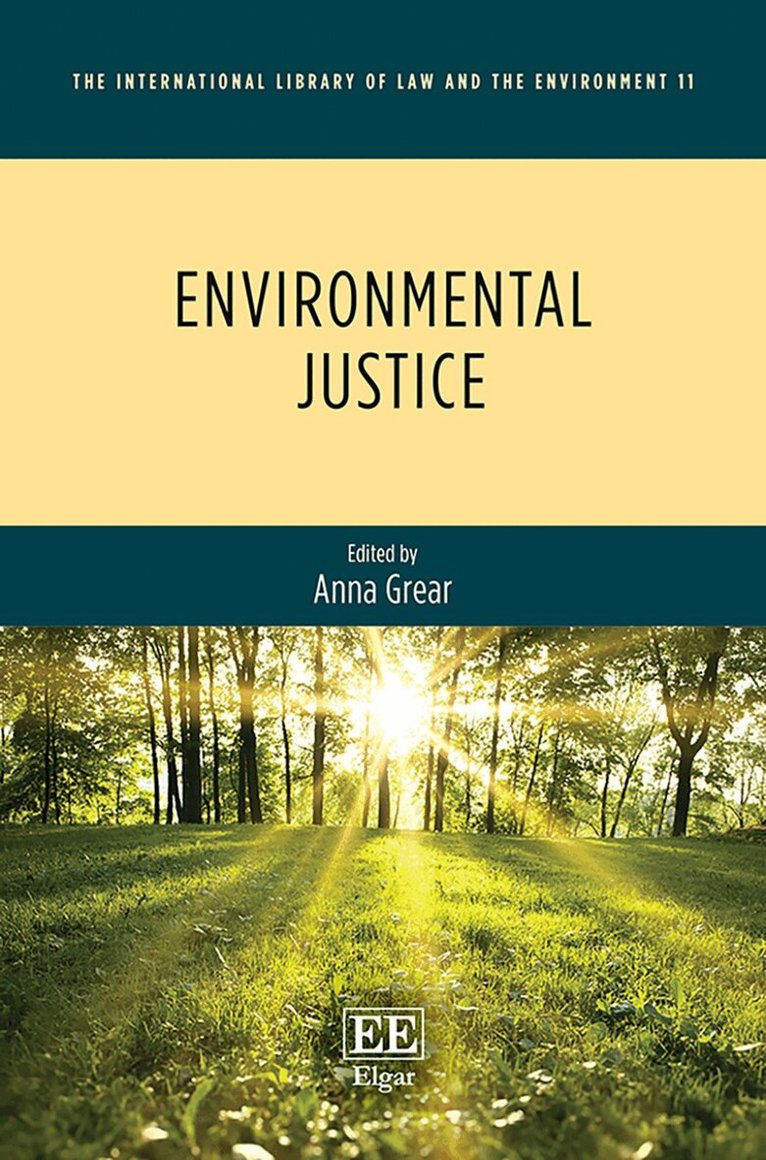
The editor takes an excitingly broad and refreshing approach to environmental justice, tracing the subject from its early developments to its contemporary need for a new non-anthropocentric ontology responsive to questions of human-non-human justice. This invaluable study includes 24 of the best available research articles in the field and offers a stimulating journey into the rich ambiguities, tensions and promise of environmental justice for the 21st century and beyond.
Produktinformation
- Utgivningsdatum:2020-02-03
- Mått:169 x 244 x undefined mm
- Format:Inbunden
- Språk:Engelska
- Serie:The International Library of Law and the Environment series
- Förlag:Edward Elgar Publishing Ltd
- ISBN:9781788970235
Utforska kategorier
Mer om författaren
Edited by Anna Grear, Adjunct Professor of Law, University of Waikato, New Zealand
Innehållsförteckning
- Contents:Introduction: ‘Staying with the Trouble’ – Environmental Justice for theAnthropocene–Capitalocene Anna Grear PART I ENVIRONMENTAL JUSTICE: TAXONOMIES ANDCONCEPTUALISATIONS1. Robert D. Bullard (1994), ‘Overcoming Racism in EnvironmentalDecisionmaking’, Environment: Science and Policy for SustainableDevelopment, 36 (4), May, 10–20, 39–44 22. Alice Kaswan (1997), ‘Environmental Justice: Bridging the Gapbetween Environmental Laws and “Justice”’, American UniversityLaw Review, 47 (2), 221–301 193. Dorceta E. Taylor (2000), ‘The Rise of the Environmental JusticeParadigm: Injustice Framing and the Social Construction ofEnvironmental Discourses’, American Behavioral Scientist, 43 (4),January, 508–80 1004. Robert R. Kuehn (2000), ‘A Taxonomy of Environmental Justice’,Environmental Law Reporter, 30 (9), September, 10681–703 173PART II ENVIRONMENTAL JUSTICE: DISTRIBUTIVE PATTERNS,STRUCTURAL UNEVENNESS5. Luke W. Cole (1992), ‘Empowerment as the Key to EnvironmentalProtection: The Need for Environmental Poverty Law’, EcologyLaw Quarterly, 19 (4), September, 619–83 1976. Sheila Foster (1998), ‘Justice from the Ground Up: DistributiveInequities, Grassroots Resistance, and the Transformative Politicsof the Environmental Justice Movement’, California Law Review,86 (4), July, 775–841 2627. Rebecca Tsosie (2007), ‘Indigenous People and EnvironmentalJustice: The Impact of Climate Change’, University of ColoradoLaw Review, 78 (4), Fall, 1625–77 3298. Melissa Checker (2008), ‘Eco-Apartheid and Global Greenwaves:African Diasporic Environmental Justice Movements’, Souls: ACritical Journal of Black Politics, Culture, and Society, 10 (4),390–408 382PART III ENVIRONMENTAL JUSTICE: PROCEDURAL JUSTICE,RELATIONAL RECOGNITION9. Daniel J. Fiorino (1990), ‘Citizen Participation and EnvironmentalRisk: A Survey of Institutional Mechanisms’, Science, Technology,and Human Values, 15 (2), Spring, 226–43 40210. Gordon Walker (2009), ‘Beyond Distribution and Proximity:Exploring the Multiple Spatialities of Environmental Justice’,Antipode, 41 (4), September, 614–36 42011. Astrid Ulloa (2017), ‘Perspectives of Environmental Justice fromIndigenous Peoples of Latin America: A Relational IndigenousEnvironmental Justice’, Environmental Justice, 10 (6), December,175–80 44312. Joshua C. Gellers and Chris Jeffords (2018), ‘TowardEnvironmental Democracy? Procedural Environmental Rights andEnvironmental Justice’, Global Environmental Politics, 18 (1),February, 99–121 449PART IV ENVIRONMENTAL JUSTICE: IDENTIFIABLE WRONGS,CORRECTIVE AND RETRIBUTIVE REPARATIONS13. Kathy Seward Northern (1997), ‘Battery and Beyond: A Tort LawResponse to Environmental Racism’, William & MaryEnvironmental Law and Policy Review, 21 (3), 485–598 47314. Tseming Yang (2002), ‘Environmental Regulation, Tort Law andEnvironmental Justice: What Could Have Been’, Washburn LawJournal, 41 (3), Spring, 607–28 58715. Peter Atkins, Manzurul Hassan and Christine Dunn (2007),‘Environmental Irony: Summoning Death in Bangladesh’,Environment and Planning A: Economy and Space, 39 (11),November, 2699–714 60916. Upendra Baxi (2010), ‘Writing about Impunity and Environment:The “Silver Jubilee” of the Bhopal Catastrophe’, Journal of HumanRights and the Environment, 1 (1), March, 23–44 625PART V ENVIRONMENTAL JUSTICE: INTERROGATING THE SOCIOPOLITICAL17. Julian Agyeman and Bob Evans (2004), ‘“Just Sustainability”: TheEmerging Discourse of Environmental Justice in Britain?’,Geographical Journal, 170 (2), June, 155–64 64818. Carmen G. Gonzalez (2011), ‘An Environmental Justice Critique ofComparative Advantage: Indigenous Peoples, Trade Policy, and theMexican Neoliberal Economic Reforms’, University ofPennsylvania Journal of International Law, 32 (3), Spring, 723–803 65819. Donna Houston (2013), ‘Crisis Is Where We Live: EnvironmentalJustice for the Anthropocene’, Globalizations, 10 (3), 439–50 73920. Joan Martinez-Alier, Leah Temper, Daniela Del Bene and ArnimScheidel (2016), ‘Is There a Global Environmental JusticeMovement?’, Journal of Peasant Studies, 43 (3), 731–55 751PART VI ENVIRONMENTAL JUSTICE: ONTOLOGICAL JUSTICE ANDTHE POLITICS OF MEANING21. Anna Stanley (2009), ‘Just Space or Spatial Justice? Difference,Discourse, and Environmental Justice’, Local Environment: TheInternational Journal of Justice and Sustainability, 14 (10),November, 999–1014 77722. Anna Tsing (2012), ‘Unruly Edges: Mushrooms as CompanionSpecies’, Environmental Humanities, 1, 141–54 79323. David Schlosberg (2013), ‘Theorising Environmental Justice: TheExpanding Sphere of a Discourse’, Environmental Politics, 22 (1),37–55 80724. Stacy Alaimo (2016), ‘Climate Systems, Carbon-Heavy Masculinity,and Feminist Exposure’, in Exposed: Environmental Politics andPleasures in Posthuman Times, Part II, Chapter 4, Minneapolis,MN, USA and London, UK: University of Minnesota Press, 91–108,216–20 826Index