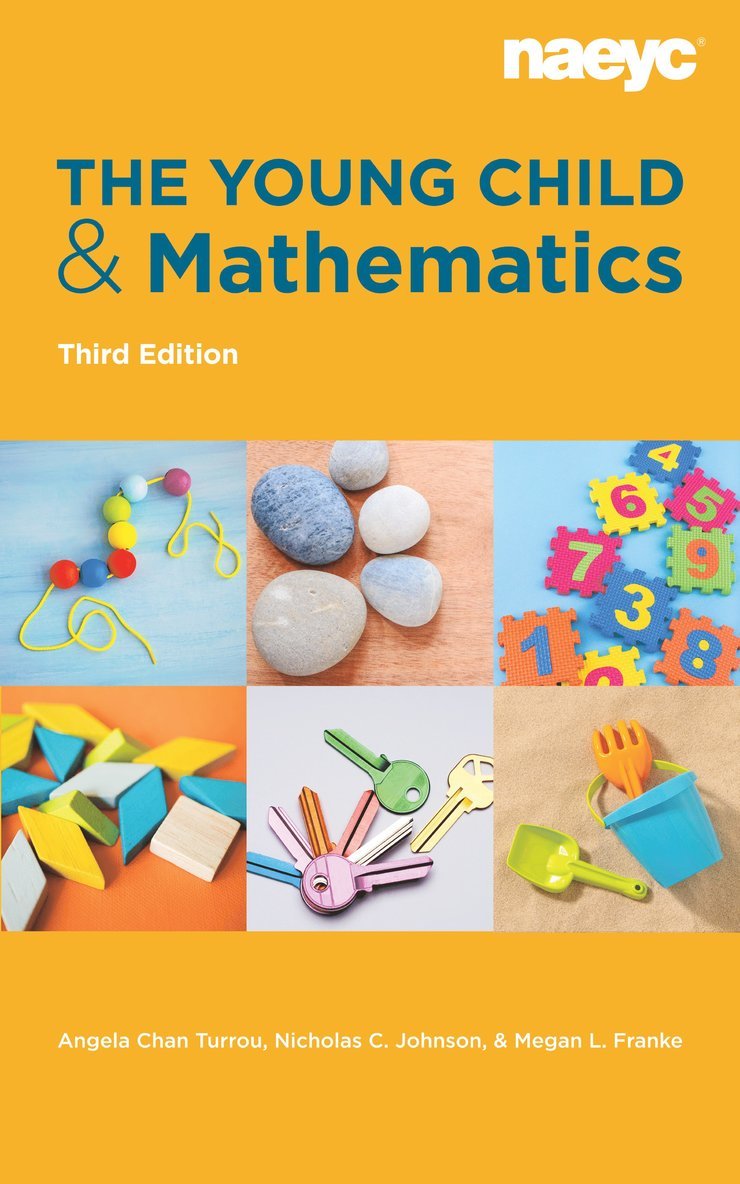
Young Child and Mathematics, Third Edition
AvAngela Chan Turrou,Nicholas C. Johnson
344 kr
Beställningsvara. Skickas inom 5-8 vardagar. Fri frakt över 249 kr.
Beskrivning
Produktinformation
- Utgivningsdatum:2022-01-06
- Mått:212 x 276 x 12 mm
- Vikt:378 g
- Format:Häftad
- Språk:Engelska
- Antal sidor:152
- Förlag:National Association for the Education of Young Children
- ISBN:9781938113932
- Utmärkelser:Winner of EXCEL Silver Award 2022 (United States)
Utforska kategorier
Mer om författaren
Angela Chan Turrou,PhD,is senior researcher and teacher educator at the University of California, LosAngeles (UCLA) Graduate School of Education and Information Studies. Her worklives at the intersection of children’s mathematical thinking, classroompractice, and teacher learning. In her work with teachers and teacher educatorsacross preschool and elementary settings, Angela leverages purposefulInstructional Activities driven by children’s mathematical thinking to supportteacher learning, collaboration, and generative growth. She is continually inspiredby teachers who, on a daily basis, create space for children to drive the mathematicalwork and challenge the broader discourse of who does and does not get to be “goodat math.” Angela is coauthor of YoungChildren’s Mathematics: Cognitively Guided Instruction in Early ChildhoodEducation (Heinemann, 2017) and coeditor of Choral Counting and Counting Collections: Transforming the PreK–5 MathClassroom (Stenhouse, 2018). Angela lives in Los Angeles, CA. Find her onTwitter @Angelaturrou. Nicholas C. Johnson, PhD, is assistantprofessor in the School of Teacher Education at San Diego State University(SDSU). His work investigates how classrooms shape children’s opportunities toparticipate and learn. A former classroom teacher, instructional coach, andcounty office coordinator, Nick partners with new and practicing teachers toexplore children’s mathematical ideas and expand what “counts” as math in school.He is a member of SDSU’s Center for Research in Mathematics and ScienceEducation, coauthor of Young Children’sMathematics: Cognitively Guided Instruction in Early Childhood Education(Heinemann, 2017), and a contributor (withNatali Gaxiola) to Choral Counting andCounting Collections: Transforming the PreK–5 Math Classroom (Stenhouse, 2018).Nick lives in San Diego, CA. Find him on Twitter @CarrythZero. Megan L. Franke, PhD, is professorof education at UCLA. Dr. Franke’s work focuses on understanding and supportingteacher learning for both preservice and in-service teachers. She isparticularly interested in how teaching mathematics with attention to students’mathematical thinking (Cognitively Guided Instruction, or CGI) can challengeexisting school structures and create opportunities for students who are oftenmarginalized to mathematically thrive. Dr. Franke is a member of theDevelopment and Research in Early Mathematics Education (DREME) Network atStanford University where she is studying pre-K–2 coherence and designingresources for early childhood teacher educators. She lives in Santa Monica, CA.Find her on Twitter @meganlfranke.
Recensioner i media
The Young Child and Mathematics is an important resource thatextends our view of both learning and teaching mathematics. Grounded inresearch, guided by concerns for equity, built from practical experiences, andpermeated with the principle that children’s mathematical thinking isparamount, this is the resource that will enrich mathematical experiences forteachers and children. —Douglas H. Clements, Distinguished University Professor,Kennedy Endowed Chair in Early Childhood Learning, and Executive Director ofthe Marsico Institute, University of Denver To read this book is to beinvited into a world of rich interactions among young children and teacherswhere children’s mathematical ideas, experiences, and identities are affirmedand allowed to flourish. With exquisite detail, you’ll develop a freshperspective to see the mathematical value in children’s playful and joyfulinteractions and discover how to build on them together with your colleagues. —Elham Kazemi, Professorof Mathematics Education, University of Washington Love it! This book is fullof everyday and universal examples of how children make sense of their worldand the math found around them. It is a timely resource that I can use toremind me of the why and how of engaging young children—not just in mathexperiences, but across the range of experiences they encounter throughout theday. I find a new “aha!” with each turn of the page. This is a welcome additionto my resource shelf and a must-have for anyone who wants to be responsive andconnect to children’s lives while helping them develop and nurture their maththinking. —Tammy D. Dunn, HeadKindergarten Teacher, Little Red School House and Elisabeth Irwin High School TheYoung Child and Mathematics, Third Edition, focuses on finding,encouraging, and supporting math thinking throughout the day. Math learningopportunities are highlighted both inside and outside of spaces typicallythought of as “math time.” Rather than a detailed account of what is involvedin early childhood mathematics, this book focuses on a smaller number of mathideas and dives deeply into them with real-world vignettes from the classroomas anchors. The authors explore and describe children’s thinking and teachers’practice within each story, returning to these examples throughout the chapterto illustrate a mathematical point or emphasize an aspect of math teaching,learning, or development. It does a great job of translating research-basedrecommendations into practical tips for teachers, like how to extendmathematical problem solving with follow-up questions. Readers will discoverthe math all around them—and also how to find it, how to assess it in authenticways, and how to raise up children’s math ideas equitably. —Alissa A. Lange,Associate Professor of Early Childhood Education and Director of EarlyChildhood STEM Lab, East Tennessee State University This book is a valuableresource that helps educators intentionally design joyful, creative learningspaces and activities that empower children as they play with math. In additionto illuminating vignettes, a strong conceptual framework encourages readers todelve more deeply into their own personal understandings of how young childrendevelop mathematical competency and confidence. A must-read for any educatorinterested in encouraging a love of math in children! —Deanna Pecaski McLennan,Kindergarten Educator and Author of EmbracingMath This new edition is theperfect resource for early childhood educators. It serves as a professionalresearch-based math education textbook as well as an engaging can’t-put-it-downresource with classroom examples and photos that any educator of young childrenwill learn from and love! —DeAnn Jones, Professor ofEarly Childhood Education, Purdue University Global and North Seattle College,and Owner and Teacher, Discovery Place Preschool The Young Child and Mathematics puts children—theirsensemaking, competencies, languages, and cultures—at the center of mathteaching and learning. Well informed by research on effective teaching, thebook vividly describes how teachers can build on young children’s mathunderstandings through developmentally appropriate and playful activities. —Deborah Stipek,Professor, Stanford University The third edition of The Young Child and Mathematics is clear, readable, andbeautifully grounded in real classrooms. The authors’ deep respect for youngchildren, early childhood educators, and important mathematical ideas shinesthrough on every page! —Tracy Johnston Zager,Math Coach and Author of Becoming theMath Teacher You Wish You’d Had
Innehållsförteckning
- PrefaceAboutthis EditionOur Theoryof Learning Introduction Everythinga Child Does Has Mathematical ValueFindingand Building on the Mathematical ValueAn Overviewof this BookEngagingwith this Book Chapter 1: Counting and OperationsInstructional Activity: Counting CollectionsExploring Children’s Thinking: Counting Exploring Children’s Thinking: OperationsAssessing Children’s UnderstandingCounting and Operations in Informal SpacesConclusion Chapter 2: Spatial Relations InstructionalActivity: Describe-Draw-Describe Exploring Children’s Thinking: Describing SpatialRelationsExploring Children’s Thinking: Representing SpatialRelationsAssessing Children’s UnderstandingSpatial Relations in Informal SpacesConclusion Chapter 3: Measurement and DataMeasurementand Data in Informal SpacesInstructional Activity: What Do You Notice?Exploring Children’s Thinking: Measurement Exploring Children’s Thinking: DataAssessing Children’s Understanding Conclusion Chapter 4: Patterns and AlgebraExploringChildren’s Thinking: Creating and Extending PatternsAssessing Children’s Understanding: Tea Party PatternsExploring Children’s Thinking: Patterns in Counting Assessing Children’s Understanding: How High CanChristopher Count?Exploring Children’s Thinking: Patterns and Algebra inStorybooksAssessing Children’s Understanding: Storybook PatternsConclusion Appendix A: AResearch Overview of What Young Children Know What YoungChildren Know: Counting and OperationsWhatYoung Children Know: Spatial RelationsWhat Young Children Know: Measurement and DataWhat Young Children Know: Patterns and AlgebraSituating What a Child Knows Appendix B: Using this Book to Support Professional LearningBringingan Instructional Activity into Your ClassroomMaking Connections Across MathContentExploring Informal SpacesCreating Classroom Spaces thatSupport ParticipationConnecting Classroom Practice to ResearchConnecting Theory to PracticeConnecting to Policy andStandards Documents ReferencesIndexAcknowledgmentsAbout the Authors
Du kanske också är intresserad av
- Signerad!
- -30%
- Nyhet
Tsaren i egen hög person : hur Vladimir Putin lurade oss alla
Roman Badanin, Michail Rubin
349 kr
- Nyhet
- 4 för 3
- 4 för 3
- -30%
- -30%