Häftad, Engelska, 2027
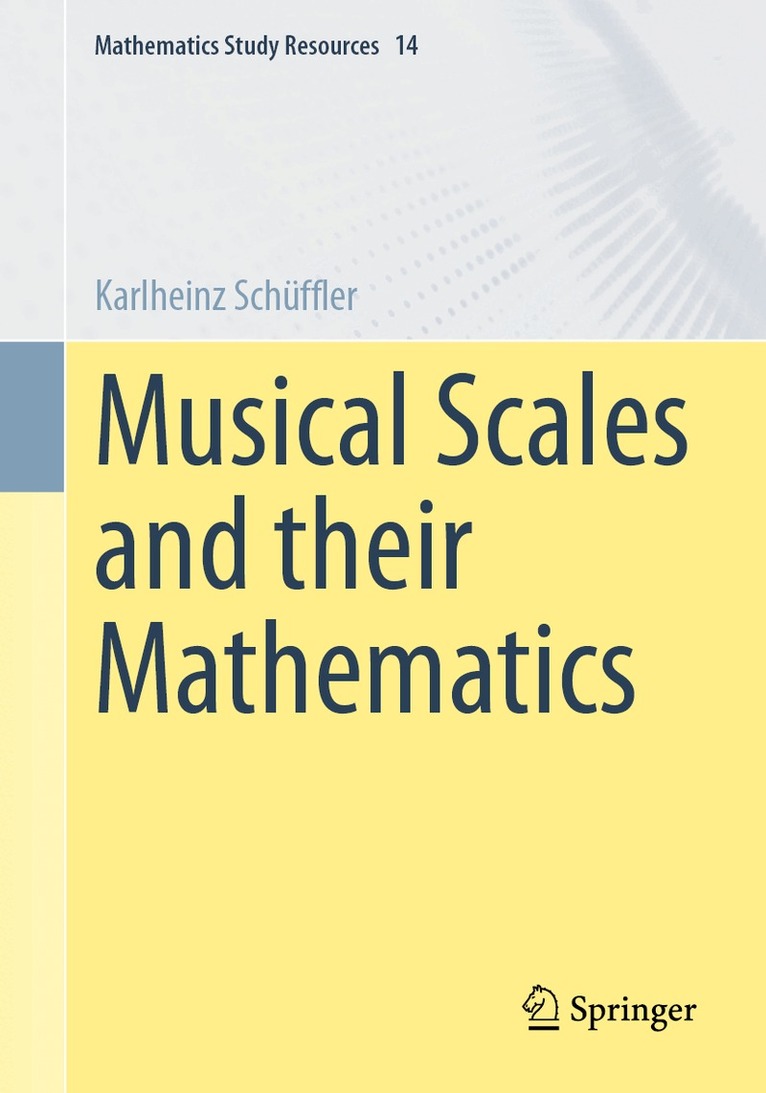
Musical Scales and their Mathematics
780 kr
Kommande
Beskrivning
The Musical Scale – A Triviality or a Problem?This book explores a provocative question and soon reveals that combining tones into “harmonious” tonal systems is a surprisingly complex challenge, involving a remarkably rich network of interconnected issues:Why does the familiar scale consist of exactly 12 tones? Could other scales exist?What roles do the famous Pythagorean comma and its various counterparts play?What do concepts such as consonance, harmony, and purity of intervals mean?What is meant by the temperament characteristic of a musical scale?What is “old tuning”, and is there a new one?These and many other questions are closely interconnected, and mathematics plays a central role in answering them. Beginning with simple ratios and numerical relationships, a rich conceptual network unfolds, allowing for scientific explanations of methods for scale generation, the circles of wolf fifths and Euler lattice selection procedures, as well as models of temperaments. In three parts, the book presents:A modern arithmetic of musical intervals, together with the theory of their division, decomposition, and construction based on prime numbers;The manifold architecture of musical scales, including their models and patterns, step geometries and characteristics, semitones, quarter tones, and commas;A mathematical foundation of tempered systems, accompanied by a novel and consistent classification of historically relevant musical tunings.Numerous examples illustrate the concepts throughout. The mathematical calculations and explanations require only elementary school mathematics, which is developed and applied to musical questions as needed. For readers less interested in the mathematics part, entertaining stories from a fairytale world of mythical musical creatures accompany the text, illustrating it in an amusing way.The English translation was prepared with the assistance of artificial intelligence. The resulting text was subsequently reviewed and revised by the author, with particular attention to technical accuracy and content.
Produktinformation
- Utgivningsdatum: 2027-02-24
- Mått: 168 x 240 x undefined mm
- Format: Häftad
- Språk: Engelska
- Serie: Mathematics Study Resources
- Antal sidor: 764
- Förlag: Springer-Verlag Berlin and Heidelberg GmbH & Co. KG
- ISBN: 9783662695401
- Originaltitel: Die Tonleiter und ihre Mathematik
Utforska kategorier
Betyg & recensioner
0 recensioner
Inga recensioner tillgängliga.