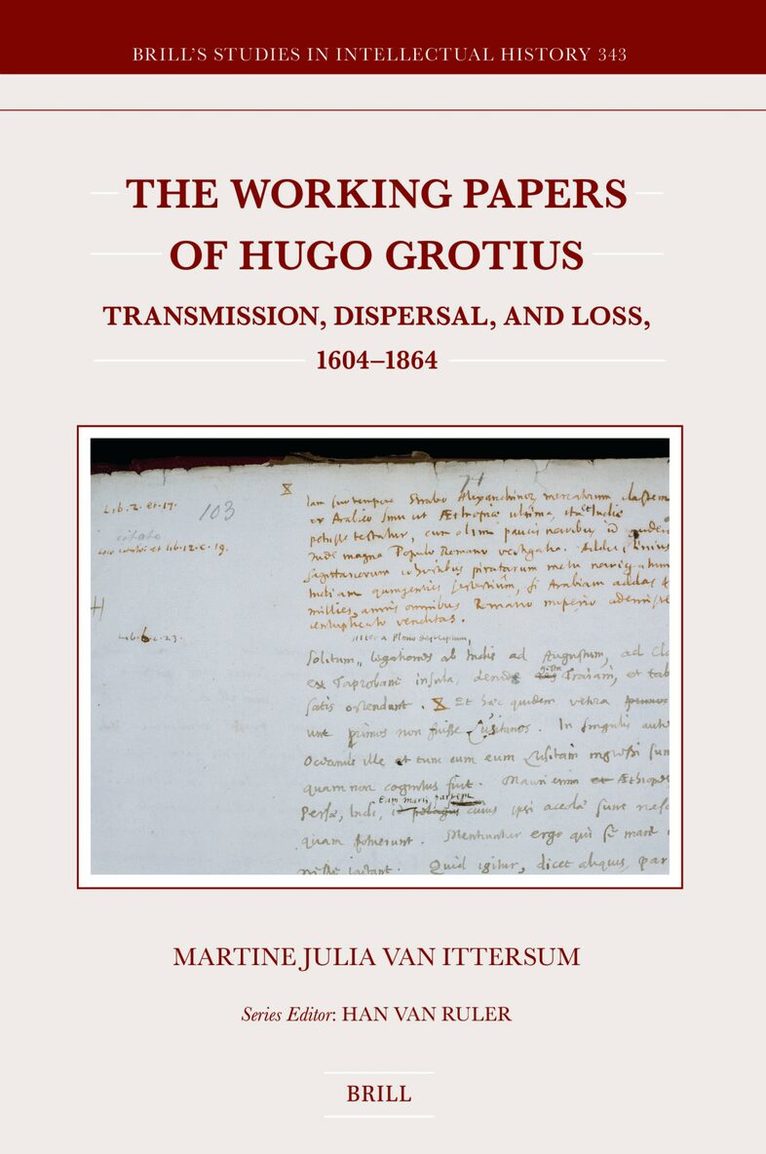
Working Papers of Hugo Grotius
Transmission, Dispersal, and Loss, 1604–1864
Del 343 i serien Brill's Studies in Intellectual History
3 261 kr
Beställningsvara. Skickas inom 5-8 vardagar. Fri frakt över 249 kr.
Beskrivning
Produktinformation
- Utgivningsdatum:2024-05-07
- Mått:155 x 235 x 53 mm
- Vikt:1 371 g
- Format:Inbunden
- Språk:Engelska
- Serie:Brill's Studies in Intellectual History
- Antal sidor:706
- Förlag:Brill
- ISBN:9789004536005
Utforska kategorier
Mer om författaren
Martine Julia van Ittersum, Ph.D. (2002), is Senior Lecturer in History at the University of Dundee (UK). She has published widely on book history, Dutch history, and the history of Western imperialism and colonialism, including Profit and Principle (Brill, 2006).
Recensioner i media
“Brill produces beautiful books, with an elegant typeface and attractive layout. Martine Julia van Ittersum is a real sleuth in the archives. Her commitment and determination in researching Grotius’ working papers and her lively writing style has resulted in a monumental new work of Grotius Forschung. The author takes us on a journey of nearly three centuries, exploring hitherto unknown historical paths at every turn. Her research findings are helpfully summarized in eight appendices. The bibliography is downright impressive, as is the treasure trove of illustrations.”Henk Nellen, author of Hugo Grotius: A Lifelong Struggle for Peace in Church and State, 1583–1645 (Brill, 2015)“This is manuscript and book history at its best, a formidable detective story which traces and reconstructs the transmission, dispersal, and loss of Hugo Grotius’ manuscripts, artifacts, and personal library during his lifetime (imprisonment, escape, exile, diplomatic appointments, shipwreck) and thereafter.”William E. Butler, Penn State University. In: Jus Gentium, Vol. 10, No. 1 (January 2025), pp. 242–243.“A veritable tour de force [...]. This book deserves to be ‘on the shelves’ of the libraries of all scholars of Grotius, and of early modern thought more generally.”Marco Barducci, University of Pavia. In: Grotiana, Vol. 36 (2025).
Innehållsförteckning
- AcknowledgementsList of Maps and Figures1 Introduction: Hugo Grotius and the Microsociologies of Archives1 Early Modern Scholars and Textual Production and Loss2 The Role of Material Wealth in Preserving Personal Archives and Libraries3 The Materiality of Texts and the Microsociologies of Archives4 The Life and Times of Hugo Grotius5 The Fate of Grotius’ Working Papers2 Knowledge Production and Records Management in Early Modern Europe: The Case of Hugo Grotius (1583–1645)1 Grotius’ Working Methods as a Lawyer and Government Official2 Is There a Start Date for Grotius’ Personal Archive?3 Where Did Grotius Keep His Books and Papers?4 The Working Methods of an Early Modern Scholar5 Access to Printed and Manuscript Materials6 How Grotius Involved His Relatives and Remonstrant Friends in Knowledge Production7 Circulating Manuscripts in the Republic of Letters8 The Role of Grotius’ Relatives and Remonstrant Friends in Printed Publication9 Conclusion3 Confiscated Manuscripts and BooksWhat Happened to Grotius’ Personal Library and Archive Following His Arrest on Charges of High Treason in August 1618?1 What Is Known Already About the Confiscation of Grotius’ Books and Working Papers in the Period 1618–1620?2 Did Grotius’ Relatives Squirrel Away Sensitive Materials Following His Arrest in August 1618?3 To Which Books and Manuscripts Did Grotius Have Access in Captivity?4 How Jan De Groot Recovered Some of His Son’s Books and Papers in Summer 16215 What Happened to Grotius’ Confiscated Papers?6 What Happened to Grotius’ Confiscated Books?7 Conclusion4 Creating a (Definitive) Corpus of Writings: How Grotius’ Employer, Relatives, and Remonstrant Friends Shaped His Intellectual Legacy (1645–1679)1 Grotius’ Intellectual Legacy as a Family Project2 What Happened to the Book Collection Sold to Christina of Sweden?3 Manuscript Hunters in Paris, London, and the Low Countries4 Pieter De Groot’s Stewardship of His Father’s Working Papers (1653–1660)5 Grotius’ Intellectual Legacy in the Era of the ‘True Freedom’ and Beyond (1660–1678)6 What Happened to the Working Papers Inherited by the Descendants of Willem De Groot?7 Conclusion5 Preserving and Editing Grotius’ Manuscripts for the Sake of Family Honor and the Remonstrant Cause (1679–1747)1 Publishing, Advertising and Deconstructing Epistolae Quotquot Reperiri Potuerunt2 A Remonstrant Hero: How Jean Le Clerc Shaped Grotius’ Intellectual Legacy3 Circulating Manuscripts in the Republic of Letters in the Eighteenth Century4 Writing and Publishing an Authoritative Biography of Hugo Grotius5 Memorialization through Physical Artifacts6 The Cornets De Groot Family in Bergen op Zoom7 Conclusion6 Confronting Grotius’ Legacy in an Age of Revolution: The Cornets De Groot Family in Rotterdam (1748–1798)1 The Cornets De Groot Family as Beneficiaries of the Stadtholders’ Patronage2 The Establishment of a Grotius Memorial in the New Church in Delft3 A Patriot Revolution in Rotterdam4 The Patriot Politics of Paulus Gevers5 Hugo Grotius and Pieter De Groot as Patriot Icons6 Jan Cornets De Groot’s Efforts to Overturn the Patriot Revolution in Rotterdam7 Papers, Portraits, and Memorabilia Passed Down the Generations8 Status Symbols: Ancestral Portraits and Grotius Memorabilia9 An Inventory of the Papers of Hugo Grotius and Pieter De Groot (April 1778)7 Constructing a Conservative National Hero in Response to Patriot Radicalism (1787–1815)1 Grotius as the Embodiment of Republican Virtue2 The Rediscovery of the Parallelon Rerumpublicarum and the Making of a Dutch National Hero3 What Can the Visser Collection Tell Us about the Transmission and Dispersal of Grotius’ Working Papers?4 How Jacobus Scheltema Rearranged Grotius’ Working Papers and Marked Up the 1778 Inventory8 End of the Lineage: How Hugo Cornets De Groot Disposed of His Grotiana (1802–1864)1 A Visit from Lieutenant-General A.W.H. Nolthenius De Man in March 18322 An Epistolary Exchange between Johan Pieter Cornets De Groot Van Kraaijenburg and Distant Relatives in Cuyck and Nijmegen3 Why Did Hugo Cornets De Groot Become Estranged from His Relatives?4 The Death of a Lonely Bachelor in Cuyck in February 18645 How Jean Baptiste Regouin Rearranged the Working Papers of Hugo Grotius and Pieter De Groot, and Then Sold These to a Tobacco Merchant9 Preparing for the Auction of the Working Papers of Hugo Grotius and Pieter De Groot, Mostly Behind the Scenes (February–November 1864)1 Christiaan Snelleman, Rotterdam Merchant and Remonstrant2 A List of Grotiana Compiled by the Remonstrant Minister C.P. Tiele3 How P.A. Tiele Put Together an Auction Catalogue, and Divided Up Manuscript Volumes into Multiple Lots4 The Auctioneer Martinus Nijhoff5 How Frederik Muller Did Business with the Nederlandsche Handel-Maatschappij10 The 1864 Auction of the Working Papers of Hugo Grotius and Pieter De Groot, and What Happened Next1 How Nijhoff Conducted the Auction and Presented Its Outcome to the Public2 The Story Behind the Swedish Government’s Acquisition of Grotiana3 What Happened to Lots 1–42?4 The Bid and Strike Prices of Lots 43–99, and the Potential and Actual Buyers5 The 1864 Auction in Comparative Context6 What Explains the Dutch Government’s Total Lack of Involvement?7 How Johan Pieter Cornets De Groot Van Kraaijenburg (Re)Assembled a Collection of Family Papers11 ConclusionAppendix 1: The 1778 Inventory of the Working Papers of Hugo Grotius and Pieter De Groot, With Notes by Jacobus ScheltemaAppendix 2: Jacobus Scheltema’s Rearrangement of the Papers of Hugo Grotius and Pieter De Groot (May 1803)Appendix 3: “Short Description of the Contents of the Enclosed Books, Volumes of Letters, Parchments with Seals Attached to Them, etc., Left by Hugo Grotius”Appendix 4: A List of Grotiana Compiled by C.P. Tiele, at the Request of Christiaan Snelleman (August 1864)Appendix 5: The Auction of the Working Papers of Hugo Grotius and Pieter De Groot: Bid Prices, Strike Prices, and Horse Trading Behind the Scenes (November 1804)Appendix 6: The Auction Proceeds: The Final Receipt Sent to Christiaan Snelleman by Martinus NijhoffAppendix 7: Grotius’ Working Papers as Rearranged by P.A. TieleAppendix 8: Inheriting Ancestral Portraits and Papers: A Genealogical ChartBibliographyIndices
Du kanske också är intresserad av
Diet, Nutrition & Chronic Disease
Shetty, McPherson, Prakash S. Shetty, Klim McPherson
Inbunden, 1997
3 261 kr
- Nyhet
Handbook On Engineering Plasticity: Theoretical Plasticity & Applications Of Plasticity Theory
David W A Rees
Inbunden, 2025
3 261 kr
Pediatric, Adolescent and Young Adult Gynecology
Albert Altchek, Liane Deligdisch
Inbunden, 2009
3 261 kr