
Visar resultat för..."Fordham University Press"
2 973 produkter
2 973 produkter
Häftad, Engelska, 2010
535 kr
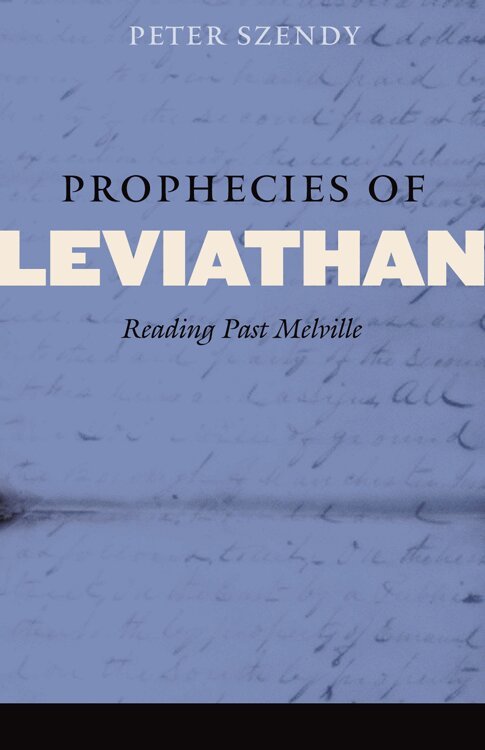
Reading Melville is not only reading. Reading Melville means being already engaged in the abyssal process of reading reading. Reading what reading is and what reading does.With Melville, Prophecies of Leviathan argues that reading, beyond its apparent linearity, is essentially prophetic, not only because Moby Dick, for example, may appear to be full of unexpected prophecies (Ishmael seems to foretell a "Grand Contested Election for the Presidency of the United States" followed by a "bloody battle in Afghanistan") but also, and more deeply, because reading itself is a prophetic experience that Melville captured in a unique way.Reading, according to Melville, might just be the prophecy of the text to come. This apparently tautological view has great consequences for the theory of literature and its relation to politics. As Szendy suggests, the beheading of Melville's "Leviathan" (which, Ishmael says, "is the text") should be read against Hobbes's sovereign body politic. Szendy's reading of Melville urges us to revisit Jacques Derrida's all too famous sentence: "There is no hors-texte." And it also urges us-as the preface to this English edition makes clear-to reflect on the (Christian) categories that we apply to the text: its life, death, and, above all, afterlife or suicide. The infinite finitude of the text: that is what reading is about.In his brilliant and thorough afterword, Gil Anidjar situates Prophecies of Leviathan among Szendy's other works and shows how the seemingly tautological self-prophecy really announces a new "ipsology," a "pluralization of the self" through a "narcissism of the other thing."
Häftad, Engelska, 2016
431 kr
Skickas
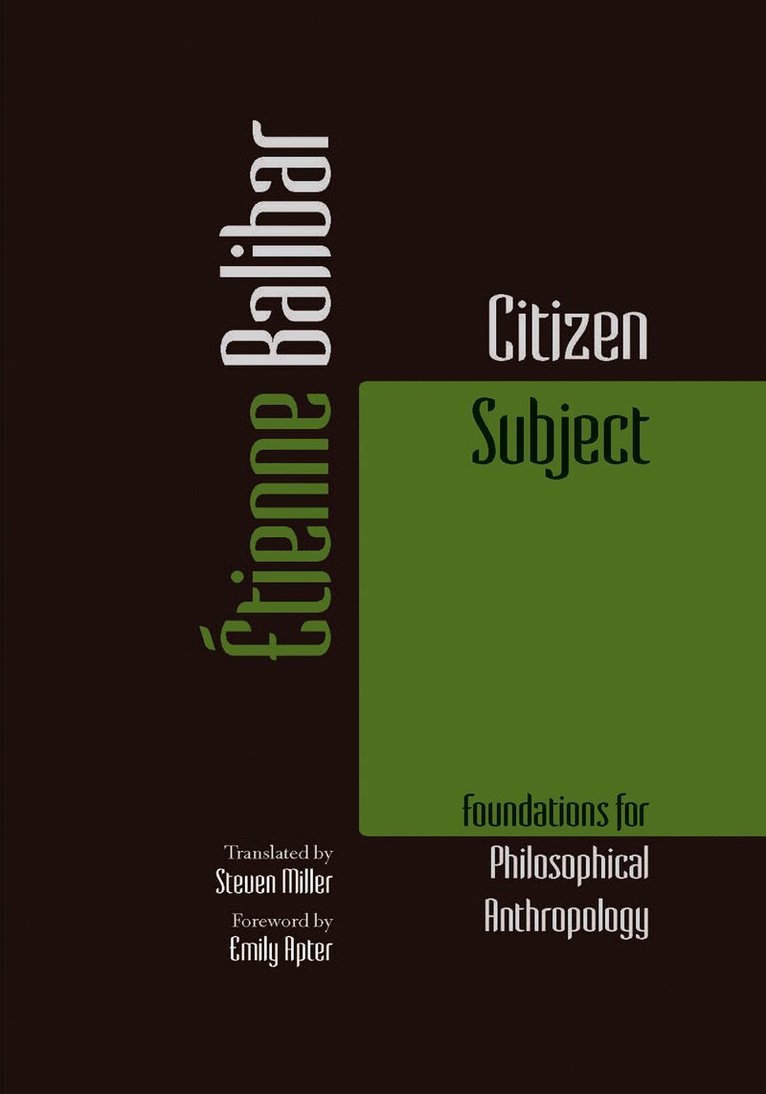
What can the universals of political philosophy offer to those who experience "the living paradox of an inegalitarian construction of egalitarian citizenship"? Citizen Subject is the summation of Étienne Balibar's career-long project to think the necessary and necessarily antagonistic relation between the categories of citizen and subject. In this magnum opus, the question of modernity is framed anew with special attention to the self-enunciation of the subject (in Descartes, Locke, Rousseau, and Derrida), the constitution of the community as "we" (in Hegel, Marx, and Tolstoy), and the aporia of the judgment of self and others (in Foucualt, Freud, Kelsen, and Blanchot).After the "humanist controversy" that preoccupied twentieth-century philosophy, Citizen Subject proposes foundations for philosophical anthropology today, in terms of two contrary movements: the becoming-citizen of the subject and the becoming-subject of the citizen. The citizen-subject who is constituted in the claim to a "right to have rights" (Arendt) cannot exist without an underside that contests and defies it. He—or she, because Balibar is concerned throughout this volume with questions of sexual difference—figures not only the social relation but also the discontent or the uneasiness at the heart of this relation. The human can be instituted only if it betrays itself by upholding "anthropological differences" that impose normality and identity as conditions of belonging to the community.The violence of "civil" bourgeois universality, Balibar argues, is greater (and less legitimate, therefore less stable) than that of theological or cosmological universality. Right is thus founded on insubordination, and emancipation derives its force from otherness.Ultimately, Citizen Subject offers a revolutionary rewriting of the dialectic of universality and differences in the bourgeois epoch, revealing in the relationship between the common and the universal a political gap at the heart of the universal itself.
Häftad, Engelska, 2005
535 kr
Contents• Shibboleth: For Paul Celan• "A Self-Unsealing Poetic Text": Poetics and Politics of Witnessing• Language Does Not Belong: An Interview• The Majesty of the Present: Reading Celan's "The Meridian"• Rams: Uninterrupted Dialogue—between Two Infinities, the PoemThis book brings together five powerful encounters. Themes central to all ofDerrida's writings thread the intense confrontation between the most famousphilosopher of our time and the Jewish poet writing in German who, perhapsmore powerfully than any other, has testified to the European experience ofthe twentieth century.They include the date or signature and its singularity; the notion of the trace;temporal structures of futurity and the "to come"; the multiplicity of languageand questions of translation; such speech acts as testimony and promising, butalso lying and perjury; the possibility of the impossible; and, above all, the questionof the poem as addressed and destined beyond knowledge, seeking to speak toand for the irreducibly other.The memory of encounters with thinkers who have also engaged Celan's workanimates these writings, which include a brilliant dialogue between twointerpretative modes—hermeneutics and deconstruction. Derrida's approach toa poem is a revelation on many levels, from the most concrete ways of reading—for example, his analysis of a sequence of personal pronouns—to the mostsweeping imperatives of human existence (and Derrida's writings are alwaysa study in the imbrication of such levels). Above all, he voices the call toresponsibility in the ultimate line of Celan's poem: "The world is gone,I must carry you," which sounds throughout the book's final essay like a refrain.Only two of the texts in this volume do not appear here in English for the first time. Of these, Schibboleth has been entirely retranslated and has been set following Derrida's own instructions for publication in French; "A Self-Unsealing Poetic Text" was substantially rewritten by Derrida himself and basically appears here as the translation of a new text. Jacques Derrida's most recent books in English translation include Counterpath: Traveling with Jacques Derrida (with Catherine Malabou). He died in Paris on October 8, 2004. Thomas Dutoit teaches at the Université de Paris 7. He translated Aporias and edited On the Name, both by Jacques Derrida.
Häftad, Engelska, 2015
254 kr
Skickas inom 5-8 vardagar
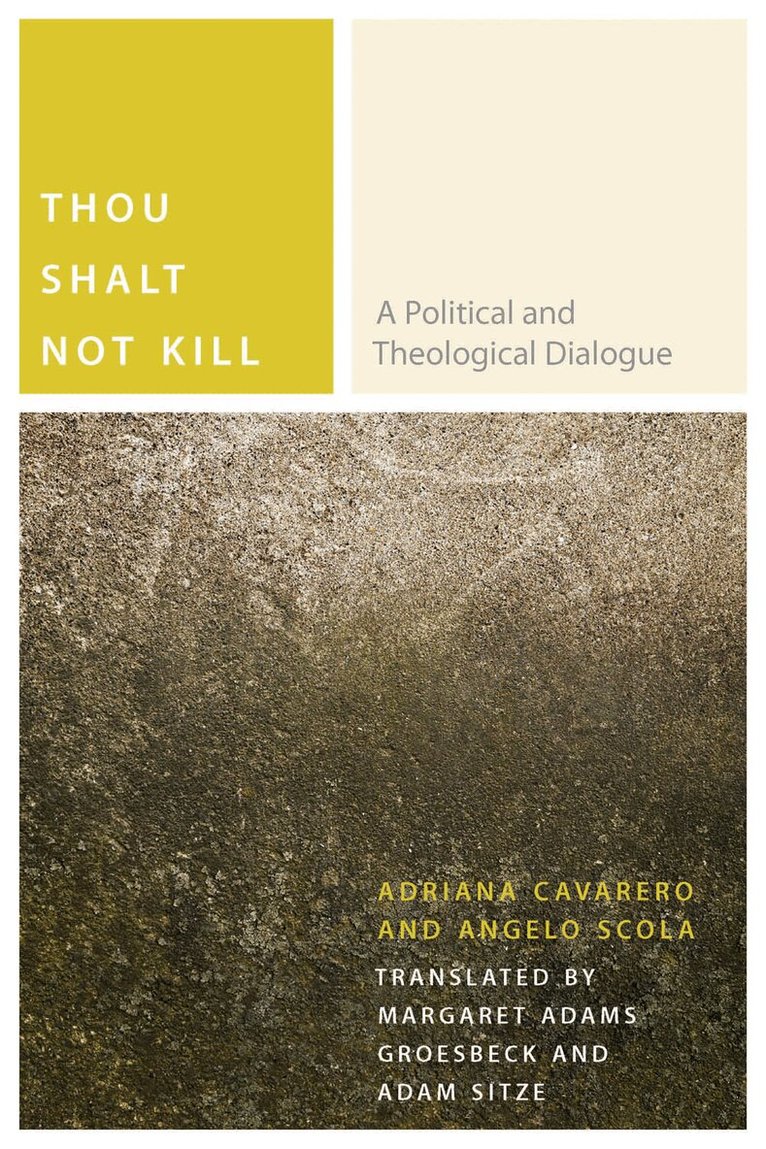
In this fascinating and rare little book, a leading Italian feminist philosopher and the Archbishop of Milan face off over the contemporary meaning of the biblical commandment not to kill.The result is a series of erudite and wide-ranging arguments that move from murder and suicide to just war and drone strikes, from bioethics and biopolitics to hermeneutics and philology, from Theodor Adorno and Max Horkheimer to Hannah Arendt and Michel Foucault, from Torah and Scripture to art and literature, from the essence of human dignity and the paradoxes of fratricide to engagements with Levinasian ethics.Less a direct debate than a disputation in the classical sense, Thou Shalt Not Kill proves to be a searching meditation on one of the unstated moral premises shared by otherwise bitterly opposed political factions. It will stimulate the mind of the novice while also reminding more advanced readers of the necessity and desirability of thinking in the present.
Häftad, Engelska, 2020
459 kr
Skickas inom 5-8 vardagar
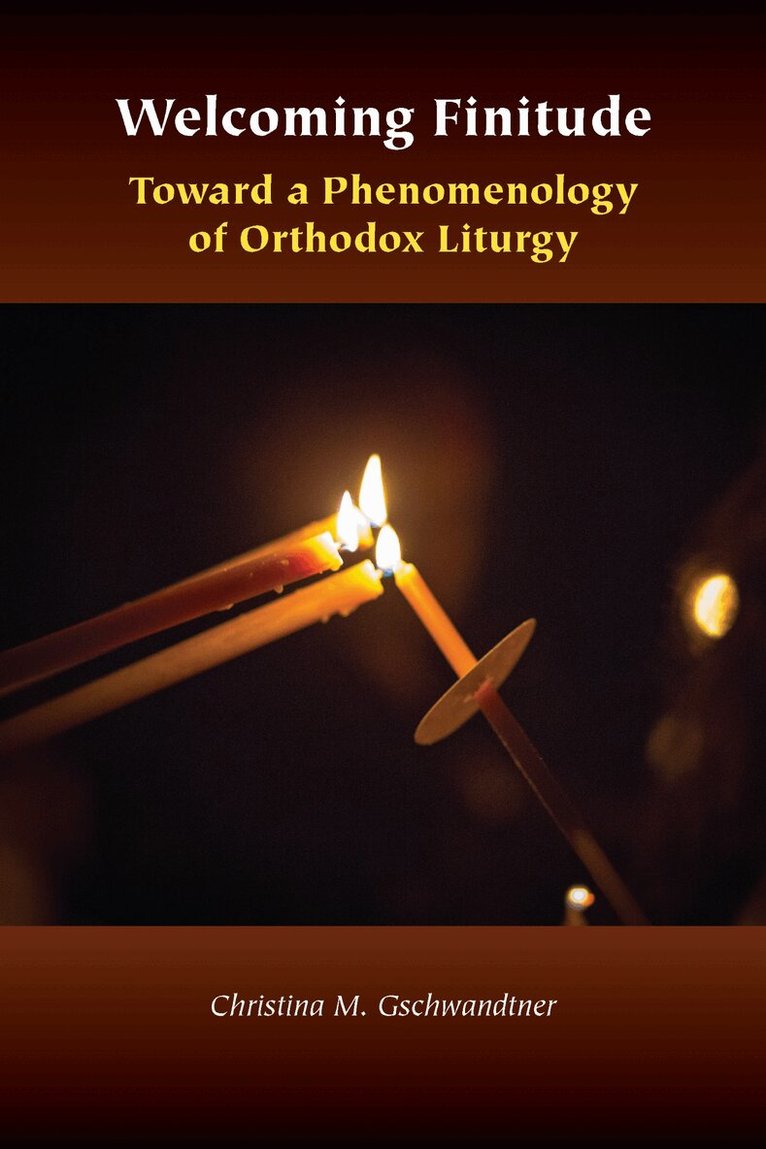
What does it mean to experience and engage in religious ritual? How does liturgy structure time and space? How do our bodies move within liturgy, and what impact does it have on our senses? How does the experience of ritual affect us and shape our emotions or dispositions? How is liturgy experienced as a communal event, and how does it form the identity of those who participate in it? Welcoming Finitude explores these broader questions about religious experience by focusing on the manifestation of liturgical experience in the Eastern Christian tradition. Drawing on the methodological tools of contemporary phenomenology and on insights from liturgical theology, the book constitutes a philosophical exploration of Orthodox liturgical experience.
Häftad, Engelska, 2023
333 kr
Skickas
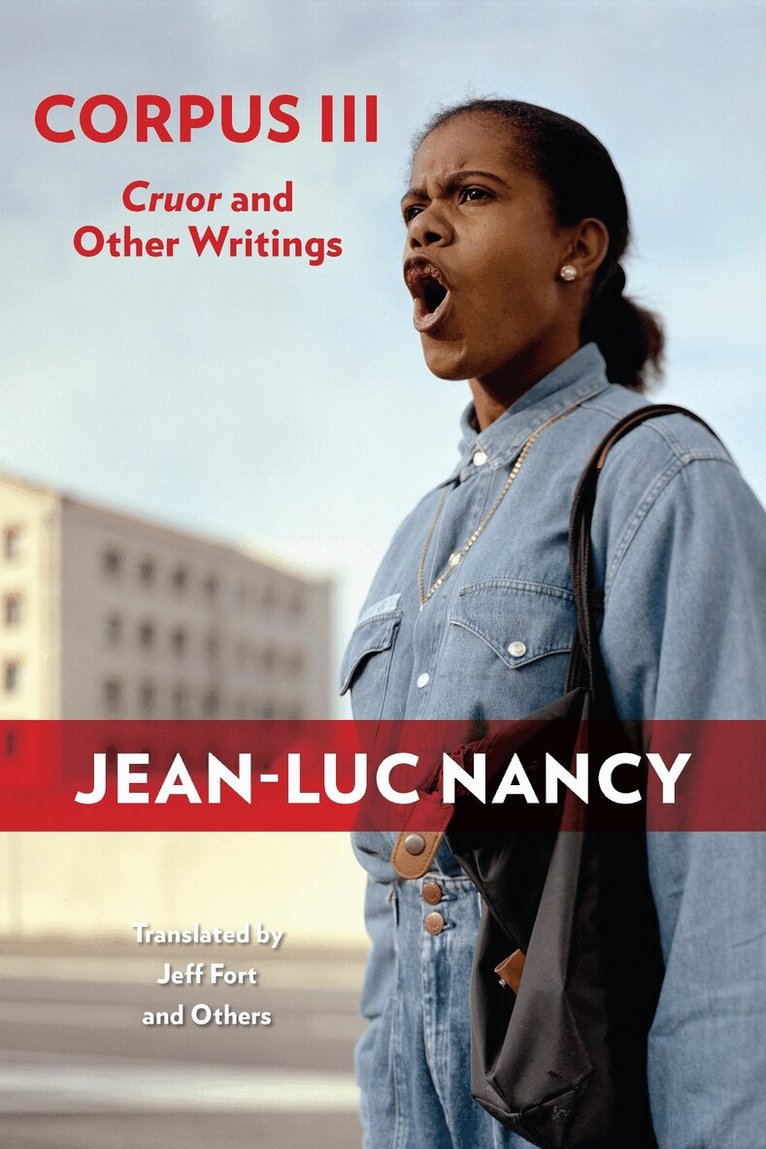
A beautiful, profound series of reflections on the body by one of the most prominent and consequential philosophers of continental EuropeThis landmark volume brings into English Jean-Luc Nancy's last completed work and concludes his remarkable philosophical reflections on the body, a project he began almost thirty years ago. Taking the body as an intersection of pulsing life and destructive cruelty on a global scale, Nancy's account becomes more vivid, more physical, than ever, even as it ventures into language that is as lyrical as it is profound. This vividness is manifest in blood: as it flows, in all its pulsing and forceful circulation, and as it spills, in the cruelty of existences confronted daily by countless destructions. This can be described as sanguis and cruor, the two Latin words for blood's intermingled but distinct aspects. This distinction allows Nancy to highlight an almost mystical sense of the body (yet one that remains soberly on this side of its manifest insistence), alongside the cruelty that pervades our world—a world whose very existence is threatened by its reduction to mere objects.The exceptional writings brought together in Corpus III comprise a masterful work of philosophy that marries rigorous erudition—on Freud, Nietzsche, and others—with rich poetic language and an actual poem. Nancy's thought opens the body onto its own unaccountable origins, its plural singularities, its enmeshed instantiations, and its excessive irreducibles, which are also the elusive excesses of language. Whereas in earlier texts Nancy has referred to this excess as poetry, here he performs it in the form of a poem, in the extraordinary hymn entitled Stoma. While the publication of a poem by Nancy is a notable event, equally noteworthy is a remarkable essay entitled "Scandalous Death," in which Nancy meditated on a subject that was to come to him too soon after. Above all, the book is crucial for bringing into English Cruor, the very last book Nancy completed before his death, an evocative meditation offered by a great thinker on the complex conditions of his own—and our—singular survival.
Häftad, Engelska, 2017
267 kr
Skickas
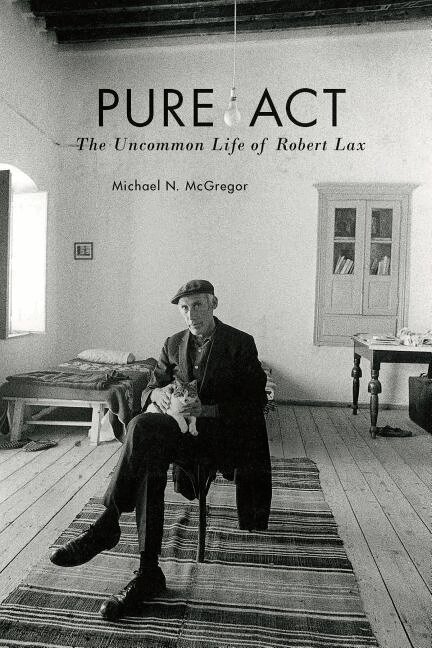
Excellence in Publishing Award, Association of Catholic PublishersHonorable Mention, Catholic Press Association Book AwardFinalist, Washington State Book AwardPure Act tells the story of poet Robert Lax, whose quest to live a true life as both an artist and a spiritual seeker inspired Thomas Merton, Jack Kerouac, William Maxwell and a host of other writers, artists and ordinary people. Known in the U.S. primarily as Merton's best friend and in Europe as a daringly original avant-garde poet, Lax left behind a promising New York writing career to travel with a circus, live among immigrants in post-war Marseilles and settle on a series of remote Greek islands where he learned and recorded the simple wisdom of the local people. Born a Jew, he became a Catholic and found the authentic community he sought in Greek Orthodox fishermen and sponge divers.In his early life, as he alternated working at The New Yorker, writing screenplays in Hollywood and editing a Paris literary journal with studying philosophy, serving the poor in Harlem and living in a sanctuary high in the French Alps, Lax pursued an approach to life he called pure act―a way of living in the moment that was both spontaneous and practiced, God-inspired and self-chosen. By devoting himself to simplicity, poverty and prayer, he expanded his capacity for peace, joy and love while producing distinctive poetry of such stark beauty critics called him "one of America's greatest experimental poets" and "one of the new 'saints' of the avant-garde."Written by a writer who met Lax in Greece when he was a young seeker himself and visited him regularly over fifteen years, Pure Act is an intimate look at an extraordinary but little-known life. Much more than just a biography, it's a tale of adventure, an exploration of friendship, an anthology of wisdom, and a testament to the liberating power of living an uncommon life.
Inbunden, Engelska, 2008
1 138 kr
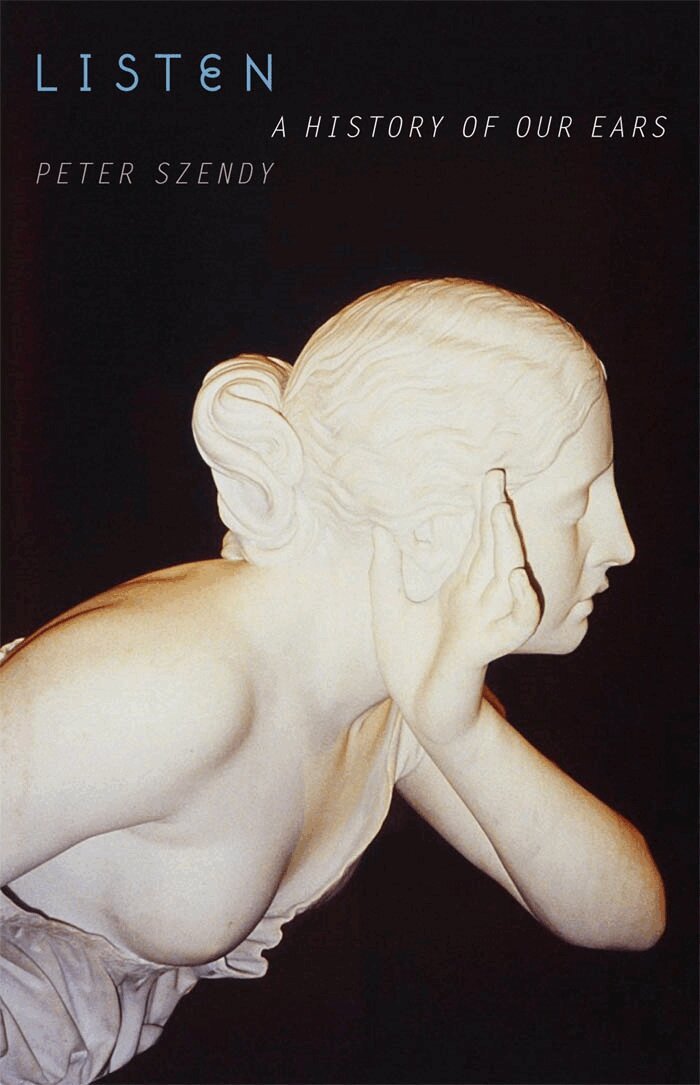
In this intimate meditation on listening, Peter Szendy examines what the role of the listener is, and has been, through the centuries. The role of the composer is clear, as is the role of the musician, but where exactly does the listener stand in relation to the music s/he listens to? What is the responsibility of the listener? Does a listener have any rights, as the author and composer have copyright? Szendy explains his love of musical arrangement (since arrangements allow him to listen to someone listening to music), and wonders whether it is possible in other ways to convey to others how we ourselves listen to music. How can we share our actual hearing with others?Along the way, he examines the evolution of copyright laws as applied to musical works and takes us into the courtroom to examine different debates on what we are and aren't allowed to listen to, and to witness the fine line between musical borrowing and outright plagiarism. Finally, he examines the recent phenomenon of DJs and digital compilations, and wonders how technology has affected our habits of listening and has changed listening from a passive exercise to an active one, whereby one can jump from track to track or play only selected pieces.
Inbunden, Engelska, 2019
1 299 kr
Already in 1929, Walter Benjamin described "a one hundred per cent image-space." Such an image space saturates our world now more than ever, constituting the visibility in which we live. The Supermarket of the Visible analyzes this space and the icons that populate it as the culmination of a history of the circulation and general commodification of images and gazes. From the first elevators and escalators (tracking shots avant la lettre) to cinema (the great conductor of gazes), all the way down to contemporary eye-tracking techniques that monitor the slightest saccades of our eyes, Peter Szendy offers an entirely novel theory of the intersection of the image and economics.The Supermarket of the Visible elaborates an economy proper to images, icons, in other words, an iconomy. Deleuze caught a glimpse of this when he wrote that "money is the back side of all the images that cinema shows and edits on the front." Since "cinema," for Deleuze, is synonymous with "universe," Szendy argues that this sentence must be understood in its broadest dimension and that a reading of key works in the history of cinema allows us a unique vantage point upon the reverse of images, their monetary implications. Paying close attention to sequences in Hitchcock, Bresson, Antonioni, De Palma, and The Sopranos, Szendy shows how cinema is not a uniquely commercial art form among other, purer arts, but, more fundamentally, helps to elaborate what might be called, with Bataille, a general iconomy.Moving deftly and lightly between political economy, aesthetic theory, and popular movies and television, The Supermarket of the Visible will be a necessary book for anyone concerned with media, philosophy, politics, or visual culture.
Häftad, Engelska, 2017
528 kr
Skickas inom 5-8 vardagar
Expectation is a major volume of Jean-Luc Nancy's writings on literature, written across three decades but, for the most part, previously unavailable in English.More substantial than literary criticism, these essays collectively negotiate literature's relation to philosophy. Nancy pursues such questions as literature's claims to truth, the status of narrative, the relation of poetry and prose, and the unity of a book or of a text, and he addresses a number of major European writers, including Dante, Sterne, Rousseau, Hölderlin, Proust, Joyce, and Blanchot.The final section offers a number of impressive pieces by Nancy that completely merge his concerns for philosophy and literature and philosophy-as-literature. These include a lengthy parody of Valéry's "La Jeune Parque," several original poems by Nancy, and a beautiful prose-poetic discourse on an installation by Italian artist Claudio Parmiggiani that incorporates the Faust theme. Opening with a substantial Introduction by Jean-Michel Rabaté that elaborates Nancy's importance as a literary thinker, this book constitutes the most substantial statement to date by one of today's leading philosophers on a discipline that has been central to his work across his career.
Häftad, Engelska, 2023
259 kr
Skickas
A provocative, highly accessible journey to the heart of Sophocles' Antigone elucidating why it keeps resurfacing as a central text of Western thought and Western culture.There is probably no classical text that has inspired more interpretation, critical attention, and creative response than Sophocles' Antigone. The general perspective from which the book is written could be summarized with this simple question: What is it about the figure of Antigone that keeps haunting us? Why do all these readings and rewritings keep emerging? To what kind of always contemporary contradiction does the need, the urge to reread and reimagine Antigone—in all kinds of contexts and languages—correspond? As key anchor points of this general interrogation, three particular "obsessions" have driven the author's thinking and writing about Antigone. First is the issue of violence. The violence in Antigone is the opposite of "graphic" as we have come to know it in movies and in the media; rather, it is sharp and piercing, it goes straight to the bone. It is the violence of language, the violence of principles, the violence of desire, the violence of subjectivity. Then there is the issue of funerary rites and their role in appeasing the specific "undeadness" that seems to be the other side of human life, its irreducible undercurrent that death alone cannot end and put to rest. This issue prompted the author to look at the relationship between language, sexuality, death, and "second death." The third issue, which constitutes the focal point of the book, is Antigone's statement that if it were her children or husband lying unburied out there, she would let them rot and not take it upon herself to defy the decree of the state. The author asks, how does this exclusivist, singularizing claim (she would do it only for Polyneices), which she uses to describe the "unwritten law" she follows, tally with Antigone's universal appeal and compelling power? Attempting to answer this leads to the question of what this particular (Oedipal) family's misfortune, of which Antigone chooses to be the guardian, shares with the general condition of humanity. Which in turn forces us to confront the seemingly self-evident question: "What is incest?"Let Them Rot is Alenka Zupančič's absorbing and succinct guided tour of the philosophical and psychoanalytic issues arising from the Theban trilogy. Her original and surprising intervention into the broad and prominent field of study related to Sophocles' Antigone illuminates the classical text's ongoing relevance and invites a wide readership to become captivated by its themes.
Häftad, Engelska, 2016
259 kr
Skickas
Winner, French Voices Grand PrizeNostalgia makes claims on us both as individuals and as members of a political community. In this short book, Barbara Cassin provides an eloquent and sophisticated treatment of exile and of desire for a homeland, while showing how it has been possible for many to reimagine home in terms of language rather than territory.Moving from Homer's and Virgil's foundational accounts of nostalgia to the exilic writings of Hannah Arendt, Cassin revisits the dangerous implications of nostalgia for land and homeland, thinking them anew through questions of exile and language. Ultimately, Cassin shows how contemporary philosophy opens up the political stakes of rootedness and uprootedness, belonging and foreignness, helping us to reimagine our relations to others in a global and plurilingual world.
Häftad, Engelska, 2008
341 kr
Skickas
How have we thought "the body"? How can we think it anew? The body of mortal creatures, the body politic, the body of letters and of laws, the "mystical body of Christ"—all these (and others) are incorporated in the word Corpus, the title and topic of Jean-Luc Nancy's masterwork.Corpus is a work of literary force at once phenomenological, sociological, theological, and philosophical in its multiple orientations and approaches. In thirty-six brief sections, Nancy offers us at once an encyclopedia and a polemical program—reviewing classical takes on the "corpus" from Plato, Aristotle, and Saint Paul to Descartes, Hegel, Husserl, and Freud, while demonstrating that the mutations (technological, biological, and political) of our own culture have given rise to the need for a new understanding of the body. He not only tells the story of this cultural change but also explores the promise and responsibilities that such a new understanding entails.The long-awaited English translation is a bold, bravura rendering. To the title essay are added five closely related recent pieces—including a commentary by Antonia Birnbaum—dedicated in large part to the legacy of the "mind-body problem" formulated by Descartes and the challenge it poses to rethinking the ancient problems of the corpus. The last and most poignant of these essays is "The Intruder," Nancy's philosophical meditation on his heart transplant. The book also serves as the opening move in Nancy's larger project called "The deconstruction of Christianity."
Häftad, Engelska, 1992
723 kr
Skickas inom 10-15 vardagar
The first edition of this extremely popular two volume Greek text has been successfully adopted in many high schools and colleges; the organization and approach used by the authors, make it an equally effective tool for those who would enjoy learning the language on their own.
Inbunden, Engelska, 2016
1 209 kr
Skickas inom 10-15 vardagar
The European Union and the single currency have given Europe more stability than it has known in the past thousand years, yet Europe seems to be in perpetual crisis about its global role. The many European empires are now reduced to a multiplicity of ethnicities, traditions, and civilizations. Europe will never be One, but to survive as a union it will have to become a federation of "islands" both distinct and connected.Though drawing on philosophers of Europe's past, Cacciari calls not to resist Europe's sunset but to embrace it. Europe will have to open up to the possibility that in few generations new exiles and an unpredictable cultural hybridism will again change all we know about the European legacy. Though scarcely alive in today's politics, the political unity of Europe is still a necessity, however impossible it seems to achieve.
Häftad, Engelska, 2018
540 kr
Skickas
Maurice Blanchot (1907–2003) was one of the most important writers of the twentieth century. His novels, shorter narratives, literary criticism, and fragmentary texts exercised enormous influence over several generations of writers, artists, and philosophers. In works such as Thomas the Obscure, The Instant of my Death, The Writing of the Disaster, The Unavowable Community, Blanchot produced some of the most incisive statements of what it meant to experience the traumas and turmoils of the twentieth century.As a journalist and political activist, Blanchot had a public side that coexisted uneasily with an inclination to secrecy, a refusal of interviews and photographs, and a reputation for mysteriousness and seclusion. These public and private Blanchots came together in complicated ways at some of the twentieth century's most momentous occasions. He was among the public intellectuals participating in the May '68 revolution in Paris and helped organize opposition to the Algerian war. During World War II, he found himself moments away from being executed by the Nazis. More controversially, he had been active in far-right circles in the '30s.Now translated into English, Christophe Bident's magisterial, scrupulous, much-praised critical biography provides the first full-length account of Blanchot's itinerary, drawing on unpublished letters and on interviews with the writer's close friends. But the book is both a biography and far more. Beyond filling out a life famous for its obscurity, Bident's book will transform the way readers of Blanchot respond to this major intellectual figure by offering a genealogy of his thought, a distinctive trajectory that is at once imaginative and speculative, at once aligned with literary modernity and a close companion and friend to philosophy.The book is also a historical work, unpacking the 'transformation of convictions' of an author who moved from the far-right in the 1930s to the far-left in the 1950s and after. Bident's extensive archival research explores the complex ways that Blanchot's work enters into engagement with his contemporaries, making the book also a portrait of the circles in which he moved, which included friends such as Georges Bataille, Marguerite Duras, Emmanuel Levinas, Michel Foucault, and Jacques Derrida.Finally, the book traces the strong links between Blanchot's life and an oeuvre that nonetheless aspires to anonymity. Ultimately, Bident shows how Blanchot's life itself becomes an oeuvre—becomes a literature that bears the traces of that life secretly. In its even-handed appraisal, Bident's sophisticated reading of Blanchot's life together with his work offers a much-needed corrective to the range of cruder accounts, whether from Blanchot's detractors or from his champions, of a life too easily sensationalized.This definitive biography of a seminal figure of our time will be essential reading for anyone concerned with twentieth-century literature, thought, culture, and politics.
Häftad, Engelska, 2015
264 kr
Skickas inom 11-20 vardagar
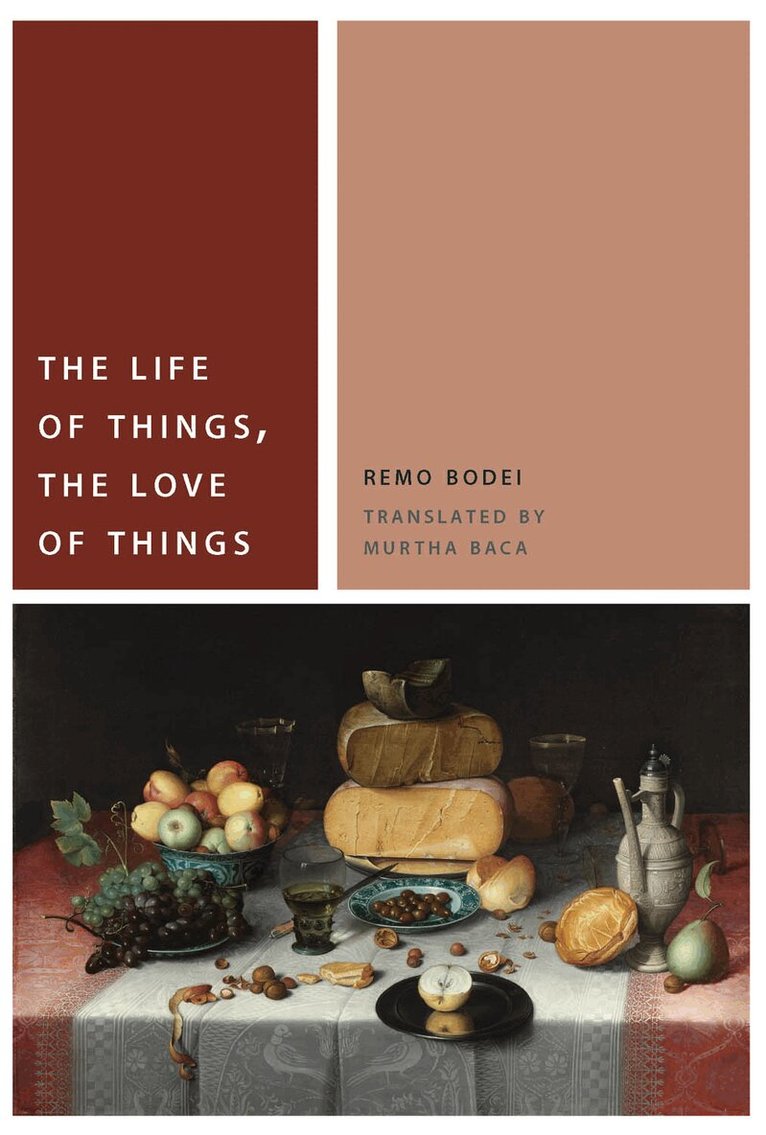
From prehistoric stone tools, to machines, to computers, things have traveled a long road along with human beings. Changing with the times, places, and methods of their production, emerging from diverse histories, and enveloped in multiple layers of meaning, things embody ideas, emotions, and symbols of which we are often unaware.The meaning of "thing" is richer than that of "object," which is something that is manipulated with indifference or according to impersonal technical procedures.Things also differ from merchandise, objects that can be sold or exchanged or seen as status symbols. Things, in the philosophical sense, are nodes of relationships with the life of others, chains of continuity among generations, bridges that connect individual and collective histories, junctions between human civilizations and nature.Things incite us to listen to reality, to make them part of ourselves, giving fresh life to an otherwise suffocating interiority. Things also reveal the hidden aspect of a "subject" in its most secret and least explored side. Things are the repositories of ideas, emotions, and symbols whose meaning we often do not understand.In an unexpected but coherent journey that includes the visions of classic philosophers from Aristotle to Husserl and from Hegel to Heidegger, along with the analysis of works of art, Bodei addresses issues such as fetishism, the memory of things, the emergence of department stores, consumerism, nostalgia for the past, the self-portraits of Rembrandt and Dutch still-lifes of the seventeenth century. The more we are able to recover objects in their wealth of meanings and integrate them into our mental and emotional horizons, he argues, the broader and deeper our world becomes.
Häftad, Engelska, 2019
367 kr
Skickas
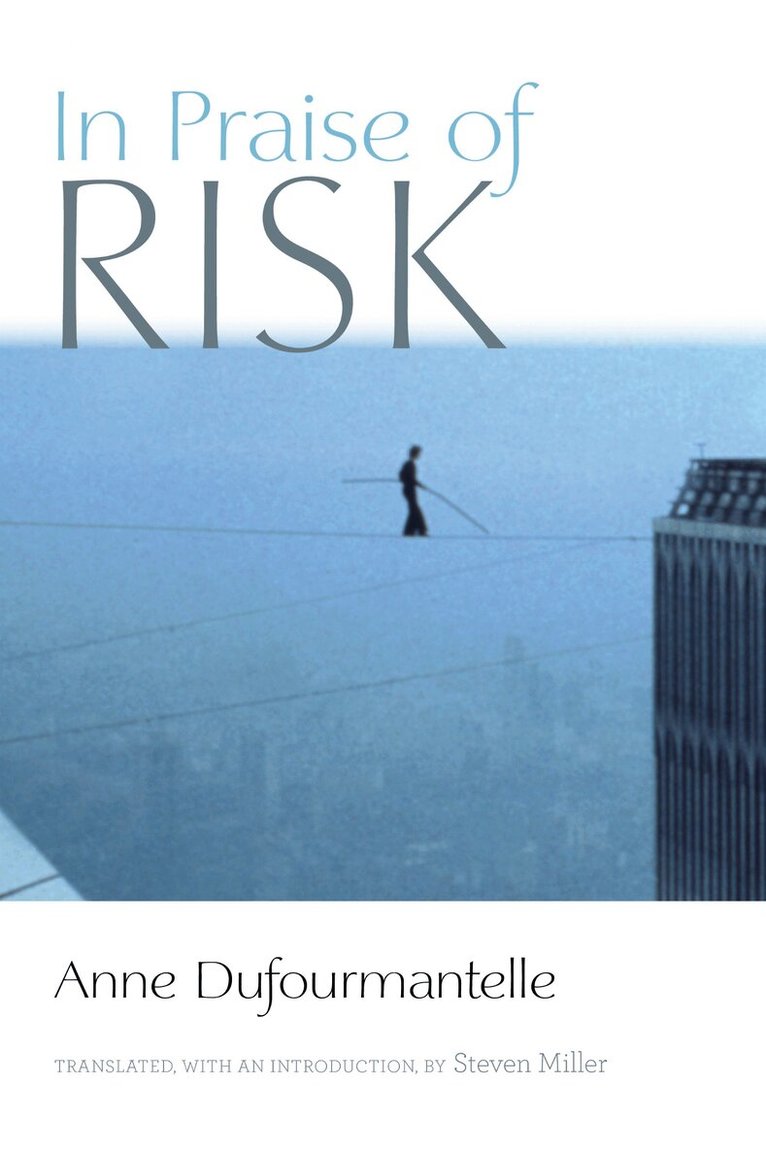
When Anne Dufourmantelle drowned in a heroic attempt to save two children caught in rough seas, obituaries around the world rarely failed to recall that she was the author of a book entitled In Praise of Risk, implying that her death confirmed the ancient adage that to philosophize is to learn how to die. Now available in English, this magnificent and already much-discussed book indeed offers a trenchant critique of the psychic work the modern world devotes to avoiding risk.Yet this is not a book on how to die but on how to live. For Dufourmantelle, risk entails an encounter not with an external threat to life but with something hidden in life that conditions our approach to such ordinary risks as disobedience, passion, addiction, leaving family, and solitudeKeeping jargon to a minimum, Dufourmantelle weaves philosophical reflections together with clinical case histories. The everyday fears, traumas, and resistances that therapy addresses brush up against such broader concerns as terrorism, insurance, addiction, artistic creation, and political revolution. Taking up a project than joins the work of many French thinkers, such as Jacques Lacan, Jacques Derrida, Jean-Luc Nancy, Hélène Cixous, Giorgio Agamben, and Catherine Malabou, Dufourmantelle works to dislodge Western philosophy, psychoanalysis, ethics, and politics from the redemptive logic of sacrifice. She discovers the kernel of a future beyond annihilation where one might least expect to find it, hidden in the unconscious.In an era defined by enhanced security measures, border walls, trigger warnings, and endless litigation, Dufourmantelle's masterwork provides a much-needed celebration of the risks that define what it means to live.
Häftad, Engelska, 2017
423 kr
Skickas inom 10-15 vardagar
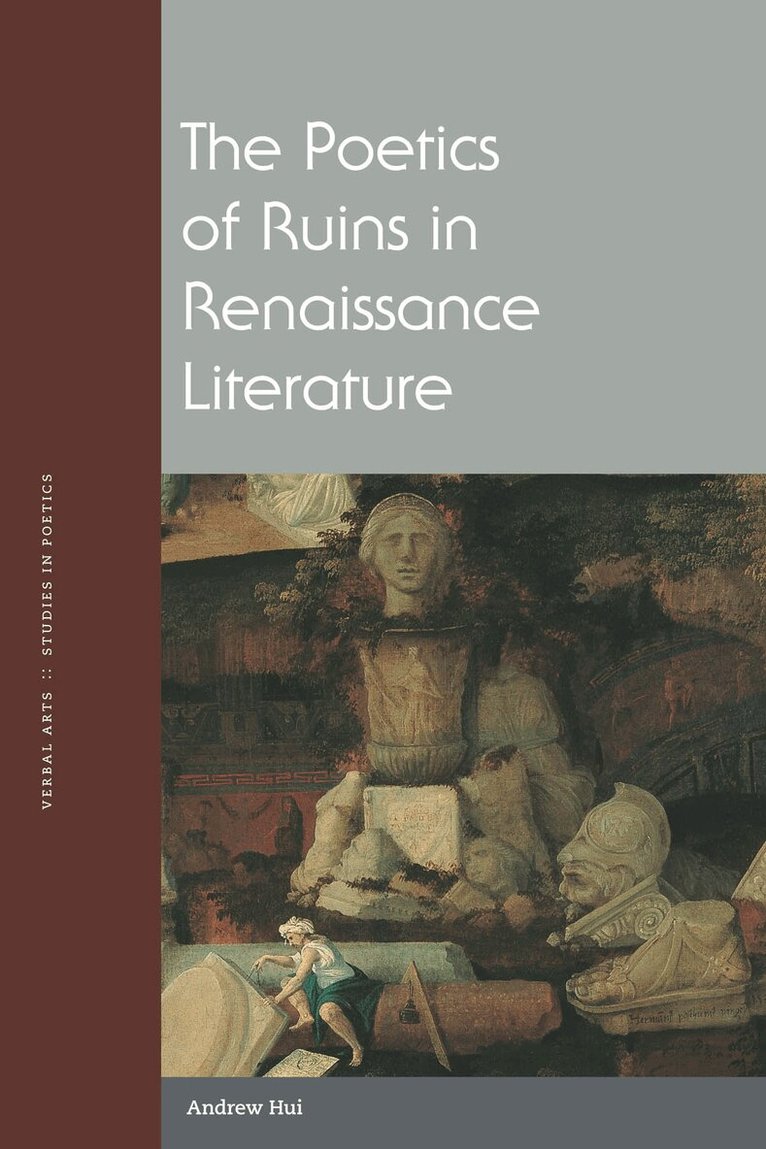
The Renaissance was the Ruin-naissance, the birth of the ruin as a distinct category of cultural discourse, one that inspired voluminous poetic production. For humanists, the ruin became the material sign that marked the rupture between themselves and classical antiquity. In the first full-length book to document this cultural phenomenon, Andrew Hui explains how the invention of the ruin propelled poets into creating works that were self-aware of their absorption of the past as well as their own survival in the future.
Häftad, Engelska, 2015
406 kr
Skickas inom 11-20 vardagar
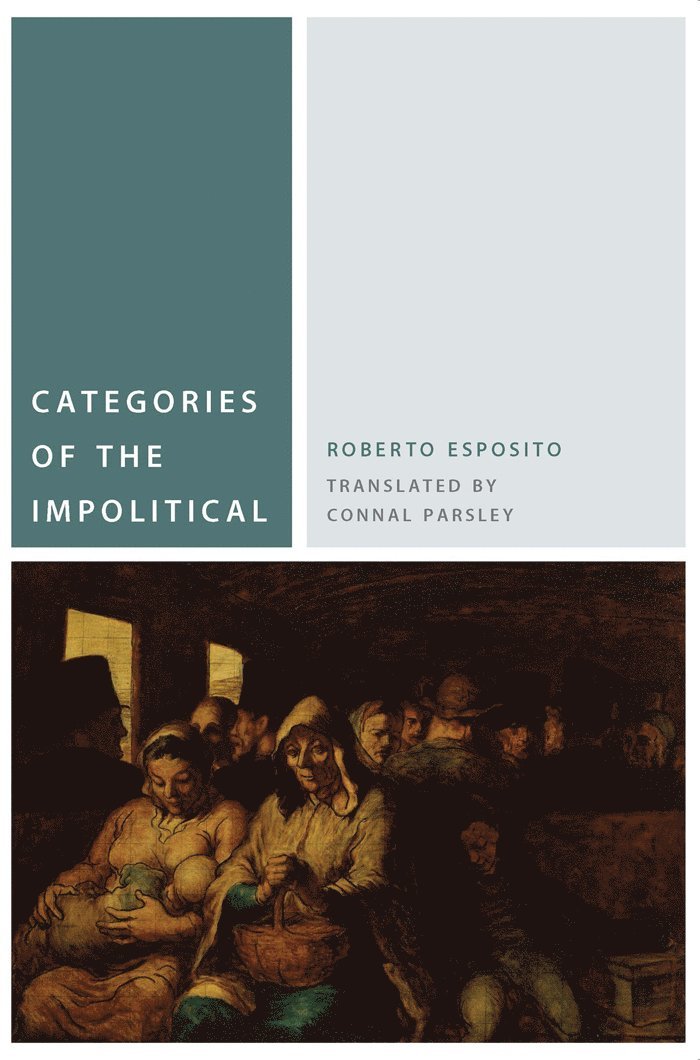
The notion of the "impolitical" developed in this volume draws its meaning from the exhaustion of modernity's political categories, which have become incapable of giving voice to any genuinely radical perspective. The impolitical is not the opposite of the political but rather its outer limit: the border from which we might glimpse a trajectory away from all forms of political theology and the depoliticizing tendencies of a completed modernity.The book's reconstruction of the impolitical lineage—which is anything but uniform—begins with the extreme conclusions reached by Carl Schmitt and Romano Guardini in their reflections on the political and then moves through a series of encounters between several great twentieth-century texts: from Hannah Arendt's On Revolution to Hermann Broch's The Death of Virgil, to Elias Canetti's Crowds and Power; from Simone Weil's The Need for Roots to Georges Bataille's Sovereignty to Ernst Junger's An der Zeitmauer.The trail forged by this analysis offers a defiant counterpoint to the modern political lexicon, but at the same time a contribution to our understanding of its categories.
Häftad, Engelska, 2011
340 kr
Skickas inom 10-15 vardagar
The Animal Side is a manifesto on the importance of animals for human thought. It attempts to characterize the importance, for human beings, of the fact that animals exist. Adopting a philosophical and poetic approach, the book seeks to show that animals' ways of inhabiting the earth are, for human consciousness, an expansion and an exploration of what philosophers and poets have tried to name by speaking of the Open.Beginning with the story of an encounter with a deer on a road at night, the book proceeds by showing that, beyond the diversity of animal life and the ways animals differ from human beings, there is a "layer of the perceptible" on which we all draw, humans and animals alike, in our own ways. At present, however, this layer itself is at risk. Thus the book can also be read as a defense and illustration of animals' modes ofbeing, and as a plea for their survival.
Häftad, Engelska, 2011
947 kr
Skickas inom 3-6 vardagar
From rumors about gnostic orgies in antiquity to the explicit erotic symbolism of alchemical texts, from the subtly coded eroticism of medieval kabbalah to the sexual magic practiced by contemporary occultists and countercultural translations of Asian Tantra, the history of Western esotericism is rich in references to the domains of eros and sexuality. This volume, which brings together an impressive array of top-level specialists, is the first to analyze the eroticism of the esoteric without sensationalism or cheap generalizations, but on the basis of expert scholarship and attention to textual and historical detail. While there are few domains where the imagination may so easily run wild, the various contributions seek to distinguish fact from fiction—only to find that historical realities are sometimes even stranger than the fantasies. In doing so, they reveal the outlines of a largely unknown history spanning more than twenty centuries.
Häftad, Engelska, 2021
407 kr
Winner, Alan Bray Memorial Book Award2022 Lammy Finalist, LGBTQ StudiesCan queer theory be erotophobic? This book proceeds from the perplexing observation that for all of its political agita, rhetorical virtuosity, and intellectual restlessness, queer theory conforms to a model of erotic life that is psychologically conservative and narrow. Even after several decades of combative, dazzling, irreverent queer critical thought, the field remains far from grasping that sexuality's radical potential lies in its being understood as "exogenous, intersubjective and intrusive" (Laplanche). In particular, and despite the pervasiveness and popularity of recent calls to deconstruct the ideological foundations of contemporary queer thought, no study has as yet considered or in any way investigated the singular role of psychology in shaping the field's conceptual impasses and politico-ethical limitations.Through close readings of key thinkers in queer theoretical thought—Eve Kosofsky Sedgwick, Leo Bersani, Lee Edelman, Judith Butler, Lauren Berlant, and Jane Gallop—Homo Psyche introduces metapsychology as a new dimension of analysis vis-à-vis the theories of French psychoanalyst Jean Laplanche, who insisted on "new foundations for psychoanalysis" that radically departed from existing Freudian and Lacanian models of the mind. Staging this intervention, Ashtor deepens current debates about the future of queer studies by demonstrating how the field's systematic neglect of metapsychology as a necessary and independent realm of ideology ultimately enforces the complicity of queer studies with psychological conventions that are fundamentally erotophobic and therefore inimical to queer theory's radical and ethical project.
Häftad, Engelska, 2015
439 kr
Skickas inom 10-15 vardagar
The debate on "political theology" that ran throughout the twentieth century has reached its end, but the ultimate meaning of the notion continues to evade us. Despite all the attempts to resolve the issue, we still speak its language—we remain in its horizon.The reason for this, says Roberto Esposito, lies in the fact that political theology is neither a concept nor an event; rather, it is the pivot around which the machine of Western civilization has revolved for more than 2,000 years. At its heart stands the juncture between universalism and exclusion, unity and separation: the tendency of the Two to make itself into One by subordinating one part to the domination of the other. All the philosophical and political categories that we use, starting with the Roman and Christian notion of "the person," continue to reproduce this exclusionary dispositif.To take our departure from political theology, then—the task of contemporary philosophy—we must radically revise our conceptual lexicon. Only when thought has been returned to its rightful "place"—connected to the human species as a whole rather than to individuals—will we be able to escape from the machine that hasimprisoned our lives for far too long.
Häftad, Engelska, 2019
431 kr
Skickas
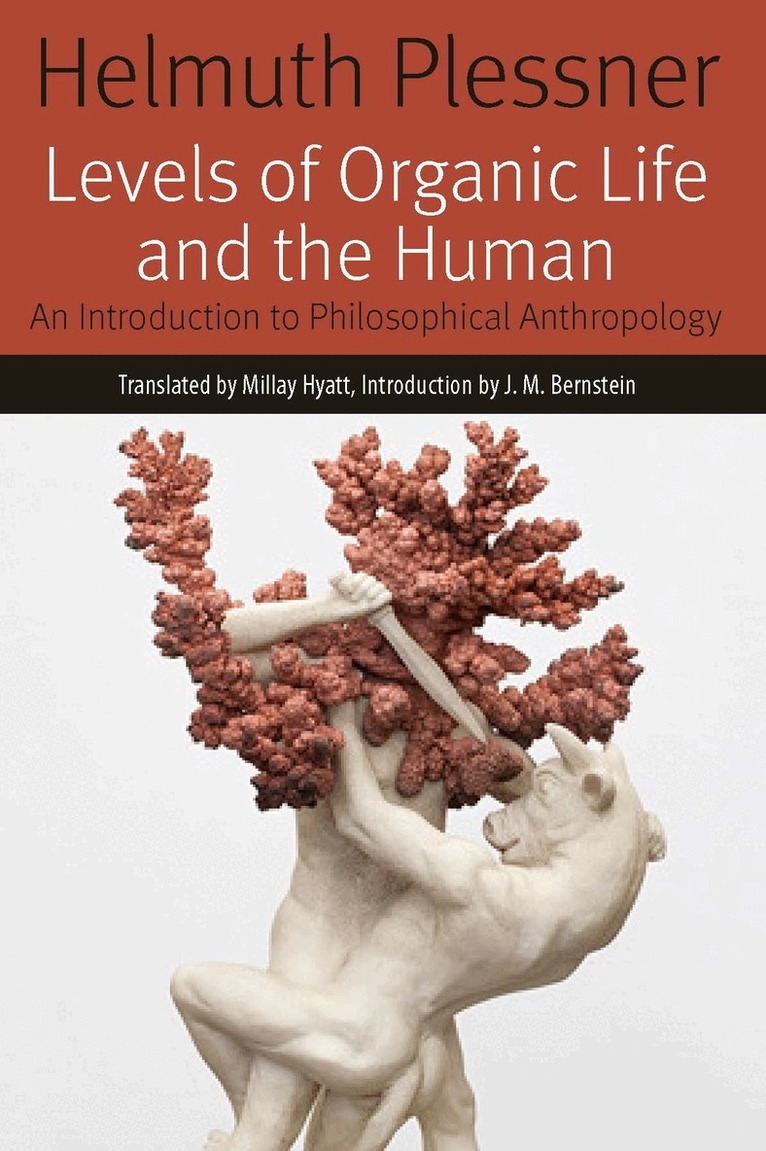
The most important work by a key figure in German thought, Helmuth Plessner's Levels of Organic Life and the Human, originally published in 1928, appears here for the first time in English, accompanied by a substantial Introduction by J. M. Bernstein, after having served for decades as an influence on thinkers as diverse as Merleau-Ponty, Peter Berger, Habermas, and the new naturalists.The Levels, as it has long been known, draws on phenomenological, biological, and social scientific sources as part of a systematic account of nature, life, and human existence. The book considers non-living nature, plants, non-human animals, and human beings in turn as a sequence of increasingly complex modes of boundary dynamics—simply put, interactions between a thing's insides and surrounding world. On Plessner's unique account, living things are classed and analyzed by their "positionality," or orientation to and within an environment. "Life" is thereby phenomenologically defined, and its universal yet internally variable features such as metabolism, reproduction, and death are explained.The approach provides a foundation not only for philosophical biology but philosophical anthropology as well. According to Plessner's radical view, the human form of life is excentric—that is, the relation between body and environment is something to which humans themselves are positioned and can take a position. This "excentric positionality" enables human beings to take a stand outside the boundaries of their own body, a possibility with significant implications for knowledge, culture, religion, and technology.Plessner studied zoology and philosophy with Hans Driesch in the 1910s before embarking on a highly productive philosophical career. His work was initially obscured by the superficially similar views of Max Scheler and Martin Heidegger and by his forced exile during World War II. Only in recent decades, as scholarship has moved more squarely into engagement with issues like animality, embodiment, human dignity, social theory, the philosophy of technology, and the philosophy of nature, has the originality and depth of Plessner's vision been appreciated.A powerful and sophisticated account of embodiment, the Levels shows, with reference both to science and to philosophy, how life can be seen on its own terms to establish its own boundaries, and how, from the standpoint of life, the human establishes itself in relation to the nonhuman. As such, the book is not merely a historical monument but a source for invigorating a range of vital current conversations around the animal, posthumanism, the material turn, and the biology and sociology of cognition.This modern philosophical classic, long-awaited in English translation, is a key book both historically and for today's interest in understanding philosophy and social theory together with science, without reducing the former to the latter.
Häftad, Engelska, 2016
511 kr
Tillfälligt slut
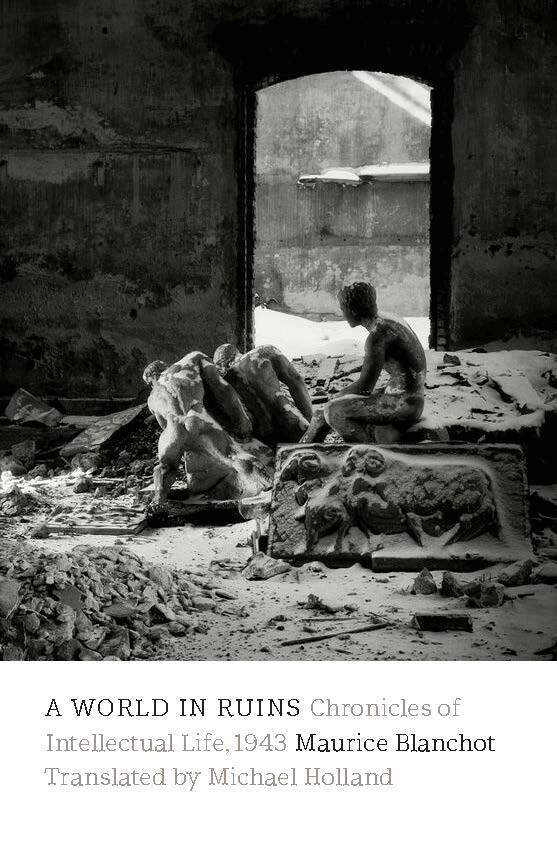
In certain key respects, 1943 marked a turning point in the war. Increasingly, victory seemed assured. However, the backdrop to this gradually improving situation was one of widespread and unremitting destruction.In the essays from that year, Blanchot writes from a position of almost total detachment from day-to-day events, now that all of his projects and involvements have come to naught. As he explores and promotes works of literature and ideas, he privileges those with the capacity to sustain a human perspective that does not merely contemplate ruin and disaster but sees them as the occasion for a radical revision of what "human" is capable of signifying.Consigning all that the name "France" has hitherto meant to him to a past that is now in ruins, Blanchot begins to sketch out a counter-history that is international in nature, and whose human field is literature.
- Nyhet
Inbunden, Engelska, 2026
361 kr
Skickas inom 3-6 vardagar
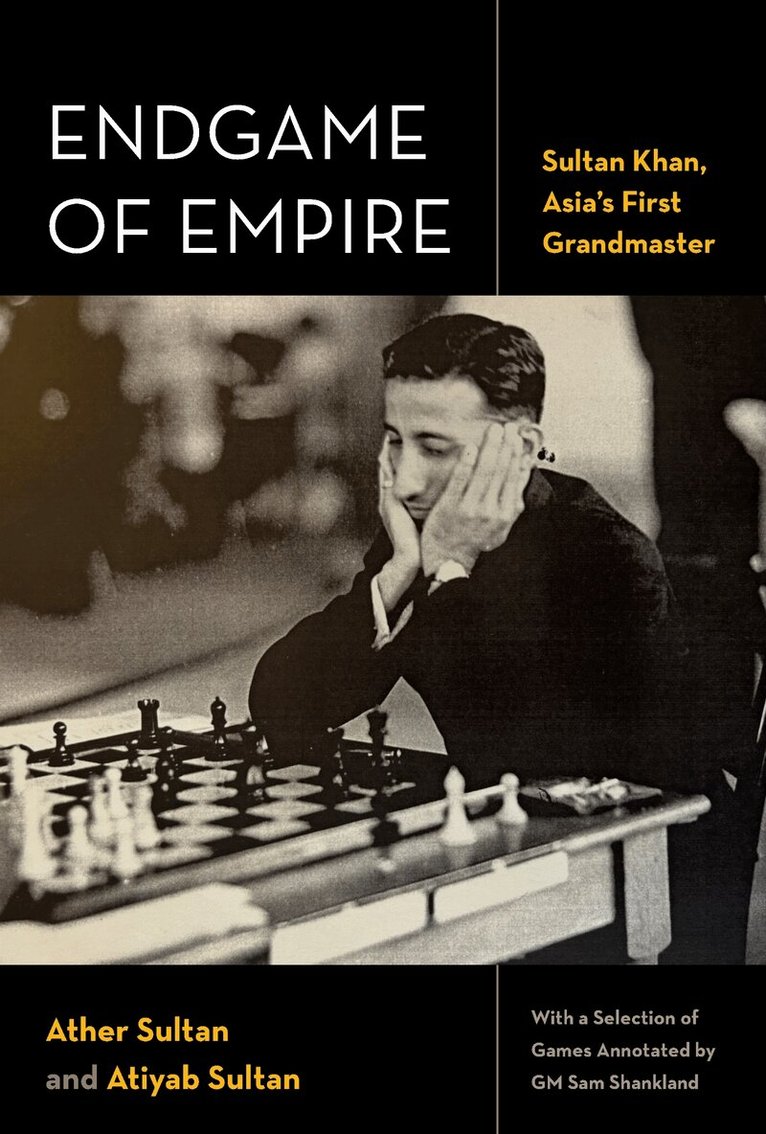
The definitive biography of a South Asian genius who conquered the international chess world on the eve of decolonizationIn the late 1920s and ’30s, the international chess scene was rocked by the success of Sultan Khan, a self-taught prodigy from colonial Punjab. In a brief international career, Khan stunned the chess elite by repeatedly defeating the world’s best players and winning the British Chess Championship three times. Despite his dazzling creativity and peerless endgame technique, Khan’s legacy has long been marginalized or inaccurately portrayed. Written by Khan’s son and granddaughter, Endgame of Empire offers a comprehensive biography of this trailblazing genius who became the first Asian and first person of color to rise to the top of international chess.From its origins in South Asia, chess had developed into an emblem of European culture. With Khan’s arrival to reclaim the game, it became a catalyst for the many ways in which individuals, ideologies, and empires clashed in the interwar period. Endgame of Empire offers a vivid portrait of Khan as he navigated challenges on and off the chessboard. His rise was meteoric, but also fraught with prejudice and ultimately cut short by the political realities of his time. Set in the broader context of race, empire, and decolonization, the book celebrates Khan’s genius as a strategist while also uncovering the difficult circumstances under which he conquered international chess. It also provides the first extended accounts of Khan’s life in colonial India before his chess career and his life after professional chess in the Pakistan whose arrival he had long desired.In an appendix, former US Chess Champion Sam Shankland walks the reader through six of Khan’s finest victories. This instructive commentary provides both an account of Khan’s style and a lesson for beginning and experienced chess players alike in the strategic ideas at which Khan was ahead of his time.At a moment of emergent nationalism in South Asia, Khan’s unassuming brilliance on the chessboard came to represent something greater: a graceful assertion of equality and a prelude to independence. Blending intimate family recollections, archival discoveries, and sharp historical analysis, Endgame of Empire reclaims a legacy long overshadowed by race, empire, and myth and offers a playbook in holding one’s own through adversity.
Inbunden, Engelska, 2024
1 299 kr
Skickas inom 10-15 vardagar
A collection of essays that outline the recent work on ecology, political theology, religion, and philosophy by one of the leading theologians of our ageAs we face relentless ecological destruction spiraling around a planet of unconstrained capitalism and democratic failure, what matters most? How do we get our bearings and direct our priorities in such a terrestrial scenario? Species, race, sex, politics, and economics will increasingly come tangled in the catastrophic trajectory of climate change. With a sense of urgency and of possibility, Catherine Keller's No Matter What reflects multiple trajectories of planetary crisis. They converge from a point of view formed of the political ecologies of a transdisciplinary theological pluralism. In its work an ancient symbolism of apocalypse deconstructs end-of-the-world narratives, Christian and secular, even as any notion of an all-controlling and good God collapses under the force of internal contradiction. In the place of a once-for-all incarnation, the materiality of unbounded intercarnation, of fragile yet animating relations of mattering earth-bodies, comes into focus.The essays of No Matter What share the preoccupation with matter characteristic of the so-called new materialism. They also root in an older ecotheological tradition, one that has long struggled against the undead legacy of an earth-betraying theology that, with the aid of its white Christian right wing, invests the denigration of matter, its spirit of "no matter," in limitless commodification. The fragile alternative Keller outlines here embraces—no matter what—the mattering of the life of the Earth and of all its spirited bodies. These essays, struggling against Christian and secular betrayals of the spirited matter of Earth, work to materialize the still possible planetary healing.
Inbunden, Engelska, 2007
1 213 kr
Skickas inom 5-8 vardagar
What does theology have to say about the place of eroticism in the salvific transformation of men and women, even of the cosmos itself? How, in turn, does eros infuse theological practice and transfigure doctrinal tropes? Avoiding the well-worn path of sexual moralizing while also departing decisively from Anders Nygren's influential insistence that Christian agape must have nothing to do with worldly eros, this book explores what is still largely uncharted territory in the realm of theological erotics. The ascetic, the mystical, the seductive, the ecstatic—these are the places where the divine and the erotic may be seen to converge and love and desire to commingle.Inviting and performing a mutual seduction of disciplines, the volume brings philosophers, historians, biblical scholars, and theologians into a spirited conversation that traverses the limits of conventional orthodoxies, whether doctrinal or disciplinary. It seeks new openings for the emergence of desire, love, and pleasure, while challenging common understandings of these terms. It engages risk at the point where the hope for salvation paradoxically endangers the safety of subjects—in particular, of theological subjects—by opening them to those transgressions of eros in which boundaries, once exceeded, become places of emerging possibility.The eighteen chapters, arranged in thematic clusters, move fluidly among and between premodern and postmodern textual traditions—from Plato to Emerson, Augustine to Kristeva, Mechthild to Mattoso, the Shulammite to Molly Bloom, the Zohar to the Da Vinci Code. In so doing, they link the sublime reaches of theory with the gritty realities of politics, the boundless transcendence of God with the poignant transience of materiality.
Inbunden, Engelska, 2007
1 341 kr
Skickas inom 10-15 vardagar
We hope—even as we doubt—that the environmental crisis can be controlled. Public awareness of our species' self-destructiveness as material beings in a material world is growing—but so is the destructiveness. The practical interventions needed for saving and restoring the earth will require a collective shift of such magnitude as to take on a spiritual and religious intensity.This transformation has in part already begun. Traditions of ecological theology and ecologically aware religious practice have been preparing the way for decades. Yet these traditions still remain marginal to society, academy, and church. With a fresh, transdisciplinary approach, Ecospirit probes the possibility of a green shift radical enough to permeate the ancient roots of our sensibility and the social sources of our practice. From new language for imagining the earth as a living ground to current constructions of nature in theology, science, and philosophy; from environmentalism's questioning of postmodern thought to a garden of green doctrines, rituals, and liturgies for contemporary religion, these original essays explore and expand our sense of how to proceed in the face of an ecological crisis that demands new thinking and acting. In the midst of planetary crisis, they activateimagination, humor, ritual, and hope.