Andrew Hui - Böcker
Visar alla böcker från författaren Andrew Hui. Handla med fri frakt och snabb leverans.
6 produkter
6 produkter
432 kr
Skickas inom 7-10 vardagar
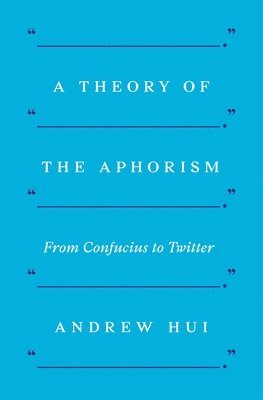
An engaging look at the aphorism, the shortest literary form, across time, languages, and culturesAphorisms—or philosophical short sayings—appear everywhere, from Confucius to Twitter, the Buddha to the Bible, Heraclitus to Nietzsche. Yet despite this ubiquity, the aphorism is the least studied literary form. What are its origins? How did it develop? How do religious or philosophical movements arise from the enigmatic sayings of charismatic leaders? And why do some of our most celebrated modern philosophers use aphoristic fragments to convey their deepest ideas? In A Theory of the Aphorism, Andrew Hui crisscrosses histories and cultures to answer these questions and more.With clarity and precision, Hui demonstrates how aphorisms—ranging from China, Greece, and biblical antiquity to the European Renaissance and nineteenth century—encompass sweeping and urgent programs of thought. Constructed as literary fragments, aphorisms open new lines of inquiry and horizons of interpretation. In this way, aphorisms have functioned as ancestors, allies, or antagonists to grand systems of philosophy.Encompassing literature, philology, and philosophy, the history of the book and the history of reading, A Theory of the Aphorism invites us to reflect anew on what it means to think deeply about this pithiest of literary forms.
233 kr
Skickas inom 7-10 vardagar
An engaging look at the aphorism, the shortest literary form, across time, languages, and culturesAphorisms—or short philosophical sayings—appear everywhere, from Confucius to Twitter, the Buddha to the Bible, Heraclitus to Nietzsche. Yet despite this ubiquity, the aphorism is the least studied literary form. What are its origins? How did it develop? Were the enigmatic sayings of charismatic sages the original “social media”? And why do some of our most celebrated modern philosophers use aphoristic fragments to convey their deepest ideas? In A Theory of the Aphorism, Andrew Hui crisscrosses histories and cultures to answer these questions and more. Encompassing literature, philology, and philosophy, A Theory of the Aphorism invites us to reflect anew on the meaning of this pithiest of literary forms.
330 kr
Skickas inom 7-10 vardagar
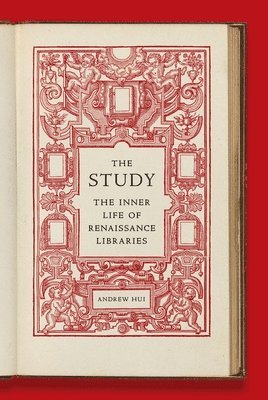
A uniquely personal account of the life and enduring legacy of the Renaissance libraryWith the advent of print in the fifteenth century, Europe’s cultural elite assembled personal libraries as refuges from persecutions and pandemics. Andrew Hui tells the remarkable story of the Renaissance studiolo—a “little studio”—and reveals how these spaces dedicated to self-cultivation became both a remedy and a poison for the soul.Blending fresh, insightful readings of literary and visual works with engaging accounts of his life as an insatiable bookworm, Hui traces how humanists from Petrarch to Machiavelli to Montaigne created their own intimate studies. He looks at imaginary libraries in Rabelais, Cervantes, Shakespeare, and Marlowe, and discusses how Renaissance painters depicted the Virgin Mary and St. Jerome as saintly bibliophiles. Yet writers of the period also saw a dark side to solitary reading. It drove Don Quixote to madness, Prospero to exile, and Faustus to perdition. Hui draws parallels with our own age of information surplus and charts the studiolo’s influence on bibliographic fabulists like Jorge Luis Borges and Umberto Eco.Beautifully illustrated, The Study is at once a celebration of bibliophilia and a critique of bibliomania. Incorporating perspectives on Islamic, Mughal, and Chinese book cultures, it offers a timely and eloquent meditation on the ways we read and misread today.
259 kr
Kommande
A study of the study—and what happens when we read too muchWith the advent of print in the fifteenth century, Europe’s cultural elite assembled personal libraries as refuges from persecutions and pandemics. Andrew Hui tells the remarkable story of the Renaissance studiolo—a “little studio”—and reveals how these spaces dedicated to self-cultivation became both a remedy and a poison for the soul.Blending fresh, insightful readings of literary and visual works with engaging accounts of his life as an insatiable bookworm, Hui traces how humanists from Petrarch to Machiavelli to Montaigne created their own intimate studies. He looks at imaginary libraries in Rabelais, Cervantes, Shakespeare, and Marlowe, and discusses how Renaissance painters depicted the Virgin Mary and St. Jerome as saintly bibliophiles. Yet writers of the period also saw a dark side to solitary reading. It drove Don Quixote to madness, Prospero to exile, and Faustus to perdition. Hui draws parallels with our own age of information surplus and charts the studiolo’s influence on bibliographic fabulists like Jorge Luis Borges and Umberto Eco.Beautifully illustrated, The Study is at once a celebration of bibliophilia and a critique of bibliomania. Incorporating perspectives on Islamic, Mughal, and Chinese book cultures, it offers a timely and eloquent meditation on the ways we read and misread today.
1 167 kr
Skickas inom 10-15 vardagar
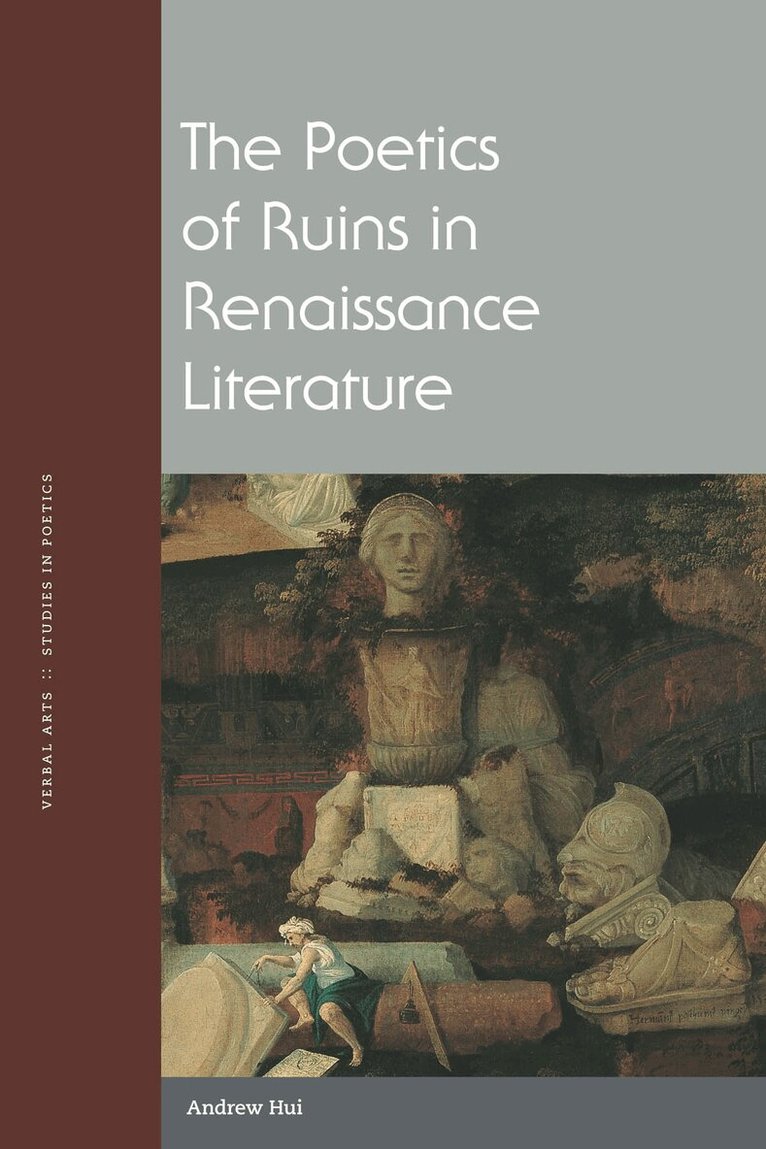
The Renaissance was the Ruin-naissance, the birth of the ruin as a distinct category of cultural discourse, one that inspired voluminous poetic production. For humanists, the ruin became the material sign that marked the rupture between themselves and classical antiquity. In the first full-length book to document this cultural phenomenon, Andrew Hui explains how the invention of the ruin propelled poets into creating works that were self-aware of their absorption of the past as well as their own survival in the future.
374 kr
Skickas inom 10-15 vardagar
The Renaissance was the Ruin-naissance, the birth of the ruin as a distinct category of cultural discourse, one that inspired voluminous poetic production. For humanists, the ruin became the material sign that marked the rupture between themselves and classical antiquity. In the first full-length book to document this cultural phenomenon, Andrew Hui explains how the invention of the ruin propelled poets into creating works that were self-aware of their absorption of the past as well as their own survival in the future.