American and European Philosophy - Böcker
Visar alla böcker i serien American and European Philosophy. Handla med fri frakt och snabb leverans.
7 produkter
7 produkter
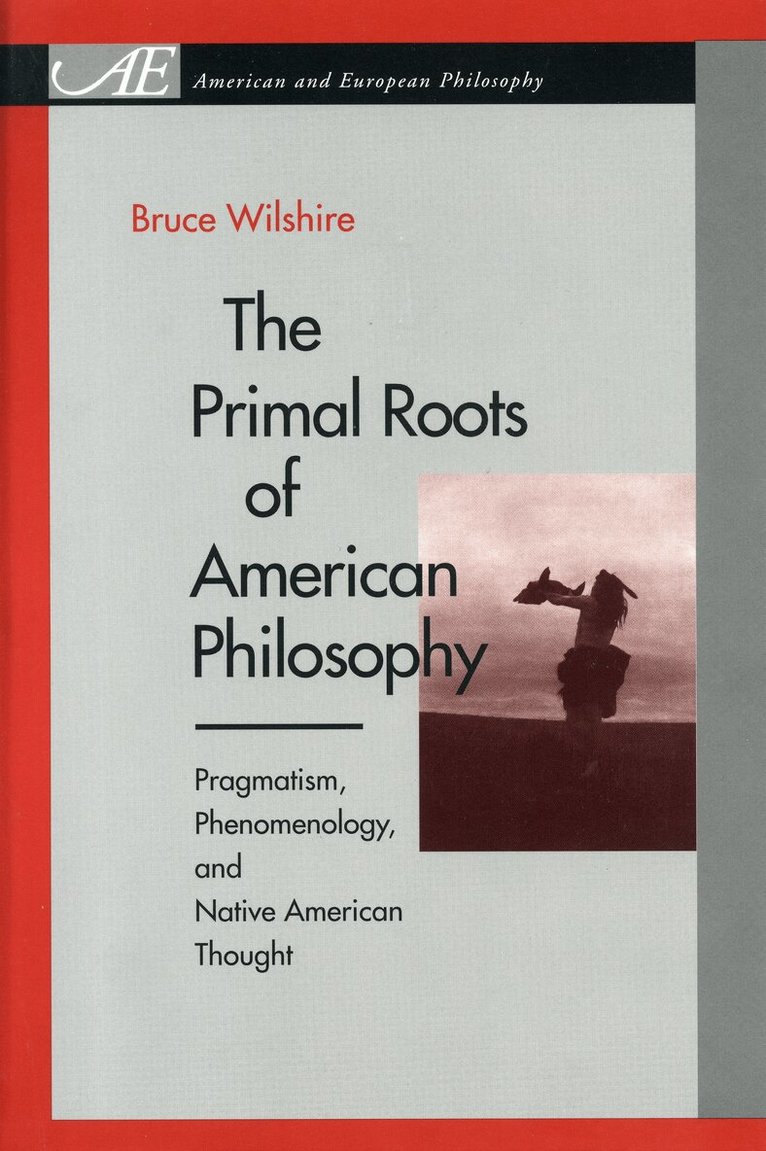
Primal Roots of American Philosophy
Pragmatism, Phenomenology, and Native American Thought
Häftad, Engelska, 2000
407 kr
Skickas inom 7-10 vardagar
Continuing his quest to bring American philosophy back to its roots, Bruce Wilshire connects the work of such thinkers as Thoreau, Emerson, Dewey, and James with Native American beliefs and practices. His search is not for exact parallels, but rather for fundamental affinities between the equally "organismic" thought systems of indigenous peoples and classic American philosophers.Wilshire gives particular emphasis to the affinities between Black Elk’s view of the hoop of the world and Emerson’s notion of horizon, and also between a shaman’s healing practices and James’s ideas of pure experience, willingness to believe, and a pluralistic universe. As these connections come into focus, the book shows how European phenomenology was inspired and influenced by the classic American philosophers, whose own work reveals the inspiration and influence of indigenous thought.Wilshire’s book also reveals how artificial are the walls that separate the sciences and the humanities in academia, and that separate Continental from Anglo-American thought within the single discipline of philosophy.
502 kr
Skickas inom 5-8 vardagar
As the only full-length treatment in English of spatiality in Martin Heidegger’s work, this book makes an important contribution to Heidegger studies as well as to research on the history of philosophy. More generally, it advances our understanding of philosophy in terms of its "exilic" character, a sense of alterity that becomes apparent when one fully engages the temporality or finitude essential to conceptual determinations.By focusing on Heidegger’s treatment of the classical difficulty of giving conceptual articulation to spatiality, the author discusses how Heidegger’s thought is caught up in and enacts the temporality it uncovers in Being and Time and in his later writings. Ultimately, when understood in this manner, thought is an "exilic" experience—a determination of being that in each case comes to pass in a loss of first principles and origins and, simultaneously, as an opening to conceptual figurations yet to come. The discussion engages such main historical figures as Plato, Aristotle, Descartes, Kant, and indirectly Husserl, as well as contemporary European and American Continental thought.
502 kr
Skickas inom 5-8 vardagar
Making sense of the world around us is a process involving both semiotic and material mediation—the use of signs and sign systems (preeminently language) and various kinds of tools (technics). As we use them, we experience them subjectively as extensions of our bodily selves and objectively as instruments for accessing the world with which we interact. Emphasizing this bipolar nature of language and technics, understood as intertwined "forms of sense," Robert Innis studies the multiple ways in which they are rooted in and transform human perceptual structures in both their individual and social dimensions. The book foregrounds and is organized around the notion of "semiotic embodiment." Language and technics are viewed as "probes" upon which we rely, in which we are embodied, and that themselves embody and structure our primary modes of encountering the world. While making an important substantive contribution to present debates about the "biasing" of perception by language and technics, Innis also seeks to provide a methodological model of how complementary analytical resources from American pragmatist and various European traditions can be deployed fruitfully in the pursuit of new insights into the phenomenon of meaning-making.
Purest of Bastards
Works of Mourning, Art, and Affirmation in the Thought of Jacques Derrida
Häftad, Engelska, 2000
432 kr
Skickas inom 5-8 vardagar
The “deconstruction” that is commonly seen to be the method of Derrida’s philosophy has an inescapably negative connotation. To counter this view of Derrida’s thought as basically destructive, David Farrell Krell invites readers to understand how it may instead be seen as fundamentally affirmative—just as Nietzsche’s philosophy, so allegedly nihilistic, is at heart a call for tragic affirmation, in amor fati. But, while affirmative, Derrida is also engaged in a thinking of mourning, which he views as the promise of memory—a fragile yet vital promise that binds past and future. The book explores what mourning means in Derrida’s writing and how the labors of mourning and affirmation are mediated by works of art. Thus the book engages many different areas of Derrida’s work, from the classic texts of deconstruction to the more recent meditations on art and mourning."This chance [affirmation without issue] can come to us only from you, do you hear me? Do you understand me? . . . And me, the purest of bastards, leaving bastards of all kinds just about everywhere.” This passage from Derrida’s La Carte postale nicely encapsulates what David Farrell Krell wants to convey about Derrida’s thought—its astonishing mix of negativity and affirmation in his labors of mourning.
577 kr
Skickas inom 5-8 vardagar
Some poems can change our lives; they lead us to look at the world through new eyes. In this book, inspired by Martin Heidegger—who found in poetry the most fundamental insights into the human condition—John Lysaker develops a concept of ur-poetry to explore philosophically how poetic language creates fresh meaning in our world and transforms the way in which we choose to live in it. Not limited to a single poem or collection of poems, ur-poetry arises when, in the interaction of an author's principal tropes, the origin of poetry is exposed as a process whereby words with inherited meaning take on a new poetic life that draws our attention to the "birth of sense"—the manner in which the manifold realities that surround us are revealed. And it is precisely through an experience of the birth of sense that we are able to understand and dwell differently among these realities. To demonstrate ur-poetry in action, the book frequently refers to such poets as Akhmatova, Ammons, Celan, Mandelstam, and Stevens, but it focuses on the work of Pulitzer Prize winner Charles Simic. By addressing the nature of human existence, the origins of sense, and the significance of history in and for human action, Lysaker argues that Simic's writing exemplifies the import that poetry can have for how we understand and live our lives.
484 kr
Skickas inom 5-8 vardagar
This book offers a radically new interpretation of the entire philosophy of J. G. Fichte by showing the impact of nineteenth-century psychological techniques and technologies on the formation of his theory of the imagination—the very centerpiece of his philosophical system. By situating Fichte’s philosophy within the context of nineteenth-century German science and culture, the book establishes a new genealogy, one that shows the extent to which German idealism’s transcendental account of the social remains dependent upon the scientific origins of psychoanalysis in the material techniques of Mesmerism. The book makes it clear that the rational, transcendental account of spirit, imagination, and the social has its source in the psychological phenomena of affective rapport. Specifically, the imagination undergoes a double displacement in which it is ultimately subject to external influence, the influence of a material technique, or, in short, a technology.
Del 7 - American and European Philosophy
John Dewey and the Artful Life
Pragmatism, Aesthetics, and Morality
Häftad, Engelska, 2011
572 kr
Skickas inom 5-8 vardagar
Aesthetic experience has had a long and contentious history in the Western intellectual tradition. Following Kant and Hegel, a human’s interaction with nature or art frequently has been conceptualized as separate from issues of practical activity or moral value. This book examines how art can be seen as a way of moral cultivation. Scott Stroud uses the thought of the American pragmatist John Dewey to argue that art and the aesthetic have a close connection to morality. Dewey gives us a way to reconceptualize our ideas of ends, means, and experience so as to locate the moral value of aesthetic experience in the experience of absorption itself, as well as in the experience of reflective attention evoked by an art object.