Cognition and Poetics - Böcker
Visar alla böcker i serien Cognition and Poetics. Handla med fri frakt och snabb leverans.
14 produkter
14 produkter
1 606 kr
Skickas inom 7-10 vardagar
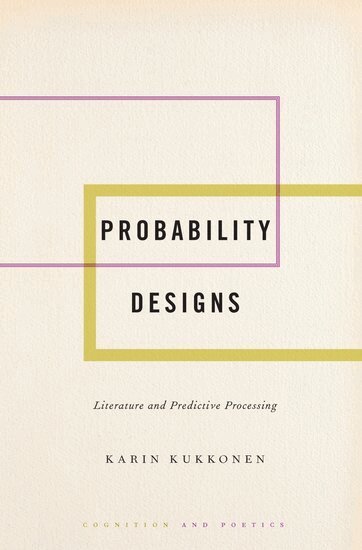
In Probability Designs, Karin Kukkonen proposes a new perspective on the complex role of predictions and probabilities in the dynamics of literary narrative. Predictive processing, an emerging account of cognition in neuroscience, psychology, and philosophy, provides the theoretical backdrop for an investigation of how literary texts shape readers' expectations and experience. Through deft analysis of the literary canon in a variety of cultures and languages, she constructs a comprehensive model of probability in a novel's plots, immersive appeal, and potential for reflection. Linking predictive processing to the idea that culture and cognition always develop in tandem, Kukkonen then sketches a place for literature and literary form in this exchange - a mode of exploratory thinking that takes language and writing to the next level.Chance encounters, last-minute rescues, and coincidences launch Kukkonen's investigation of the literary manipulation of predictions. Through an enlightening blend of cognitive sciences and literary theory, Probability Designs enriches scholarly debates in literary studies and sheds light on how vital literature is for human thought.
1 299 kr
Skickas inom 5-8 vardagar
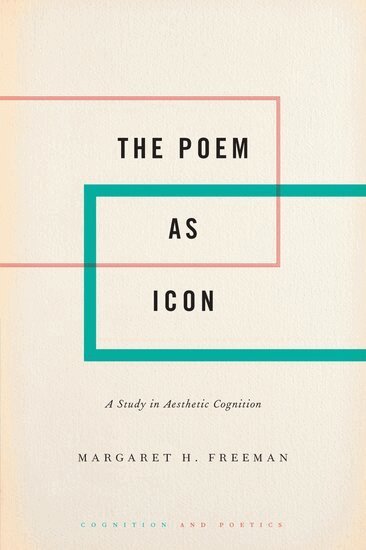
Poetry is the most complex and intricate of human language used across all languages and cultures. Its relation to the worlds of human experience has perplexed writers and readers for centuries, as has the question of evaluation and judgment: what makes a poem "work" and endure. The Poem as Icon focuses on the art of poetry to explore its nature and function: not interpretation but experience; not what poetry means but what it does. Using both historic and contemporary approaches of embodied cognition from various disciplines, Margaret Freeman argues that a poem's success lies in its ability to become an icon of the felt "being" of reality.Freeman explains how the features of semblance, metaphor, schema, and affect work to make a poem an icon, with detailed examples from various poets. By analyzing the ways poetry provides insights into the workings of human cognition, Freeman claims that taste, beauty, and pleasure in the arts are simply products of the aesthetic faculty, and not the aesthetic faculty itself. The aesthetic faculty, she argues, should be understood as the science of human perception, and therefore constitutive of the cognitive processes of attention, imagination, memory, discrimination, expertise, and judgment.
1 460 kr
Skickas inom 5-8 vardagar
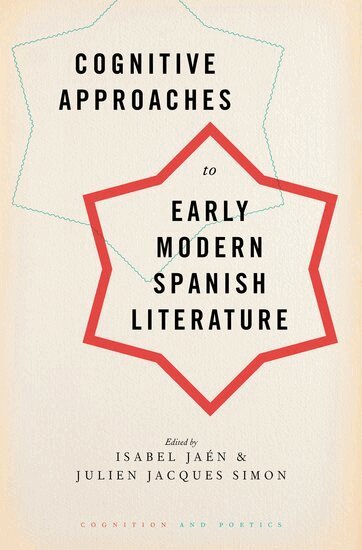
Cognitive Approaches to Early Modern Spanish Literature is the first anthology exploring human cognition and literature in the context of early modern Spanish culture. It includes the leading voices in the field, along with the main themes and directions that this important area of study has been producing. The book begins with an overview of the cognitive literary studies research that has been taking place within early modern Spanish studies over the last fifteen years. Next, it traces the creation of self in the context of the novel, focusing on Cervantes's Don Quixote in relation to the notions of embodiment and autopoiesis as well as the faculties of memory and imagination as understood in early modernity. It continues to explore the concept of embodiment, showing its relevance to delve into the mechanics of the interaction between actors and audience both in the jongleuresque and the comedia traditions. It then centers on cognitive theories of perception, the psychology of immersion in fictional worlds, and early modern and modern-day notions of intentionality to discuss the role of perceiving and understanding others in performance, Don Quixote, and courtly conduct manuals. The last section focuses on the affective dimension of audience-performer interactions in the theatrical space of the Spanish corrales and how emotion and empathy can inform new approaches to presenting Las Casas's work in the literature classroom. The volume closes with an afterword offering strategies to design a course on mind and literature in early modernity.
1 600 kr
Skickas inom 5-8 vardagar
Expressive Minds and Artistic Creations: Studies in Cognitive Poetics presents multidisciplinary and interdisciplinary research papers describing new developments in the field of cognitive poetics. The articles examine the complex connections between cognition and poetics with special attention given to how people both create and interpret novel artistic works in a variety of expressive media, including literature, music, art, and multimodal artifacts. The authors have diverse disciplinary backgrounds, but all of them embrace theories and research findings from multiple perspectives, such as linguistics, psychology, literary studies, music, art, neuroscience, and media studies. Several authors explicitly discuss empirical and theoretical challenges in doing interdisciplinary work, which is often considered as essential to future progress in cognitive poetics. Scholars address many specific research questions in their articles, including most notably, the role of embodiment and simulation in human imagination, the importance of conceptual metaphors and conceptual blending processes in the creation and interpretation of literature, and the function of multiperspectivity in poetic and multimodal texts. Several new ideas are also advanced in the volume regarding the cognitive mechanisms responsible for artistic creations and understandings. The volume overall offers an expanded view of cognitive poetics research which situates the study of expressive minds within a broader range of personal, social, cultural and historical contexts. Among other leading researchers, many contributors are world-famous scholars of psychology, linguistics, and literature, including Raymond W. Gibbs, Jr., Zoltán Kövecses, and Reuven Tsur, whose defining papers also survey the roles and significance of conceptual mechanisms in literature.
1 259 kr
Skickas inom 5-8 vardagar
This book brings together researchers with cognitive-scientific and literary backgrounds to present innovative research in all three variations on the possible interactions between literary studies and cognitive science. The tripartite structure of the volume reflects a more ambitious conception of what cognitive approaches to literature are and could be than is usually encountered, and thus aims both to map out and to advance the field. The first section corresponds to what most people think of as "cognitive poetics" or "cognitive literary studies": the study of literature by literary scholars drawing on cognitive-scientific methods, findings, and/or debates to yield insights into literature. The second section demonstrates that literary scholars needn't only make use of cognitive science to study literature, but can also, in a reciprocally interdisciplinary manner, use a cognitively informed perspective on literature to offer benefits back to the cognitive sciences. Finally, the third section, "literature in cognitive science", showcases some of the ways in which literature can be a stimulating object of study and a fertile testing ground for theories and models, not only to literary scholars but also to cognitive scientists, who here engage with some key questions in cognitive literary studies with the benefit of their in-depth scientific knowledge and training.
1 760 kr
Skickas inom 5-8 vardagar
Poetic Conventions as Cognitive Fossils offers a major theoretical statement of where poetic conventions come from. The work comprises Reuven Tsur's research in cognitive poetics to show how conventional poetic styles originate from cognitive rather than cultural principles. The book contrasts two approaches to cultural conventions in general, and poetic conventions in particular. They include what may be called the "culture-begets-culture" or "influence-hunting" approach, and the "constraints-seeking" or "cognitive-fossils" approach here expounded. The former assumes that one may account for cultural programs by pointing out their roots in earlier cultural phenomena and provide a map of their migrations. The latter assumes that cultural programs originate in cognitive solutions to adaptation problems that have acquired the status of established practice. Both conceptions assume "repeated social transmission," but with very different implications. The former frequently ends in infinite regress; the latter assumes that in the process of repeated social transmission, cultural programs come to take forms which have a good fit to the natural constraints and capacities of the human brain. Tsur extends the principles of this analysis of cognitive origins of poetic form to the writing systems, not only of the Western world, but also to Egyptian hieroglyphs through the evolution of alphabetic writing via old Semitic writing, and Chinese and Japanese writings; to aspects of figuration in medieval and Renaissance love poetry in English and French; to the metaphysical conceit; to theories of poetic translation; to the contemporary theory of metaphor; and to slips of the tongue and the tip-of-the-tongue phenomenon, showing the workings and disruption of psycholinguistic mechanisms. Analysis extends to such varying sources as the formulae of some Mediaeval Hebrew mystic poems, and the ballad 'Edward,' illustrative of extreme 'fossilization' and the constraints of the human brain.
648 kr
Skickas inom 5-8 vardagar
Poetic Conventions as Cognitive Fossils offers a major theoretical statement of where poetic conventions come from. The work comprises Reuven Tsur's research in cognitive poetics to show how conventional poetic styles originate from cognitive rather than cultural principles. The book contrasts two approaches to cultural conventions in general, and poetic conventions in particular. They include what may be called the "culture-begets-culture" or "influence-hunting" approach, and the "constraints-seeking" or "cognitive-fossils" approach here expounded. The former assumes that one may account for cultural programs by pointing out their roots in earlier cultural phenomena and provide a map of their migrations. The latter assumes that cultural programs originate in cognitive solutions to adaptation problems that have acquired the status of established practice. Both conceptions assume "repeated social transmission," but with very different implications. The former frequently ends in infinite regress; the latter assumes that in the process of repeated social transmission, cultural programs come to take forms which have a good fit to the natural constraints and capacities of the human brain. Tsur extends the principles of this analysis of cognitive origins of poetic form to the writing systems, not only of the Western world, but also to Egyptian hieroglyphs through the evolution of alphabetic writing via old Semitic writing, and Chinese and Japanese writings; to aspects of figuration in medieval and Renaissance love poetry in English and French; to the metaphysical conceit; to theories of poetic translation; to the contemporary theory of metaphor; and to slips of the tongue and the tip-of-the-tongue phenomenon, showing the workings and disruption of psycholinguistic mechanisms. Analysis extends to such varying sources as the formulae of some Mediaeval Hebrew mystic poems, and the ballad 'Edward,' illustrative of extreme 'fossilization' and the constraints of the human brain.
1 400 kr
Skickas inom 5-8 vardagar
This study provides an introduction to the neoclassical debates around how literature is shaped in concert with the thinking and feeling human mind. Three key rules of neoclassicism, namely, poetic justice (the rewards and punishments of characters in the plot), the unities (the coherence of the fictional world and its extensions through the imagination) and decorum (the inferential connections between characters and their likely actions), are reconsidered in light of social cognition, embodied cognition and probabilistic, predictive cognition. The meeting between neoclassical criticism and today's research psychology, neurology and philosophy of mind yields a new perspective for cognitive literary study.Neoclassicism has a crucial contribution to make to current debates around the role of literature in cultural and cognition. Literary critics writing at the time of the scientific revolution developed a perspective on literature the question of how literature engages minds and bodies as its central concern. A Prehistory of Cognitive Poetics traces the cognitive dimension of these critical debates in seventeenth- and eighteenth-century Britain and puts them into conversation with today's cognitive approaches to literature.Neoclassical theory is then connected to the praxis of eighteenth-century writers in a series of case studies that trace how these principles shaped the emerging narrative form of the novel. The continuing relevance of neoclassicism also shows itself in the rise of the novel, as A Prehistory of Cognitive Poetics illustrates through examples including Pamela, Tom Jones and the Gothic novel.
1 426 kr
Skickas inom 7-10 vardagar
Does literature merely represent cognitive processes, or can it enhance, parallel, or reassess the scientific study of the mind? Beckett and the Cognitive Method argues that Samuel Beckett's narrative work, rather than just expressing or rendering mental states, inaugurates an exploratory use of narrative as an introspective modeling technology. Through a detailed analysis of Beckett's entire corpus and published volumes of letters, this book argues that Beckett pioneered a new method of writing to construct (in a mode analogous to scientific inquiry) models for the exploration of core laws, processes, and dynamics in the human mind.Marco Bernini integrates frameworks from contemporary narrative theory, cognitive sciences, phenomenology, and philosophy of mind to make a case for Beckett's modeling practice. Bernini demonstrates how this modeling applies to a vast array of processes including the (narrative) illusion of a sense of self, the dialogic interaction with memories and felt presences, the synesthetic nature of inner experience and mental imagery, the role of moods and emotions as cognitive drives, and the emergent quality of consciousness. Beckett and the Cognitive Method also reflects on how Beckett's fictional cognitive models are transformed into reading, auditory, or spectatorial experiences generating through narrative devices insights on what the sciences can only discursively report. As such, Bernini argues that literature should be considered a proper exploration of the mind, with its own tools and models for cognitive inquiry.
1 320 kr
Skickas inom 5-8 vardagar
Cognitive cultural theorists have rarely taken up sex, sexuality, or gender identity. When they have done so, they have often stressed the evolutionary sources of gender differences. In Sexual Identities, Patrick Colm Hogan extends his pioneering work on identity to examine the complexities of sex, the diversity of sexuality, and the limited scope of gender. Drawing from a diverse body of literary works, Hogan illustrates a rarely drawn distinction between practical identity (the patterns in what one does, thinks, and feels) and categorical identity (how one labels oneself or is categorized by society). Building on this distinction, he offers a nuanced reformulation of the idea of social construction, distinguishing ideology, situational determination, shallow socialization, and deep socialization. He argues for a meticulous skepticism about gender differences and a view of sexuality as evolved but also contingent and highly variable. The variability of sexuality and the near absence of gender fixity--and the imperfect alignment of practical and categorical identities in both cases--give rise to the social practices that Judith Butler refers to as "regulatory regimes." Hogan goes on to explore the cognitive and affective operation of such regimes. Ultimately, Sexual Identities turns to sex and the question of how to understand transgendering in a way that respects the dignity of transgender people, without reverting to gender essentialism.
1 440 kr
Skickas inom 5-8 vardagar
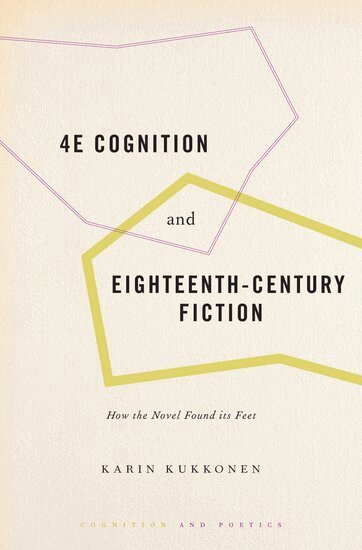
When the novel broke into cultural prominence in the eighteenth century, it became notorious for the gripping, immersive style of its narratives. In this book, Karin Kukkonen explores this phenomenon through the embodied style in Eliza Haywood's flamboyant amatory fiction, Charlotte Lennox's work as a cultural broker between Britain and France, Sarah Fielding's experimental novels, and Frances Burney's practice of life-writing and fiction-writing. Four female authors who are often written out of the history of the genre are here foregrounded in a critical account that emphasizes the importance of engaging readers' minds and bodies, and which invites us to revisit our understanding of the rise of the modern novel. Kukkonen's innovative theoretical approach is based on the approach of 4E cognition, which views thinking as profoundly embodied and embedded in social and material contexts, extending into technologies and material devices (such as a pen), and enactive in the inherent links between perceiving the world and moving around in it. 4E Cognition and Eighteenth-Century Fiction investigates the eighteenth-century novel through each of these trajectories and shows how language explores its embodied dimension by increasing the descriptions of inner perception, or the bodily gestures around spoken dialogue. The embodied dimension is then related to the media ecologies of letter-writing, book learning, and theatricality. As the novel feeds off and into these social and material contexts, it comes into its own as a lifeworld technology that might not answer to standards of nineteenth-century realism but that feels 'real' because it is integrated into the lifeworld and embodied experiences.4E cognition answers one of the central challenges to cognitive literary studies: how to integrate historical and cultural contexts into cognitive approaches.
1 317 kr
Skickas inom 5-8 vardagar
This is an open access title available under the terms of a CC BY-NC-ND 4.0 International license. It is free to read at Oxford Scholarship Online and offered as a free PDF download from OUP and selected open access locations. The triggers of laughter in spoken language or conversation can often be very simple, such as a change in gesture, or in vocal tone or tempo. Speakers and listeners understand these dynamics of gesture through motor cognition and use them to great effect. The causes of laughter and the experience of humor in written texts, however, are less well understood. In Kinesic Humor, Guillemette Bolens offers a cognitive poetics-based study of triggers of laughter in texts, focusing in particular on tonic shifts and gesture in plot and narrative. Bolens shows how literary texts from a variety of periods provide remarkably precise information concerning kinesthesia, the role of tonicity in communication, and the impact of momentum, timing, and tempo on the way in which gestures are processed in human exchanges. She investigates the narrative use of such parameters and how they prompt laughter in a wide-ranging corpus of major authors that includes Chrétien de Troyes, Cervantes, Milton, Saint-Simon, Rousseau, Sterne, and Stendhal. Using the theory of embodied cognition, Bolens shows how thwarted perceptions and expectations of movements and sensations produce the cognitive shifts typical of humor. Bringing together narratology, cognitive studies, gesture studies, humor studies, and historical context, this book offers original perspectives on important artworks and represents a major contribution to cognitive poetics. Originally published in French as L'Humour et le savoir des corps in 2016, this volume not only brings the work to an English-speaking audience for the first time but expands significantly on the original by analyzing a new corpus of texts and engaging with recent advances in the field to develop a cutting-edge theory of kinesic humor.
974 kr
Skickas inom 5-8 vardagar
Comics and Cognition develops an analytical approach to multimodal communication in comics through insights from embodied cognitive science, especially cognitive linguistics and visual psychology. Mike Borkent extends previous cognitive poetic frameworks to the study of multimodality in comics, providing a cohesive analytical framework that connects comics to other literary and artistic interests. His approach highlights the embodiment of cognition, a process which structures knowledge in long term memory, and activates it through perception, mental simulation, and blending. These cognitive processes allow readers to make impressions, predictions, inferences, and eventually conclusions about a text. Many of these layers of reader comprehension are unconscious but emerge into a conscious experience of the multimodal text with a richly construed and nuanced texture. This book unpacks the dynamic interplay between the reader and the multimodal text throughout the processes of reading, including opportunities for interaction, interrogation, and improvisation of meaning derived from the reader's embodied and textual experiences, tackling crucial features of the comics form, and their impact on such issues as viewpoint, temporality, abstraction, metacommentary, and transmediation. The proposed multimodal cognitive poetics applies to narrative and art comics, in both print and digital media.
1 440 kr
Skickas inom 5-8 vardagar
Literary style is something many people talk about, but few could define. Yet it is crucial for our response to narrative art. Style can facilitate or obscure the events of a story or the motivations of a character, enhance the aesthetic appeal of a narrative or complicate its emotional impact, and even inflect the political or ethical implications of a work. It is precisely this complex operation of style that Patrick Colm Hogan explains in Style in Narrative. Drawing on recent psychological research, this book proposes a new and clear definition of style and provides a systematic theoretical account of style in relation to cognitive and affective science. Hogan's definition stresses that style varies by both scope, or the range of text or texts that may share a style, and level, the components of an individual work that might involve a shared style. The book uses rich examples from literature, film, and graphic fiction, including analysis of Virginia Woolf's Mrs. Dalloway, Shakespeare's canon, William Faulkner's As I Lay Dying, and Art Spiegelman's Maus, as well as visual analysis of films by Robert Rodriguez, Deepa Mehta, Eric Rohmer, M.F.Husain, Yasujiro Ozu, and Chuan Lu. Through these studies Hogan identifies stylistic concerns common across mediums as well as the most consequential stylistic differences between them.Bringing together three often separated mediums within a coherent framework, Style in Narrative makes an important contribution to and necessary intervention in the field of stylistics.