Elements in The Aegean Bronze Age - Böcker
Visar alla böcker i serien Elements in The Aegean Bronze Age. Handla med fri frakt och snabb leverans.
12 produkter
12 produkter
241 kr
Skickas inom 7-10 vardagar
This Element provides an overview of Aegeomania: the fascination, sometimes bordering on the obsession, with the Aegean Bronze Age, which manifests itself in the uses of Aegean Bronze Age material culture to create something new in literature, the visual and performing arts, and many other cultural practices. It discusses the role that Aegeomania can play in our understanding of the Aegean Bronze Age and illustrates this with examples from the 1870s to the present, which include, among many others, poems by Emma Lazarus, Salvatore Quasimodo, and Giorgos Seferis; novels by Kristmann Gudmundsson, Mary Renault, Don DeLillo, Zeruya Shalev, and Sally Rooney; Freudian psychoanalysis; sculptures by Henry Moore and Pablo Picasso; music by Harrison Birtwistle and the rock band Giant Squid; films by Robert Wise and Wolfang Petersen; elegant textiles and garments created by Josef Frank and Karl Lagerfeld. This title is also available as Open Access on Cambridge Core.
241 kr
Skickas inom 7-10 vardagar
An undulating flow of multi-scalar exchanges pulsed across the surface of Aegean from the beginnings of the Bronze Age in the third millennium to the transition into the Iron Age nearly two thousand years later. Such exchanges were variable in nature. Most probably occurred within a rather circumscribed environment, involving neighboring communities operating across the many real but traversable geographical boundaries that characterize the Aegean landscape - ridges separating mountain plateaus, rocky coastal stretches between bays, or narrow straits amidst archipelagos. This Element is focused on the less-frequent but important long-distance exchanges that connected people in the Aegean with the wider Mediterranean and European world, especially focusing on interactions that may be classified as 'economic'. After reviewing basic definitions and discussing some methods and materials available for studying long-distance exchange, this Element presents a diachronic assessment of the geospatial, scalar, and structural characteristics of long-distance exchange and inter-regional economies.
241 kr
Skickas inom 7-10 vardagar
This Element focusses on the emergence of Aegean Prehistory as a discipline, starting with the first recorded encounters with prehistoric monuments and artefacts and ending with the decipherment of Linear B in 1952. It broadens the history of Aegean Bronze Age archaeology as told in popular accounts as a series of excavations of great men, particularly Heinrich Schliemann at Troy and Mycenae and Sir Arthur Evans at Knossos. Though their work is of fundamental importance for the discipline, here it is placed within wider political, institutional and intellectual frameworks. This Element also provides an overview of the work of many other archaeologists across the Aegean and the regional and historical context in which they operated. It provides a brief but comprehensive history of the formative stages of the study of Aegean Prehistory.
775 kr
Skickas inom 7-10 vardagar
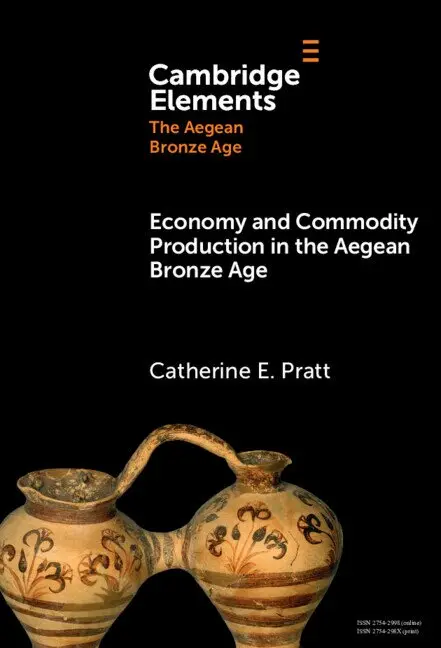
This Element does not discuss every aspect of the economy. Rather, it focuses on the first stage of an economic cycle − that of production. Two of the major guiding questions are: What products were the Bronze Age palatial states concerned with producing in surplus? And how did the palatial states control the production of these essential commodities? To answer these questions, the Element synthesizes previous work while interspersing its own conclusions on certain sub-topics, especially in light of recent archaeological data that help to fill out a picture incomplete based on textual evidence alone. With these goals in mind, this Element brings together both textual and archaeological data to reconstruct the internal economy and the production of commodities under the purview of Minoan and Mycenaean palatial states.
241 kr
Skickas inom 7-10 vardagar
This Element does not discuss every aspect of the economy. Rather, it focuses on the first stage of an economic cycle − that of production. Two of the major guiding questions are: What products were the Bronze Age palatial states concerned with producing in surplus? And how did the palatial states control the production of these essential commodities? To answer these questions, the Element synthesizes previous work while interspersing its own conclusions on certain sub-topics, especially in light of recent archaeological data that help to fill out a picture incomplete based on textual evidence alone. With these goals in mind, this Element brings together both textual and archaeological data to reconstruct the internal economy and the production of commodities under the purview of Minoan and Mycenaean palatial states.
241 kr
Skickas inom 7-10 vardagar
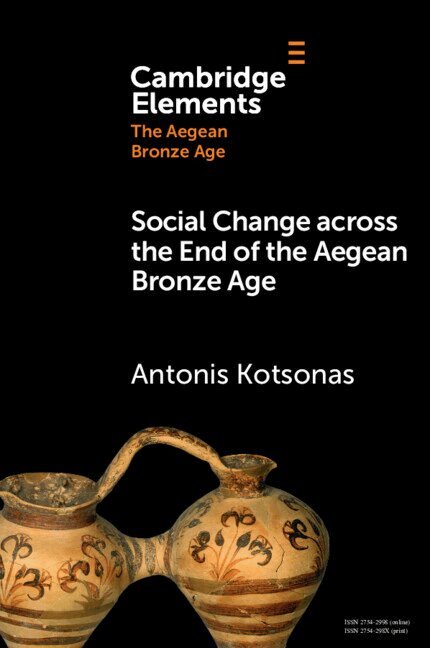
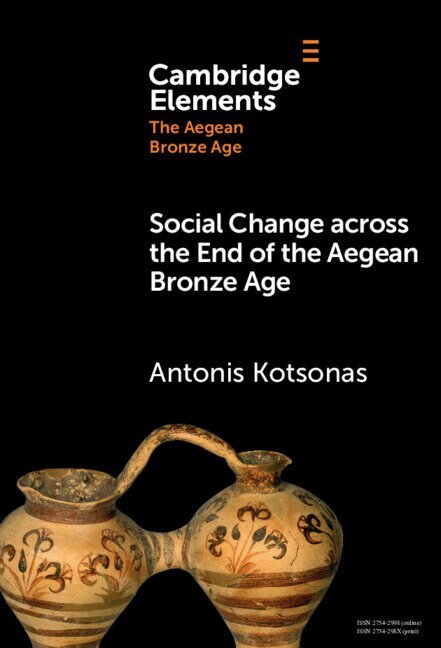
For a long time, scholarship on the end of the Aegean Bronze Age has been preoccupied with political, ethnic/racial, economic, environmental, and other change; however, it has rarely centered the discussion on social change. Drawing from anthropological and sociological critiques of social change, the Element compares the Greek archaeological record before and after the collapse of 1200 BCE, focusing on developments in the 12th to early 10th centuries, which are examined against the background of the Mycenaean palatial system of the 14th and 13th centuries. The seven sections of the Element cover the reasons for the collapse of the Mycenaean palaces; socio-political, demographic, and socio-economic change after the collapse; and the manifestation of this change in settlements, burials, and sanctuaries. The Appendix offers a discussion of the relative and absolute chronologies of the period, with emphasis on recent important but debatable suggestions for revisions.
775 kr
Skickas inom 7-10 vardagar
For a long time, scholarship on the end of the Aegean Bronze Age has been preoccupied with political, ethnic/racial, economic, environmental, and other change; however, it has rarely centered the discussion on social change. Drawing from anthropological and sociological critiques of social change, the Element compares the Greek archaeological record before and after the collapse of 1200 BCE, focusing on developments in the 12th to early 10th centuries, which are examined against the background of the Mycenaean palatial system of the 14th and 13th centuries. The seven sections of the Element cover the reasons for the collapse of the Mycenaean palaces; socio-political, demographic, and socio-economic change after the collapse; and the manifestation of this change in settlements, burials, and sanctuaries. The Appendix offers a discussion of the relative and absolute chronologies of the period, with emphasis on recent important but debatable suggestions for revisions.
720 kr
Skickas inom 7-10 vardagar
An undulating flow of multi-scalar exchanges pulsed across the surface of Aegean from the beginnings of the Bronze Age in the third millennium to the transition into the Iron Age nearly two thousand years later. Such exchanges were variable in nature. Most probably occurred within a rather circumscribed environment, involving neighboring communities operating across the many real but traversable geographical boundaries that characterize the Aegean landscape - ridges separating mountain plateaus, rocky coastal stretches between bays, or narrow straits amidst archipelagos. This Element is focused on the less-frequent but important long-distance exchanges that connected people in the Aegean with the wider Mediterranean and European world, especially focusing on interactions that may be classified as 'economic'. After reviewing basic definitions and discussing some methods and materials available for studying long-distance exchange, this Element presents a diachronic assessment of the geospatial, scalar, and structural characteristics of long-distance exchange and inter-regional economies.
775 kr
Skickas inom 7-10 vardagar
This Element provides an overview of Aegeomania: the fascination, sometimes bordering on the obsession, with the Aegean Bronze Age, which manifests itself in the uses of Aegean Bronze Age material culture to create something new in literature, the visual and performing arts, and many other cultural practices. It discusses the role that Aegeomania can play in our understanding of the Aegean Bronze Age and illustrates this with examples from the 1870s to the present, which include, among many others, poems by Emma Lazarus, Salvatore Quasimodo, and Giorgos Seferis; novels by Kristmann Gudmundsson, Mary Renault, Don DeLillo, Zeruya Shalev, and Sally Rooney; Freudian psychoanalysis; sculptures by Henry Moore and Pablo Picasso; music by Harrison Birtwistle and the rock band Giant Squid; films by Robert Wise and Wolfang Petersen; elegant textiles and garments created by Josef Frank and Karl Lagerfeld. This title is also available as Open Access on Cambridge Core.
775 kr
Skickas inom 7-10 vardagar
This Element focusses on the emergence of Aegean Prehistory as a discipline, starting with the first recorded encounters with prehistoric monuments and artefacts and ending with the decipherment of Linear B in 1952. It broadens the history of Aegean Bronze Age archaeology as told in popular accounts as a series of excavations of great men, particularly Heinrich Schliemann at Troy and Mycenae and Sir Arthur Evans at Knossos. Though their work is of fundamental importance for the discipline, here it is placed within wider political, institutional and intellectual frameworks. This Element also provides an overview of the work of many other archaeologists across the Aegean and the regional and historical context in which they operated. It provides a brief but comprehensive history of the formative stages of the study of Aegean Prehistory.
775 kr
Skickas inom 7-10 vardagar
This Element explores the textile crafts and cloth cultures of the Aegean Bronze Age, focusing on two categories of archaeological evidence: excavated textiles (or their imprints) and tools used for yarn production and weaving. Together, these types of material testimonies offer complementary perspectives on a textile history that spans 2,000 years. A gro wing body of evidence suggests that the Aegean was home to communities of skilled textile craftspeople who produced cloth ranging from plain and coarse to fine and elaborate. As regional connectivity increased throughout the Bronze Age, interactions in textile craft flourished. In time, textile production became central to the political economies that emerged in the Aegean region. The expertise of Bronze Age Aegean spinners and weavers is vividly illustrated through the material record of their tools, while even the smallest excavated cloth fragments stand as fragile, yet enduring testaments to textile craftsmanship.
241 kr
Skickas inom 7-10 vardagar
This Element explores the textile crafts and cloth cultures of the Aegean Bronze Age, focusing on two categories of archaeological evidence: excavated textiles (or their imprints) and tools used for yarn production and weaving. Together, these types of material testimonies offer complementary perspectives on a textile history that spans 2,000 years. A gro wing body of evidence suggests that the Aegean was home to communities of skilled textile craftspeople who produced cloth ranging from plain and coarse to fine and elaborate. As regional connectivity increased throughout the Bronze Age, interactions in textile craft flourished. In time, textile production became central to the political economies that emerged in the Aegean region. The expertise of Bronze Age Aegean spinners and weavers is vividly illustrated through the material record of their tools, while even the smallest excavated cloth fragments stand as fragile, yet enduring testaments to textile craftsmanship.