Greeks Overseas - Böcker
Visar alla böcker i serien Greeks Overseas. Handla med fri frakt och snabb leverans.
11 produkter
11 produkter
The Poetics of Victory in the Greek West
Epinician, Oral Tradition, and the Deinomenid Empire
Inbunden, Engelska, 2015
1 320 kr
Skickas inom 5-8 vardagar
The Poetics of Victory in the Greek West examines the relationship between epinician and the heroizing narratives about athletes, or "hero-athlete narratives, " that circulated orally in Sicily and Italy in the late archaic and early classical period. Drawing on the colorful stories told about athletes in later sources, the fragments of Simonides and the surviving odes of Pindar and Bacchylides, it argues that epinician was formed in opposition to orally transmitted narratives and that these two forms-epinician and the "hero-athlete narrative "-promoted opposed political visions, with epinician promoting the Deinomenid empire and its structures and the hero-athlete narrative opposing Deinomenid rule. Combining an intimate knowledge of the material culture of the Greek West with an innovative use of available source material, The Poetics of Victory in the Greek West exposes the rich intersections between athletics and politics in Sicily and Italy, offering a new and compelling account of Deinomenid self-promotion and of the varied and complex communities that operated under Deinomenids' control or within their shadow. Further, by establishing models of production and interpretation for the orally transmitted narratives and bringing them into dialogue with epinician, The Poetics of Victory in the Greek West reveals much about epinician as a form, how it developed in the West, what meanings it already carried and what meanings it accrued as it was appropriated by Hieron after Gelon's death.
805 kr
Skickas inom 5-8 vardagar
Greek knowledge of and interest in foreign peoples is commonly believed to have developed in conjunction with a wider sense of "Greekness" that emerged during the Hellenic encounter with Achaemenid Persia during the late sixth to early fifth centuries BC. The dramatic nature of this "clash of cultures" is widely thought to have laid the foundations for prose descriptions of foreign lands and peoples by causing previously vague imaginings to crystallize into a diametric opposition between "Hellene" and "barbarian." The Invention of Greek Ethnography challenges the legitimacy of this narrative. Drawing on recent advances in ethnographic and cultural studies and material culture-based analyses of the ancient Mediterranean, Joseph Skinner argues that ethnographic discourse was already widespread throughout the archaic Greek world long before the invention of ethnographic prose, incorporating not only texts but also a wide range of iconographic and archaeological materials. The reconstruction of this "ethnography before ethnography" demonstrates that discourses of identity played a vital role in defining what it meant to be Greek in the first place. The development of ethnographic writing and historiography is shown to be rooted in a wider process of "positioning" that was continually unfurling across time, as groups and individuals scattered across the Mediterranean world sought to locate themselves in relation to both the narratives of the past and other people. The Invention of Greek Ethnography provides a shift in critical perspective that will have significant implications for our understanding of how Greek identity came into being, the manner in which early discourses of difference should be conceptualized, and the way in which narrative history should ultimately be interpreted.
719 kr
Skickas
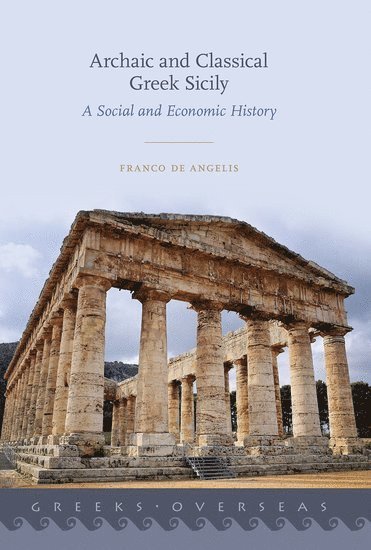
Ancient Greek migrants in Sicily produced societies and economies that both paralleled and differed from their homeland. Explanations for these similarities and differences have been hotly debated. On the one hand, some scholars have viewed the ancient Greeks as one in a long line of migrants who were shaped by Sicily and its inhabitants. On the other hand, other scholars have argued that the Greeks acted as the main source of innovation and achievement in the culture of ancient Sicily, a culture that was still removed from that of mainland Greece. Neither of these positions is completely satisfactory. What is lacking in this debate is a basic framework for understanding ancient Sicily's social and economic history. Archaic and Classical Greek Sicily represents the first ever systematic and comprehensive attempt to synthesize the historical and archaeological evidence, and to deploy it to test the various historical models proposed over the past two centuries. It adopts an interdisciplinary approach that combines classical and prehistoric studies, texts and material culture, and a variety of methods and theories to put the history of Greek Sicily on a completely new footing. While Sicily and Greece had conjoined histories from the start, their relationship was not one of periphery and center or of colony and state in any sense, but of an interdependent and mutually enriching diaspora. At the same time, local conditions and peoples, including Phoenician migrants, also shaped the evolution of Sicilian Greek societies and economies. This book reveals and explains the similarities and differences between developments in Greek Sicily and the mainland, and brings greater clarity to the parts played by locals and immigrants in ancient Sicily's impressive achievements.
1 239 kr
Skickas inom 5-8 vardagar
Myth, Locality, and Identity argues that Pindar engages in a striking, innovative style of mythmaking that represents and shapes Sicilian identities in his epinician odes for Sicilian victors in the fifth century BCE. While Sicily has been thought to be lacking in local traditions for Pindar to celebrate, Lewis argues that the Sicilian odes offer examples of the formation of local traditions: the monster Typho whom Zeus defeated to become king of the gods, for example, now lives beneath Mt. Aitna; Persephone receives the island of Sicily as a gift from Zeus; and the Peloponnesian river Alpheos travels to Syracuse in pursuit of the local spring nymph Arethusa. By weaving regional and Panhellenic myth into the local landscape, as the book shows, Pindar infuses physical places with meaning and thereby contextualizes people, cities, and their rulers within a wider Greek framework. During this time period, Greek Sicily experienced a unique set of political circumstances: the inhabitants were continuously being displaced, cities were founded and resettled, and political leaders rose and fell from power in rapid succession. This book offers the first sustained analysis of myth in Pindar's odes for Sicilian victors across the island that accounts for their shared context. The nodes of myth and place that Pindar fuses in this poetry reinforce and develop a sense of place and community for citizens locally; at the same time, they raise the profile of physical sites and the cities attached to them for larger audiences across the Greek world. In addition to providing new readings of Pindaric odes and offering a model for the formation of Sicilian identities in the first half of the fifth century, the book contributes new insights into current debates on the relationship between myth and place in classical literature.
1 505 kr
Skickas inom 5-8 vardagar
Ancient Greek migrants in Sicily produced societies and economies that both paralleled and differed from their homeland. Since the nineteenth century explanations for these similarities and differences have been heavily debated, with attention focusing in particular on the roles played on this frontier by locals and immigrants in Greek Sicily's remarkable cultural efflorescence. Polarized positions have resulted. On one side, scholars have viewed the ancient Greeks as one of a long line of incomers whom Sicily and its inhabitants shape. On the other side, the ancient Greeks have been viewed in a hierarchical manner with the Sicilian Greeks acting as the source of innovation and achievement in shaping their Sicily, while at the same being lesser to homeland Greece, the center of their world. Neither of these two extremes is completely satisfactory. What is lacking in this debate is a basic work on social and economic history that gathers the historical and archaeological evidence and deploys it to test the various historical models proposed over the past two hundred years. This book represents the first ever such systematic and comprehensive endeavor. It adopts a broadly based interdisciplinary approach that combines classical and prehistoric studies, texts, and material culture, and a variety of methods and theories to put the history of Greek Sicily on a completely new footing. While Sicily and Greece had conjoined histories right from the start, their relationship was not one of center and periphery or "colonial" in any sense, but of an interdependent and mutually enriching diaspora. At the same time, local conditions and peoples, including Phoenician migrants, also shaped the evolution of Sicilian Greek societies and economies. This book reveals and explains the similarities and differences with developments in Greece and brings greater clarity to the parts played by locals and immigrants in ancient Sicily's impressive achievements.
1 130 kr
Skickas inom 5-8 vardagar
The Politics of Identity in Greek Sicily and Southern Italy offers the first sustained analysis of the relationship between collective identity and politics in the Greek West during the period c. 600-200 BCE. Greeks defined their communities in multiple and varied ways, including a separate polis identity for each city-state; sub-Hellenic ethnicities such as Dorian and Ionian; regional identities; and an overarching sense of Greekness. Mark Thatcher skillfully untangles the many overlapping strands of these plural identities and carefully analyzes how they relate to each other, presenting a compelling new account of the role of identity in Greek politics. Identity was often created through conflict and was reshaped as political conditions changed. It created legitimacy for kings and tyrants, and it contributed to the decision-making processes of poleis. A series of detailed case studies explore these points by drawing on a wide variety of source material, including historiography, epinician poetry, coinage, inscriptions, religious practices, and material culture. The wide-ranging analysis covers both Sicily and southern Italy, encompassing cities such as Syracuse, Camarina, Croton, and Metapontion; ethnic groups such as the Dorians and Achaeans; and tyrants and politicians from the Deinomenids and Hermocrates to Pyrrhus and Hieron II. Spanning the Archaic, Classical, and Hellenistic periods, this study is an essential contribution to the history, societies, cultures, and identities of Greek Sicily and southern Italy.
446 kr
Skickas inom 5-8 vardagar
Greek civilization and identity crystallized not when Greeks were close together but when they came to be far apart. It emerged during the Archaic period when Greeks founded coastal city states and trading stations in ever-widening horizons from the Ukraine to Spain. No center directed their diffusion: mother cities were numerous and the new settlements ("colonies") would often engender more settlements. The "Greek center" was at sea; it was formed through back-ripple effects of cultural convergence, following the physical divergence of independent settlements. "The shores of Greece are like hems stitched onto the lands of Barbarian peoples" (Cicero). Overall, and regardless of distance, settlement practices became Greek in the making and Greek communities far more resembled each other than any of their particular neighbors like the Etruscans, Iberians, Scythians, or Libyans. The contrast between "center and periphery" hardly mattered (all was peri-, "around"), nor was a bi-polar contrast with Barbarians of much significance. Should we admire the Greeks for having created their civilization in spite of the enormous distances and discontinuous territories separating their independent communities? Or did the salient aspects of their civilization form and crystallize because of its architecture as a de-centralized network? This book claims that the answer lies in network attributes shaping a "Small Greek World," where separation is measured by degrees of contact rather than by physical dimensions.
1 680 kr
Skickas inom 5-8 vardagar
This groundbreaking book attempts a fully contextualized reading of the poetry written by Pindar for Hieron of Syracuse in the 470s BC. It argues that the victory odes and other occasional songs composed by Pindar for the Sicilian tyrant were part of an extensive cultural program that included athletic competition, coinage, architecture, sanctuary dedication, city foundation, and much more. In the tumultuous years following the Persian invasion of Greece in 480, elite Greek leaders and their cities struggled to capitalize on the Greek victory and to define themselves as free peoples who triumphed over the threat of Persian monarchy. Pindar's victory odes are an important contribution to Hieron's goal of panhellenic pre-eminence, redescribing contemporary tyranny as an instantiation of golden-age kingship and consonant with best Greek tradition. In a delicate process of cultural legitimation, the poet's praise deploys athletic victories as a signs of more general preeminence. Three initial chapters set the stage by presenting the history and culture of Syracuse under the Deinomenid tyrants, exploring issues of performance and patronage, and juxtaposing Hieron to rival Greek leaders on the mainland. Subsequent chapters examine in turn all Pindar's preserved poetry for Hieron and members of his court, and contextualizes this poetry by comparing it to the songs written for Hieron by Pindar's poetic contemporary, Bacchylides. These odes develop a specifically "tyrannical " mythology in which a hero from the past enjoys unusual closeness with the gods, only to bring ruin on him or herself by failing to manage this closeness appropriately. Such negative exemplars counterbalance Hieron's good fortune and present the dangers against which he must (and does) protect himself by regal virtue. The readings that emerge are marked by exceptional integration of literary interpretation with the political/historical context.
1 128 kr
Skickas inom 5-8 vardagar
Greek civilization and identity crystallized not when Greeks were close together but when they came to be far apart. It emerged during the Archaic period when Greeks founded coastal city states and trading stations in ever-widening horizons from the Ukraine to Spain. No center directed their diffusion: mother cities were numerous and the new settlements ("colonies") would often engender more settlements. The "Greek center" was at sea; it was formed through back-ripple effects of cultural convergence, following the physical divergence of independent settlements. "The shores of Greece are like hems stitched onto the lands of Barbarian peoples" (Cicero). Overall, and regardless of distance, settlement practices became Greek in the making and Greek communities far more resembled each other than any of their particular neighbors like the Etruscans, Iberians, Scythians, or Libyans. The contrast between "center and periphery" hardly mattered (all was peri-, "around"), nor was a bi-polar contrast with Barbarians of much significance. Should we admire the Greeks for having created their civilization in spite of the enormous distances and discontinuous territories separating their independent communities? Or did the salient aspects of their civilization form and crystallize because of its architecture as a de-centralized network? This book claims that the answer lies in network attributes shaping a "Small Greek World," where separation is measured by degrees of contact rather than by physical dimensions.
1 469 kr
Skickas inom 5-8 vardagar
Italy's Lost Greece is the untold story of the modern engagement with the ancient Greek settlements of South Italy--an area known since antiquity as Magna Graecia. This "Greater Greece," at once Greek and Italian, has continuously been perceived as a region in decline since its archaic golden age, and has long been relegated to the margins of classical studies. Giovanna Ceserani's evocative and nuanced analysis recovers its significance within the history of classical archaeology. It was here that the Renaissance first encountered an ancient Greek landscape, and during the "Hellenic turn" of eighteenth-century Europe the temples of Paestum and the painted vases of South Italy played major roles, but since then, Magna Graecia--lying outside the national boundaries of modern Greece, and sharing in the complicated regional dynamic of the Italian Mezzogiorno--has fitted awkwardly into the commonly accepted paradigms of Hellenism. The unfolding of this process provides a unique insight into three developments: the humanist investment in the ancient past, the evolution of modern Hellenism, and the making of classical archaeology. Drawing on antiquarian and archaeological writings, histories and travelogues about Magna Graecia, and recent rewritings of the history and imagining of the South, Italy's Lost Greece sheds new light on well known figures in the history of archaeology while recovering forgotten ones. This is an Italian story of European resonance, which transforms our understanding of the transition from antiquarianism to archaeology, of the relationship between nation-making and institution-building in the study of the ancient past, and of the reconstruction of classical Greece in the modern world.
1 576 kr
Skickas inom 5-8 vardagar
Greek ethnography is commonly believed to have developed in conjunction with the wider sense of Greek identity that emerged during the Greeks' "encounter with the barbarian"--Achaemenid Persia--during the late sixth to early fifth centuries BC. The dramatic nature of this meeting, it was thought, caused previous imaginings to crystallise into the diametric opposition between "Hellene" and "barbarian" that would ultimately give rise to ethnographic prose. The Invention of Greek Ethnography challenges the legitimacy of this conventional narrative. Drawing on recent advances in ethnographic and cultural studies and in the material culture-based analyses of the Ancient Mediterranean, Joseph Skinner argues that ethnographic discourse was already ubiquitous throughout the archaic Greek world, not only in the form of texts but also in a wide range of iconographic and archaeological materials. As such, it can be differentiated both on the margins of the Greek world, like in Olbia and Calabria and in its imagined centers, such as Delphi and Olympia. The reconstruction of this "ethnography before ethnography" demonstrates that discourses of identity and difference played a vital role in defining what it meant to be Greek in the first place long before the fifth century BC. The development of ethnographic writing and historiography are shown to be rooted in this wider process of "positioning" that was continually unfurling across time, as groups and individuals scattered the length and breadth of the Mediterranean world sought to locate themselves in relation to the narratives of the past. This shift in perspective provided by The Invention of Greek Ethnography has significant implications for current understanding of the means by which a sense of Greek identity came into being, the manner in which early discourses of identity and difference should be conceptualized, and the way in which so-called "Great Historiography," or narrative history, should ultimately be interpreted.